Diode and Thyristors Market Insights
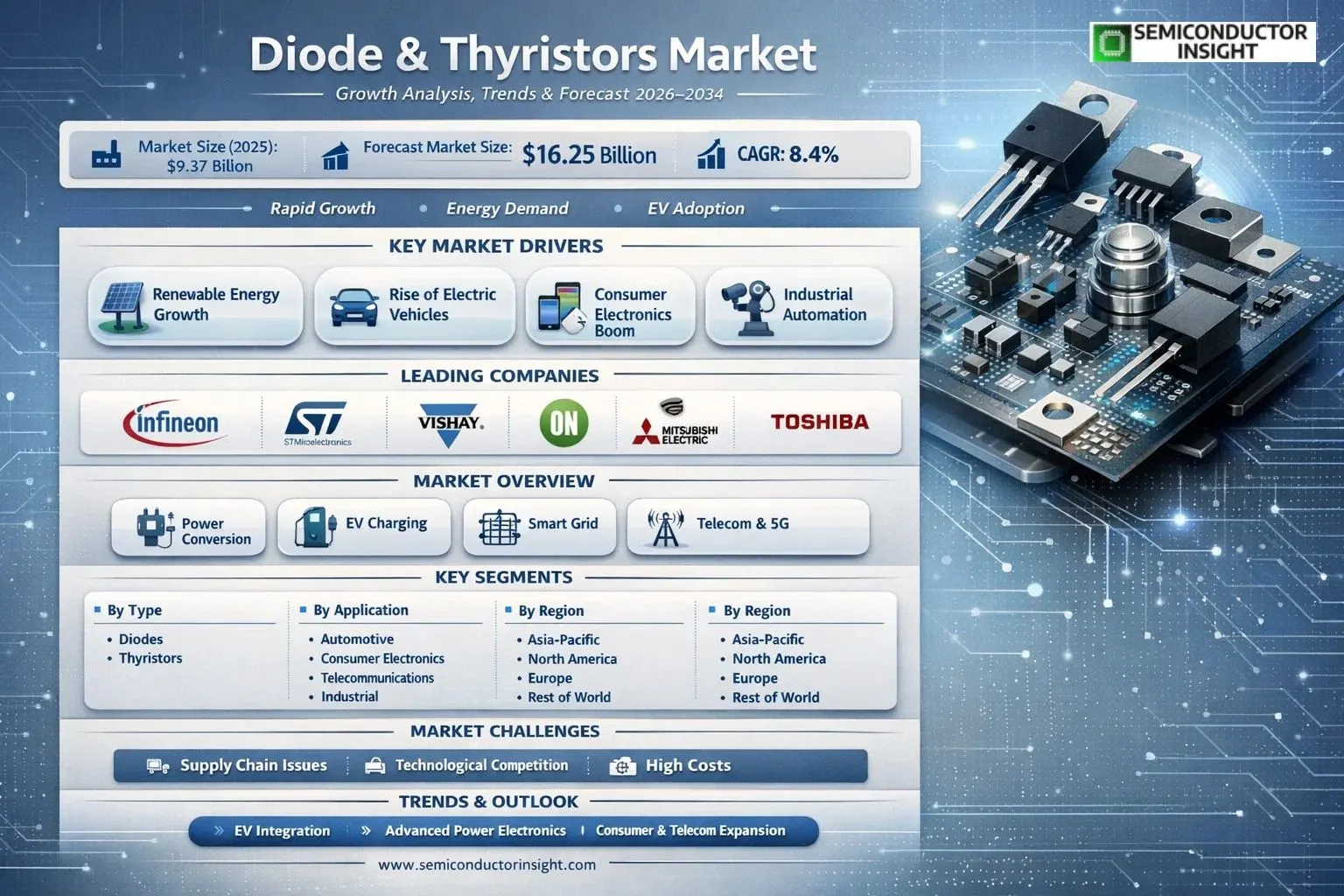
Global diode and thyristors market size was valued at USD 9.37 billion in 2025. The market is projected to grow from USD 10.15 billion in 2026 to USD 16.25 billion by 2034, exhibiting a CAGR of 8.4% during the forecast period.
Diodes and thyristors are fundamental semiconductor components critical for controlling and rectifying electrical current. A diode is a two-terminal device that allows current to flow primarily in one direction, acting as a one-way valve for electricity. It is an essential element in circuits for applications like power conversion and signal demodulation. A thyristor, or Silicon Controlled Rectifier (SCR), is a more robust, multi-layer semiconductor device that functions as a controllable switch for high-power applications. It can be triggered to conduct current and will remain on until the current drops below a certain threshold, making it ideal for controlling power in motor drives, lighting systems, and industrial equipment.
The market is experiencing robust growth driven by the escalating global demand for energy-efficient power management solutions across various industries. The rapid proliferation of renewable energy systems, such as solar and wind power, is a significant catalyst because these technologies heavily rely on diodes and thyristors for power conversion and inversion. Furthermore, the automotive sector’s accelerated shift toward electric vehicles (EVs) is a major growth driver, as these vehicles require sophisticated power electronics for battery management, motor control, and onboard charging systems. The expansion of industrial automation and smart grid infrastructure also fuels demand for these components to ensure reliable and efficient power control.
MARKET DRIVERS
Expansion in Renewable Energy and EVs
Diode and Thyristors Market is propelled by surging demand for power semiconductors in renewable energy systems. Solar inverters and wind turbine converters increasingly rely on diodes for rectification and thyristors for switching, supporting global clean energy transitions. With renewable capacity expected to exceed 3,700 GW by 2025, this segment drives substantial growth in Diode and Thyristors Market.
Consumer Electronics and Automotive Boom
Advancements in consumer electronics, including smartphones and smart home devices, necessitate efficient diodes for power management and thyristors for dimming controls. Concurrently, the automotive sector’s shift to electric vehicles (EVs) amplifies needs for high-voltage thyristors in onboard chargers and diodes in battery management systems. EV sales projected at over 14 million units in 2025 further bolster Diode and Thyristors Market.
➤ Industrial automation and 5G infrastructure enhance reliability requirements, positioning diodes and thyristors as core components.
Rising industrialization in Asia-Pacific, coupled with 5G deployments, underscores the role of these semiconductors in high-frequency rectification and power control, ensuring sustained momentum in Diode and Thyristors Market.
MARKET CHALLENGES
Supply Chain Vulnerabilities
Diode and Thyristors Market faces disruptions from geopolitical tensions and raw material shortages, particularly silicon wafers. Recent events have increased lead times by up to 20%, impacting production scalability and raising costs for manufacturers.
Other Challenges
Competition from Wide Bandgap Semiconductors
Silicon carbide (SiC) and gallium nitride (GaN) devices offer superior efficiency, challenging traditional diodes and thyristors in high-power applications. This shift pressures incumbents to innovate amid Diode and Thyristors Market’s evolution.
MARKET RESTRAINTS
High Manufacturing Costs and Maturity
Elevated production expenses for precision fabrication limit scalability in Diode and Thyristors Market, especially for specialized thyristors used in HVDC systems. Mature technologies in consumer segments curb pricing flexibility, with average costs remaining stable around $0.50-$2 per unit.
Strict regulatory standards for reliability in power electronics add compliance burdens, restraining rapid market entry. Additionally, market saturation in developed regions slows growth, as replacement demand dominates over new installations.
Technological plateaus in silicon-based diodes hinder performance gains against emerging alternatives, imposing restraints on the overall Diode and Thyristors Market expansion.
MARKET OPPORTUNITIES
Smart Grids and IoT Integration
Diode and Thyristors Market stands to benefit from smart grid developments, where thyristors enable flexible AC transmission and diodes support DC microgrids. Investments exceeding $500 billion by 2030 create avenues for enhanced power flow control.
IoT proliferation in industrial settings demands compact, efficient diodes for sensor powering and thyristors for motor controls, unlocking growth in edge computing applications within Diode and Thyristors Market.
Emerging markets in Africa and Latin America offer untapped potential through infrastructure electrification, positioning diodes and thyristors as vital for cost-effective power solutions.
Diode and Thyristors Market Trends
Integration in Electric Vehicle Power Systems
In Diode and Thyristors Market, a prominent trend is the growing integration of these components in electric vehicle (EV) power systems. Diodes play a crucial role in rectifying alternating current (AC) to direct current (DC) for battery charging, while also supporting DC-DC converters to adjust voltages for various vehicle components. Thyristors, known for their high current and voltage handling capabilities, are essential in motor control systems, enabling precise regulation of speed and torque. Additionally, thyristors facilitate regenerative braking by converting kinetic energy back into storable electrical energy. As environmental concerns drive higher EV adoption, demand for reliable diodes and thyristors in power electronics continues to surge, positioning this segment as a key growth driver within the broader Diode and Thyristors Market.
Other Trends
Expansion in Consumer Electronics and Communications
Diode and Thyristors Market is experiencing steady expansion in consumer electronics and communications applications. Diodes are fundamental in power supplies, LED lighting, and radio receivers, ensuring unidirectional current flow for efficient circuit operation. Thyristors enhance power control in devices requiring precise switching. With rising demand for smartphones, smart home systems, and telecommunications infrastructure, manufacturers are innovating specialized variants to meet performance needs. This trend underscores the versatility of diodes and thyristors across everyday electronics, contributing to sustained market momentum.
Innovation Driven by Leading Manufacturers
Competition among key players such as Infineon Technologies AG, STMicroelectronics, Vishay, and Asian firms like JieJie Microelectronics and Mitsubishi Electric is fueling innovation in Diode and Thyristors Market. These companies are focusing on developing high-efficiency, compact components tailored for automotive, computer peripherals, and other industrial uses. Recent advancements in semiconductor fabrication improve durability and thermal management, addressing challenges in high-power environments. Regional dynamics, particularly in Asia with strong production bases in China, Japan, and South Korea, support global supply chains. This competitive landscape encourages mergers, product launches, and R&D investments, ensuring Diode and Thyristors Market evolves to meet diverse application demands while navigating supply chain and technological hurdles.
COMPETITIVE LANDSCAPE
Key Industry Players
Leading Players in Diode and Thyristors Market
Diode and Thyristors Market, valued at US$ 9,365 million in 2025 and projected to reach US$ 16,250 million by 2034 at a CAGR of 8.4%, features a moderately concentrated competitive landscape dominated by established semiconductor giants. Leading players such as Infineon Technologies AG, STMicroelectronics, and Vishay Intertechnology command significant market shares through their extensive portfolios in power semiconductors, advanced manufacturing capabilities, and strong presence in key applications like automotive power electronics and industrial controls. These companies leverage vertical integration, R&D investments, and global supply chains to maintain leadership, particularly in high-voltage thyristors and efficient diodes critical for electric vehicles and renewable energy systems. The top five players collectively hold a substantial revenue portion, driving innovation amid rising demand for energy-efficient components.
Beyond the market leaders, several niche and regional players contribute to a dynamic ecosystem, focusing on specialized diode types and thyristors for consumer electronics, communications, and automotive segments. Companies like Diodes Incorporated, ON Semiconductor (now onsemi), and Littelfuse excel in discrete semiconductors with tailored solutions for DC-DC converters and motor controls, while Asian firms such as JieJie Microelectronics and Shindengen Electric capitalize on cost-effective production for emerging markets. Mergers, acquisitions, and strategic partnerships, as noted in recent industry developments, intensify competition, with players like Renesas Electronics and Mitsubishi Electric expanding through technological advancements in SiC-based diodes and high-power thyristors. This fragmented yet innovative structure fosters growth opportunities across regions, particularly in Asia-Pacific.
List of Key Diode and Thyristors Companies Profiled
- JieJie Microelectronics
- Diodes Incorporated
- SINO-Microelectronics
- Infineon Technologies AG
- Semikron
- Central Semiconductor
- STMicroelectronics
- Shindengen Electric
- WeEn Semiconductors
- ON Semiconductor
- ABB Ltd
- Vishay Intertechnology
- Renesas Electronics
- Littelfuse
- Toshiba
Segment Analysis:
| Segment Category | Sub-Segments | Key Insights |
| By Type |
|
Diodes
|
| By Application |
|
Automotive
|
| By End User |
|
Industrial
|
| By Voltage Rating |
|
Medium Voltage
|
| By Material |
|
Silicon
|
Regional Analysis: Diode and Thyristors Market
Asia-Pacific
Asia-Pacific’s robust foundry infrastructure supports high-volume diode and thyristor production, with seamless integration from wafer fabrication to assembly. This ecosystem reduces lead times and costs, catering to global demand in power supplies and rectification circuits.
Electric vehicle proliferation drives specialized thyristors for motor drives and diodes for battery management. Regional automakers prioritize reliable power semiconductors, fostering innovation in compact, high-current devices.
Solar and wind projects rely on thyristors for grid-tied inverters and diodes for energy harvesting. Policy-driven expansions enhance market penetration, emphasizing durable components for harsh environments.
R&D investments yield advanced packaging for high-frequency diodes and gate-turn-off thyristors, supporting 5G infrastructure and smart grids. Collaborations accelerate commercialization in Diode and Thyristors Market.
North America
North America exhibits steady growth in Diode and Thyristors Market, anchored by technological innovation and diverse end-user applications. The region’s strength lies in advanced R&D centers driving high-performance power semiconductors for aerospace, defense, and data centers. Automotive electrification gains momentum with diodes integral to onboard chargers and thyristors in propulsion systems. Renewable energy deployments, especially offshore wind, demand robust components for power conversion. Industrial automation sectors favor reliable thyristors for motor controls and variable speed drives. Strategic trade partnerships facilitate supply chain resilience, mitigating disruptions. Focus on energy efficiency regulations spurs adoption of low-loss diodes in consumer appliances and telecom equipment. Leading firms invest in sustainable manufacturing, aligning with circular economy principles while maintaining competitive edges in premium diode and thyristors market segments.
Europe
Europe’s diode and thyristors market thrives on stringent environmental standards and industrial sophistication. Automotive powertrains, particularly in electric and hybrid vehicles, heavily incorporate thyristors for efficient switching and diodes for protection circuits. Renewable energy transitions prioritize grid-stabilizing components, with thyristors enabling high-voltage direct current transmission. Industrial sectors leverage these semiconductors in robotics and factory automation for precise power management. Regulatory frameworks promote energy-efficient electronics, boosting demand in smart home devices and lighting systems. Collaborative EU initiatives foster innovation in silicon carbide-enhanced diodes, enhancing performance in harsh conditions. Supply chain diversification reduces dependency on external sources, strengthening regional diode and thyristors market resilience amid geopolitical shifts.
South America
South America emerges as a promising diode and thyristors market, propelled by infrastructure modernization and consumer electronics uptake. Hydroelectric and solar projects necessitate thyristors for power conditioning and diodes for rectification in remote grids. Automotive assembly lines integrate these components for growing vehicle fleets, focusing on cost-effective solutions. Urban expansion drives demand in telecommunications and appliances, where reliable power semiconductors ensure operational stability. Economic recovery initiatives support local manufacturing partnerships, gradually building capacity. Challenges like import reliance are offset by investments in regional fabs, positioning South America for expanded participation in Global diode and thyristors market dynamics.
Middle East & Africa
The Middle East and Africa diode and thyristors market gains traction through energy diversification and digital transformation. Oil and gas operations utilize thyristors in variable frequency drives, while renewables like solar farms require diodes for photovoltaic inverters. Telecom infrastructure expansions in urbanizing areas depend on efficient power management devices. Automotive aftermarket and emerging EV adoption introduce new applications. Government visions for smart cities integrate these semiconductors in lighting and control systems. Strategic investments bridge infrastructure gaps, enhancing market maturity. Regional collaborations with global players accelerate technology transfer, fostering sustainable growth in Diode and Thyristors Market.
Report Scope
This market research report provides a comprehensive analysis of Diode and Thyristors Market, covering the forecast period 2026–2034. It offers detailed insights into market dynamics, technological advancements, competitive landscape, and key trends shaping the industry.
Key focus areas of the report include:
- Market Overview: The report begins with an overview outlining its current market scenario, key growth indicators, and industry transformation drivers. It discusses macroeconomic factors, demand–supply balance, regulatory landscape, and the strategic role of semiconductors in powering advancements across industries such as automotive, telecommunications, consumer electronics, and industrial automation.
- Market Size & Forecast: Historical data and future projections for revenue, unit shipments, and market value across major regions and segments.
- Segmentation Analysis: Detailed breakdown by product type, technology, application, and end-user industry to identify high-growth segments and investment opportunities.
- Regional Insights: Insights into market performance across North America, Europe, Asia-Pacific, Latin America, and the Middle East & Africa, including country-level analysis where relevant.
- Competitive Landscape: Profiles of leading market participants, including their product offerings, R&D focus, manufacturing capacity, pricing strategies, and recent developments such as mergers, acquisitions, and partnerships.
- Technology Trends & Innovation: Assessment of emerging technologies, integration of AI/IoT, semiconductor design trends, fabrication techniques, and evolving industry standards.
- Market Drivers & Restraints: Evaluation of factors driving market growth along with challenges, supply chain constraints, regulatory issues, and market-entry barriers.
- Stakeholder Insights: Insights for component suppliers, OEMs, system integrators, investors, and policymakers regarding the evolving ecosystem and strategic opportunities.
Primary and secondary research methods are employed, including interviews with industry experts, data from verified sources, and real-time market intelligence to ensure the accuracy and reliability of the insights presented.
FREQUENTLY ASKED QUESTIONS:
What is the current market size of Diode and Thyristors Market?
-> Global Diode and Thyristors market was valued at USD 9,365 million in 2025 and is expected to reach USD 16,250 million by 2034, at a CAGR of 8.4%.
Which key companies operate in Diode and Thyristors Market?
-> Key players include Infineon Technologies AG, STMicroelectronics, Vishay, ON Semiconductor, Diodes Incorporated, Mitsubishi Electric, ABB Ltd, and Toshiba, among others.
What are the key growth drivers?
-> Key growth drivers include rising demand for electric vehicles, power electronics systems for motor control and battery management, and expansion in automotive and consumer electronics sectors.
Which region dominates the market?
-> Asia dominates the market, driven by major countries like China and Japan.
What are the emerging trends?
-> Emerging trends include increased adoption in electric vehicles for power rectification and regenerative braking, advancements in high-voltage thyristors, and growth in power electronics applications.

Get Sample Report PDF for Exclusive Insights
Report Sample Includes
- Table of Contents
- List of Tables & Figures
- Charts, Research Methodology, and more...
 Download Sample Report PDF