Power Over Ethernet (PoE) IC Market Insights
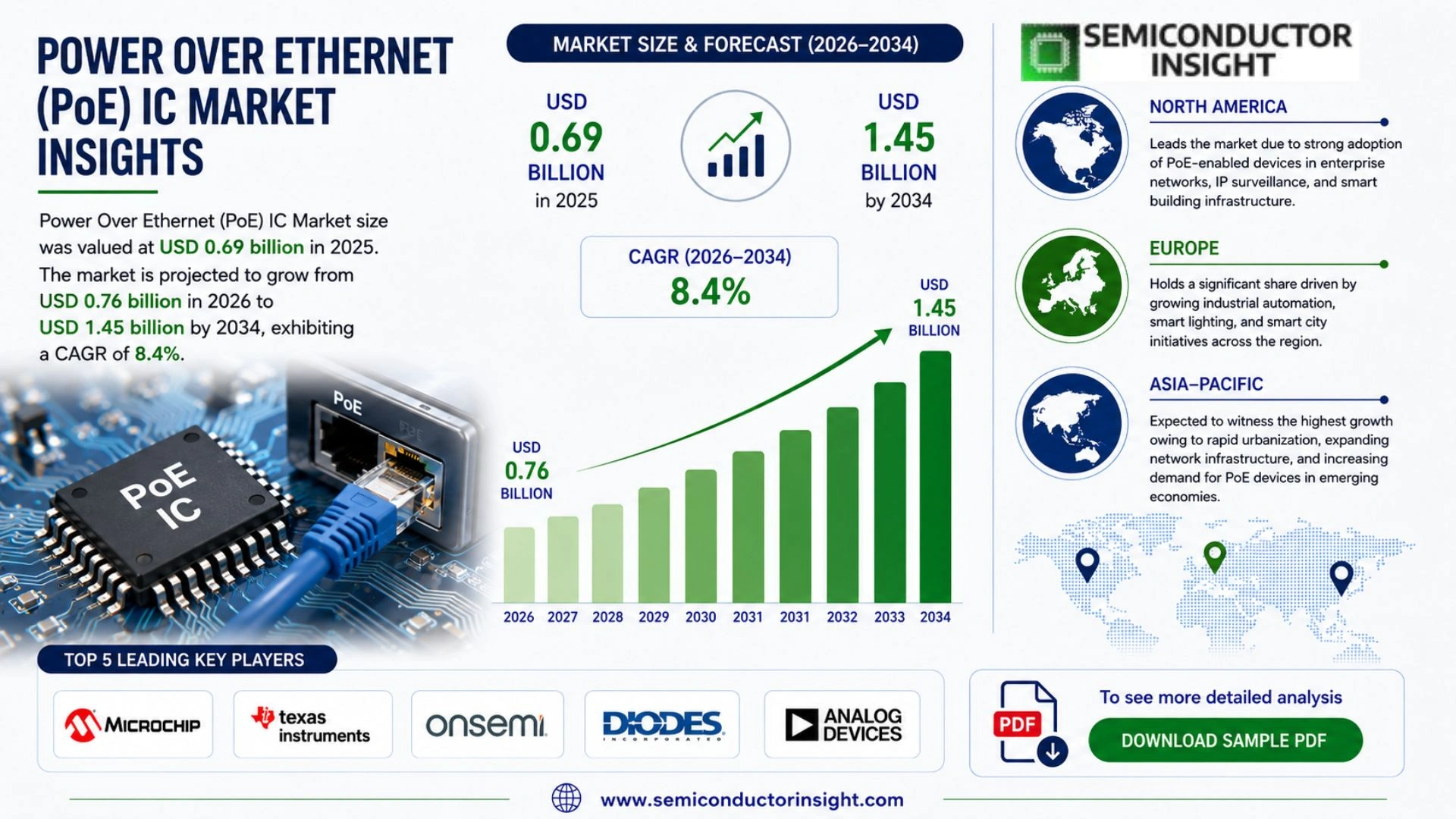
Power Over Ethernet (PoE) IC Market size was valued at USD 0.69 billion in 2025. The market is projected to grow from USD 0.76 billion in 2026 to USD 1.45 billion by 2034, exhibiting a CAGR of 8.4% during the forecast period.
Power Over Ethernet (PoE) ICs are specialized semiconductor components that enable the transmission of both power and data over a single Ethernet cable. These integrated circuits are essential for modern networking applications, supporting devices such as IP cameras, wireless access points, VoIP phones, and LED lighting systems without the need for separate power supplies. They typically include power sourcing equipment (PSE) controllers and powered device (PD) controllers that manage power negotiation, detection, and delivery according to IEEE 802.3af, 802.3at, and 802.3bt standards.
The market is experiencing steady growth due to several factors, including the rapid expansion of IoT infrastructure, increasing adoption of smart building technologies, and rising demand for energy-efficient networking solutions. Furthermore, the proliferation of high-power applications such as advanced security systems and industrial automation drives the need for more sophisticated PoE ICs capable of delivering up to 90W or higher. Advancements in semiconductor design are also contributing to market expansion by improving efficiency and reducing heat dissipation in compact form factors. Initiatives by key players in the market are expected to fuel further development. For instance, ongoing innovations focus on higher power delivery and better integration with next-generation Ethernet standards. Texas Instruments Incorporated, Microchip Technology Inc., Analog Devices Inc., and STMicroelectronics are some of the key players that operate in the market with a wide range of portfolios.
MARKET DRIVERS
Expansion of IoT and Smart Building Infrastructure
Power Over Ethernet (PoE) IC Market is experiencing robust growth fueled by the rapid proliferation of IoT devices and the widespread adoption of smart building technologies. PoE ICs enable efficient delivery of both power and data over a single Ethernet cable, simplifying installations and reducing infrastructure costs for connected devices such as IP cameras, wireless access points, and sensors.
Rising Demand for High-Power PoE Standards
Advancements in IEEE 802.3bt (PoE++) standards supporting up to 90W delivery have expanded applications to energy-intensive devices including LED lighting systems, PTZ cameras, and building automation equipment. This evolution drives demand for advanced PSE and PD controller ICs that offer improved efficiency and thermal management in commercial and industrial environments.
➤ The increasing integration of PoE in network infrastructure supports centralized power management and enhances operational reliability across enterprise deployments.
Additionally, the growth in VoIP communications, 5G/Wi-Fi deployments, and smart city initiatives further accelerates the need for reliable PoE IC solutions that minimize cabling complexity while maintaining high performance.
MARKET CHALLENGES
Interoperability and Standardization Issues
Variations in PoE implementations across manufacturers continue to pose compatibility challenges between Power Sourcing Equipment (PSE) and Powered Devices (PD). These inconsistencies can lead to power delivery failures or suboptimal performance, requiring careful selection of certified components to ensure seamless ecosystem integration.
Other Challenges
Limited Transmission Distance
Ethernet cable length restrictions of approximately 100 meters constrain deployment flexibility in large-scale facilities, often necessitating additional equipment or alternative solutions for extended reach applications.
Power Limitations for High-Load Devices
Despite improvements, PoE may not fully meet the demands of certain high-energy industrial equipment, leading organizations to rely on traditional power sources in specific use cases and slowing full market penetration.
MARKET RESTRAINTS
High Initial Deployment Costs
Upgrading legacy network infrastructure to support advanced PoE ICs involves significant capital investment in compatible switches, cabling, and controllers. This cost barrier particularly affects small and medium enterprises and projects in cost-sensitive regions, moderating the pace of adoption despite long-term operational savings.
Technical Complexity and Skill Gaps
The design and integration of modern PoE systems demand specialized expertise in power management, thermal considerations, and compliance with evolving standards. Shortages of skilled professionals in PoE technology can delay project timelines and increase implementation risks for organizations transitioning to smart infrastructure.
MARKET OPPORTUNITIES
Emergence of High-Efficiency and Intelligent PoE Solutions
Opportunities abound in developing energy-efficient PoE ICs with enhanced monitoring, cybersecurity features, and AI-driven power optimization. These innovations align with sustainability goals and support the expansion into industrial IoT, healthcare, and intelligent transportation systems where reliable, low-maintenance power delivery is critical.
Growth in Emerging Markets and Smart City Projects
Rapid urbanization and government investments in digital infrastructure across Asia-Pacific and other developing regions present substantial growth potential. PoE IC manufacturers can capitalize on demand for cost-effective networking in smart lighting, public safety, and building automation projects that prioritize simplified deployment and scalability. Power Over Ethernet (PoE) IC Market continues to witness robust demand as businesses accelerate the deployment of IoT infrastructure across various sectors. PoE ICs serve as critical components that enable simultaneous transmission of power and data through a single Ethernet cable, eliminating the need for separate power sources for connected devices. This capability has become increasingly vital for supporting IP cameras, wireless access points, VoIP phones, and LED lighting systems in modern networked environments.
Smart Building Technologies Boosting Market Momentum
Adoption of smart building solutions represents a significant trend Power Over Ethernet (PoE) IC Market. These technologies rely heavily on PoE ICs to deliver efficient power management and connectivity for integrated systems. Enhanced power negotiation and delivery features aligned with IEEE 802.3af, 802.3at, and 802.3bt standards allow seamless operation of multiple devices while optimizing energy consumption in commercial and industrial facilities.
Rising Need for High-Power Applications
The proliferation of advanced security systems and industrial automation drives demand for more sophisticated Power Over Ethernet (PoE) IC solutions. Modern applications require ICs capable of supporting higher power delivery levels, prompting manufacturers to develop components that maintain stability and performance under increased loads. This evolution supports complex installations where reliable power transmission is essential for operational continuity. Technological progress in semiconductor engineering plays a pivotal role in shaping Power Over Ethernet (PoE) IC Market. Innovations focus on improving power efficiency while minimizing heat dissipation within compact designs, addressing key challenges in dense networking environments. Integration with next-generation Ethernet standards further enhances the versatility of PoE ICs, enabling them to meet the requirements of evolving high-performance applications. Leading industry participants such as Texas Instruments Incorporated, Microchip Technology Inc., Analog Devices Inc., and STMicroelectronics continue to advance product portfolios through targeted development initiatives centered on higher power capabilities and improved system integration.
COMPETITIVE LANDSCAPE
Key Industry Players
Power Over Ethernet (PoE) IC Market
Power Over Ethernet (PoE) IC Market is moderately consolidated, with leading semiconductor companies dominating through extensive product portfolios covering both Power Sourcing Equipment (PSE) and Powered Device (PD) controllers. Texas Instruments Incorporated stands out as a prominent market leader, offering a comprehensive range of high-efficiency PoE solutions compliant with IEEE 802.3af/at/bt standards, supported by strong innovation in higher power delivery and integration capabilities for IoT and enterprise networking applications.
Other significant players focus on niche segments such as compact designs for industrial automation, energy-efficient solutions for smart buildings, and advanced high-power ICs. These companies drive competition through technological advancements in power management, thermal efficiency, and compatibility with next-generation Ethernet standards, contributing to the market’s projected growth from USD 0.76 billion in 2026 to USD 1.45 billion by 2034.
List of Key Power Over Ethernet (PoE) IC Companies Profiled
- Texas Instruments Incorporated
- Microchip Technology Inc.
- Analog Devices Inc.
- STMicroelectronics
- Broadcom Inc.
- onsemi
- Silicon Laboratories Inc.
- Monolithic Power Systems
- Maxim Integrated (Analog Devices)
- Kinetic Technologies
- Diodes Incorporated
- ON Semiconductor (onsemi)
- Skyworks Solutions, Inc.
- Linear Technology (Analog Devices)
Segment Analysis:
| Segment Category | Sub-Segments | Key Insights |
| By Type |
|
PSE ICs dominate due to their critical role in managing power delivery and negotiation from the source side. They offer advanced features for efficient power allocation across multiple ports. These controllers excel in enterprise networking environments where centralized power management enhances reliability. Their robust protection mechanisms against overloads and short circuits make them essential for mission-critical deployments. Ongoing design improvements focus on better thermal management and seamless integration with modern Ethernet switches. |
| By Application |
|
IP Surveillance Cameras represent a leading application segment driven by the need for simplified cabling in security installations. PoE ICs enable reliable power and data transmission over long distances without additional wiring. This supports flexible camera placement and reduces installation complexity significantly. Enhanced power capabilities allow integration of advanced features like pan-tilt-zoom mechanisms and infrared illumination. The segment benefits from growing emphasis on smart city infrastructure and enterprise security solutions. |
| By End User |
|
Commercial Buildings lead this segment as organizations prioritize smart building technologies and energy-efficient networking. PoE ICs facilitate centralized management of various connected devices while minimizing power infrastructure costs. They support seamless integration with building automation systems for improved operational efficiency. The flexibility in device deployment enhances workplace productivity and security. Adoption is further propelled by trends toward sustainable and intelligent office environments. |
| By PoE Standard |
|
IEEE 802.3bt emerges as the leading standard due to its support for higher power delivery essential for modern high-performance devices. It accommodates sophisticated applications requiring greater energy throughput while maintaining data integrity. This standard enables broader device compatibility and future-proofing of network installations. Manufacturers focus on controllers that ensure backward compatibility with legacy systems. Enhanced efficiency features help address thermal challenges in dense deployments. |
| By Port Configuration |
|
Multi-Port ICs lead this category by offering scalable power management solutions for complex networking equipment. They optimize board space and reduce component count in switch designs. Advanced power budgeting algorithms ensure efficient distribution across connected devices. These configurations support the growing density of IoT endpoints in contemporary networks. Their integration capabilities streamline manufacturing processes for networking hardware vendors. |
Regional Analysis: Power Over Ethernet (PoE) IC Market
Asia-Pacific
Asia-Pacific hosts world-class semiconductor fabrication facilities that accelerate the development of advanced PoE ICs. Companies focus on miniaturization and higher power budgeting capabilities to meet demands from data centers and enterprise networking. Strategic partnerships between IC designers and OEMs ensure tailored solutions for regional applications in intelligent transportation and building automation.
Governments and enterprises across the region are integrating PoE-enabled devices into smart city frameworks and industrial IoT networks. The technology’s ability to deliver both data and power over single cables reduces installation complexity and operational costs. This drives demand for sophisticated PoE ICs optimized for reliability in challenging environmental conditions.
Regional players are strengthening domestic supply chains for critical PoE components to mitigate global disruptions. Investment in local R&D centers supports the creation of customized IC solutions while maintaining high standards for energy efficiency and electromagnetic compatibility required by modern networking equipment.
Expanding 5G base stations, edge computing facilities, and AI-powered surveillance systems create sustained opportunities for innovative PoE IC designs. Companies are pursuing strategies centered on sustainability, developing lower-power variants that align with regional green technology mandates and corporate ESG goals.
North America
North America maintains a strong position Power Over Ethernet (PoE) IC Market through leadership in technology innovation and early adoption of high-performance networking solutions. The region excels in developing PoE ICs with advanced features such as intelligent power management and enhanced security protocols for enterprise and data center applications. Business strategies focus on premium differentiation, targeting sectors like healthcare, education, and finance where reliable power delivery is critical. Collaboration between semiconductor firms and system integrators drives the creation of next-generation PoE solutions optimized for cloud infrastructure and remote monitoring systems. Regulatory emphasis on energy efficiency further encourages the adoption of sophisticated IC designs that minimize power losses while maximizing functionality.
Europe
Europe demonstrates steady growth Power Over Ethernet (PoE) IC Market, supported by stringent sustainability regulations and ambitious digital infrastructure programs. The region prioritizes PoE technologies that align with circular economy principles and reduced carbon footprints in building automation and industrial settings. Market participants emphasize compliance with EU directives on energy consumption, fostering demand for efficient PoE ICs in smart lighting, access control, and environmental monitoring applications. Strategic investments target R&D for interoperable solutions across diverse networking standards, while partnerships with industrial automation leaders enhance the integration of PoE in Industry 4.0 environments.
South America
South America is emerging as a promising market for Power Over Ethernet (PoE) IC technologies, particularly in urban development and telecommunications modernization efforts. Countries are gradually adopting PoE solutions to streamline infrastructure deployment in security systems and public connectivity projects. Local business strategies focus on cost-effective implementations that leverage the technology’s simplified cabling advantages in regions with challenging logistics. Growing interest in smart agriculture and resource management applications creates new avenues for PoE IC integration, with international players forming alliances to adapt solutions to local environmental and operational requirements.
Middle East & Africa
The Middle East & Africa region shows increasing interest Power Over Ethernet (PoE) IC Market driven by smart city initiatives and oil & gas sector modernization. Investments in advanced surveillance, environmental sensing, and connectivity infrastructure boost demand for robust PoE solutions capable of operating in harsh conditions. Business approaches center on technology transfer and localized adaptation of IC designs to support reliable power delivery in remote installations. The region’s focus on economic diversification fuels opportunities in hospitality, healthcare, and education sectors where PoE-enabled devices enhance operational efficiency and reduce maintenance needs.
Report Scope
This market research report provides a comprehensive analysis of the Power Over Ethernet (PoE) IC Market , covering the forecast period 2026–2034. It offers detailed insights into market dynamics, technological advancements, competitive landscape, and key trends shaping the industry.
Key focus areas of the report include:
- Market Overview: The report begins with an overview outlining its current market scenario, key growth indicators, and industry transformation drivers. It discusses macroeconomic factors, demand–supply balance, regulatory landscape, and the strategic role of semiconductors in powering advancements across industries such as automotive, telecommunications, consumer electronics, and industrial automation.
- Market Size & Forecast: Historical data and future projections for revenue, unit shipments, and market value across major regions and segments.
- Segmentation Analysis: Detailed breakdown by product type, technology, application, and end-user industry to identify high-growth segments and investment opportunities.
- Regional Insights: Insights into market performance across North America, Europe, Asia-Pacific, Latin America, and the Middle East & Africa, including country-level analysis where relevant.
- Competitive Landscape: Profiles of leading market participants, including their product offerings, R&D focus, manufacturing capacity, pricing strategies, and recent developments such as mergers, acquisitions, and partnerships.
- Technology Trends & Innovation: Assessment of emerging technologies, integration of AI/IoT, semiconductor design trends, fabrication techniques, and evolving industry standards.
- Market Drivers & Restraints: Evaluation of factors driving market growth along with challenges, supply chain constraints, regulatory issues, and market-entry barriers.
- Stakeholder Insights: Insights for component suppliers, OEMs, system integrators, investors, and policymakers regarding the evolving ecosystem and strategic opportunities.
Primary and secondary research methods are employed, including interviews with industry experts, data from verified sources, and real-time market intelligence to ensure the accuracy and reliability of the insights presented.
FREQUENTLY ASKED QUESTIONS:
What is the current market size of Power Over Ethernet (PoE) IC Market?
-> Power Over Ethernet (PoE) IC Market was valued at USD 0.69 billion in 2025 and is expected to reach USD 1.45 billion by 2034.
Which key companies operate Power Over Ethernet (PoE) IC Market?
-> Key players include Texas Instruments Incorporated, Microchip Technology Inc., Analog Devices Inc., and STMicroelectronics, among others.
What are the key growth drivers?
-> Key growth drivers include rapid expansion of IoT infrastructure, increasing adoption of smart building technologies, and rising demand for energy-efficient networking solutions.
Which region dominates the market?
-> Asia-Pacific is the fastest-growing region with strong demand from IoT and industrial sectors.
What are the emerging trends?
-> Emerging trends include higher power delivery up to 90W, better integration with next-generation Ethernet standards, and advancements in semiconductor design for improved efficiency.

Get Sample Report PDF for Exclusive Insights
Report Sample Includes
- Table of Contents
- List of Tables & Figures
- Charts, Research Methodology, and more...