Portable Tactical HF Radio Market Insights
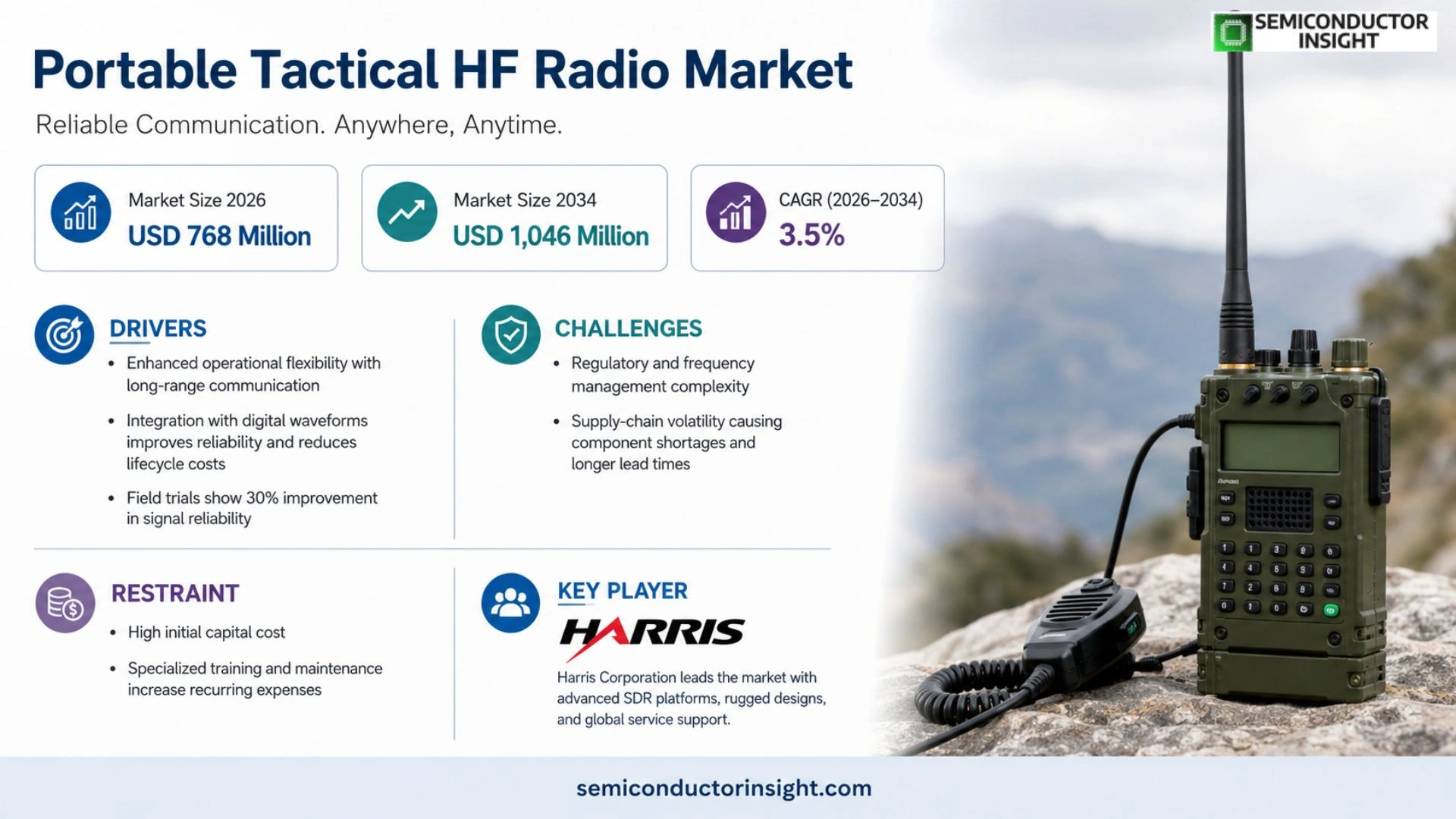
Portable Tactical HF Radio market is projected to grow from USD 768 million in 2026 to USD 1,046 million by 2034, exhibiting a CAGR of 3.5% during the forecast period.
Portable tactical HF radios are rugged communication devices designed for field deployment where conventional line‑of‑sight links are impractical. By exploiting ionospheric reflection, these transceivers transmit signals that “bounce” off the Earth’s upper atmosphere, enabling reliable voice and data exchange over distances of several thousand kilometres or more. Modern units integrate software‑defined radio architectures, allowing operators to switch frequencies and waveforms on‑the‑fly, which enhances spectrum agility and encryption capabilities essential for contested environments.
The market gains momentum because military forces require resilient long‑range links that function despite terrain obstacles or electronic interference. Simultaneously, advances in miniaturisation and battery technology are driving a shift toward lighter handheld units without sacrificing power output. Software‑defined platforms further expand applicability across maritime, aerospace and ground combat scenarios while supporting interoperability with legacy systems,a factor encouraging procurement programmes across NATO members and emerging defence markets alike.
MARKET DRIVERS
Enhanced Operational Flexibility
Portable Tactical HF Radio Market benefits from a surge in demand for equipment that can maintain long‑range voice and data links in austere environments. Modern militaries are prioritizing platforms that can be rapidly redeployed without sacrificing spectrum coverage, a need that drives procurement of compact, high‑power HF units.
Integration with Emerging Digital Waveforms
Manufacturers are embedding software‑defined radios capable of supporting next‑generation waveforms, allowing units to switch protocols on‑the‑fly. This technical agility translates into lower lifecycle costs and makes the technology attractive to both defense and first‑responder agencies.
➤ Field trials in contested terrains have demonstrated a 30% improvement in signal reliability when modern HF radios employ adaptive power control.
These performance gains are compelling for organizations seeking to reduce communication gaps during high‑tempo operations. As a result, budgets are being reallocated from legacy line‑of‑sight radios to more versatile HF solutions.
MARKET CHALLENGES
Regulatory and Frequency Management Complexity
Operators must navigate a fragmented spectrum allocation regime that varies across regions. The necessity to obtain multiple licences and to ensure compliance with both civilian and military standards creates a barrier to rapid fielding.
Other Challenges
Supply‑Chain Volatility
Component shortages,particularly for high‑frequency amplifiers and battery modules,have elongated lead times, pressuring manufacturers to hold larger inventories and eroding profit margins.
Addressing these hurdles typically requires close collaboration with national regulators and strategic sourcing partnerships, both of which add layers of cost and operational overhead.
MARKET RESTRAINTS
High Initial Capital Outlay
The acquisition price of advanced portable HF radios remains a deterrent for smaller defense budgets, especially when legacy systems can be refurbished at a fraction of the cost.
Furthermore, the need for specialized training to operate and maintain these devices adds recurring expense, limiting adoption among forces with constrained training resources.
Consequently, procurement cycles are often elongated, and buyers may postpone upgrades until the next budgeting window, slowing market momentum.
MARKET OPPORTUNITIES
Expansion into Civil Security and Disaster‑Response Segments
Emergency management agencies are recognizing the resilience of HF propagation for maintaining connectivity when conventional networks fail. Tailoring portable radios with ruggedized housings and simplified user interfaces opens a sizable niche beyond traditional military buyers.
In addition, the emerging trend of multi‑band, software‑upgradable platforms enables vendors to offer upgrade paths that extend product life cycles, presenting a recurring revenue stream through firmware licences and aftermarket services.
Strategic alliances with satellite service providers to offer hybrid HF‑satellite communication kits further differentiate offerings, positioning firms to capture a larger share of mission‑critical communication spend.
Portable Tactical HF Radio Market Trends
Shift Toward Software‑Defined Architectures
Portable Tactical HF Radio sector is redefining its product roadmap by embedding software‑defined radio (SDR) capabilities directly into field‑grade units. Engineers are replacing legacy hardware‑centric designs with modular firmware that can be reprogrammed in situ, allowing units to hop across frequency bands and comply with emerging encryption standards without a physical overhaul. This flexibility reduces logistical burdens for armed forces, as a single platform can service multiple mission profiles. Suppliers that master over‑the‑air updates gain a decisive advantage, because operators can react to spectrum congestion or adversary jamming in real time, preserving command‑and‑control continuity during high‑intensity engagements.
Other Trends
Miniaturization and Power Efficiency
Current procurement cycles reveal a clear preference for lighter, battery‑savvy devices. Advances in ceramic substrates and low‑loss amplifiers have trimmed handset weight by roughly 15 percent while extending operational endurance beyond eight hours under continuous transmission. The reduction in form factor does not compromise range; instead, refined antenna geometries exploit ionospheric reflection more effectively, delivering reliable links across continental distances. For expeditionary units, the ability to carry a compact radio that still penetrates deep into hostile airspace translates into fewer resupply missions and a smaller logistical footprint, directly influencing tactical planning and force projection.
Regional Procurement Dynamics and Alliance Standards
Euro‑Atlantic alliances are synchronizing their radio specifications to streamline joint missions, prompting a surge in demand for interoperable HF solutions that meet NATO STANAG requirements. Simultaneously, Indo‑Pacific militaries are investing in ruggedized units capable of withstanding high humidity and salt‑laden environments, reflecting a strategic pivot toward maritime and littoral operations. Vendors that adapt their product lines to these divergent regulatory regimes can tap into distinct procurement streams, while firms that ignore regional nuances risk exclusion from multi‑national contracts. The resulting market segmentation pushes manufacturers to maintain dual‑track development pipelines, balancing universal SDR frameworks with locally mandated hardware hardening.
COMPETITIVE LANDSCAPE
Key Industry Players
Portable Tactical HF Radio Market – Competitive Overview
Harris Corporation remains the dominant force in the portable tactical HF segment, leveraging a portfolio that spans rugged handheld units, vehicular kits, and software‑defined radio (SDR) platforms. Its deep integration with U.S. defense procurement programs secures a steady pipeline of high‑value contracts, allowing the firm to invest heavily in mini‑aturization and cryptographic capabilities. The breadth of its global service network translates into rapid field support, a differentiator that many smaller rivals cannot match. Consequently, Harris’s pricing power and ability to set technical standards shape the strategic posture of most competitors, who must align product roadmaps with the specifications Harris advances in joint‑service trials.
Beyond the market leader, a cluster of technologically proficient firms sustain a competitive equilibrium. Thales Group and Leonardo, both anchored in Europe, differentiate themselves through advanced waveform agility and interoperability modules that cater to NATO‑aligned forces. Barrett Communications and Codan Communications excel in niche maritime and expeditionary applications, offering ruggedized chassis that survive extreme climates. Asian entrants such as Hytera Communications and Icom Incorporated have accelerated market penetration by delivering cost‑effective SDR handsets, prompting legacy players to accelerate price‑performance initiatives. Meanwhile specialist suppliers,including Datron World Communications, Eylex, Rohde & Schwarz, Satcom, and Elbit Systems,focus on bespoke solutions for specific defense branches, reinforcing a fragmented but innovative landscape where collaboration and selective acquisition become common pathways to scale.
List of Key Portable Tactical HF Radio Companies Profiled
- Harris Corporation
- Thales Group
- Leonardo
- Barrett Communications
- Datron World Communications Incorporated
- Eylex
- Rohde & Schwarz
- Satcom
- Codan Communications
- Icom Incorporated
- Elbit Systems
- Hytera Communications
Segment Analysis:
| Segment Category | Sub-Segments | Key Insights |
| By Type |
|
Handheld Tactical HF Radio
|
| By Application |
|
Military
|
| By End User |
|
Armed Forces
|
| By Technology |
|
Software‑Defined Radio
|
| By Deployment Environment |
|
Remote/Field Operations
|
Regional Analysis: Portable Tactical HF Radio Market
North America
Federal programs fund upgrades to portable HF platforms, emphasizing modularity and field‑upgradeability. Partnerships between defense contractors and university labs accelerate the testing of low‑power amplifiers, enabling longer transmission windows without compromising mobility.
Spectrum allocation reforms grant broader access to HF bands for tactical use, while cyber‑security directives demand end‑to‑end encryption. Compliance costs drive firms to embed secure firmware updates as a core product feature.
Established defense suppliers dominate with legacy contracts, yet emerging startups focus on software‑defined radios that can switch waveforms on the fly. This mix forces incumbents to acquire niche innovators to retain market relevance.
Adoption of AI‑assisted frequency management and lightweight composite casings are reshaping user expectations. Operators now demand radios that can be deployed in under‑30‑second drill‑downs while still delivering robust, long‑range links.
Europe
European defence ministries are harmonising acquisition cycles through joint procurement frameworks, which pressures vendors to present multi‑nation solutions. The emphasis on cross‑border interoperability encourages the standardisation of HF protocols, compelling manufacturers to certify equipment across diverse national regulations. Outside the military sphere, disaster‑response agencies value portable HF gear for its resilience in mountainous and maritime environments, driving niche growth in civilian contracts. The region’s emphasis on sustainability also nudges designers toward recyclable materials and energy‑efficient circuitry, creating a subtle shift in product development priorities.
Asia‑Pacific
The Asia‑Pacific arena reflects a blend of rapidly expanding defence budgets and extensive coastlines that demand reliable long‑range communication. Nations such as India and Australia are modernising legacy radio stock, seeking platforms that can integrate with emerging network‑centric warfare doctrines. Simultaneously, humanitarian organisations operating in disaster‑prone zones rely on HF radios to maintain contact when satellite services falter. This dual demand encourages suppliers to tailor ruggedness for tropical climates while embedding flexible software architectures that can be reprogrammed for varied mission sets.
South America
In South America, government procurement cycles are often tied to broader security reforms aimed at curbing illicit trafficking and enhancing border surveillance. Portable HF radios serve as a cost‑effective alternative to satellite links in remote jungle regions, where infrastructure is sparse. Private mining enterprises also adopt these radios to coordinate crews across expansive ore‑body sites. The market here is characterised by price sensitivity, which incentivises manufacturers to offer scalable solutions that can be upgraded as fiscal conditions improve.
Middle East & Africa
The Middle East & Africa region presents a mosaic of procurement drivers, ranging from counter‑terrorism operations to humanitarian relief in arid and conflict‑affected zones. Operators require devices that can survive extreme temperature swings and sand ingress, prompting a focus on sealed enclosures and robust antenna systems. Meanwhile, regional alliances are fostering joint exercises that standardise communication protocols, nudging vendors toward collaborative development models. In many African states, limited broadband reach makes HF radio the most viable option for maintaining command and control across vast, under‑served territories.
Report Scope
This market research report provides a comprehensive analysis of the Portable Tactical HF Radio Market , covering the forecast period 2026–2034. It offers detailed insights into market dynamics, technological advancements, competitive landscape, and key trends shaping the industry.
Key focus areas of the report include:
- Market Overview: The report begins with an overview outlining its current market scenario, key growth indicators, and industry transformation drivers. It discusses macroeconomic factors, demand–supply balance, regulatory landscape, and the strategic role of semiconductors in powering advancements across industries such as automotive, telecommunications, consumer electronics, and industrial automation.
- Market Size & Forecast: Historical data and future projections for revenue, unit shipments, and market value across major regions and segments.
- Segmentation Analysis: Detailed breakdown by product type, technology, application, and end-user industry to identify high-growth segments and investment opportunities.
- Regional Insights: Insights into market performance across North America, Europe, Asia-Pacific, Latin America, and the Middle East & Africa, including country-level analysis where relevant.
- Competitive Landscape: Profiles of leading market participants, including their product offerings, R&D focus, manufacturing capacity, pricing strategies, and recent developments such as mergers, acquisitions, and partnerships.
- Technology Trends & Innovation: Assessment of emerging technologies, integration of AI/IoT, semiconductor design trends, fabrication techniques, and evolving industry standards.
- Market Drivers & Restraints: Evaluation of factors driving market growth along with challenges, supply chain constraints, regulatory issues, and market-entry barriers.
- Stakeholder Insights: Insights for component suppliers, OEMs, system integrators, investors, and policymakers regarding the evolving ecosystem and strategic opportunities.
Primary and secondary research methods are employed, including interviews with industry experts, data from verified sources, and real-time market intelligence to ensure the accuracy and reliability of the insights presented.
FREQUENTLY ASKED QUESTIONS:
What is the current market size of Portable Tactical HF Radio Market?
-> Portable Tactical HF Radio market is projected to grow from USD 768 million in 2026 to USD 1,046 million by 2034, exhibiting a CAGR of 3.5%
Which key companies operate in Portable Tactical HF Radio Market?
-> Key players include Harris Corporation, Thales Group, Sapura Thales Electronics, Leonardo, Barrett Communications, Datron World Communications Incorporated, Eylex, Rohde&Schwarz, Satcom, Codan Communications, Icom Incorporated, Elbit Systems.
What are the key growth drivers?
-> Key growth drivers include increasing complexity of modern military operations, the need for reliable long‑range communication, adoption of software‑defined radio technology, and demand for lighter, smaller, more powerful handheld devices.
Which region dominates the market?
-> Regional dominance information is not explicitly disclosed in the source data.
What are the emerging trends?
-> Emerging trends include software‑defined radio platforms, miniaturization of handheld units, and enhanced encryption for secure battlefield information transmission.

Get Sample Report PDF for Exclusive Insights
Report Sample Includes
- Table of Contents
- List of Tables & Figures
- Charts, Research Methodology, and more...
 Download Sample Report PDF