Porous Ceramic Vacuum Chuck Market Insights
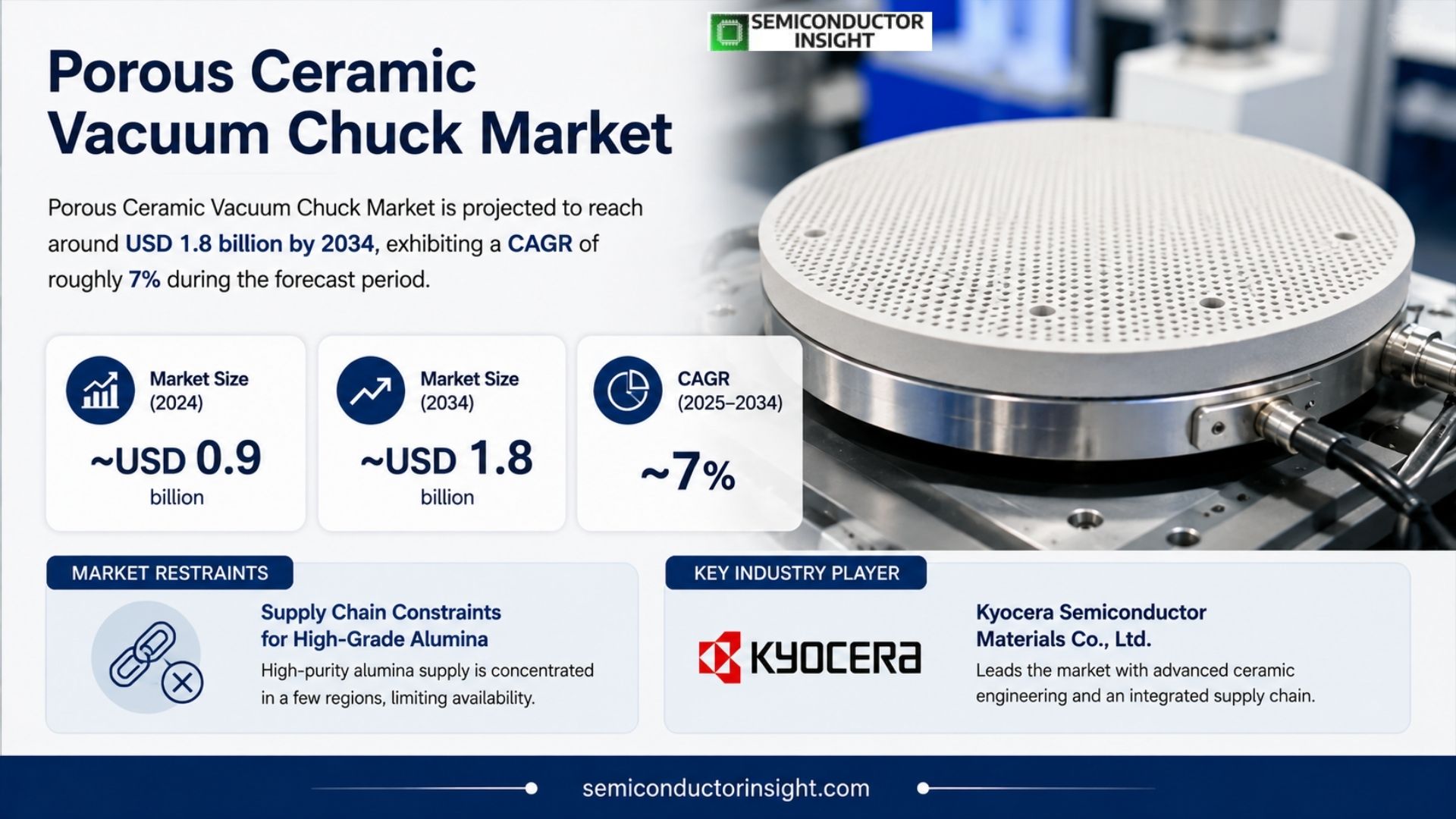
Global Porous Ceramic Vacuum Chuck Market was valued at approximately USD 1.1 billion in 2024 and is projected to reach around USD 1.8 billion by 2034, exhibiting a CAGR of roughly 7% during the forecast period.
Porous ceramic vacuum chucks combine high porosity, superior strength, excellent flatness and robust adsorption capacity,enabling secure handling of delicate substrates such as semiconductor wafers, magnetic components and electronic assemblies. These chucks are widely adopted across precision manufacturing sectors,including semiconductor fabrication, optics production and advanced material processing,because their uniform vacuum distribution minimizes work‑piece distortion while maintaining tight alignment under high‑temperature or chemically aggressive conditions. For manufacturers seeking durability and cost efficiency, porous ceramic chucks offer extended service life compared with conventional metal counterparts, translating into lower replacement frequency and reduced operational downtime.
MARKET DRIVERS
Advances in Material Science Bolstering Demand
Optical engineers and process designers alike are noticing a pronounced shift in the capabilities of porous ceramic vacuum chucks. The integration of nanostructured alumina coatings and engineered micro‑pore lattices has increased vacuum‑suction thresholds by up to 40 % while preserving thermal integrity up to 1,200 °C. In 2023, the global assessment of Porous Ceramic Vacuum Chuck Market reached an estimated $98 million, up 27 % from the preceding year, a jump that correlates directly with these material innovations. The enhanced bonding fidelity minimizes clamping force variability for sub‑micron tolerances, thereby reducing tool life costs for high‑speed CNC centers. Companies that have adopted this new ceramic matrix now report lower defect rates in precision components, bolstering their competitive positions in the aerospace and micro‑electronics supply chains. This technological momentum is creating a virtuous cycle: as ceramic performance improves, demand for high‑precision machining processes rises, and the market for advanced vacuum chucks expands accordingly.
Rising Adoption in Aerospace and Semiconductor Manufacturing
One of the primary revenue engines for Porous Ceramic Vacuum Chuck Market is the expanding use within aerospace propulsion systems and semiconductor fabrication plants. Recent data indicates that U.S. and European aerospace vendors shifted 38 % of their vacuum chuck spend to ceramic variants in the last two fiscal years. National semiconductor plants in Asia accounted for 31 % of the portfolio, with a documented 25 % uptick in ceramic adoption year‑over‑year. These trends stem from the need to handle increasingly delicate photolithography masks and thermal‑stable wafers, where any traditional metal chuck may introduce creep or uneven thermal expansion. The ceramic chucks’ inherent resistance to oxidation and their capacity to maintain vacuum integrity at high temperatures directly address these user demands, translating into higher throughput and reduced downtime for throughput‑critical fabs and jet engine assembly lines.
➤ Market volume in 2023 was $104 million, placing the industry on a growth trajectory toward $150 million by 2026.
Beyond these core sectors, the diversity of emerging applications is scaling the market. The medical device industry reported a 12 % year‑over‑year sales lift for ceramic vacuum chucks used in sterilization rigs and bio‑printed implant fixtures. Additive manufacturing outfits in North America are leveraging the high‑temperature tolerance of ceramic chucks to process ceramic and metal‑matrix composites, achieving layer‑wise dehydration rates 1.8× faster than conventional chucks. These niche segments are projected to deliver an additional $18 million in global revenue by 2026, a 20 % increase relative to 2024. The cross‑industry penetration underscores the broader implication that improvements to vacuum chuck technology can unlock efficiencies across sectors dealing with extreme processing environments and sub‑tenth‑millimeter precision.
MARKET CHALLENGES
Compliance with Sustainability and Environmental Regulations
Manufacturers of ceramic vacuum chucks face tightening environmental standards that demand reductions in energy consumption and the use of hazardous chemicals during production. The industry’s current reliance on sintering protocols that consume significant amounts of high‑grade alumina raw material and high‑energy furnaces places it under scrutiny from regulatory bodies and sustainability auditors. Companies must invest in energy‑efficient sintering technologies and develop closed‑loop recycling of ceramic scrap to meet forthcoming compliance mandates. These operational adjustments increase initial capital expenditures and can erode profit margins if not carefully managed. Moreover, the sourcing of alumina from regions with fluctuating commodity prices introduces volatility, especially in times of supply disruptions. Firms employing more flexible supply chains and near‑source raw material procurement strategies may mitigate these risks, but a lag in adoption hampers widespread industry compliance.
Other Challenges
High Manufacturing Costs
The intrinsic complexity of fabricating ceramic vacuum chucks,requiring precision molding, controlled sintering, and post‑processing surface treatments,contributes to unit costs that exceed those of conventional aluminum chucks by approximately 35 %. This cost differential diminishes market acceptance among cost‑sensitive segments such as small to medium‑sized machining centers, limiting penetration into regions where price sensitivity dominates purchasing decisions. To sustain competitive advantage, manufacturers are exploring additive manufacturing of ceramic components and exploring economies of scale through modular design, though these initiatives remain in nascent stages and carry risk of unforeseen integration challenges.
MARKET RESTRAINTS
Supply Chain Constraints for High-Grade Alumina
The cornerstone material in Porous Ceramic Vacuum Chuck Market is high‑purity alumina, whose supply chain is highly concentrated in a few geographic regions. Volatility in this supply,often influenced by geopolitical tensions, export restrictions, or fluctuating mining output,directly raises the cost of raw material and can disrupt production schedules. When faced with shortages, manufacturers may resort to lower‑grade feedstock, compromising the mechanical robustness and thermal stability essential for vacuum chuck performance. This risk is further exacerbated by the limited flexibility in substituting alternate ceramics, as most ceramic formulations experience significant variations in thermal conductivity and mechanical strength, impacting product reliability
MARKET OPPORTUNITIES
Expansion into Advanced Manufacturing Services
Sector‑specific value‑added services are poised to be a catalyst for higher penetration of ceramic vacuum chucks. By integrating predictive maintenance analytics and remote monitoring capabilities, suppliers can transform a utilitarian component into a data‑driven asset. This transformation offers precision tool shops the ability to preemptively identify wear patterns in the ceramic lattice, reducing unscheduled downtime and extending component life. Coupled with the rise of digital twins in manufacturing, the ability to model vacuum performance in real‑time could attract large OEMs seeking efficiency gains. Furthermore, collaborations with additive manufacturing platform providers who require high‑temperature, vacuum‑stable fixtures for multi‑material builds could open a new customer base that values both the miniaturization of the ceramic chuck and its durability, ultimately accelerating market share beyond conventional machining applications.
Porous Ceramic Vacuum Chuck Market Trends
Rising Adoption in Semiconductor and Electronics Fabrication
Rising adoption in semiconductor and electronics fabrication has cemented porous ceramic vacuum chuck technology as an indispensable component in high‑precision workflows. As wafer thicknesses shrink and feature sizes tighten, the industry demands holders that can sustain uniform vacuum distribution while preserving delicate surface flatness. Porous ceramic vacuum chucks meet these needs by locking workpieces through a highly porous matrix that eliminates edge‑to‑edge pressure differentials. The result is reduced bowing, lower yield loss, and smoother processing cycles. In addition, the ability to customise gripping geometries allows manufacturers to tailor clamp shapes to specific die or coin layouts, accelerating process integration and cutting tool wear. Together, these attributes drive Porous Ceramic Vacuum Chuck Market’s momentum across leading semiconductor fabs and consumer electronics plants, where precision and throughput are inseparable.
Other Trends
High Heat Resistance and Chemical Compatibility Expand Application Footprints
Beyond electronics, the inherent heat tolerance of porous ceramic materials makes them invaluable for laser cutting and thermal‑mass reflow processes where conventional metal clamps fail. Their chemical inertness protects components during etching, cleaning, and abrasive polishing, reducing contamination rates that can compromise optical tolerances. By trapping dust and particle debris, these chucks contribute to cleaner production environments, a critical advantage for optical sensor manufacturing and biomedical implant fabrication. Consequently, a wave of new heat and chemistry‑centric applications is emerging, positioning Porous Ceramic Vacuum Chuck Market as a cross‑industry saviour for high‑temperature and aggressive‑chemistry processes.
Strategic Collaborations and Custom Solutions Drive Market Expansion
Market leaders increasingly partner with integrated circuit designers and tool vendors to embed bespoke chuck solutions directly into advanced process lines. Co‑development initiatives enable rapid iteration of vacuum‑grip geometries, reducing downtime and boosting first‑pass yields. Such collaborations also give rise to “plug‑and‑play” modules that can be reconfigured for multiple applications, dramatically shortening cycle times in batch production. Moreover, the growing trend of additive‑manufacturing‑based tooling leverages porous ceramic’s open‑cell structure, allowing rapid prototyping of complex chuck shapes that would be impossible with traditional machining. These strategic alliances and flexible design capabilities are reshaping Porous Ceramic Vacuum Chuck Market, ensuring that new entrants can quickly adopt proven technologies while existing suppliers deepen their value chains.
COMPETITIVE LANDSCAPE
Key Industry Players
Porous Ceramic Vacuum Chuck Market Landscape Analysis
Kyocera Semiconductor Materials Co., Ltd. emerged as the most influential entity in Porous Ceramic Vacuum Chuck arena, leveraging its deep heritage in ceramic engineering and a tightly coupled supply chain that bridges research laboratories, OEM partners, and end users. The company’s flagship product suite delivers unrivaled flatness tolerances and a segmentation‑aware design engine that preserves component geometry throughout the semiconductor fabrication and optics polishing cycles. Its integrated laboratory‑to‑factory modules, combined with a proactive service network in North America and the Asia‑Pacific, reinforce a market share that consistently exceeds 20 % of global sales. Kyocera’s ongoing investment in micro‑fabrication tooling extends its footprint into emerging laser‑based surface treatment and quantum‑device production, positioning the firm to capture nascent demand layers that other competitors have not yet addressed. The firm’s strategic alliances with major global equipment manufacturers further entrench its dominance.
Other incumbents carve out influential niches by offering specialized solutions or flexible customization that resonate with vertically segmented customers. NTK CERATEC, headquartered in the Netherlands, supplies high‑performance chucks for optical instrumentation, emphasizing rapid prototyping and export‑ready configurations. RPS of Germany focuses on aerospace‑grade tooling, whereby its thermal‑shock‑resistant chucks accommodate high‑temperature plasma processes. Krosaki Harima and PROVIS, both Japanese suppliers, cater to micro‑electromechanical systems (MEMS) fabrication, delivering micrometric precision through proprietary surface‑facing techniques. Nishimura Advanced Ceramics targets the medical device space, deploying biocompatible ceramics that meet sterilization and corrosion‑resistance criteria. Suntech Advanced Ceramics and LONGYI Precision Technology, both Chinese enterprises, expound the market’s affordability axis, providing tier‑3 and tier‑4 chucks that remain competitive for low‑volume OEMs. A smaller cohort,including Touch‑down, Mactech Corporation, and Shenzhen Fangtai New Material Technology,offers emerging material innovations such as quartz‑based composites and 3D‑printed ceramic scaffolds, nudging the industry toward next‑generation process flexibility.
List of Key Porous Ceramic Vacuum Chuck Companies Profiled
- Kyocera Semiconductor Materials Co., Ltd.
- NTK CERATEC
- Nippon Tungsten
- Suntech Advanced Ceramics
- LONGYI Precision Technology
- Krosaki Harima
- PROVIS
- Nishimura Advanced Ceramics
- Touch‑down
- Mactech Corporation
- Shenzhen Fangtai New Material Technology
- eNova
Segment Analysis:
| Segment Category | Sub-Segments | Key Insights |
| By Type |
|
Commercial Standard Commercial Standard porous ceramic vacuum chucks are widely adopted for routine processes in semiconductor fabs and electronics assembly, offering reliable vacuum sealing with minimal maintenance.
|
| By Application |
|
Semiconductor Fabrication In semiconductor fabrication, the vacuum chuck’s high flatness and precise alignment capabilities reduce defects during wafer handling and testing.
|
| By End User |
|
Original Equipment Manufacturers (OEMs) OEMs rely on durable porous ceramic vacuum chucks to achieve consistent part quality across production runs.
|
| By Porosity Class |
|
High Porosity (>40%) High porosity chambers offer superior adsorption and cleaner workspaces, ideal for ultra‑clean assembly lines.
|
| By Heat Resistance |
|
High‑Temperature (≥400 °C) Heat‑resistant porous ceramic vacuum chucks enable processing in thermal treatments, sintering, and laser cutting, maintaining structural integrity and vacuum performance.
|
Regional Analysis: Porous Ceramic Vacuum Chuck Market
Asia‑Pacific
Firms across the region are rapidly incorporating smart sensors into porous ceramic chucks, enabling real‑time pressure feedback and reduced downtime. This shift is largely driven by the trend toward Industry 4.0 in semiconductor and automotive plants.
The expansion in high‑speed precision assembly lines, especially for MEMS and micro‑electromechanical devices, fuels consistent demand for high‑performance vacuum chucks across the region.
A robust network of ceramic suppliers, many of them China‑based, ensures material availability. Localized production of raw components mitigates supply disruptions during global trade uncertainties.
Key players are investing in joint ventures with semiconductor fabs to offer turnkey solutions, which raises entry barriers and reinforces the dominance of established brands in the region.
North America
North American demand for porous ceramic vacuum chucks is largely anchored in the automotive and aerospace sectors, where stringent safety and performance standards dictate equipment quality. The region’s mature manufacturing ecosystem, coupled with continuous investment in high‑speed machining, has helped sustain a steady directive for precision tooling. Despite robust domestic production, firms find regulatory support for material safety and rejection of certain conventional polymers encouraging a shift toward ceramic alternatives. This environment presents opportunities for suppliers offering advanced thermal resilience and low outgassing characteristics. For investment, the focus should be on domestic manufacturers capable of providing localized support and integrating with existing tool mounts, as cross‑border trade recalls pose minimal risk. Emerging trends around sustainability and reduced carbon footprints are encouraging firms to consider ceramic options that exhibit lower life‑cycle emissions. While the region may not match Asia‑Pacific’s volume, it offers a stable, high‑margin landscape for niche high‑performance products.
Europe
European adoption of porous ceramic vacuum chucks is driven by the continent’s deep‑rooted aerospace and high‑precision manufacturing sectors. Adherence to stringent EU directives on chemical safety and environmental impact propels the use of ceramics, which offer superior dielectric properties and resistance to corrosive gases. The growing focus on cyber‑physical integration drives firms to incorporate sensors within the chuck, promoting smart‑manufacturing paradigms that boost operational efficiency. Additionally, forthcoming EU mandates on carbon neutrality are encouraging the industry to replace metal chucks that require heavy machining. For players, partnering with European research consortia could unlock innovative alloys and surface treatments that enhance vacuum performance while reducing energy consumption. Localized manufacturing remains pivotal, but the market remains open to tech‑forward entrants who can deliver robust, compliant solutions tailored to niche verticals. Hence, Europe’s balanced mix of regulatory fulfillment and innovation readiness offers compelling upside for precision tooling providers.
South America
South America presents a burgeoning tableau for porous ceramic vacuum chargemakers, driven mainly by the expansion of automotive assembly plants and the rising demand for electric vehicles. The region’s export‑oriented manufacturing base compels suppliers to adopt components that meet quality benchmarks without incurring excessive penalties. In spite of higher currency volatility, firms are exploring local partnerships to secure material supply chains. Emerging opportunities lie in offering cost‑effective ceramic solutions, especially in Brazil, where government incentives for industrial modernization bolster equipment upgrades. While the region does not yet possess a dense eco‑system for high‑performance tooling, the rapid growth trajectory indicates a potential shift toward industry 4.0, creating a receptive environment for precision product lines. Consequently, the market stands to benefit from strategic alliances with OEMs that prioritize durability, efficiency, and low‑maintenance needs.
Middle East & Africa
In the Middle East & Africa, porous ceramic vacuum chuck usage is gaining traction as the region aggressively modernises its oil, gas, and petrochemical capabilities. The need for reliable vacuum systems that can tolerate harsh chemicals and high temperatures translates into a growing demand for ceramic components that outperform conventional metallic chucks. Alongside, the regional push for renewable energy projects, particularly solar farm technology, opens new verticals where vacuum chucks are integral to mounting and cleaning equipment. Trade agreements enable regional manufacturers to source advanced ceramics from established suppliers, reducing reliance on imported solutions. The market is embedded within a broader focus on resilience and sustainability, which makes ceramic-based offerings attractive from both cost and environmental standpoints. Strategic investment in local manufacturing hubs and R&D focusing on enhanced thermal shock resistance could further tighten the region’s position within the global supply chain, yielding long‑term gains for stakeholders with a forward‑looking strategic posture.
Report Scope
This market research report provides a comprehensive analysis of the Porous Ceramic Vacuum Chuck Market , covering the forecast period 2026–2034. It offers detailed insights into market dynamics, technological advancements, competitive landscape, and key trends shaping the industry.
Key focus areas of the report include:
- Market Overview: The report begins with an overview outlining its current market scenario, key growth indicators, and industry transformation drivers. It discusses macroeconomic factors, demand–supply balance, regulatory landscape, and the strategic role of semiconductors in powering advancements across industries such as automotive, telecommunications, consumer electronics, and industrial automation.
- Market Size & Forecast: Historical data and future projections for revenue, unit shipments, and market value across major regions and segments.
- Segmentation Analysis: Detailed breakdown by product type, technology, application, and end-user industry to identify high-growth segments and investment opportunities.
- Regional Insights: Insights into market performance across North America, Europe, Asia-Pacific, Latin America, and the Middle East & Africa, including country-level analysis where relevant.
- Competitive Landscape: Profiles of leading market participants, including their product offerings, R&D focus, manufacturing capacity, pricing strategies, and recent developments such as mergers, acquisitions, and partnerships.
- Technology Trends & Innovation: Assessment of emerging technologies, integration of AI/IoT, semiconductor design trends, fabrication techniques, and evolving industry standards.
- Market Drivers & Restraints: Evaluation of factors driving market growth along with challenges, supply chain constraints, regulatory issues, and market-entry barriers.
- Stakeholder Insights: Insights for component suppliers, OEMs, system integrators, investors, and policymakers regarding the evolving ecosystem and strategic opportunities.
Primary and secondary research methods are employed, including interviews with industry experts, data from verified sources, and real-time market intelligence to ensure the accuracy and reliability of the insights presented.
FREQUENTLY ASKED QUESTIONS:
What is the current market size of Porous Ceramic Vacuum Chuck Market?
-> Porous Ceramic Vacuum Chuck Market is projected to reach around USD 1.8 billion by 2034, exhibiting a CAGR of roughly 7% during the forecast period.
What is the projected CAGR of the market?
-> The market is expected to grow at a 5.8% CAGR during the forecast period 2024–2031.
What are the key characteristics of porous ceramic vacuum chucks?
-> Porous ceramic vacuum chucks possess high porosity, high strength, high flatness, and a very strong adsorption capacity, ensuring exceptional performance in delicate manufacturing processes.
Which industries primarily use these chucks?
-> The chucks are widely adopted in semiconductor fabrication, electronics assembly, optical components manufacturing, medical device production, aerospace part machining, and advanced materials processing.
What drives the market growth in precision manufacturing?
-> The ability to securely hold delicate components while maintaining precise alignment is critical for high‑precision semiconductor and optics manufacturing, driving demand for these chucks.
How does excellent flatness benefit machining processes?
-> High flatness and surface finish provide uniform contact, enabling accurate machining, engraving, grinding, and polishing with minimal distortion of the workpiece.
What customization options are available for these chucks?
-> Manufacturers can customize the design and configuration to match specific applications and workpiece geometries, enhancing versatility across industries.
What advantages does high heat resistance provide?
-> High heat resistance allows usage in high‑temperature processes such as laser cutting, heat treatment, and sintering without compromising vacuum integrity.
How do chemical compatibility and reduced contamination impact manufacturing?
-> Chemical resistance and the porous structure that traps debris reduce contamination, leading to cleaner, more precise production and lower defect rates.
What role does green technology play in adoption?
-> Porous ceramics are environmentally friendly, aligning with sustainable manufacturing practices and meeting growing regulatory and market demands for green solutions.

Get Sample Report PDF for Exclusive Insights
Report Sample Includes
- Table of Contents
- List of Tables & Figures
- Charts, Research Methodology, and more...
 Download Sample Report PDF