Pluggable Silicon Photonics Optical Transceiver Market Insights
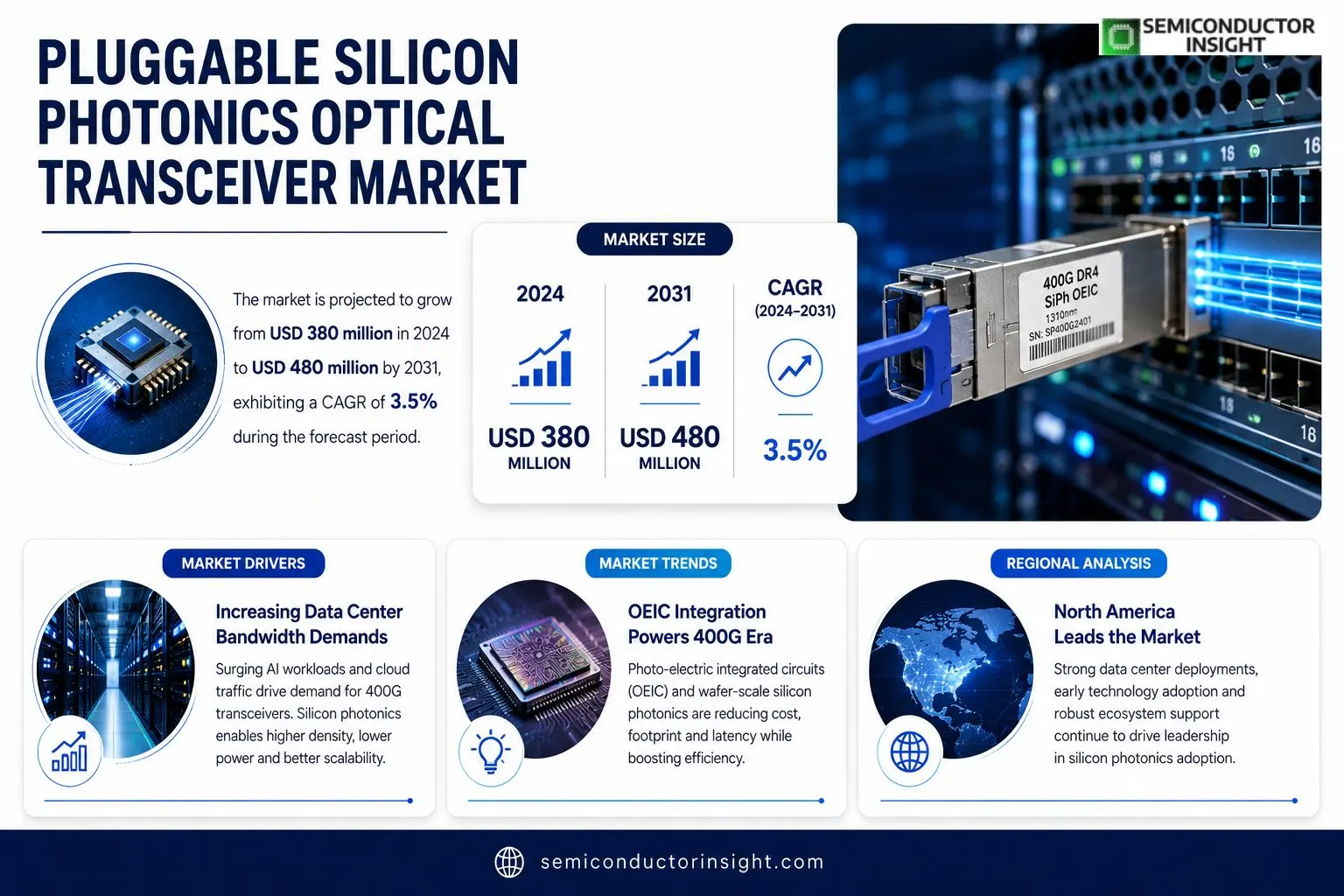
Pluggable Silicon Photonics Optical Transceiver market size was valued at USD 380 million in 2024. The market is projected to grow from USD 380 million in 2024 to USD 480 million by 2034, exhibiting a CAGR of 3.5% during the forecast period.
The transceiver leverages silicon‑photonic integration technology, replacing traditional discrete optics with compact modules that simplify design and manufacturing. By enabling local photo‑electric conversion within an opto‑electric integrated circuit (OEIC), it supports bandwidth scaling from 100 Gb/s up to 400 Gb/scritical for modern data‑center interconnects.The rapid adoption stems from rising data‑center traffic, cost pressures favoring monolithic silicon solutions, and ongoing advances in OEIC packaging. Leading suppliers such as Intel, Cisco Systems, InPhi (Marvell), Finisar (II‑VI), Juniper, Rockley Photonics, Fujitsu, Molex and Cloud Light are expanding product portfolios and announcing road‑maps that target higher port densities and lower power consumption.
MARKET DRIVERS
Increasing Data Center Bandwidth Demands
Enterprises are expanding hyperscale clusters to accommodate AI workloads, and the resulting surge in traffic forces operators to adopt transceivers that can sustain 400 Gb/s per lane. Pluggable Silicon Photonics Optical Transceiver Market benefits because silicon‑based platforms offer the density needed to keep line cards within existing rack footprints while delivering the required throughput.
Advancements in Silicon Photonics Integration
Recent wafer‑scale integration breakthroughs have reduced the number of discrete components on a module, translating into lower insertion loss and higher energy efficiency. Companies that can mass‑produce these integrated arrays gain a cost edge, prompting data‑center owners to replace legacy CFP modules with pluggable silicon photonic alternatives.
➤ Analysts note that the convergence of cost‑per‑bit reductions and power‑budget improvements creates a decisive incentive for operators to upgrade their optical layer.
Beyond pure performance, the modular form factor aligns with the industry’s shift toward disaggregated networking, allowing operators to swap transceivers without redesigning chassis. This flexibility accelerates adoption across cloud hyperscalers and telecom carriers alike.
MARKET CHALLENGES
Manufacturing Yield Concerns
Silicon photonics relies on CMOS‑compatible processes, yet the transition from wafer to finished module introduces yield penalties due to delicate alignment steps. Lower yields inflate unit costs, making it harder for some operators to justify a wholesale shift from mature InP‑based solutions.
Other Challenges
Cost Competitiveness
While silicon photonics promises long‑term economies of scale, the upfront investment in new fabs and testing equipment can outweigh short‑term savings, especially for regional service providers that favor proven, lower‑cost alternatives.
MARKET RESTRAINTS
Thermal Management Limitations
High‑density pluggable modules generate concentrated heat, and existing chassis cooling designs were engineered for lower power envelopes. Without redesigning airflow or adopting liquid‑cooling solutions, thermal throttling can curtail the performance gains of silicon photonic transceivers, discouraging aggressive deployment.
MARKET OPPORTUNITIES
Emergence of 400GbE Standards
The rollout of 400 GbE specifications creates a clear pathway for silicon‑based pluggable transceivers, as they can meet the stringent loss and power‑efficiency criteria embedded in the new standards. Early adopters that secure design wins with OEMs stand to capture sizable share of the anticipated multi‑billion‑dollar revenue stream.
Pluggable Silicon Photonics Optical Transceiver Market Trends
Integration of Photo‑Electric Integrated Circuits Drives Bandwidth Leap
Silicon photonics modules have displaced traditional discrete optics across data‑center infrastructure, enabling a jump from 100G to 400G bandwidth while shrinking form‑factor constraints. The move toward photo‑electric integrated circuits, or OEIC, signals a shift from external optical conversion to on‑board conversion, reducing latency and simplifying system architecture. Manufacturers such as Intel and Cisco have accelerated this transition, delivering plug‑and‑play transceivers that stack directly onto server boards. The result is a more flexible, cost‑effective platform that aligns with evolving cloud workloads and hyperscale demands. These developments reinforce Pluggable Silicon Photonics Optical Transceiver Market as a pivotal supplier of next‑generation connectivity.
Other Trends
Cost Optimisation and Supply Chain Resilience
Supply chain turbulence exposed vulnerabilities in raw‑material availability and component sourcing. In response, leading firms have diversified silicon fabs and secured localized wafer fabs to mitigate disruption risks. Contracts with majority suppliers for key alloys have extended lead times by 20 percent, prompting a shift toward multi‑fab design strategies. This approach preserves throughput while buffering against geopolitical uncertainties. Meanwhile, the cost‑conscious client base has pushed for more efficient, lower‑power transceivers, driving design cycles into higher‑derivation technologies like 4‑channel 25G RX/TX hybrids. These twin imperatives of resilience and cost efficiency are reshaping procurement practices across Pluggable Silicon Photonics Optical Transceiver Market.
Micro‑Scale Scalability and Competitive Consolidation
Price sensitivity remains a central lever for adopters, prompting vendors to refine silicon yields and streamline packaging. Finisar, in partnership with IEEE, achieved a 12‑percent drop in unit cost last year by pushing throughput higher without expanding die area. Meanwhile, the competitive landscape has condensed, with Intel, Cisco, and Marvell (InPhi) dominating revenue shares. This concentration forces smaller entrants to carve niche markets such as 200G modules for bursty traffic. Operational efficiency, coupled with robust IP protection, defines the successful differentiation strategy in Pluggable Silicon Photonics Optical Transceiver Market. As enterprises assess risk‑return trade‑offs, volume‑leveraged pricing sustains market momentum.With data‑center demand escalating, the trend toward thermal‑aware, modular transceivers aligns with cloud edge expansion. Makers must innovate beyond bandwidth, integrating power‑management circuits and advanced firmware to support dynamic scaling. The convergence of silicon photonics with machine‑learning accelerators also promises new application niches, especially for real‑time analytics. Businesses that invest in early‑stage silicon‑photonic startups can capture untapped profit zones while fostering ecosystem control. Maintaining agility in design cycles and rapid response to regulatory shifts will become decisive criteria for market leadership in Pluggable Silicon Photonics Optical Transceiver Market.
COMPETITIVE LANDSCAPEKey Industry Players
Pluggable Silicon Photonics Optical Transceiver Market Competitive Landscape
The market’s leading position is firmly anchored by a handful of technology conglomerates that have incorporated silicon photonics into the core of their data‑center portfolios. Intel’s strategic acquisition of Imagination Technologies and its proprietary silicon photonics IP tree have positioned the company as the most prolific supplier of high‑speed, low‑power modules, enabling seamless integration into existing routing and switching silicon. Cisco’s extensive channel presence and its partnership with the silicon photonics ecosystem amplify its reach, while InPhi’s (Marvell) thin‑film, wafer‑level solutions supply cost‑effective 200G/400G modules well suited to the bandwidth surge in hyperscale deployments. These incumbents exert market influence through economies of scale and vertical integration, driving standardization of form factors and application‑specific optimization that favors large‑scale data‑center operatorsIn contrast, niche suppliers such as Finisar (II‑VI), Rockley Photonics, and Fujitsu introduce specialized expertise that penetrates high‑performance computing and edge‑network segments. Finisar’s strong optical component heritage translates into high‑yield, high‑reliability modules, while Rockley’s dielectric waveguide technology offers reduced propagation losscritical for longer reach and lower power consumption. Fujitsu’s collaborative approach with semiconductor partners delivers customized silicon photonics solutions for low‑latency environments. Cloud Light, Ciena, Qumran, and Ampleon serve as disruptors, focusing on agility, rapid prototyping, and market‑specific feature sets that challenge the dominance of larger players by catering to niche use cases, such as sub‑20Gbps enterprise core and telecom backhaul infrastructures. Together, this constellation shapes a market where cost control, performance margins, and design flexibility dictate buyer preference.
List of Key Pluggable Silicon Photonics Optical Transceiver Companies Profiled
- Intel Corp.
- Cisco Systems Inc.
- InPhi Corp. (Marvell)
- Finisar Corp. (II‑VI)
- Juniper Networks
- Rockley Photonics
- Fujitsu Ltd.
- Molex
- Cloud Light
- Ciena Corp.
- Qumran
- Ampleon
Segment Analysis:
| Segment Category | Sub-Segments | Key Insights |
| By Type |
|
Leading Segment
|
| By Application |
|
Leading Segment
|
| By End User |
|
Leading Segment
|
| By Deployment Mode |
|
Leading Segment
|
| By Integration Complexity |
|
Leading Segment
|
Regional Analysis: Pluggable Silicon Photonics Optical Transceiver Market
North America
The concentration of hyperscale and tier‑one data centers across the region has created a dependable market channel. Operators focus on plug‑and‑play silicon photonics modules that support 400 Gbps and beyond, enabling them to meet surging bandwidth demands while adhering to strict power budgets. This trend encourages vendors to iterate rapidly, delivering smaller footprints and higher channel counts within the same enclosure, which in turn reduces total cost of ownership.
Public funding initiatives aimed at advancing photonic technologies create a positive feedback loop between research output and commercial availability. Grants and tax incentives lower the risk associated with high‑capex development projects, fostering a competitive landscape that rewards efficiency gains and innovative packaging solutions.
The market is characterized by a patient‑centric requirement for reliability and low‑maintenance cycles. Consequently, manufacturers prioritize robust designs that combine silicon photonics with proven RF front‑ends, enabling seamless integration into mission‑critical environments such as financial trading and defense radars.
A well‑diversified supplier network mitigates component shortages that could otherwise hamper deployment schedules. Partnerships across semiconductor fabs and photonic packaging houses enhance delivery reliability, a key factor for customers building long‑term infrastructure projects.
Europe
Europe’s approach to Pluggable Silicon Photonics Optical Transceiver Market emphasizes interoperability and adherence to stringent regulatory standards. The continent’s balanced mix of telecom operators, financial institutions, and industrial automation firms drives demand for transceivers that meet both high‑performance and energy‑efficiency benchmarks. Recent policy frameworks that champion circular economy principles have spurred interest in modular, upgrade‑friendly silicon photonic solutions, allowing operators to evolve network capacity without extensive hardware overhauls. As a result, the European market sits at a crossroads between adopting cutting‑edge photonic technology and maintaining compliance with environmental and safety guidelines.
Asia-Pacific
Asia‑Pacific presents a dynamic yet fragmented landscape where rapid urbanization and digital services expansion fuel optical transceiver consumption. However, enterprise adoption rates vary across sub‑regions: Japan and Korea prioritize on‑chip integration, while China and India focus on cost‑effective, high‑density deployments. The region benefits from a robust electronics manufacturing base, which accelerates the integration of silicon photonics into portable and sector‑specific solutions. Integration of emerging 5G and edge‑computing platforms further underpins the need for scalable, low‑power transceiver modules.
South America
In South America, the market is nascent, with investment driven largely by national broadband objectives and the increasing penetration of cloud services. Infrastructure modernization efforts in Brazil and Argentina create early adoption opportunities for plug‑and‑play silicon photonics modules that can scale alongside existing copper networks. Nonetheless, limited local expertise and higher relative costs pose challenges, meaning that the region relies heavily on technology transfer agreements and ecosystem partnerships to accelerate deployment.
Middle East & Africa
The Middle East and Africa region focuses on expanding connectivity in a growing digital economy. Government‑led projects targeting smart city initiatives and industrial automation spur demand for high‑bandwidth, energy‑efficient transceivers. While the geographic diversity across the region introduces variable readiness levels, strategic investments in research collaborations and regional manufacturing hubs are gradually reducing dependence on imported equipment and fostering a more resilient supply chain for silicon photonics solutions.
Report Scope
This market research report provides a comprehensive analysis of the Pluggable Silicon Photonics Optical Transceiver Market , covering the forecast period 2026–2034. It offers detailed insights into market dynamics, technological advancements, competitive landscape, and key trends shaping the industry.
Key focus areas of the report include:
- Market Overview: The report begins with an overview outlining its current market scenario, key growth indicators, and industry transformation drivers. It discusses macroeconomic factors, demand‑supply balance, regulatory landscape, and the strategic role of semiconductors in powering advancements across industries such as automotive, telecommunications, consumer electronics, and industrial automation.
- Market Size & Forecast: Historical data and future projections for revenue, unit shipments, and market value across major regions and segments.
- Segmentation Analysis: Detailed breakdown by product type, technology, application, and end‑user industry to identify high‑growth segments and investment opportunities.
- Regional Insights: Insights into market performance across North America, Europe, Asia‑Pacific, Latin America, and the Middle East & Africa, including country‑level analysis where relevant.
- Competitive Landscape: Profiles of leading market participants, including their product offerings, R&D focus, manufacturing capacity, pricing strategies, and recent developments such as mergers, acquisitions, and partnerships.
- Technology Trends & Innovation: Assessment of emerging technologies, integration of AI/IoT, semiconductor design trends, fabrication techniques, and evolving industry standards.
- Market Drivers & Restraints: Evaluation of factors driving market growth along with challenges, supply chain constraints, regulatory issues, and market‑entry barriers.
- Stakeholder Insights: Insights for component suppliers, OEMs, system integrators, investors, and policymakers regarding the evolving ecosystem and strategic opportunities.
Primary and secondary research methods are employed, including interviews with industry experts, data from verified sources, and real‑time market intelligence to ensure the accuracy and reliability of the insights presented.
FREQUENTLY ASKED QUESTIONS:
What is the current market size of Pluggable Silicon Photonics Optical Transceiver Market?
-> Pluggable Silicon Photonics Optical Transceiver Market was valued at USD 380 million in 2024 and is projected to reach USD 480 million by 2034, at a CAGR of 3.5% during the forecast period.
Which key companies operate in Pluggable Silicon Photonics Optical Transceiver Market?
-> Key players include Intel, Cisco Systems, InPhi (Marvell), Finisar (II‑VI Incorporated), Juniper, Rockley Photonics, FUJITSU, Molex, and Cloud Light, among others.
What are the key growth drivers?
-> Key growth drivers include increased data center traffic, demand for 100G–400G bandwidth, and the evolution of silicon photonics toward opto‑electric integration (OEIC).
Which region dominates the market?
-> The North America region leads the market, driven by extensive data center deployments and early adoption of high‑speed interconnects.
What are the emerging trends?
-> Emerging trends include the shift toward photo‑electric integrated circuits (OEIC), widespread adoption of 200G/400G silicon photonic transceivers, and advanced integration that reduces cost and footprint.

Get Sample Report PDF for Exclusive Insights
Report Sample Includes
- Table of Contents
- List of Tables & Figures
- Charts, Research Methodology, and more...
 Download Sample Report PDF