PIR-based Motion Detector Market Insights
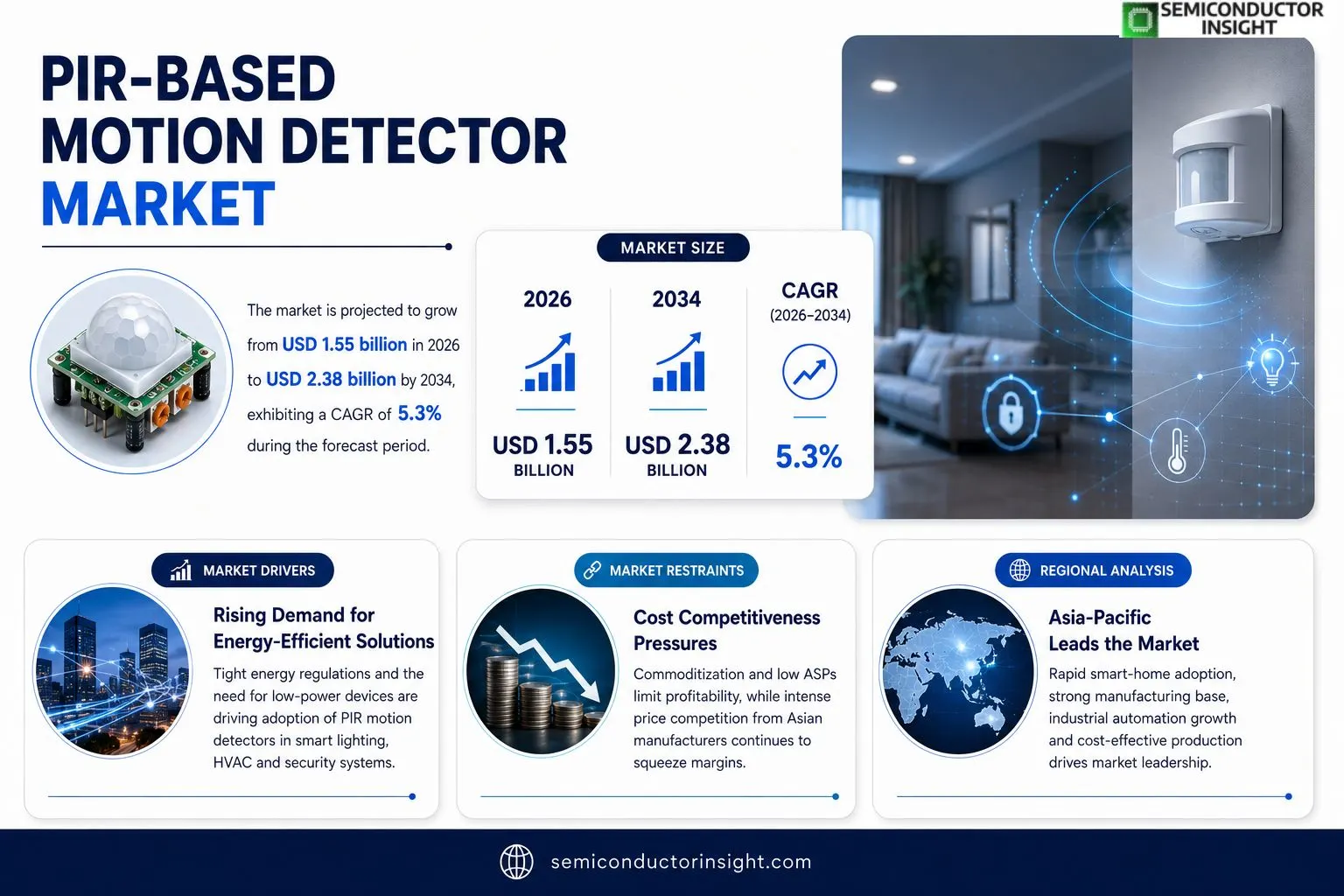
PIR-based Motion Detector market size was estimated at USD 1.45 billion in 2025. The market is projected to grow from USD 1.55 billion in 2026 to USD 2.38 billion by 2034, exhibiting a CAGR of 5.3% during the forecast period.
A PIR‑based motion detector senses movement of people, animals or other objects by detecting changes in infrared radiation emitted by bodies heat signatures. It is commonly integrated into burglar‑alarm panels and automatically activated lighting systems, providing reliable occupancy detection without line‑of‑sight constraints. Because the sensor operates passively, power consumption remains lowa key advantage for battery‑powered smart‑home devices and large‑scale IoT deployments such as building‑automation networks, energy‑saving lighting controls and industrial safety monitoring
MARKET DRIVERS
Rising Energy‑Efficiency Regulations
The push for lower electricity consumption in residential and commercial spaces has thrust low‑power sensors into the spotlight. PIR‑based Motion Detector Market participants benefit because passive infrared units consume a fraction of the energy required by radar or ultrasonic alternatives, enabling manufacturers to claim compliance with increasingly strict building codes. Companies that can certify their devices against tier‑III energy standards are winning new specification contracts from architects and facility managers.
Expansion of Connected Home Ecosystems
Smart‑hub platforms such as Matter and Zigbee are standardising the way motion sensors communicate with lighting, security, and HVAC controllers. This interoperability fuels a surge in retrofit projects where legacy switches are replaced by motion‑activated modules. Vendors that embed seamless OTA firmware updates see faster adoption rates, as installers avoid the logistical headache of field re‑programming.
➤ “Designers now specify motion detection as the default control method for lighting in 60 % of new smart‑home builds, up from 35 % five years ago.”
Because the sensor’s passive nature eliminates false triggers from ambient vibrations, architects are increasingly specifying PIR units for high‑ceiling retail corridors, where traditional beam sensors would be costly to align. The resulting shift not only raises unit volumes but also expands the average selling price as manufacturers bundle analytics and cloud connectivity.
MARKET CHALLENGES
Technical Integration Barriers
While the low‑cost advantage of PIR sensors is clear, integrating them into multi‑protocol IoT gateways often requires custom firmware layers. Small‑scale OEMs lack the engineering bandwidth to develop and maintain these interfaces, leading to longer time‑to‑market and increased R&D spend. Consequently, some projects defer to higher‑priced but plug‑and‑play alternatives.
Other Challenges
Supply Chain Volatility
Component shortages for silicon photodiodes and micro‑lens assemblies have intermittently throttled production capacity. When lead times stretch beyond eight weeks, system integrators either over‑stock inventoryraising carrying costsor source from secondary suppliers, risking quality inconsistencies.
MARKET RESTRAINTS
Cost Competitiveness Pressures
Commoditisation of the core sensor element has driven unit prices below $0.50 for high‑volume production runs. This price erosion squeezes margins for manufacturers that rely solely on hardware sales. Without value‑added servicessuch as predictive‑maintenance analytics or subscription‑based monitoringprofitability remains vulnerable to further cost undercutting by Asian scale producers.
MARKET OPPORTUNITIES
Commercial Building Automation
Corporate campuses are retrofitting legacy lighting with occupancy‑based controls to meet ESG targets. PIR sensors, combined with building‑management‑system APIs, can cut lighting energy use by up to 30 % in office towers. Vendors that package sensor hardware with a SaaS analytics layer are positioned to secure multi‑year service contracts, turning a one‑time sale into a recurring revenue stream.Healthcare facilities are another underserved segment. Regulations mandate patient‑room privacy while ensuring emergency egress. PIR modules integrated with nurse‑call systems enable hands‑free lighting without compromising patient comfort, creating a niche where safety and efficiency intersect.Finally, emerging markets in Southeast Asia are witnessing rapid urbanisation and a construction boom for mid‑rise apartments. Local developers are adopting international green‑building certifications, driving demand for affordable, low‑maintenance motion detectors that meet both energy and fire‑safety standards.
PIR-based Motion Detector Market Trends
IoT‑Enabled Integration Fuels Adoption
The convergence of passive infrared sensing with the expanding Internet of Things ecosystem is reshaping how buildings and factories manage occupancy. By embedding PIR‑based motion detectors into connected lighting and security platforms, operators gain real‑time visibility that reduces unnecessary power draw and limits false alarms. The technology’s low cost and minimal power consumption align with the push for distributed edge intelligence, allowing manufacturers to offer plug‑and‑play modules that sync with cloud‑based dashboards. This synergy not only shortens installation cycles but also creates recurring revenue streams through subscription‑style monitoring services, prompting vendors to prioritize firmware that supports over‑the‑air updates and interoperable data formats.
Other Trends
Energy‑Efficient Lighting Controls
Smart lighting schemes increasingly rely on PIR‑based detectors to differentiate between occupied and vacant zones. When integrated with daylight harvesting sensors, these detectors trigger dimming or full shutdown, translating occupant behavior into measurable energy savings. Facility managers are adopting analytics that correlate motion patterns with HVAC set‑points, enabling coordinated adjustments that prevent climate overshoot in unoccupied spaces. The cost‑effectiveness of passive infrared compared with video‑based solutions encourages retrofits in legacy structures, where wiring constraints make wireless or battery‑assisted PIR modules attractive. As utility incentives reward demonstrable reductions, the market sees a steady stream of projects that embed motion‑sensing logic directly into lighting control boards.
Industrial Automation Expands Use Cases
Beyond building automation, manufacturers are embedding PIR‑based motion detectors into robotic workcells and safety interlocks. The sensors provide a non‑intrusive means to verify human presence before a machine initiates motion, satisfying occupational safety standards without sacrificing throughput. In logistics hubs, detectors monitor aisle traffic, feeding data to conveyor‑control algorithms that adapt speed based on real‑time occupancy. This data-driven approach reduces wear on equipment and optimizes labor allocation. As factories adopt modular production lines, the flexibility of passive infrared moduleseasy to mount, calibrate, and replacemakes them a preferred choice for engineers seeking scalable safety solutions.
COMPETITIVE LANDSCAPE
Key Industry Players
PIR‑Based Motion Detector Market – Competitive Overview
Panasonic continues to dominate the PIR‑based motion detector segment, leveraging its extensive sensor portfolio and deep integration capabilities with smart‑home platforms. Its broad distribution network across North America, Europe, and Asia captures a sizable share of high‑volume applications such as residential lighting control and commercial security systems. The recent acquisition of a niche German optics firm has strengthened Panasonic’s product differentiation, enabling more precise field‑of‑view configurations that satisfy stringent energy‑efficiency standards. This consolidation illustrates a market where scale, technology breadth, and OEM alliances dictate bargaining power, allowing the leader to set pricing benchmarks that pressure smaller integrators. At the same time, Panasonic’s aggressive rollout of mixed‑signal ASICs signals an intent to lock in next‑generation IoT ecosystems, reinforcing its strategic advantage.Beyond the dominant tier, a cadre of specialized manufacturers is reshaping niche segments. InfraTec and Heimann Sensor have carved out leadership in industrial automation where ruggedness and low‑temperature performance are critical. Asian players such as Zhengzhou Winsen Electronics Technology and Shanghai Nicera Sensor are expanding rapidly by offering cost‑effective, single‑element modules for mass‑market IoT devices. Meanwhile, firms like Murata, AMS AG, and STMicroelectronics are injecting advanced signal‑processing ASICs that enhance detection accuracy while reducing false alarms. The diversification of capabilities across these companies creates a competitive environment in which strategic partnerships, focused R&D investments, and selective geographic expansion become essential for capturing emerging applications such as smart‑city lighting, automotive occupancy sensing, and building‑management automation. These dynamics suggest a fragmented yet highly innovative field where niche expertise can translate into meaningful market share.
List of Key PIR‑Based Motion Detector Companies Profiled
- Panasonic
- Nippon Ceramic
- Murata
- InfraTec
- Zhengzhou Winsen Electronics Technology
- Zilog
- Heimann Sensor
- Excelitas
- Shanghai Nicera Sensor
- Senba Sensing Technology
- AMS AG
- Honeywell
- Bosch Sensortec
- STMicroelectronics
- TE Connectivity
Segment Analysis:
| Segment Category | Sub-Segments | Key Insights |
| By Type |
|
Leading Segment
|
| By Application |
|
Leading Segment
|
| By End User |
|
Leading Segment
|
Regional Analysis: PIR-based Motion Detector Market
North America
A second driver is the proliferation of smart‑home platforms that treat motion sensors as the primary trigger for lighting, HVAC, and alarm subsystems. Developers of these platforms value the minimal latency and privacy‑preserving nature of passive infrared detection, which sidesteps the data‑intensive demands of camera‑based solutions. This preference has spurred a wave of partnership agreements between sensor manufacturers and cloud‑service providers, creating bundled offerings that simplify procurement for residential builders.
The regulatory backdrop reinforces this momentum. Updated building‑energy codes across several states now credit the use of PIR‑based controls toward compliance thresholds, prompting architects to specify the technology as a cost‑effective compliance pathway. Consequently, manufacturers are expanding capacity in North‑American fabs to meet a pipeline of demand that is less susceptible to the cyclical swings observed in other regions. The cumulative effect is a market environment where product innovation and volume growth reinforce each other, cementing North America’s status as the benchmark for competitive performance in PIR-based Motion Detector Market.
factories across the United States and Canada leverage PIR sensors to switch conveyor lighting only when personnel are present, locking out unnecessary illumination during off‑shift hours. This approach aligns with lean‑manufacturing goals by shaving idle‑energy costs while preserving worker safety, and it incentivizes OEMs to embed motion‑detection modules directly onto machine housings.
The rise of voice‑assistant ecosystems has amplified demand for discreet, battery‑free motion detectors that can be wall‑mounted without visual clutter. PIR devices feed occupancy data to hubs that orchestrate lighting scenes, creating a seamless user experience that drives repeat purchases of compatible hardware.
Revised state energy codes now award points for motion‑triggered lighting controls, prompting large‑scale project owners to prioritize PIR‑based solutions in bid specifications. Compliance incentives reduce upfront justification costs, accelerating adoption cycles for newer sensor models.
Domestic component sourcing has become a strategic imperative after recent disruptions. Suppliers are reshoring key semiconductor layers, shortening lead times and granting system integrators greater visibility over inventory, which sustains the market’s growth trajectory.
Europe
European stakeholders view PIR-based Motion Detector Market through the lens of energy‑efficiency directives that mandate zero‑standby power for commercial lighting. Nations such as Germany and France have embedded motion sensing into public‑building retrofits, encouraging local manufacturers to develop sensors that meet the region’s rigorous electromagnetic compatibility standards. The convergence of green‑building certifications and a strong emphasis on user privacyparticularly in GDPR‑compliant environmentsmakes camera‑free sensing an attractive option for office spaces and hospitality venues. As a result, system integrators are packaging PIR modules with building‑management software, creating a value‑added service that differentiates them from suppliers focused solely on hardware.
Asia‑Pacific
In the Asia‑Pacific corridor, rapid urbanization fuels construction of high‑rise residential towers where space constraints favour compact, low‑maintenance motion detectors. Countries like India and Indonesia are witnessing a shift from legacy infrared tubes to solid‑state PIR chips, driven by the need for devices that can operate on limited power budgets in off‑grid housing projects. Meanwhile, Japan’s mature consumer‑electronics sector is experimenting with PIR sensors embedded in appliance interiors to enable context‑aware energy savings. These divergent use‑cases illustrate a market in transition, where manufacturers must balance cost‑sensitivity with the demand for robust performance across varied climatic zones.
South America
South American markets are still defining the role of motion detection within broader smart‑city initiatives. Brazil’s municipal lighting programs have begun to pilot PIR‑enabled streetlights that dim after pedestrian traffic subsides, a strategy that aligns with public‑sector targets for carbon‑reduction. However, fragmented distribution channels and limited local design expertise mean many projects rely on imported sensor modules, which introduces price pressure. To gain traction, vendors are establishing regional engineering hubs that can tailor firmware to local power‑grid irregularities and provide on‑site training for installation crews.
Middle East & Africa
The Middle East & Africa region presents a paradox of high disposable income paired with extreme environmental conditions. In Gulf Cooperation Council (GCC) nations, luxury hotels and high‑end retail outlets incorporate PIR sensors to automate lighting in expansive atria, capitalizing on the technology’s ability to function reliably amid intense heat. In contrast, many African nations prioritize ruggedness over finesse, seeking detectors that can tolerate dust ingress and power fluctuations common in remote installations. This duality pushes manufacturers to diversify product lines, delivering both premium, aesthetically refined units for affluent markets and hardened, cost‑effective models for emerging economies.
Report Scope
This market research report provides a comprehensive analysis of the PIR-based Motion Detector Market , covering the forecast period 2026–2034. It offers detailed insights into market dynamics, technological advancements, competitive landscape, and key trends shaping the industry.
Key focus areas of the report include:
- Market Overview: The report begins with an overview outlining its current market scenario, key growth indicators, and industry transformation drivers. It discusses macroeconomic factors, demand–supply balance, regulatory landscape, and the strategic role of semiconductors in powering advancements across industries such as automotive, telecommunications, consumer electronics, and industrial automation.
- Market Size & Forecast: Historical data and future projections for revenue, unit shipments, and market value across major regions and segments.
- Segmentation Analysis: Detailed breakdown by product type, technology, application, and end-user industry to identify high-growth segments and investment opportunities.
- Regional Insights: Insights into market performance across North America, Europe, Asia-Pacific, Latin America, and the Middle East & Africa, including country-level analysis where relevant.
- Competitive Landscape: Profiles of leading market participants, including their product offerings, R&D focus, manufacturing capacity, pricing strategies, and recent developments such as mergers, acquisitions, and partnerships.
- Technology Trends & Innovation: Assessment of emerging technologies, integration of AI/IoT, semiconductor design trends, fabrication techniques, and evolving industry standards.
- Market Drivers & Restraints: Evaluation of factors driving market growth along with challenges, supply chain constraints, regulatory issues, and market-entry barriers.
- Stakeholder Insights: Insights for component suppliers, OEMs, system integrators, investors, and policymakers regarding the evolving ecosystem and strategic opportunities.
Primary and secondary research methods are employed, including interviews with industry experts, data from verified sources, and real-time market intelligence to ensure the accuracy and reliability of the insights presented.
FREQUENTLY ASKED QUESTIONS:
What is the current market size of PIR-based Motion Detector Market?
-> PIR-based Motion Detector Market was valued at USD 1.45 billion in 2025 USD 1.55 billion in 2026 to USD 2.38 billion by 2034, exhibiting a CAGR of 5.3% during the forecast period.
Which key companies operate in PIR-based Motion Detector Market?
-> Key players include Panasonic, Nippon Ceramic, Murata, InfraTec, Zhengzhou Winsen Electronics Technology, Zilog, Heimann Sensor, Excelitas, Shanghai Nicera Sensor, Senba Sensing Technology.
What are the key growth drivers?
-> Key growth drivers include expansion of IoT ecosystems, increasing demand for energy‑efficient smart lighting, rising security concerns, and adoption of automated building management systems.
Which region dominates the market?
-> Asia holds the largest share driven by rapid smart‑home penetration, extensive industrial automation, and strong manufacturing bases.
What are the emerging trends?
-> Emerging trends include AI‑enhanced motion detection, integration with wireless mesh networks, and development of ultra‑low‑power PIR sensors for battery‑free IoT deployments.

Get Sample Report PDF for Exclusive Insights
Report Sample Includes
- Table of Contents
- List of Tables & Figures
- Charts, Research Methodology, and more...
 Download Sample Report PDF