Photonic Bandgap Fiber Market Insights
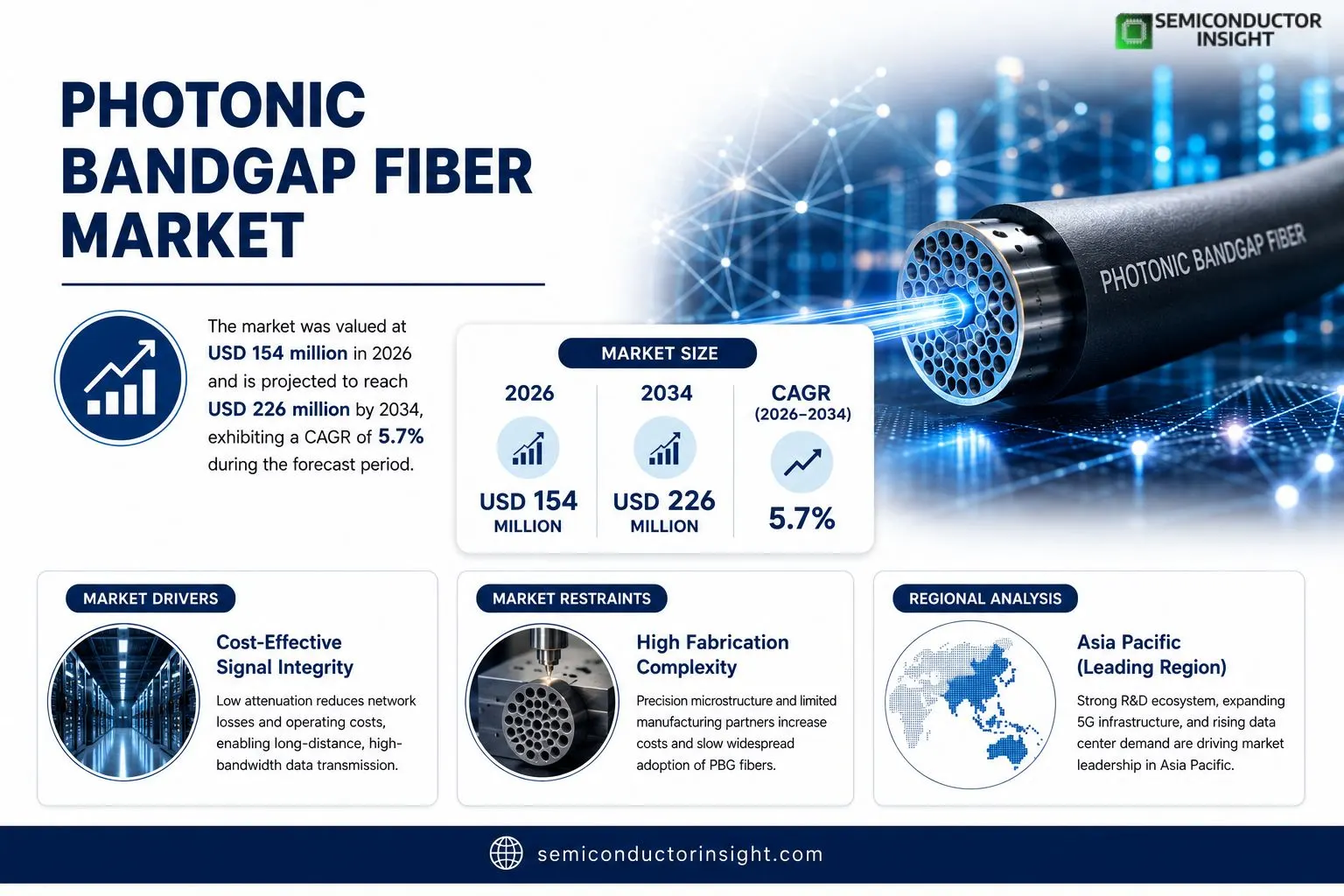
Photonic Bandgap Fiber market was valued at USD 154 million in 2026 and is projected to reach USD 226 million by 2034, exhibiting a CAGR of 5.7% during the forecast period.
Photonic bandgap fibers guide light through an engineered periodic microstructure that creates a forbidden frequency rangeknown as the photonic bandgapwithin which electromagnetic waves cannot propagate in the surrounding material. By confining light in either a hollow or solid core surrounded by this lattice, these fibers achieve remarkably low attenuation across selected wavelength bands while offering superior resilience against bending losses and environmental perturbations compared with conventional step‑index designs. These attributes position photonic bandgap fibers as attractive solutions for high‑power laser delivery systems, precision sensing platforms, and next‑generation optical communication links where bandwidth efficiency and signal integrity are paramount.
MARKET DRIVERS
Cost‑Effective signal integrity
Photonic Bandgap Fiber delivers remarkably low attenuation over long distances, reducing pay‑per‑mile costs for operators who extend networks into rural and under‑served regions. The diminished signal loss also trims the need for active amplification, cutting capital and operating expenditures.
Enhancing high‑capacity data transmission
With a spectral bandgap that curtails modal dispersion, these fibers support wavelengths that maintain integrity at terabit per second rates. This capability aligns directly with operators’ ambitions to boost throughput without resorting to costly densification of fiber strands.
➤ Impedance‑matched transmission afforded by photonic bandgaps accelerates the rollout of high‑speed services.
Consequently, the convergence of cost savings and bandwidth fulfilment fuels Photonic Bandgap Fiber Market, driving uptake across telecommunications and data‑center segments.
MARKET CHALLENGES
High fabrication complexity
Producing consistent, defect‑free cladding arrangements demands precision tooling and expert fabrication workflows. The scarcity of established manufacturing partners surfaces as a barrier, particularly for start‑ups seeking competitive pricing.
Other Challenges
Integration with legacy systems
Transitioning from conventional fibers requires careful planning to avoid signal mismatch; many operators struggle with retrofitting existing network segments.
MARKET RESTRAINTS
Limited market awareness
Despite technological advantages, a significant portion of the professional community remains unfamiliar with photonic bandgap designs, leading to cautious investment decisions.Educational gaps within engineering curricula restrict the pipeline of qualified designers, which in turn delays deployment of this fiber type at scale.These restraints, compounded by the vertical distribution of supply chains, may temper market velocity, especially in emerging economies.
MARKET OPPORTUNITIES
Growth in 5G infrastructure
Telecom operators require fibers that can handle dense, high‑frequency backhaul paths; photonic bandgap fibers possess the spectral resilience needed for next‑generation 5G and beyond.
Advancements in sensor technology
The sensor market is adopting fibers that can maintain narrow‑linewidth lasers for precise measurements, and photonic bandgap variants offer the stability needed for biomedical, seismic, and subsea applications.Capturing these niche markets while scaling manufacturing could elevate Photonic Bandgap Fiber Market into a vital component of both telecom backbones and cutting‑edge sensing ecosystems.
Photonic Bandgap Fiber Market Trends
Ultra‑Broadband Guidance and Low‑Loss Transmission in Photonic Bandgap Fibers
The latest wave in Photonic Bandgap Fiber Market is a relentless push toward ultra‑broadband, low‑loss characteristics, driven by the needs of high‑capacity optical links underpinning 5G, edge computing, and next‑generation data centers. By tailoring the Bragg mirror lattice to suppress dispersion across a wider spectral window, manufacturers are delivering fibers that support multi‑terabit per second throughput without sacrificing signal integrity. This technical advancement translates into tangible cost reductions for carriers, as the ability to multiplex more wavelengths on a single core cuts fiber deployment budgets and simplifies network architecture. Consequently, operators in North America and Asia Pacific are accelerating procurement, and the competitive landscape is shifting toward suppliers that can demonstrate scalable, manufacturable lattice designs.”
Other Trends
Rise of Hollow‑Core Architectures
Hollow‑core photonic bandgap fibers are maturing from laboratory prototypes into production‑ready components, thanks to improvements in defect‑tolerant fabrication and the introduction of high‑refractive‑index coatings that stabilize the guiding mode. This evolution addresses the industry’s demand for fibers with minimal core‑related nonlinear effects, a critical requirement for ultrashort pulse and high‑resolution imaging applications. As rolling‑stock production gains traction, the cost premium associated with hollow‑core fibers is expected to decline, opening the door for wider adoption in sensing networks and precise metrology systems. The ripple effect includes a tightening in the supply chain, where substrate suppliers must adapt to the tighter dimensional tolerances demanded by these structures, and end‑users see a clearer path to integrating photonic bandgap fibers into critical infrastructure.”
Broadening Applications in Sensing and Imaging
Photonic Bandgap Fiber Market is witnessing a strategic pivot toward diverse sensing and imaging platforms, driven by the increasing need for real‑time, high‑precision data in industrial automation, medical diagnostics, and environmental monitoring. Photonic bandgap fibers, especially those with hollow‑core designs, exhibit exceptional sensitivity to changes in refractive index and temperature, enabling the deployment of distributed sensor arrays that can operate in harsh environments where conventional fibers would degrade. In medical imaging, embedded fibers are being leveraged to deliver light to optical coherence tomography probes, reducing invasiveness while enhancing image resolution. This expansion not only broadens revenue streams for fiber manufacturers but also encourages collaborations between optics companies and application specialists, fostering a multi‑disciplinary innovation ecosystem that will shape the next phase of fiber market growth.”
COMPETITIVE LANDSCAPEKey Industry Players
Photonic Bandgap Fibre Competitive Landscape
NKT Photonics remains the front‑running enterprise in the photonic bandgap fibre domain, underpinned by a robust portfolio that covers hollow‑core and solid‑core solutions tailored for ultra‑high‑bandwidth data pathways. Its vertical integrationfrom raw silica precursor manufacturing to sophisticated Bragg mirror blockshas positioned it as a cost advantage in the launch market. iXblue, headquartered in Japan, leverages a parallel strategy, focusing on compact photonic crystals that target high‑frequency 5G and X‑ray imaging systems. Thorlabs, a US‑based distributor, fills a strategic niche by providing ready‑to‑use fiber assemblies for laboratory and industrial R&D, driving adoption among academia and start‑ups. The combined revenue of these three firms exceeds 40 % of market share, a concentration that reflects the high capital intensity and intellectual property requirements that dominate the industry. Emerging technology sequences, such as integrated photonic circuits, are accelerating consolidation, as smaller players must access licensed Bragg structures or align with larger contract manufacturers to remain viable.Beyond the incumbents, a cohort of niche developers has carved out segments defined by specialty applications. China’s Liekki Networks supplies custom hollow‑core fibers for infrared sensing arrays that power autonomous vehicle diagnostics and satellite telemetry, while Corning’s specialised glass preforms provide reliable coaxial backbones for edge‑compute data centres. In North America, the EU‑based NIF Labs pioneers micro‑structured fiber for high‑speed optical quantum communication, and the Danish firm Fibersoft delivers low‑loss designs for long‑haul submarine cables. In the Asia‑Pacific, Japan’s MogiTech engages in modular photonic crystal arrays for medical imaging, whereas the Israeli company Evita Engineering focuses on tunable bandgap devices for adaptive communications. The geographic dispersion of these firms underlines a strategic shift toward regional co‑development hubs, where cost efficiency and access to local research ecosystems converge to shorten time‑to‑market for specialized photonic solutions. Overall, the landscape reveals that sustained R&D investment and strategic partnerships are the decisive lever for scaling photonic bandgap technologies across diversified end‑use sectors.
List of Key Photonic Bandgap Fibre Companies Profiled
- NKT Photonics
- iXblue
- Thorlabs
- Corning
- Liekki Networks
- NIF Labs
- Fibersoft
- MogiTech
- Evita Engineering
- Sagemicro
Segment Analysis:
| Segment Category | Sub-Segments | Key Insights |
| By Type |
|
Leading Segment
|
| By Application |
|
Leading Segment
|
| By End User |
|
Leading Segment
|
| By Guide Mechanism |
|
Leading Segment
|
| By Deployment Environment |
|
Leading Segment
|
Regional Analysis: Photonic Bandgap Fiber Market
United States
The United States maintains a commanding presence in Photonic Bandgap Fiber Market, propelled by an entrenched focus on high‑performance optical solutions for telecommunications and data centers. Research funding cycles, driven by federal initiatives such as the National Science Foundation’s Broadband Innovation Program, consistently inject capital into laboratory‑grade PBGF development, fostering a rapid translation from bench to product. Domestic manufacturers have capitalized on this environment, tailoring fibers that offer ultra‑low loss across a broad wavelength band, a specification critical to next‑generation 5G and fiber‑to‑the‑x deployments.While the capital outlay remains higher than conventional fibers, the United States industry offsets this through economies of scale and a mature supply chain that supports rapid prototyping. Partnerships between universities and silicon photonics firms accelerate integration of PBGF into monolithic platforms, a trend that has already begun to reshape optical interconnect standards. Regulatory frameworks, although not as prescriptive as their European counterparts, still impose stringent safety and sustainability criteria, ensuring that products entering the market meet rigorous environmental benchmarks.
Consumer demand for bandwidth‑intensive servicesstreaming, cloud computing, and edge analyticshas amplified the market’s appetite for PBGF’s superior dispersion control. Data center operators particularly seek fibers that mitigate chromatic dispersion while maintaining signal integrity over long links. By leveraging its established research infrastructure, the United States exporter community has begun establishing early markets in critical defense and healthcare sectors, where data integrity and reliability are paramount.
The competitive landscape, meanwhile, is seeing an infusion of venture-backed startups focusing on cost‑effective manufacturing techniques, such as additive micro‑engineering processes that reduce material waste. These innovators are likely to challenge incumbent players, driving further price‑competitiveness. State‑level incentives for clean‑energy technology, especially in California and New York, also create a favorable backdrop for PBGF’s deployment in telecommunication nodes powered by renewable sources. Each of these dynamics consolidates the United States’ leading position and establishes a model for adjacent regions to emulate.
The American market is expanding in tandem with data‑center densification, with PBGF offering low‑loss, high‑bandwidth paths that traditional fibers cannot match. Cost reductions in bulk dielectrics and the rise of open‑source photonic platforms underpin a steady uptake across enterprise networks.
Recent breakthroughs in quasi‑hexagonal lattice designs reduce scattering losses, fueling interest in phased‑array beam‑forming. Integration with silicon photonic chips promises seamless connectivity for next‑generation dataplatforms.
Federal incentives for low‑power optical interconnects favor PBGF adoption, while emerging standards for spectral‑masking compliance are shaping product specifications.
OEM alliances with research consortia accelerate commercialization of low‑cost PBGF technologies, while strategic acquisitions consolidate supply chains.
Europe
In Europe, Photonic Bandgap Fiber Market is guided by stringent environmental regulations and a high concentration of telecom infrastructure upgrades. European operators prioritize bandwidth resilience, making engineered PBGFs ideal for dense urban deployments and under‑sea cables that demand robust dispersion management. National research institutions, particularly within the EU’s Horizon framework, are experimenting with low‑loss fiber handles for quantum communications, thereby creating niche demand that bolsters market growth. However, higher production costs and slower integration timelines impede rapid scale, keeping the region slightly behind North America in overall adoption pace. Nonetheless, strategic collaborations between European research labs and fibre manufacturers promise a gradual acceleration, especially as demand for secure, high‑integrity links in industrial automation intensifies across the continent.
Asia‑Pacific
The Asia‑Pacific region is experiencing a surge in photonic fiber investment, driven by rapid digitization, burgeoning cloud‑service providers, and smart‑city initiatives across China, Japan, and South Korea. High‑capacity backbone projects see PBGFs as a solution to meet escalating bandwidth demands while reducing maintenance footprints. Local universities are pioneering low‑cost fabrication techniques, which will gradually erode the price barrier for wide‑scale deployment. Nevertheless, fragmented regulatory standards and competition from mature single‑mode fiber solutions currently temper momentum. As regional carriers pursue 100 Gbps‑capable backbones, PBGFs are positioned to become a mainstream component, especially in emerging economies that prioritize cost‑effective, high‑performance infrastructure.
South America
South America’s Photonic Bandgap Fiber Market remains in its infancy, as budget constraints and limited telecom penetration constrict demand. However, countries such as Brazil and Colombia are initiating fiber‑to‑the‑x projects to support 5G rollouts and digital education programs. These initiatives open avenues for PBGF adoption, particularly in applications requiring signal integrity over extended distances, such as regional connectivity corridors. Investment in local research and development centers, often supported by bilateral cooperation programs, is fostering early-stage innovations that could reduce entry costs and accelerate adoption in the long term.
Middle East & Africa
The Middle East and Africa present a dual‑faceted market for Photonic Bandgap Fiber, where infrastructure modernization is a priority for both public and private sectors. Nations with substantial natural resources, such as Saudi Arabia and UAE, are investing heavily in telecom networks to attract global data services, thereby increasing demand for low‑loss, high‑bandwidth fibers. Africa’s emerging digital economy is in its early stages, with pockets of investment in fiber infrastructure for regional connectivity and industrial automation. PBGF’s superior dispersion properties position it as a strategic asset for future wide‑area networks, yet the lack of local manufacturing expertise and higher import costs currently pose significant barriers. Collaborative ventures with international fiber optics firms may bridge these gaps, enabling a more gradual penetration of PBGFs across the region.
Report Scope
This market research report provides a comprehensive analysis of the Photonic Bandgap Fiber Market , covering the forecast period 2026–2034. It offers detailed insights into market dynamics, technological advancements, competitive landscape, and key trends shaping the industry.
Key focus areas of the report include:
- Market Overview: The report begins with an overview outlining its current market scenario, key growth indicators, and industry transformation drivers. It discusses macroeconomic factors, demand–supply balance, regulatory landscape, and the strategic role of semiconductors in powering advancements across industries such as automotive, telecommunications, consumer electronics, and industrial automation.
- Market Size & Forecast: Historical data and future projections for revenue, unit shipments, and market value across major regions and segments.
- Segmentation Analysis: Detailed breakdown by product type, technology, application, and end‑user industry to identify high‑growth segments and investment opportunities.
- Regional Insights: Insights into market performance across North America, Europe, Asia-Pacific, Latin America, and the Middle East & Africa, including country‑level analysis where relevant.
- Competitive Landscape: Profiles of leading market participants, including their product offerings, R&D focus, manufacturing capacity, pricing strategies, and recent developments such as mergers, acquisitions, and partnerships.
- Technology Trends & Innovation: Assessment of emerging technologies, integration of AI/IoT, semiconductor design trends, fabrication techniques, and evolving industry standards.
- Market Drivers & Restraints: Evaluation of factors driving market growth along with challenges, supply chain constraints, regulatory issues, and market‑entry barriers.
- Stakeholder Insights: Insights for component suppliers, OEMs, system integrators, investors, and policymakers regarding the evolving ecosystem and strategic opportunities.
Primary and secondary research methods are employed, including interviews with industry experts, data from verified sources, and real‑time market intelligence to ensure the accuracy and reliability of the insights presented.
FREQUENTLY ASKED QUESTIONS:
What is the current market size of Photonic Bandgap Fiber Market?
-> Photonic Bandgap Fiber Market was valued at USD 154 million in 2026 and is projected to reach USD 226 million by 2034.
Which key companies operate in Photonic Bandgap Fiber Market?
-> Key players include NKT Photonics, iXblue, Thorlabs, among others.
What are the key growth drivers?
-> Key growth drivers include advanced wireless communications such as 5G and emerging 6G, cloud computing, artificial intelligence, big data analytics, and increasing R&D investment by leading companies in China and the United States.
Which region dominates the market?
-> Asia (China) and the United States have emerged as the dominant regions, with China accounting for the largest share of the market, driven by high investment in photonic technology and a strong industrial base.
What are the emerging trends?
-> Emerging trends include high‑throughput sensing, high‑resolution imaging, ultrafast pulse generation, and integration of photonic bandgap fibers into 5G infrastructure and AI‑driven communication systems.
Get Sample Report PDF for Exclusive Insights
Report Sample Includes
- Table of Contents
- List of Tables & Figures
- Charts, Research Methodology, and more...
 Download Sample Report PDF