Photoelectric Sensors and Inductive Sensors for Food and Beverage Market Insights
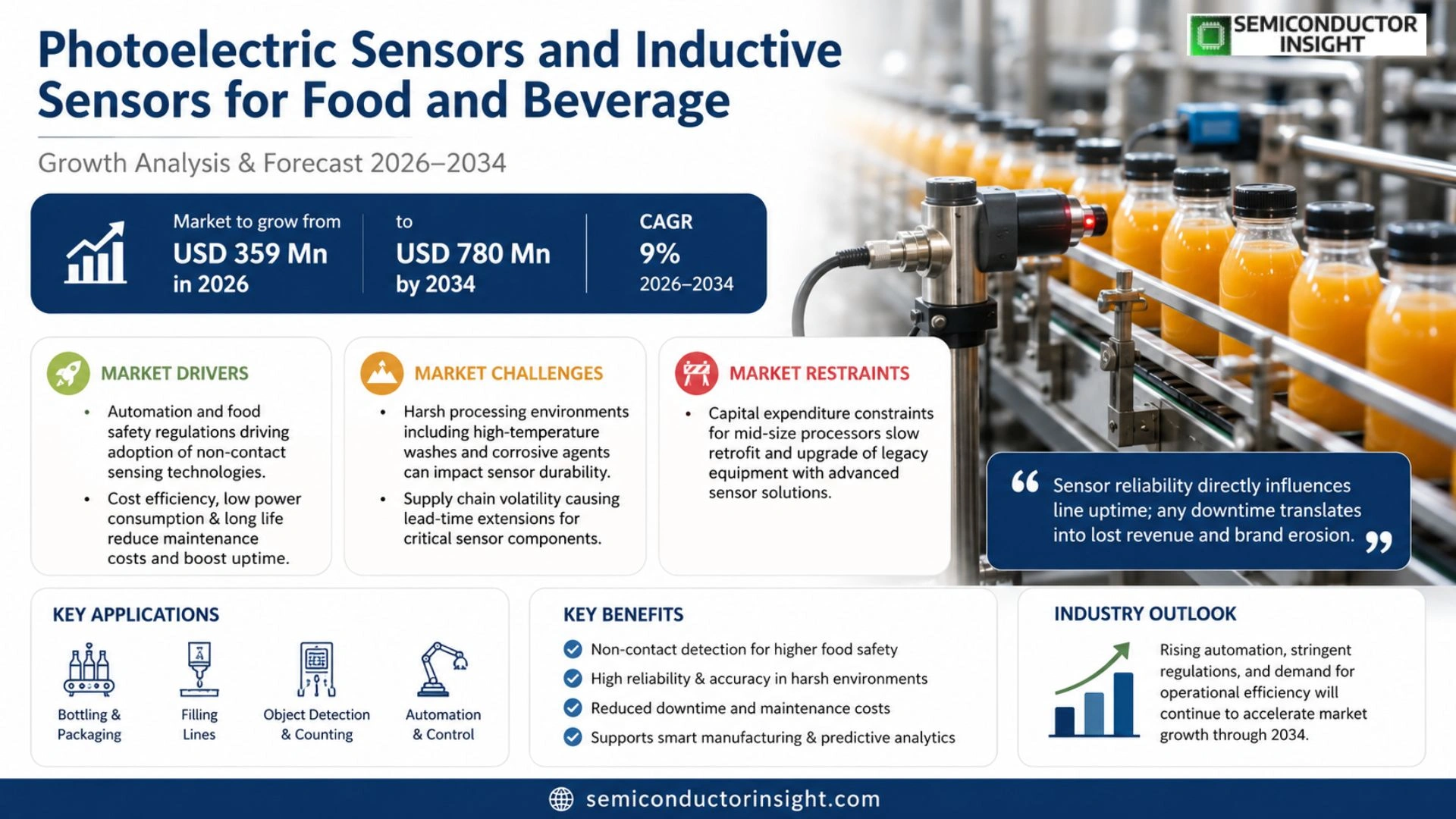
Photoelectric Sensors and Inductive Sensors for Food and Beverage market will rise from USD 359 million in 2026 to approximately USD 780 million by 2034, reflecting a compound annual growth rate of about 9 percent over the forecast horizon.
A photoelectric sensor, often called a photo‑eye, detects distance, absence or presence of an object by emitting light,typically infrared,and receiving its reflection or interruption. Three principal configurations exist: opposed (through‑beam), retro‑reflective, and diffuse‑type proximity sensing. An inductive sensor generates an electromagnetic field that senses ferrous metal targets without physical contact, making it suitable for harsh processing environments.
The upward trend stems from expanding automation across food‑processing lines, stricter hygiene standards that favor non‑contact detection methods, and cost efficiencies achieved through higher production volumes. Manufacturers such as Keyence, Omron, Sick, Pepperl + Fuchs and Ifm Electronic are actively broadening their portfolios to meet these industry requirements.
MARKET DRIVERS
Automation and Food Safety Regulations
The tightening of HACCP standards across major producing nations has compelled manufacturers to invest in non‑contact sensing technologies. Photoelectric Sensors and Inductive Sensors for Food and Beverage Market adoption is accelerating because these devices minimize contamination risk while delivering precise material handling.
Cost Efficiency in High‑Volume Lines
Modern production lines are benchmarked against unit‑cost targets that leave little margin for error. The low power consumption and long‑life expectancy of solid‑state sensors translate into measurable reductions in maintenance budgets, a factor that resonates strongly with capital‑intensive beverage processors.
➤ “Sensor reliability directly influences line uptime; any downtime translates into lost revenue and brand erosion.”
Consequently, equipment integrators are positioning Photoelectric Sensors and Inductive Sensors for Food and Beverage Market as core components of digital twins, enabling predictive analytics that further tighten cost controls.
MARKET CHALLENGES
Harsh Processing Environments
High‑temperature washes, corrosive cleaning agents, and abrasive product flows test the durability of sensor housings. Even with IP‑rated enclosures, misalignment or seal degradation can force unscheduled shutdowns, eroding confidence among end‑users.
Other Challenges
Supply Chain Volatility
Fluctuations in semiconductor fab capacity have introduced lead‑time extensions for critical sensor chips, pressuring OEMs to hold larger inventories or seek alternate component sources.
MARKET RESTRAINTS
Capital Expenditure Constraints
Mid‑size food processors often operate on thin margins, making it difficult to allocate funds for comprehensive sensor upgrades. The upfront cost of retrofitting legacy equipment with Photoelectric Sensors and Inductive Sensors for Food and Beverage Market solutions can outweigh perceived short‑term benefits, slowing broader diffusion.
MARKET OPPORTUNITIES
Smart Packaging Integration
Emerging trends in intelligent packaging demand real‑time monitoring of fill levels and seal integrity. Embedding miniature inductive and photoelectric sensors directly onto fill‑and‑seal machines offers a pathway for manufacturers to differentiate products through traceable quality metrics, opening a lucrative niche within Photoelectric Sensors and Inductive Sensors for Food and Beverage Market.
Photoelectric Sensors and Inductive Sensors for Food and Beverage Market Trends
Rising Adoption of Vision‑Based Automation in Food Production
Manufacturers are replacing mechanical limit switches with photoelectric sensors to meet hygiene standards and speed requirements in bottling, packaging and sorting lines. The infrared‑based eye allows non‑contact detection of product presence, minimizing contamination risk while delivering millisecond response times. In the United States, the shift is already evident as facilities upgrade legacy equipment to comply with stricter safety protocols. Asian processors, particularly in China, are expanding capacity and favouring diffused‑type sensors that tolerate dust and steam,conditions typical of high‑throughput ovens. The cumulative effect is a steady lift in sensor volume, which underpins the forecasted increase of Photoelectric Sensors and Inductive Sensors for Food and Beverage Market from $329 million in 2024 to $606 million by 2031.
Other Trends
Inductive Sensors Penetrate Metal‑Handling Lines
Inductive sensors are gaining traction on metal‑based conveyance systems where ferrous components such as cans, caps and metal frames must be tracked without wear. Their ability to detect metal through non‑magnetic coatings reduces the need for frequent calibration, a cost advantage that resonates with large‑scale breweries and dairy plants. As production lines shift toward higher speeds, the electromagnetic field generated by inductive devices offers a reliable signal even at 2 m/s belt speeds, supporting tighter line synchronization and lower reject rates.
Consolidation among Tier‑One Sensor Suppliers
The competitive landscape is coalescing around a core group of manufacturers,Keyence, Omron, Sick, Pepperl + Fuchs and Ifm Electronic,whose combined revenue share approaches 60 % of the sector. Recent strategic acquisitions have broadened their portfolio, blending photoelectric and inductive technologies into unified control modules. This concentration provides buyers with integrated solutions but also raises entry barriers for niche players. Companies that can demonstrate superior reliability in harsh food‑processing environments, such as resistance to cleaning‑in‑place chemicals, are likely to secure long‑term contracts and benefit from the market’s healthy growth trajectory.
COMPETITIVE LANDSCAPE
Key Industry Players
Competitive Landscape of Photoelectric and Inductive Sensors in Food & Beverage
The sensor segment for food and beverage processing is tightly led by a handful of multinational manufacturers. Keyence, Omron, Sick and Pepperl + Fuchs together control roughly four‑tenths of global revenue, a reflection of their deep R&D pipelines that cover opposed, retro‑reflective and diffused photoelectric designs as well as high‑precision inductive heads for ferrous detection. Their advantage stems from certifications that meet hygienic standards, extensive distributor networks across North America, Europe and Asia, and the ability to bundle hardware with analytics platforms that appeal to large‑scale processors seeking to reduce downtime. Because these firms can supply both standard and custom‑engineered solutions, mid‑size processors often gravitate toward them rather than assembling a disparate supply chain, reinforcing the concentration at the top of the market.
Beyond the dominant quartet, a diverse set of niche players sustains innovation in specialised applications. IFM Electronic, Turck and Baumer focus on modular inductive units that integrate seamlessly into bottling lines, while Autonics and Panasonic leverage cost‑effective diffused photoelectric sensors for low‑speed packaging equipment. European firms such as Schneider Electric and Balluff emphasize robust housings for harsh cleaning environments, whereas Asian entrants like Optex, TAKEX and Wenglor target rapid‑change production cells in China and India. These companies often excel in regional compliance, offering localized after‑sales support that larger players cannot match, thereby carving out profitable segments in a market that values both reliability and regulatory fit.
List of Key Photoelectric Sensors and Inductive Sensors for Food and Beverage Companies Profiled
- Keyence
- Omron
- Sick
- Pepperl + Fuchs
- IFM Electronic GmbH
- Turck
- Baumer
- Autonics
- Panasonic
- Rockwell Automation
- Balluff
- Optex
- TAKEX
- Wenglor
- Schneider Electric
Segment Analysis:
| Segment Category | Sub-Segments | Key Insights |
| By Type |
|
Photoelectric Sensors
Inductive Sensors
|
| By Application |
|
Filling Level Verification
Sanitary Sealing Verification
|
| By End User |
|
Dairy Processing
Beverage Bottling
|
| By Hygiene Requirements |
|
Sanitary‑Rated Sensors
|
| By Integration Complexity |
|
Smart‑Sensor Networking
|
Regional Analysis: Photoelectric Sensors and Inductive Sensors for Food and Beverage Market
The EU’s food‑safety directives compel processors to eliminate physical contact wherever feasible, prompting a surge in photonic sensor deployment. Concurrently, the Machinery Directive tightens requirements for electromagnetic compatibility, sharpening the appeal of inductive sensors that exhibit low interference profiles.
Northern Italy, Germany, and the Benelux corridor host dense clusters of sensor suppliers, creating a fertile environment for collaborative R&D and rapid prototyping that can be rapidly translated into production‑line upgrades.
Processors prioritize sensors that combine high detection accuracy with easy cleanability. This drives demand for sealed photoelectric heads and rugged inductive coils that can withstand CIP (clean‑in‑place) cycles without recalibration.
Recent geopolitical frictions have nudged European buyers toward local component sources, reducing lead times and insulating production lines from trans‑Atlantic disruptions.
North America
In North America, the market is shaped by large‑scale bottling operations that favour inductive sensors for metal detection in high‑speed lines. Food safety audits from agencies such as the FDA amplify the value of photoelectric sensors for detecting foreign objects on packaging surfaces. Vendors leverage extensive distribution networks to provide field‑service contracts, ensuring minimal downtime for critical production nodes.
Asia‑Pacific
Asia‑Pacific exhibits a paradox of rapid capacity expansion and fragmented technology adoption. While emerging economies invest heavily in new processing plants, many operators rely on legacy sensor sets. The compelling cost advantage of inductive devices for metal‑free sorting, however, is catalysing a gradual migration toward more sophisticated photoelectric systems as quality standards tighten across the region.
South America
South American processors contend with volatile commodity prices, prompting a focus on equipment that maximises yield. Photoelectric sensors that deliver precise level‑measurement enable tighter control of ingredient dosing, while inductive sensors are prized for their durability in high‑humidity environments common to the region’s tropical locales.
Middle East & Africa
In the Middle East & Africa, the sector’s growth is anchored by investments in ultra‑modern food‑processing hubs, especially in the Gulf Cooperation Council states. The arid climate elevates the importance of sensors with robust enclosure ratings, making sealed inductive designs a natural fit. Concurrently, premium‑segment manufacturers are introducing photoelectric solutions that support traceability mandates demanded by export markets.
Report Scope
This market research report provides a comprehensive analysis of the Photoelectric Sensors and Inductive Sensors for Food and Beverage Market , covering the forecast period 2026–2034. It offers detailed insights into market dynamics, technological advancements, competitive landscape, and key trends shaping the industry.
Key focus areas of the report include:
-
Market Overview: The report begins with an overview outlining its current market scenario, key growth indicators, and industry transformation drivers. It discusses macroeconomic factors, demand–supply balance, regulatory landscape, and the strategic role of semiconductors in powering advancements across industries such as automotive, telecommunications, consumer electronics, and industrial automation.
- Market Size & Forecast: Historical data and future projections for revenue, unit shipments, and market value across major regions and segments.
- Segmentation Analysis: Detailed breakdown by product type, technology, application, and end-user industry to identify high-growth segments and investment opportunities.
- Regional Insights: Insights into market performance across North America, Europe, Asia-Pacific, Latin America, and the Middle East & Africa, including country-level analysis where relevant.
- Competitive Landscape: Profiles of leading market participants, including their product offerings, R&D focus, manufacturing capacity, pricing strategies, and recent developments such as mergers, acquisitions, and partnerships.
- Technology Trends & Innovation: Assessment of emerging technologies, integration of AI/IoT, semiconductor design trends, fabrication techniques, and evolving industry standards.
- Market Drivers & Restraints: Evaluation of factors driving market growth along with challenges, supply chain constraints, regulatory issues, and market-entry barriers.
- Stakeholder Insights: Insights for component suppliers, OEMs, system integrators, investors, and policymakers regarding the evolving ecosystem and strategic opportunities.
Primary and secondary research methods are employed, including interviews with industry experts, data from verified sources, and real-time market intelligence to ensure the accuracy and reliability of the insights presented.
FREQUENTLY ASKED QUESTIONS:
What is the current market size of Photoelectric Sensors and Inductive Sensors for Food and Beverage Market?
-> Photoelectric Sensors and Inductive Sensors for Food and Beverage market will rise from USD 359 million in 2026 to approximately USD 780 million by 2034
Which key companies operate in Photoelectric Sensors and Inductive Sensors for Food and Beverage Market?
-> Key players include Keyence, Omron, Sick, Pepperl + Fuchs, Ifm Electronic GmbH, Turck Banner, Baumer, Autonics, Panasonic, Rockwell Automation, among others.
What are the key growth drivers?
-> Key growth drivers include rising automation in food and beverage processing, increasing demand for hygienic and non‑contact sensing solutions, safety compliance requirements, and the push for energy‑efficient production lines.
Which region dominates the market?
-> Asia-Pacific leads the market, driven by rapid industrial expansion and high adoption rates in China and Japan, while North America and Europe also show strong growth.
What are the emerging trends?
-> Emerging trends include integration of IoT and AI for predictive maintenance, development of smart sensors with real‑time data analytics, miniaturization for compact equipment, and enhanced durability for harsh food‑processing environments.
Get Sample Report PDF for Exclusive Insights
Report Sample Includes
- Table of Contents
- List of Tables & Figures
- Charts, Research Methodology, and more...
 Download Sample Report PDF