Phone Camera Sensor Market Insights
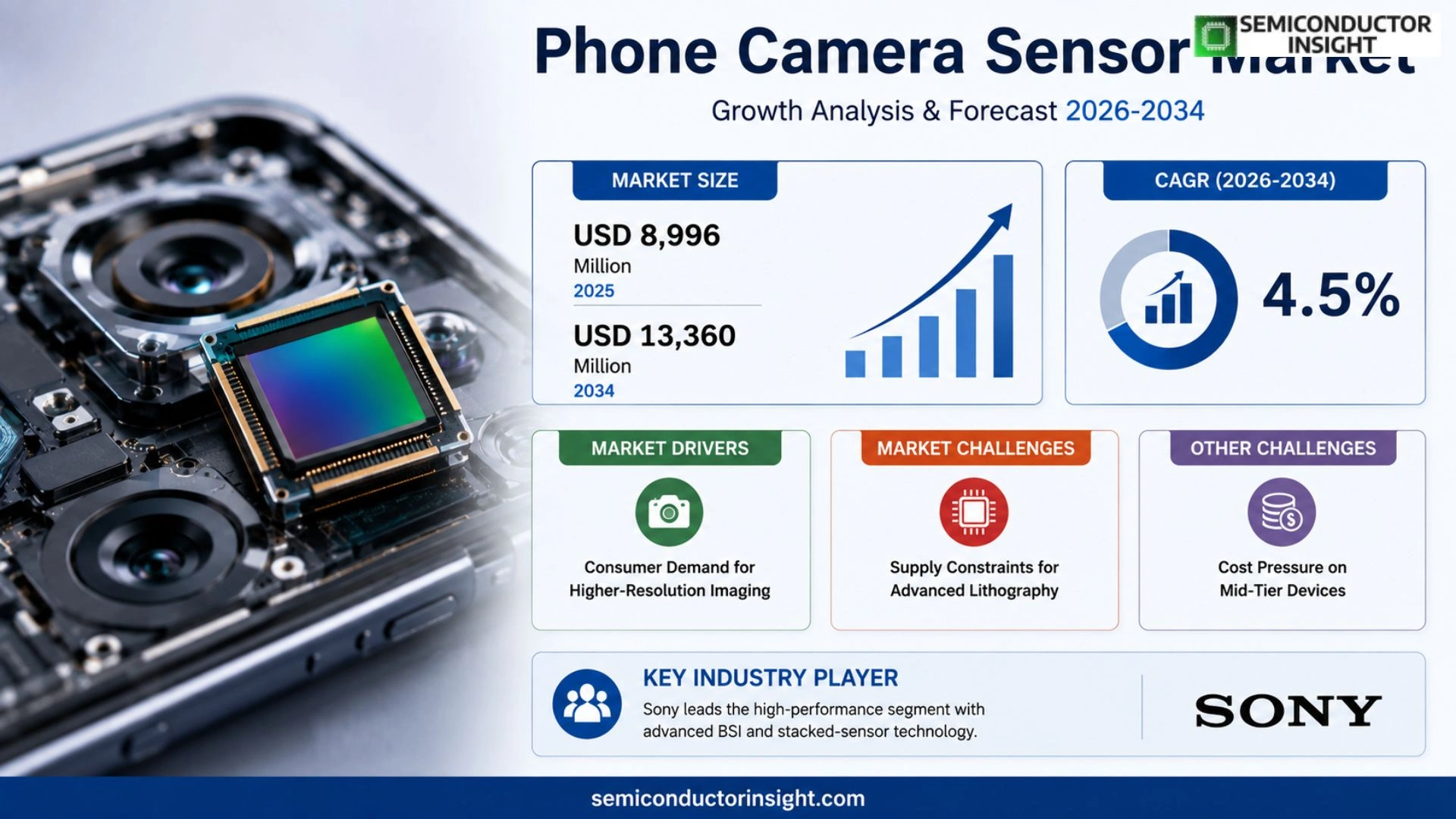
Phone Camera Sensor market was valued at USD 8,996 million in 2025 and is expected to increase to approximately USD 13,360 million by 2034, reflecting an implied compound annual growth rate of about 4½ percent over the period.
A mobile phone camera sensor-typically a CMOS image sensor (CIS)-converts optical signals formed by the lens into electrical charges at each pixel array before delivering digital image data through read‑out circuits and analog‑to‑digital conversion.
Because smartphones operate under severe space, power‑consumption and thermal‑dissipation constraints, sensor development emphasizes low noise, high dynamic range and rapid autofocus.
The technology path progressed from early low‑resolution CCDs to back‑side illuminated CMOS devices and now stacked architectures that separate pixel layers from logic layers, boosting readout speed and enabling on‑chip AI functions. This core component supports QR scanning, facial recognition, augmented reality and computational photography workflows.
MARKET DRIVERS
Consumer Demand for Higher‑Resolution Imaging
In the past twelve months, flagship smartphones have pushed pixel counts beyond 108 MP, compelling component manufacturers to invest in larger, more light‑sensitive chips. This shift reflects users’ willingness to pay a premium for clearer low‑light photos, a trend that directly inflates the Phone Camera Sensor Market’s top‑line.
Integration of AI‑Assisted Features
Machine‑learning pipelines now rely on on‑sensor data preprocessing to reduce latency for portrait‑mode and night‑vision functions. Vendors that embed AI‑optimised circuitry inside the sensor gain a competitive edge, prompting OEMs to source next‑gen parts at a faster cadence.
➤ Manufacturers that align sensor design with AI workloads are seeing contract values rise 15 % year‑over‑year.
These dynamics collectively amplify capital allocation across the supply chain, ensuring that the Phone Camera Sensor Market retains a growth trajectory that outpaces the broader semiconductor segment.
MARKET CHALLENGES
Supply Constraints for Advanced Lithography
Advanced CMOS processes, especially those below 10 nm, remain bottlenecked by limited fab capacity in East Asia. When foundries prioritize high‑margin GPU wafers, sensor orders experience lead‑time extensions that can erode OEM launch windows and pressure the Phone Camera Sensor Market’s delivery schedule.
Other Challenges
Cost Pressure on Mid‑Tier Devices
Mid‑range smartphones represent a 45 % share of shipments, yet their pricing elasticity forces sensor makers to compress margins, often resulting in thinner profit buffers for incremental R&D.
MARKET RESTRAINTS
Regulatory Scrutiny Over Data Capture
Privacy legislations in Europe and North America increasingly flag high‑resolution imaging as a potential vector for biometric misuse. Compliance audits force sensor suppliers to embed encryption modules, adding bill‑of‑materials cost and lengthening design cycles.
Furthermore, tariff measures imposed by several regions raise import costs for sensor modules, narrowing the price advantage for OEMs seeking cost‑effective sourcing.
These factors collectively temper the upside potential of the Phone Camera Sensor Market, urging participants to diversify geographic exposure and mitigate policy‑related risk.
MARKET OPPORTUNITIES
Emergence of Foldable Form‑Factors
Foldable smartphones demand ultra‑thin, flexible sensors that can survive repeated bending without performance loss. Early adopters of organic‑photodiode technology are positioning themselves to capture a segment projected to account for 8 % of total handset sales within five years, creating a lucrative niche for innovative sensor designs.
Beyond mobile, automotive infotainment systems are integrating high‑definition rear‑camera modules for driver‑assist functions. Sensor providers that qualify for automotive‑grade reliability can tap an ancillary revenue stream that complements traditional handset sales.
Finally, the burgeoning aftermarket of clip‑on lenses and modular camera upgrades for smartphones opens a direct‑to‑consumer channel, allowing sensor manufacturers to monetize premium optics without relying solely on OEM contracts.
Phone Camera Sensor Market Trends
System‑Level Integration Elevates Imaging
The Phone Camera Sensor Market is moving beyond pixel count alone. Flagship smartphones now treat the sensor as a nexus that intertwines optics, on‑chip stabilization, ISP tuning, and on‑device AI. This convergence raises the bar for low‑light capture, portrait realism, and video smoothness, because each element is calibrated against a shared performance target. Manufacturers that can deliver a tightly co‑designed stack-from silicon wafer to lens coating-gain a measurable edge in user perception, especially as social‑media platforms reward consistent color fidelity and fast autofocus. The shift also pressures suppliers to tighten yield control and packaging precision, since marginal defects translate directly into visual artifacts that tarnish brand reputation.
Other Trends
Pixel Architecture Evolution
Early generations relied on front‑illuminated CMOS designs; today’s sensors increasingly adopt back‑side illumination and stacked architectures. The latter separates the photodiode layer from the logic tier, enabling readout speeds that cut rolling‑shutter distortion and permit on‑chip multi‑frame fusion. While the headline numbers still reference megapixels, the real value comes from enlarging full‑well capacity and improving quantum efficiency. Manufacturers that invest in wafer‑level stacking can introduce new output modes-such as high‑frame‑rate HDR streams-without inflating the sensor footprint, a critical consideration for ultra‑thin devices. This architectural shift also opens opportunities for integrated functions like on‑sensor AI inference, which offloads basic scene classification from the main processor, thereby extending battery life during prolonged video recording.
Supply‑Chain Resilience Shapes Outlook
Capacity constraints at the foundry level and the specialized nature of packaging materials have created a de‑facto multi‑sourcing strategy among the leading players. Companies that diversify wafer suppliers while securing long‑term contracts for specialty gases and microlens components are better positioned to meet the 3.5 billion‑unit production volume forecast for 2025. At the same time, tighter tolerances in module assembly are becoming a competitive differentiator; consistent calibration across millions of units reduces variance in color rendering and autofocus speed. As consumer expectations gravitate toward reliable “point‑and‑shoot” experiences rather than raw specifications, firms that synchronize their supply chain with system‑level design priorities will capture the most sustainable upside in the Phone Camera Sensor Market.
COMPETITIVE LANDSCAPE
Key Industry Players
Phone Camera Sensor Market – Competitive Overview
Sony continues to dominate the high‑performance segment, leveraging its early adoption of back‑side illumination (BSI) and stacked‑sensor architecture to secure a sizable share of flagship‑grade orders. The company’s deep vertical integration-from silicon wafer processing to advanced packaging-allows it to sustain thin‑form‑factor designs while delivering low‑noise, high‑dynamic‑range output that premium smartphone OEMs prize. Because flagship devices increasingly treat imaging as a brand differentiator, Sony’s ability to match rapid read‑out speeds with on‑chip AI accelerators translates into pricing power and stable margins, reinforcing a market structure where a handful of integrated device manufacturers (IDMs) command the upper tier and set technology roadmaps for downstream assemblers.
Beyond Sony, the landscape features a blend of seasoned IDMs and agile fabless firms that together address mid‑range and emerging‑market demand. Samsung Electronics supplies a broad spectrum of CMOS sensors, emphasizing volume efficiency and incremental pixel‑size improvements. OmniVision and GalaxyCore focus on cost‑effective BSI and hybrid‑stacked designs, making them attractive partners for Asian OEMs targeting aggressive price points. SmartSens and Himax specialize in ultra‑compact modules that integrate lens and sensor, catering to foldable‑phone projects. Sharp and Panasonic maintain niche relevance through high‑resolution sensors for niche photography phones, while ON Semiconductor and STMicroelectronics provide sensor‑compatible driver ICs that broaden ecosystem compatibility. Chinese entrants such as TCL, Zhongtian, and SmartSens‑affiliated factories increase supply resilience by offering multi‑source options for OEMs wary of single‑supplier risk. These players often collaborate with OSATs to accelerate packaging innovations, ensuring that thin‑module constraints do not impede performance progression.
List of Key Phone Camera Sensor Companies Profiled
- Sony Corporation
- Samsung Electronics
- OmniVision Technologies
- GalaxyCore Inc.
- Himax Technologies
- SmartSens Technology Co., Ltd.
- Sharp Corporation
- ON Semiconductor
- STMicroelectronics
- Panasonic Corporation
- TCL Communication Technology Holdings Ltd.
- Zhongtian Semiconductor Co., Ltd.
- Apple Inc. (sensor design collaborations)
- Qualcomm Technologies, Inc. (sensor‑ISP integration)
- Google LLC (custom sensor projects)
Segment Analysis:
| Segment Category | Sub-Segments | Key Insights |
| By Type |
|
CMOS Sensor remains the foundational technology, valued for its low power draw and integration ease. ‑ It provides a reliable baseline for cost‑sensitive devices while supporting incremental enhancements in noise performance. ‑ Manufacturers focus on process refinements that improve light efficiency without inflating cost. ‑ The evolution toward BSI and stacked variants builds on this base, preserving core advantages while adding speed and dynamic range. |
| By Application |
|
Main Camera commands the highest attention of system designers, driving co‑optimization of sensor, lens, and image‑signal‑processor. ‑ It sets the visual tone for flagship experiences through superior low‑light handling and color fidelity. ‑ Ultra‑wide and telephoto modules diversify creative possibilities, emphasizing consistent rendering across focal lengths. ‑ Front cameras prioritize smooth video and realistic skin tones, reflecting the rise of personal content creation. |
| By End User |
|
Flagship Smartphone Brands treat the sensor as a differentiator, integrating advanced stacked designs and aggressive pixel‑level tuning. ‑ Their emphasis lies on delivering cinema‑grade video, accurate portrait bokeh, and reliable performance across challenging lighting. ‑ Mid‑range players balance capability with cost, leveraging mature CMOS platforms and computational tricks such as multi‑frame fusion. ‑ Entry‑level devices focus on robustness and energy efficiency, accepting modest imaging goals to preserve battery life. |
| By Technology Integration |
|
Sensor‑Lens Co‑design is emerging as a decisive factor, aligning pixel geometry with lens aperture to maximize light capture. ‑ On‑chip AI acceleration enables real‑time HDR merging, scene detection, and dynamic focus adjustments, reducing reliance on post‑processing. ‑ Advanced packaging such as chip‑on‑wafer and thin‑form‑factor modules supports slimmer device profiles while preserving performance. |
| By Market Focus |
|
Performance‑Driven Segments prioritize sensor speed, dynamic range, and low‑light consistency, influencing the adoption of stacked architectures. ‑ Cost‑Efficiency Segments emphasize stable yields, standardized designs, and supply‑chain resilience to keep unit costs predictable. ‑ Creator‑Centric Segments focus on high frame‑rate video, real‑time effects, and seamless integration with on‑device editing tools, shaping sensor‑ISP co‑evolution. |
Regional Analysis: Phone Camera Sensor Market
Asia‑Pacific
Proximity of wafer‑fab facilities to sensor assembly plants curtails transit time and reduces exposure to logistics bottlenecks, allowing manufacturers to respond swiftly to shifts in OEM demand and maintain tight inventory turns.
A dense network of research institutes and university labs fuels continuous refinement of pixel architecture, delivering incremental gains in low‑light sensitivity that OEMs translate into consumer‑facing camera upgrades.
Local governments often pair tax relief with technology‑transfer requirements, nudging multinational players toward joint ventures that embed advanced sensor capabilities within regional product line‑ups.
Mobile users in the region exhibit a strong preference for devices that excel in night‑mode photography, prompting OEMs to prioritize sensor modules that balance pixel size with power efficiency.
North America
In North America, the emphasis lies less on volume manufacturing and more on integration of sensor technology into premium flagship devices. American OEMs, supported by a mature ecosystem of software developers, leverage sophisticated AI pipelines that extract maximum detail from each frame. This drives sensor suppliers to prioritize high‑speed data transfer and on‑chip image‑signal processing, features that enable real‑time enhancements such as portrait mode blurring and HDR reconstruction. Market entrants that can deliver a seamless hardware‑software interface gain a competitive edge, compelling established players to lock in long‑term contracts with sensor manufacturers that promise rapid iteration cycles.
Europe
European markets are characterized by stringent privacy regulations and a consumer base that values sustainability. Sensor makers therefore focus on low‑power architectures and transparent data‑handling practices to align with regional expectations. Moreover, a cluster of automotive and industrial users repurposes phone‑grade sensors for machine‑vision tasks, creating a crossover niche that blends mobile imaging expertise with industrial reliability standards. Companies that can navigate regulatory compliance while offering modular sensor platforms stand to capture a portion of this diversified demand.
South America
South American adoption of advanced camera sensors is propelled by a growing middle class that seeks premium mobile experiences without premium price tags. Local distributors favor suppliers that can deliver cost‑effective modules with sufficient dynamic range for outdoor photography, a common use case given the region’s vibrant street culture. Partnerships that include localized assembly help mitigate tariff impacts, encouraging global vendors to establish regional footholds that balance price sensitivity with feature richness.
Middle East & Africa
In the Middle East and Africa, the market is shaped by a blend of high‑spending urban consumers and emerging economies where price pressure remains acute. Sensor providers that can offer scalable solutions-ranging from compact, low‑cost units for entry‑level devices to high‑resolution arrays for flagship models-address the divergent needs across the region. Additionally, the rise of social‑media influencers has heightened demand for devices capable of delivering vivid, share‑ready imagery, prompting OEMs to prioritize sensors with superior color accuracy and fast autofocus, thereby influencing supply decisions.
Report Scope
This market research report provides a comprehensive analysis of the Phone Camera Sensor Market , covering the forecast period 2026–2034. It offers detailed insights into market dynamics, technological advancements, competitive landscape, and key trends shaping the industry.
Key focus areas of the report include:
- Market Overview: The report begins with an overview outlining its current market scenario, key growth indicators, and industry transformation drivers. It discusses macroeconomic factors, demand–supply balance, regulatory landscape, and the strategic role of semiconductors in powering advancements across industries such as automotive, telecommunications, consumer electronics, and industrial automation.
- Market Size & Forecast: Historical data and future projections for revenue, unit shipments, and market value across major regions and segments.
- Segmentation Analysis: Detailed breakdown by product type, technology, application, and end-user industry to identify high-growth segments and investment opportunities.
- Regional Insights: Insights into market performance across North America, Europe, Asia-Pacific, Latin America, and the Middle East & Africa, including country-level analysis where relevant.
- Competitive Landscape: Profiles of leading market participants, including their product offerings, R&D focus, manufacturing capacity, pricing strategies, and recent developments such as mergers, acquisitions, and partnerships.
- Technology Trends & Innovation: Assessment of emerging technologies, integration of AI/IoT, semiconductor design trends, fabrication techniques, and evolving industry standards.
- Market Drivers & Restraints: Evaluation of factors driving market growth along with challenges, supply chain constraints, regulatory issues, and market-entry barriers.
- Stakeholder Insights: Insights for component suppliers, OEMs, system integrators, investors, and policymakers regarding the evolving ecosystem and strategic opportunities.
Primary and secondary research methods are employed, including interviews with industry experts, data from verified sources, and real-time market intelligence to ensure the accuracy and reliability of the insights presented.
FREQUENTLY ASKED QUESTIONS:
What is the current market size of Phone Camera Sensor Market?
-> Global Phone Camera Sensor market was valued at USD 8,996 million in 2025 and is projected to reach USD 13,822 million by 2032, at a CAGR of 4.5% during the forecast period.
Which key companies operate in Phone Camera Sensor Market?
-> Key players include Sony, Samsung, OmniVision, GalaxyCore, SmartSens, Himax, among others.
What are the key growth drivers?
-> Key growth drivers include rising user expectations for high‑quality point‑and‑shoot results, the surge of short‑form video and social media content, demand for advanced computational photography, and continuous process innovations such as back‑side illumination, stacking and advanced packaging.
Which region dominates the market?
-> Asia‑Pacific dominates the Phone Camera Sensor market, driven by the concentration of leading smartphone manufacturers and high consumer demand.
What are the emerging trends?
-> Emerging trends include stacked sensor architectures, AI‑assisted image processing, video‑centric features such as high frame‑rate capture and real‑time HDR, and platform‑level calibration and cross‑camera color matching.

Get Sample Report PDF for Exclusive Insights
Report Sample Includes
- Table of Contents
- List of Tables & Figures
- Charts, Research Methodology, and more...