Phase Shifter (Analog, Digital) for Phased Arrays Market Insights
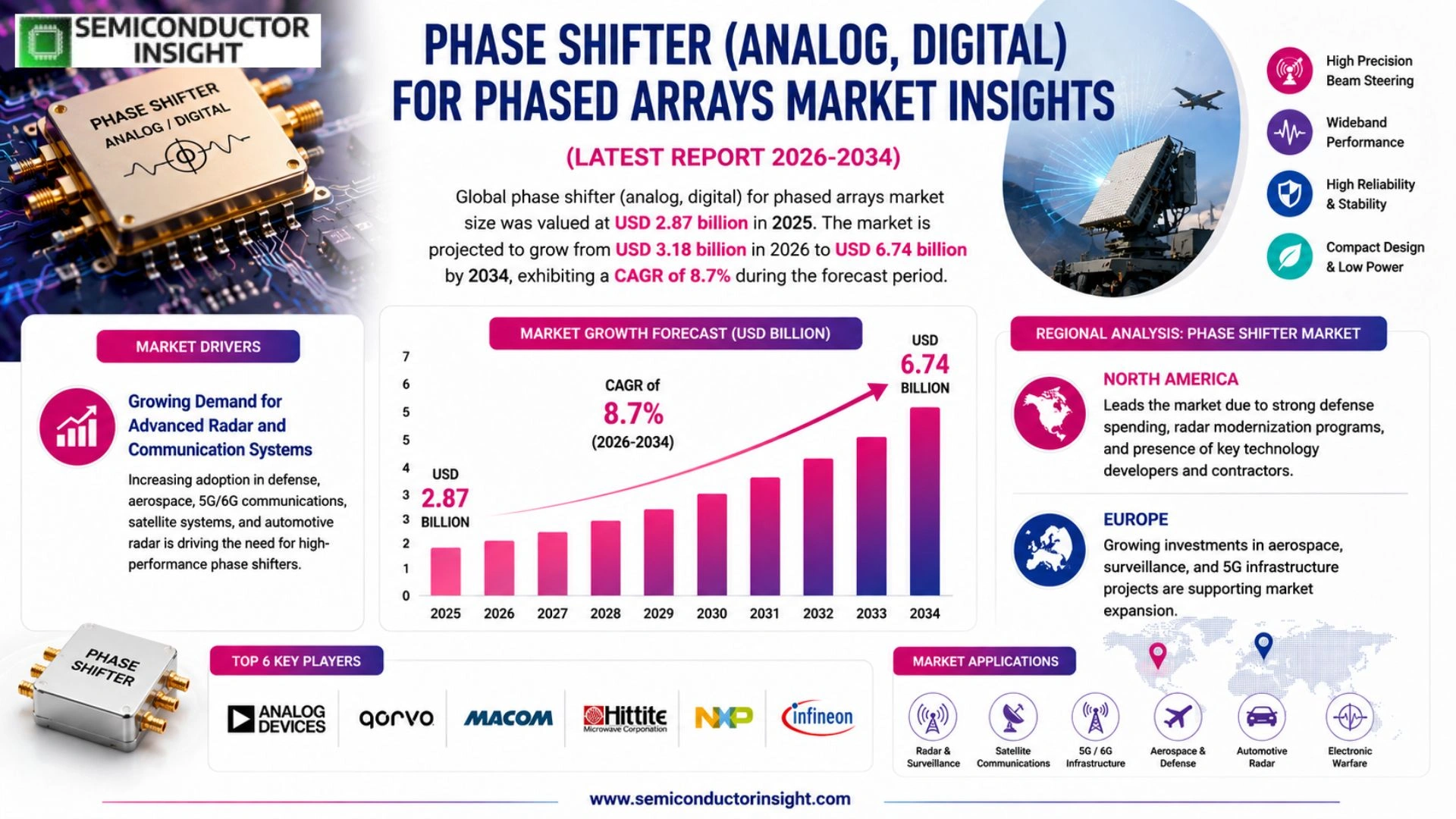
Global Phase Shifter (Analog, Digital) for Phased Arrays Market size was valued at USD 2.87 billion in 2025. The market is projected to grow from USD 3.18 billion in 2026 to USD 6.74 billion by 2034, exhibiting a CAGR of 8.7% during the forecast period.
Phase shifters are critical electronic components used in phased array antenna systems to control the direction of a beam by altering the phase of the signal passing through each antenna element. These devices are broadly categorized into analog phase shifters, which offer continuous phase variation, and digital phase shifters, which provide discrete phase states with high repeatability and integration capability. Both types are integral to applications spanning defense radar systems, 5G telecommunications, satellite communications, and electronic warfare platforms.
The market is witnessing robust growth driven by accelerating deployment of 5G infrastructure, expanding defense modernization programs, and rising adoption of active electronically scanned array (AESA) radar systems worldwide. Furthermore, growing investments in Low Earth Orbit (LEO) satellite constellations , including programs by SpaceX, OneWeb, and Amazon’s Project Kuiper , are significantly amplifying demand for high-performance phase shifters. Key industry participants such as Analog Devices, Inc., Qorvo, Inc., and MACOM Technology Solutions maintain strong market presence with diversified product portfolios spanning both analog and digital phase shifter technologies.
MARKET DRIVERS
Surging Defense Modernization Programs Accelerating Demand for Phased Array Systems
The global defense sector’s accelerating investment in next-generation radar and electronic warfare systems has emerged as a pivotal growth catalyst for Phase Shifter (Analog, Digital) for Phased Arrays Market. Governments across North America, Europe, and the Asia-Pacific region are allocating substantial budgets toward modernizing aging radar infrastructure, driving procurement of advanced phased array antennas that rely critically on high-performance phase shifter components. Both analog phase shifters and digital phase shifters are integral to achieving precise beam steering, electronic scanning, and signal control in modern active electronically scanned array (AESA) radar platforms.
5G Rollout and Commercial Wireless Infrastructure Expansion Driving Phase Shifter Adoption
The rapid global deployment of 5G networks has created substantial commercial demand for phased array antennas equipped with analog and digital phase shifters. Massive MIMO base stations and millimeter-wave 5G small cells depend on phased array architectures to deliver high-throughput, low-latency connectivity. As telecom operators worldwide accelerate infrastructure buildout, the requirement for cost-effective, highly integrated phase shifter solutions , spanning both analog and digital variants , has intensified considerably. This commercial wave complements the defense sector’s demand, broadening the total addressable market for phase shifter manufacturers and semiconductor foundries alike.
➤ The convergence of defense AESA radar modernization and commercial 5G mmWave deployments is establishing a dual demand engine for Phase Shifter (Analog, Digital) for Phased Arrays Market, with satellite communications and autonomous vehicle radar further expanding the application landscape.
Beyond defense and 5G, the proliferating adoption of phased array systems in low Earth orbit (LEO) satellite constellations and emerging automotive radar applications is reinforcing market growth. LEO satellite operators require compact, electronically steerable antennas for ground terminals and space-borne payloads, where analog and digital phase shifters enable the beam agility essential for maintaining connectivity with fast-moving satellites. This multi-vertical demand profile is strengthening the commercial viability and investment attractiveness of the phase shifter for phased arrays ecosystem.
MARKET CHALLENGES
Technical Complexity and Integration Challenges in High-Frequency Phase Shifter Design
One of the most significant challenges confronting Phase Shifter (Analog, Digital) for Phased Arrays Market is the inherent design complexity associated with achieving low insertion loss, wide bandwidth, and high phase accuracy simultaneously , particularly at millimeter-wave frequencies. As phased arrays are increasingly deployed in the 24 GHz to 100 GHz range for 5G and radar applications, both analog phase shifters based on PIN diodes or MEMS and digital phase shifters built on GaAs or GaN semiconductor processes face stringent performance trade-offs. Maintaining phase linearity, minimizing amplitude imbalance, and managing thermal dissipation across large array elements remain formidable engineering hurdles that can extend product development cycles and increase manufacturing costs.
Other Challenges
Supply Chain Vulnerabilities and Semiconductor Sourcing Constraints
The phase shifter supply chain is heavily dependent on specialized compound semiconductor materials, including gallium arsenide (GaAs), gallium nitride (GaN), and silicon germanium (SiGe). Geopolitical tensions, export controls, and the limited number of qualified foundries capable of producing high-frequency monolithic microwave integrated circuits (MMICs) create sourcing risks that can disrupt production timelines for phased array system integrators. These constraints are particularly acute for defense-grade digital phase shifters requiring radiation-hardened or military-specification components.
High Development and Qualification Costs
The extensive testing, validation, and regulatory qualification processes required for phase shifter components used in aerospace, defense, and satellite communication applications represent a significant cost barrier. Compliance with military standards and export regulations such as ITAR further complicates market entry for new participants in the analog and digital phase shifter for phased arrays space, consolidating competitive advantage among established defense electronics incumbents.
MARKET RESTRAINTS
High Unit Costs and Power Consumption Limiting Widespread Commercial Adoption
Despite robust demand signals, Phase Shifter (Analog, Digital) for Phased Arrays Market faces a notable restraint in the form of elevated component costs associated with high-frequency MMIC-based phase shifters. The fabrication of precision analog and digital phase shifters using advanced compound semiconductor processes remains expensive relative to conventional silicon-based RF components, constraining adoption in cost-sensitive commercial segments such as consumer wireless equipment and entry-level satellite terminals. While silicon-on-insulator (SOI) and CMOS-based phase shifter solutions are emerging to address cost pressures at lower frequency bands, performance parity with GaAs and GaN counterparts at millimeter-wave frequencies has not yet been fully achieved.
Power Dissipation Constraints in Large-Scale Phased Array Deployments
Large phased array systems incorporating hundreds or thousands of antenna elements require an equivalent number of phase shifter units, creating substantial aggregate power consumption that poses thermal management and system efficiency challenges. For battery-operated or size, weight, and power (SWaP)-constrained platforms such as unmanned aerial vehicles and portable ground terminals, the cumulative power draw of analog and digital phase shifters across a full array can restrict operational endurance and system miniaturization. This restraint is actively driving R&D investment toward lower-power phase shifter architectures, but commercially mature low-power solutions remain limited in availability, moderating near-term market expansion in SWaP-sensitive applications.
MARKET OPPORTUNITIES
Expanding LEO Satellite Constellation Programs Creating Sustained Demand for Phased Array Phase Shifters
The rapid proliferation of LEO broadband satellite constellations represents a transformative growth opportunity for Phase Shifter (Analog, Digital) for Phased Arrays Market. Operators deploying large-scale satellite internet networks require electronically steerable user terminals and gateway antennas capable of continuously tracking fast-moving satellites, making high-performance analog and digital phase shifters indispensable. The scale of planned LEO deployments , involving thousands of satellites and millions of ground terminals globally , is expected to generate sustained, high-volume demand for cost-optimized phase shifter solutions, incentivizing semiconductor manufacturers to invest in scalable production processes and integrated beamforming chipsets.
Automotive Radar and Advanced Driver Assistance Systems Emerging as a High-Growth Vertical
The automotive industry’s transition toward higher levels of vehicle autonomy is creating a nascent but rapidly expanding application vertical for phased array radar systems and, by extension, analog and digital phase shifters. Advanced driver assistance systems (ADAS) and autonomous vehicle platforms increasingly rely on high-resolution radar sensors operating in the 77 GHz and 79 GHz bands, where electronically steerable phased arrays offer superior object detection, angular resolution, and response speed compared to mechanically scanned alternatives. As automotive OEMs and Tier-1 suppliers scale production of radar-equipped vehicles, the demand for compact, low-cost, automotive-grade phase shifter components is poised to grow substantially, offering phase shifter manufacturers a significant diversification opportunity beyond traditional defense and telecommunications markets.
Integration of AI-Driven Beamforming Unlocking Advanced Capabilities for Digital Phase Shifter Platforms
The convergence of artificial intelligence and machine learning with phased array signal processing is opening new avenues for digital phase shifters capable of adaptive, intelligent beam management. AI-driven beamforming algorithms can dynamically optimize phase shifter settings across large arrays in real time, enhancing spectral efficiency, interference mitigation, and multi-target tracking performance. This capability is particularly relevant for next-generation radar, electronic warfare, and 5G advanced applications. Semiconductor and system-level companies that can deliver tightly integrated digital phase shifter solutions with embedded processing capabilities are well-positioned to capture premium market segments and establish differentiated competitive positions within the broader Phase Shifter (Analog, Digital) for Phased Arrays Market.
Trends
Rising Adoption of Active Electronically Scanned Array (AESA) Radar Systems Driving Market Momentum
Phase Shifter (Analog, Digital) for Phased Arrays Market is experiencing significant momentum driven by the accelerating global deployment of active electronically scanned array (AESA) radar systems. Defense agencies across North America, Europe, and Asia-Pacific are modernizing their radar infrastructure, creating sustained demand for both analog and digital phase shifters. These components are fundamental to AESA systems, enabling precise electronic beam steering without mechanical movement, which translates to enhanced target tracking, reduced radar cross-section, and improved battlefield reliability. Defense modernization programs in countries such as the United States, India, South Korea, and several European nations continue to prioritize AESA integration across airborne, naval, and ground-based platforms, reinforcing the strategic importance of high-performance phase shifter solutions.
Other Trends
Expansion of 5G Infrastructure Amplifying Demand for Digital Phase Shifters
The global rollout of 5G telecommunications infrastructure represents one of the most influential demand drivers for digital phase shifters used in phased array antenna systems. Massive MIMO (Multiple Input Multiple Output) base stations and millimeter-wave 5G deployments rely heavily on phased array technology to achieve the required beamforming precision and spectral efficiency. Digital phase shifters, valued for their high repeatability and seamless integration with digital signal processing architectures, are increasingly preferred by telecommunications equipment manufacturers. As mobile network operators worldwide accelerate their 5G densification strategies, the volume requirements for compact, power-efficient digital phase shifter components continue to rise substantially.
Low Earth Orbit Satellite Constellation Programs Fueling Phase Shifter Innovation
Growing investments in Low Earth Orbit (LEO) satellite constellations are emerging as a pivotal trend reshaping Phase Shifter (Analog, Digital) for Phased Arrays Market. Programs championed by organizations such as SpaceX, OneWeb, and Amazon’s Project Kuiper require advanced phased array terminals capable of dynamically tracking fast-moving satellites. Both analog and digital phase shifters play a critical role in enabling the high-speed beam steering required for uninterrupted connectivity in these systems. This trend is encouraging manufacturers to develop phase shifters with broader bandwidth, lower insertion loss, and compact form factors compatible with consumer and enterprise satellite terminals.
Technological Advancements by Leading Market Participants Shaping Competitive Landscape
Key industry participants including Analog Devices, Inc., Qorvo, Inc., and MACOM Technology Solutions are actively advancing their phase shifter product portfolios to address the evolving requirements of defense, telecommunications, and satellite communication applications. Ongoing research and development efforts are focused on improving phase accuracy, expanding operational frequency ranges into millimeter-wave bands, and enhancing monolithic microwave integrated circuit (MMIC) integration. These technological advancements are not only improving system-level performance but are also enabling cost reductions through higher levels of integration, making advanced phase shifter solutions accessible across a broader range of end-use applications within the phased arrays ecosystem.
COMPETITIVE LANDSCAPE
Key Industry Players
Phase Shifter (Analog, Digital) for Phased Arrays Market: Competitive Dynamics and Leading Manufacturers
Global Phase Shifter (Analog, Digital) for Phased Arrays Market is characterized by a moderately consolidated competitive landscape, with a handful of technologically advanced semiconductor and RF component manufacturers commanding significant market share. Analog Devices, Inc., Qorvo, Inc., and MACOM Technology Solutions emerge as dominant players, each maintaining diversified product portfolios spanning both analog and digital phase shifter technologies. These leaders leverage deep R&D capabilities, established supply chain networks, and longstanding relationships with defense primes and telecommunications OEMs to reinforce their competitive positioning. The accelerating rollout of 5G infrastructure, coupled with expanding defense modernization programs and growing demand for active electronically scanned array (AESA) radar systems, continues to intensify competition among established players while simultaneously attracting new entrants with innovative GaAs, GaN, and silicon-based phase shifter solutions.
Beyond the top-tier suppliers, several niche and specialized players contribute significantly to the competitive ecosystem. Companies such as Renesas Electronics, Smiths Interconnect, and APITech cater to mission-critical defense and aerospace applications, offering ruggedized and high-reliability phase shifter solutions. Meanwhile, semiconductor firms including Skyworks Solutions and Broadcom Inc. address the high-volume commercial 5G and satellite communications segments with cost-optimized, highly integrated phase shifter ICs. The competitive intensity is further heightened by strategic investments from firms such as Northrop Grumman and Raytheon Technologies, which develop proprietary phase shifter technologies in-house for integration into advanced radar and electronic warfare platforms. As demand from Low Earth Orbit (LEO) satellite constellation programs , including those by SpaceX, OneWeb, and Amazon’s Project Kuiper , continues to scale, competition for design wins in the phased array front-end market is expected to remain fierce through the forecast period.
List of Key Phase Shifter (Analog, Digital) for Phased Arrays Companies Profiled
- Analog Devices, Inc.
- Qorvo, Inc.
- MACOM Technology Solutions
- Skyworks Solutions, Inc.
- Broadcom Inc.
- Renesas Electronics Corporation
- Northrop Grumman Corporation
- Raytheon Technologies Corporation
- Smiths Interconnect
- APITech
- Mercury Systems, Inc.
- Ducommun Incorporated
- National Instruments (NI)
- Teledyne Technologies Incorporated
- CTS Corporation
Segment Analysis:
| Segment Category | Sub-Segments | Key Insights |
| By Type |
|
Digital Phase Shifters represent the leading and fastest-growing segment within the phase shifter market, driven by their strong compatibility with modern integrated circuit architectures and the broader shift toward software-defined systems.
Analog phase shifters, while yielding continuous phase variation that is beneficial in certain high-linearity applications, are increasingly being complemented or replaced by digital counterparts as system designers prioritize programmability and scalability in next-generation phased array deployments. |
| By Application |
|
Defense Radar Systems continue to dominate as the leading application segment for phase shifters in phased arrays, underpinned by sustained and expanding global defense modernization initiatives.
Meanwhile, the 5G telecommunications infrastructure application is emerging as a compelling growth driver, as massive MIMO and beamforming antenna systems deployed in base stations and small cells increasingly incorporate both analog and digital phase shifters to manage signal directionality and coverage efficiency across dense urban environments. |
| By End User |
|
Defense & Military end users represent the largest and most established consumer base for phase shifters in phased array systems, with procurement driven by stringent performance, reliability, and security requirements that set the standard for the broader industry.
The telecommunications service provider segment is rapidly gaining prominence as the global rollout of 5G networks accelerates, with operators deploying beamforming-enabled base stations that depend on high-frequency, low-power phase shifter solutions to deliver improved spectral efficiency and network capacity. |
| By Frequency Band |
|
Ku-Band & Ka-Band phase shifters are emerging as the leading growth sub-segment, propelled by the exponential rise of Low Earth Orbit satellite constellation programs and high-throughput satellite communication networks demanding compact, efficient phased array terminals.
|
| By Technology Platform |
|
Gallium Nitride (GaN) is rapidly establishing itself as the leading technology platform for next-generation phase shifters in high-power and high-frequency phased array applications, owing to its superior material properties compared to legacy semiconductor technologies.
|
Regional Analysis: Phase Shifter (Analog, Digital) for Phased Arrays Market
North America
North America’s defense sector remains the single largest end-user of analog and digital phase shifters for phased arrays. Continuous modernization programs covering active electronically scanned array radars, missile defense systems, and unmanned aerial vehicle communications platforms sustain a steady and expanding procurement pipeline, encouraging domestic manufacturers to invest aggressively in next-generation phase shifter architectures with enhanced bandwidth and miniaturized form factors.
The rapid nationwide deployment of 5G New Radio networks has created a parallel commercial demand stream for phased array phase shifters in North America. Telecom infrastructure providers and original equipment manufacturers are integrating highly integrated digital phase shifter chipsets into base station antenna modules, driving volume production and cost reduction that ultimately benefit both commercial and defense segments of the market.
North America hosts a dense ecosystem of semiconductor foundries, fabless designers, and packaging specialists uniquely capable of advancing gallium arsenide, gallium nitride, and silicon germanium process technologies essential for high-performance analog and digital phase shifter fabrication. This concentration of expertise accelerates time-to-market for new phased array solutions and creates significant barriers to entry for competing regions.
Federal agencies including DARPA, the Department of Defense, and NASA channel substantial funding into phased array and phase shifter research programs. These investments nurture collaborative projects between national laboratories, leading universities, and private industry, consistently producing breakthrough analog and digital phase shifter designs that transition from research prototypes to fielded systems, maintaining North America’s technological leadership throughout the forecast period.
Europe
Europe represents a highly significant and technologically mature regional market for the Phase Shifter (Analog, Digital) for Phased Arrays ecosystem. Countries such as Germany, France, the United Kingdom, Italy, and Sweden anchor the region’s demand through sustained investments in sovereign defense capabilities, next-generation radar modernization programs, and cross-border collaborative defense initiatives under frameworks such as the European Defence Fund. European aerospace and defense prime contractors have long emphasized indigenously developed phased array radar systems for both airborne and naval platforms, creating consistent demand for precision analog and digital phase shifter components. The region is also witnessing growing commercial momentum driven by 5G network rollouts and the advancement of satellite communication ground terminals. European semiconductor and RF technology firms are actively developing competitive phase shifter solutions, though the region continues to rely partially on North American and Asian suppliers for advanced compound semiconductor substrates. Policy initiatives promoting European strategic autonomy in defense electronics are expected to further stimulate domestic phase shifter production capacity over the 2026–2034 period.
Asia-Pacific
Asia-Pacific is rapidly emerging as the most dynamic growth region in Global Phase Shifter (Analog, Digital) for Phased Arrays Market, propelled by aggressive military modernization programs across China, India, Japan, South Korea, and Australia, alongside the world’s fastest-expanding 5G infrastructure deployment landscape. China’s domestic defense industry has made substantial strides in developing indigenous phased array radar systems incorporating both analog and digital phase shifters, reducing reliance on foreign suppliers and creating a self-sustaining innovation cycle. Japan and South Korea bring advanced semiconductor manufacturing capabilities that support high-quality phase shifter component production for both domestic consumption and export. India’s defense procurement reforms and initiatives such as Make in India are fostering local development of phased array technologies. The commercial satellite communications and automotive radar segments further broaden the addressable market for analog and digital phase shifters across the region, making Asia-Pacific a critical theater for competitive strategy over the forecast horizon.
South America
South America occupies a developing but strategically noteworthy position Phase Shifter (Analog, Digital) for Phased Arrays Market. Brazil stands as the region’s most significant market participant, supported by its national defense industrial policy and efforts to modernize the Brazilian Air Force and Navy with contemporary radar systems incorporating phased array architectures. While the region currently imports the majority of its analog and digital phase shifter components from North American, European, and Asian suppliers, bilateral defense cooperation agreements and technology transfer arrangements are gradually building local technical competency. The expanding rollout of 5G telecommunications infrastructure across major Brazilian and Argentine urban centers is creating an emerging commercial demand layer. Budget constraints and economic volatility continue to temper near-term growth expectations, but long-term defense modernization commitments and telecommunications investment plans position South America for measured participation in the global phased array phase shifter supply chain through 2034.
Middle East & Africa
The Middle East & Africa region presents a distinctive demand profile Phase Shifter (Analog, Digital) for Phased Arrays Market, characterized by concentrated procurement activity among Gulf Cooperation Council nations investing heavily in advanced air defense, border surveillance, and maritime monitoring systems. Saudi Arabia, the United Arab Emirates, and Israel lead regional demand, with Israel notable for its world-class indigenous phased array radar development capabilities that incorporate sophisticated analog and digital phase shifter technologies. Gulf states procure advanced phased array systems predominantly through partnerships with North American and European defense contractors, generating a consistent flow of phase shifter component demand. Africa’s market contribution remains limited at present, though South Africa maintains a modest defense electronics industrial base. Across the broader region, growing interest in satellite communications infrastructure and smart city surveillance systems provides supplementary commercial demand, suggesting gradual market diversification beyond purely defense-driven applications as the 2026–2034 forecast period progresses.
Report Scope
This market research report provides a comprehensive analysis of the Phase Shifter (Analog, Digital) for Phased Arrays Market , covering the forecast period 2026–2034. It offers detailed insights into market dynamics, technological advancements, competitive landscape, and key trends shaping the industry.
Key focus areas of the report include:
- Market Overview: The report begins with an overview outlining its current market scenario, key growth indicators, and industry transformation drivers. It discusses macroeconomic factors, demand–supply balance, regulatory landscape, and the strategic role of semiconductors in powering advancements across industries such as automotive, telecommunications, consumer electronics, and industrial automation.
- Market Size & Forecast: Historical data and future projections for revenue, unit shipments, and market value across major regions and segments.
- Segmentation Analysis: Detailed breakdown by product type, technology, application, and end-user industry to identify high-growth segments and investment opportunities.
- Regional Insights: Insights into market performance across North America, Europe, Asia-Pacific, Latin America, and the Middle East & Africa, including country-level analysis where relevant.
- Competitive Landscape: Profiles of leading market participants, including their product offerings, R&D focus, manufacturing capacity, pricing strategies, and recent developments such as mergers, acquisitions, and partnerships.
- Technology Trends & Innovation: Assessment of emerging technologies, integration of AI/IoT, semiconductor design trends, fabrication techniques, and evolving industry standards.
- Market Drivers & Restraints: Evaluation of factors driving market growth along with challenges, supply chain constraints, regulatory issues, and market-entry barriers.
- Stakeholder Insights: Insights for component suppliers, OEMs, system integrators, investors, and policymakers regarding the evolving ecosystem and strategic opportunities.
Primary and secondary research methods are employed, including interviews with industry experts, data from verified sources, and real-time market intelligence to ensure the accuracy and reliability of the insights presented.
FREQUENTLY ASKED QUESTIONS:
What is the current market size of Phase Shifter (Analog, Digital) for Phased Arrays Market?
-> Global Phase Shifter (Analog, Digital) for Phased Arrays Market size was valued at USD 2.87 billion in 2025 and is projected to grow from USD 3.18 billion in 2026 to USD 6.74 billion by 2034, exhibiting a CAGR of 8.7% during the forecast period.
Which key companies operate Phase Shifter (Analog, Digital) for Phased Arrays Market?
-> Key players include Analog Devices, Inc., Qorvo, Inc., and MACOM Technology Solutions, among others, maintaining strong market presence with diversified product portfolios spanning both analog and digital phase shifter technologies.
What are the key growth drivers?
-> Key growth drivers include accelerating deployment of 5G infrastructure, expanding defense modernization programs, rising adoption of active electronically scanned array (AESA) radar systems, and growing investments in Low Earth Orbit (LEO) satellite constellations including programs by SpaceX, OneWeb, and Amazon’s Project Kuiper.
Which region dominates the market?
-> Asia-Pacific is among the fastest-growing regions driven by 5G rollout and defense investments, while North America remains a dominant market owing to significant defense modernization expenditure and established aerospace and telecommunications infrastructure.
What are the emerging trends?
-> Emerging trends include integration of digital phase shifters in AESA radar platforms, expansion of LEO satellite constellations requiring high-performance phased array antennas, growing use of analog and digital phase shifters in 5G mmWave systems, and continued advancement in electronic warfare applications.

Get Sample Report PDF for Exclusive Insights
Report Sample Includes
- Table of Contents
- List of Tables & Figures
- Charts, Research Methodology, and more...
 Download Sample Report PDF