Phase Change Memory (PCM, 3D XPoint) Market Insights
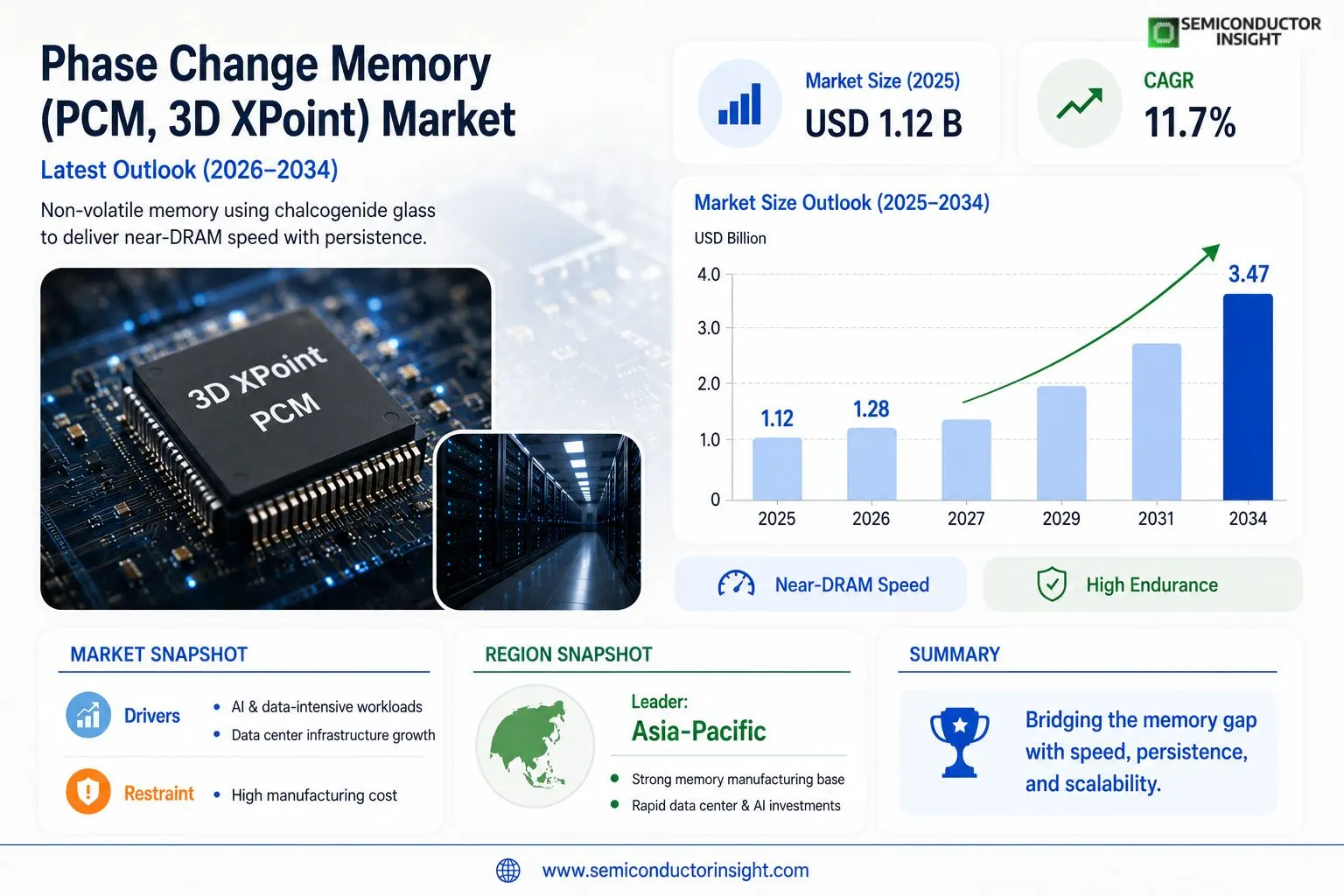
Global Phase Change Memory (PCM, 3D XPoint) market size was valued at USD 1.12 billion in 2025. The market is projected to grow from USD 1.28 billion in 2026 to USD 3.47 billion by 2034, exhibiting a CAGR of 11.7% during the forecast period.
Phase Change Memory (PCM), commercially advanced through Intel and Micron’s 3D XPoint technology, is a non-volatile memory technology that leverages the unique properties of chalcogenide glass materials to switch between amorphous and crystalline states, representing binary data. Unlike conventional NAND flash or DRAM, PCM delivers a compelling combination of high read/write endurance, byte-addressability, and near-DRAM latency, positioning it as a critical bridging technology in the memory hierarchy. Applications span enterprise storage, data center acceleration, embedded systems, and edge computing environments.
The market is experiencing robust momentum driven by the surging demand for high-performance, low-latency memory solutions in data-intensive workloads such as artificial intelligence, machine learning, and real-time analytics. Furthermore, the exponential growth of data center infrastructure globally has intensified the need for storage-class memory (SCM) solutions where PCM plays a pivotal role. Intel’s Optane DC Persistent Memory, based on 3D XPoint architecture, gained significant enterprise traction before Intel’s strategic restructuring of its Optane business in 2022, which has since redirected industry focus toward next-generation PCM development by players including Micron Technology, IBM, and Samsung Electronics. These companies continue advancing PCM integration within broader memory and storage ecosystems.
MARKET DRIVERS
Surging Demand for High-Performance, Low-Latency Memory Solutions
Phase Change Memory (PCM, 3D XPoint) Market is experiencing robust growth momentum driven by the escalating need for memory technologies that bridge the performance gap between DRAM and NAND flash storage. As data-intensive workloads such as artificial intelligence, machine learning, and real-time analytics become increasingly mainstream across enterprise and cloud computing environments, conventional memory architectures are struggling to keep pace. Phase Change Memory offers read latencies significantly lower than traditional NAND flash, making it a compelling solution for applications where speed and data persistence are both critical requirements.
Expansion of Data Centers and Cloud Infrastructure
The rapid proliferation of hyperscale data centers and cloud infrastructure globally is a significant driver for Phase Change Memory (PCM, 3D XPoint) Market. Cloud service providers and enterprise IT operators are under constant pressure to optimize storage hierarchies while reducing total cost of ownership. PCM-based storage-class memory enables tiered memory architectures that allow servers to process larger in-memory datasets without fully relying on expensive DRAM. This capability is particularly valuable in workloads involving large graph analytics, in-memory databases, and high-frequency transaction processing systems.
➤ The integration of Phase Change Memory into NVMe-based solid-state drives and persistent memory modules is accelerating adoption across enterprise data center deployments, where workload latency and endurance requirements are increasingly stringent.
Furthermore, government and private sector investments in next-generation computing infrastructure, including edge computing nodes and high-performance computing (HPC) clusters, are broadening the addressable market for Phase Change Memory (PCM, 3D XPoint) technologies. As digital transformation initiatives intensify across sectors such as healthcare, finance, and telecommunications, the demand for non-volatile, byte-addressable memory solutions is expected to remain a sustained driver throughout the forecast period.
MARKET CHALLENGES
High Manufacturing Complexity and Cost Barriers Limiting Widespread Adoption
Despite its technical advantages, Phase Change Memory (PCM, 3D XPoint) Market faces considerable challenges rooted in the complexity and cost of manufacturing. Producing phase change memory cells at scale requires precise control of chalcogenide material properties and advanced lithography processes, which drive up production costs compared to established NAND flash manufacturing. The capital expenditure required for PCM fabrication facilities remains substantially higher than that of conventional flash memory fabs, creating a significant barrier for new market entrants and limiting competitive supply dynamics.
Other Challenges
Limited Ecosystem Maturity and Software Support
Phase Change Memory (PCM, 3D XPoint) Market is also constrained by a relatively immature software and ecosystem infrastructure. Operating systems, middleware, and application frameworks have historically been optimized for DRAM and NAND flash memory paradigms. Adapting these software layers to fully exploit the byte-addressability and persistence characteristics of PCM requires significant re-engineering effort, which many enterprise software vendors have been slow to undertake. The absence of broad, standardized programming models for persistent memory continues to slow enterprise adoption.
Competitive Pressure from Emerging Memory Technologies
Phase Change Memory (PCM, 3D XPoint) Market faces intensifying competition from alternative next-generation memory technologies, including Resistive RAM (ReRAM), Magnetoresistive RAM (MRAM), and Ferroelectric RAM (FeRAM). Each of these technologies offers its own trade-offs in terms of endurance, density, and cost, and several are attracting significant R&D investment from major semiconductor companies. This competitive landscape creates uncertainty around long-term market positioning for PCM and 3D XPoint-based solutions, particularly as key industry players reassess their product roadmaps in response to evolving workload requirements.
MARKET RESTRAINTS
Supply Chain Concentration and Dependency on Key Manufacturers
One of the primary restraints impacting Phase Change Memory (PCM, 3D XPoint) Market is the high concentration of production capability among a limited number of semiconductor manufacturers. The exit of certain major players from active commercialization efforts has reduced the number of companies supplying PCM and 3D XPoint-based products at volume, creating supply chain vulnerabilities. This consolidation limits customer choice and introduces procurement risk for enterprises seeking to build long-term infrastructure strategies around phase change memory solutions, as supply continuity and product roadmap stability cannot be guaranteed across the broader vendor landscape.
Endurance and Write Cycle Limitations Relative to DRAM
While Phase Change Memory (PCM, 3D XPoint) offers meaningful advantages over NAND flash in terms of latency and endurance, it still falls short of DRAM in terms of raw write cycle durability under the most demanding workloads. In write-intensive applications, the finite endurance characteristics of PCM cells can lead to wear-out concerns that require sophisticated wear-leveling algorithms and system-level management overhead. This technical limitation restrains adoption in mission-critical environments where memory reliability and longevity are non-negotiable requirements, and it necessitates additional engineering investment to mitigate potential data integrity risks over extended operational periods.
MARKET OPPORTUNITIES
Growing Adoption of Persistent Memory in AI and In-Memory Database Applications
Phase Change Memory (PCM, 3D XPoint) Market is positioned to capitalize on the accelerating adoption of persistent memory architectures within artificial intelligence inference workloads and large-scale in-memory database platforms. Enterprises deploying real-time analytics engines and AI-driven decision systems increasingly require memory tiers that combine the speed of DRAM with the data persistence of storage. PCM and 3D XPoint-based persistent memory modules address this requirement directly, enabling faster restart times, reduced data reload latency, and more cost-effective scaling of in-memory dataset sizes , attributes that are becoming critical differentiators in competitive enterprise IT environments.
Edge Computing and IoT Deployments as Emerging Growth Vectors
The rapid expansion of edge computing infrastructure and Internet of Things (IoT) deployments presents a compelling opportunity for Phase Change Memory (PCM, 3D XPoint) Market. Edge nodes require memory solutions that combine low power consumption, non-volatility, and high endurance in thermally and spatially constrained environments , characteristics well-aligned with PCM technology. As the volume of edge-connected devices grows and the data processing burden at the network edge intensifies, demand for purpose-built memory solutions capable of handling persistent workloads in ruggedized or resource-constrained conditions is expected to increase meaningfully, opening new application segments beyond traditional data center deployments.
Strategic R&D Investment and Next-Generation Product Development
Ongoing research and development activity in chalcogenide materials science, cell architecture optimization, and 3D stacking techniques is creating opportunities for Phase Change Memory (PCM, 3D XPoint) Market to overcome current limitations around cost, endurance, and density. Academic institutions and semiconductor companies are actively exploring multi-level cell PCM designs and novel material compositions that could significantly improve storage density while reducing per-bit cost. These advancements, combined with growing standardization efforts around persistent memory interfaces and programming models, are expected to progressively reduce adoption barriers and expand the competitive viability of Phase Change Memory solutions across a broader range of commercial and industrial applications.
Trends
Rising Demand for High-Performance, Low-Latency Memory in Data-Intensive Workloads
Phase Change Memory (PCM, 3D XPoint) Market is witnessing accelerating momentum as enterprises and data center operators increasingly seek memory solutions capable of bridging the performance gap between conventional DRAM and NAND flash storage. PCM technology, which leverages the switching properties of chalcogenide glass materials between amorphous and crystalline states, delivers byte-addressability and near-DRAM latency that conventional storage-class memory alternatives struggle to match. The rapid proliferation of artificial intelligence, machine learning, and real-time analytics workloads has intensified enterprise interest in high-endurance, low-latency memory architectures where Phase Change Memory (PCM, 3D XPoint) solutions serve a pivotal role within the broader memory hierarchy.
Other Trends
Strategic Industry Realignment Following Intel’s Optane Transition
Intel’s strategic restructuring of its Optane business in 2022, which was built on 3D XPoint architecture, marked a defining inflection point for Phase Change Memory (PCM, 3D XPoint) Market. Rather than diminishing interest, this transition has redirected significant research and development focus toward next-generation PCM innovation. Companies including Micron Technology, IBM, and Samsung Electronics have continued advancing PCM integration within broader memory and storage ecosystems, signaling that industry commitment to this technology remains intact despite the consolidation of earlier commercial deployments.
Expanding Role in Data Center and Edge Computing Infrastructure
The exponential growth of global data center infrastructure has reinforced the strategic relevance of storage-class memory solutions, with Phase Change Memory (PCM, 3D XPoint) technology positioned as a key enabler of accelerated data access in enterprise storage and server environments. Simultaneously, edge computing deployments are emerging as a notable growth avenue, as PCM’s non-volatile characteristics and high read/write endurance make it well-suited for embedded systems operating in latency-sensitive, resource-constrained environments where traditional memory solutions face performance limitations.
Continued Innovation Driving Long-Term Market Differentiation
As Phase Change Memory (PCM, 3D XPoint) Market evolves beyond its initial commercial phase, ongoing material science advancements and architectural refinements are expected to enhance PCM’s scalability and cost competitiveness. The technology’s unique combination of non-volatility, endurance, and byte-level addressability continues to differentiate it from competing memory technologies, sustaining its relevance across enterprise storage, data center acceleration, and emerging AI infrastructure applications where memory performance remains a critical determinant of overall system efficiency.
COMPETITIVE LANDSCAPE
Key Industry Players
Phase Change Memory (PCM, 3D XPoint) Market , Competitive Dynamics and Leading Innovators
Global Phase Change Memory (PCM, 3D XPoint) market is characterized by a concentrated yet highly innovative competitive landscape, with a handful of technology giants and specialized semiconductor firms driving the majority of research, development, and commercialization efforts. Intel Corporation and Micron Technology jointly pioneered the 3D XPoint architecture, which served as the foundational commercial breakthrough for PCM-based storage-class memory (SCM). Intel’s Optane DC Persistent Memory product line achieved notable enterprise adoption, particularly in data center and high-performance computing environments, before Intel’s strategic exit from the Optane business in 2022. This development significantly reshaped competitive dynamics, accelerating investment from rivals including Samsung Electronics, SK Hynix, and IBM, all of whom have deepened their PCM and next-generation non-volatile memory research programs. Samsung, leveraging its dominant position in the broader memory semiconductor market, continues to explore PCM integration within its advanced memory hierarchy roadmap, targeting artificial intelligence, machine learning, and real-time analytics workloads that demand near-DRAM latency combined with non-volatile data persistence.
Beyond the tier-one players, several niche and emerging companies are making meaningful contributions to the Phase Change Memory ecosystem. Ovonyx, a company historically instrumental in chalcogenide-based memory research, has played a foundational role in PCM intellectual property development. STMicroelectronics and Numonyx (later acquired by Micron) have been active in embedded PCM solutions targeting automotive, industrial, and IoT edge computing applications. IBM Research has consistently advanced PCM cell engineering, multi-level cell storage techniques, and neuromorphic computing applications leveraging PCM’s analog switching properties. Western Digital and Seagate Technology, as major storage infrastructure providers, maintain strategic interest in SCM technologies including PCM as they evolve their enterprise storage portfolios. Smaller technology firms and fabless design companies such as Everspin Technologies, Crossbar Inc., and Weebit Nano are also active in the broader resistive and phase-change memory space, competing on differentiated process nodes and application-specific memory architectures suited to edge and embedded markets.
List of Key Phase Change Memory (PCM, 3D XPoint) Companies Profiled
- Intel Corporation
- Micron Technology, Inc.
- Samsung Electronics Co., Ltd.
- SK Hynix Inc.
- IBM Corporation
- STMicroelectronics N.V.
- Western Digital Corporation
- Seagate Technology Holdings plc
- Everspin Technologies, Inc.
- Crossbar Inc.
- Weebit Nano Ltd.
- Ovonyx Memory Technology
- Adesto Technologies (acquired by Dialog Semiconductor)
- KIOXIA Holdings Corporation
- Rambus Inc.
Segment Analysis:
| Segment Category | Sub-Segments | Key Insights |
| By Type |
|
3D XPoint-Based PCM holds the leading position within the type segment, pioneered commercially through Intel and Micron’s collaborative architecture.
|
| By Application |
|
Data Center Infrastructure represents the dominant application segment for Phase Change Memory, driven by the relentless global expansion of hyperscale and colocation facilities.
|
| By End User |
|
Cloud Service Providers & Hyperscalers constitute the leading end-user segment, as these organizations operate at the frontier of data-intensive computing and continuously seek memory technologies that enhance throughput and reduce operational bottlenecks.
|
| By Interface |
|
NVMe Interface leads the interface segment for Phase Change Memory deployments, owing to its ability to fully exploit the low-latency and high-throughput characteristics that distinguish PCM from legacy storage technologies.
|
| By Form Factor |
|
DIMM (Dual In-Line Memory Module) emerges as the dominant form factor within the Phase Change Memory market, largely due to its seamless compatibility with existing server motherboard architectures and memory slot infrastructure.
|
Regional Analysis: Phase Change Memory (PCM, 3D XPoint) Market
Asia-Pacific
Asia-Pacific hosts the world’s most sophisticated semiconductor fabrication networks, giving Phase Change Memory (PCM, 3D XPoint) Market a decisive regional advantage. Established foundries and memory manufacturers across South Korea, Taiwan, and Japan provide end-to-end production capabilities , from raw material sourcing to final chip packaging , enabling faster commercialization cycles and cost-efficient scaling that no other region can currently match.
National semiconductor strategies across the Asia-Pacific region have made advanced memory technologies, including Phase Change Memory and 3D XPoint architectures, a priority area for state-backed funding. Programs in China, South Korea, and Japan are actively subsidizing R&D centers, university-industry collaborations, and pilot fabrication lines to accelerate the development and domestic adoption of next-generation non-volatile memory solutions.
The exponential growth of hyperscale data centers and AI-driven computing infrastructure across China, India, and Southeast Asia is generating strong demand for high-speed, low-latency memory technologies. Phase Change Memory (PCM, 3D XPoint) solutions are increasingly evaluated by regional cloud service providers and enterprise IT operators seeking storage-class memory alternatives capable of bridging the performance gap between DRAM and NAND flash.
Asia-Pacific’s commanding position in consumer electronics manufacturing creates embedded demand channels for advanced memory components. As smartphones, wearables, edge computing devices, and automotive electronics proliferate across the region, original equipment manufacturers are evaluating Phase Change Memory and 3D XPoint technologies for applications demanding superior endurance, faster access speeds, and greater energy efficiency compared to conventional memory solutions.
North America
North America represents a strategically critical market for Phase Change Memory (PCM, 3D XPoint) technology, anchored by the United States’ commanding position in semiconductor intellectual property, enterprise computing, and cloud infrastructure. The region is home to some of the world’s most influential technology companies and hyperscale data center operators, which have historically been early adopters of emerging memory technologies including PCM and 3D XPoint architectures. American research universities and national laboratories continue to advance the fundamental science underpinning phase-change materials, contributing to a rich innovation pipeline. The presence of major semiconductor design firms and memory ecosystem developers ensures that North America remains a hub for PCM product definition and go-to-market strategy, even as volume manufacturing increasingly occurs elsewhere. Federal investment in domestic semiconductor competitiveness, particularly following recent industrial policy initiatives, is also expected to support the longer-term development of advanced memory supply chains within the region, further reinforcing North America’s relevance to Global Phase Change Memory market trajectory through 2034.
Europe
Europe occupies a meaningful and evolving position in Global Phase Change Memory (PCM, 3D XPoint) market, characterized by strong academic research foundations, rigorous regulatory frameworks, and a growing emphasis on technological sovereignty in strategic sectors. Leading research institutions across Germany, France, the Netherlands, and Scandinavia are actively engaged in memory materials research and neuromorphic computing applications, many of which intersect directly with phase-change memory capabilities. The European Union’s coordinated semiconductor strategy, aimed at reducing dependency on external memory supply chains, has elevated advanced non-volatile memory technologies as a policy priority. Industrial demand from Europe’s automotive sector , particularly for embedded memory solutions in electric vehicles and advanced driver assistance systems , represents a compelling growth vector for PCM adoption. While Europe currently lacks the large-scale PCM fabrication infrastructure of Asia-Pacific, collaborative programs between academia, government, and industry are steadily building regional competencies in Phase Change Memory design and application development.
Latin America
Latin America occupies an emerging and opportunity-rich position within Global Phase Change Memory (PCM, 3D XPoint) market, primarily as a demand-side region rather than a manufacturing hub. Brazil, Mexico, and Chile are experiencing accelerating digital transformation across financial services, telecommunications, and public sector IT, generating growing interest in high-performance memory solutions capable of supporting modern data-intensive applications. Regional data center investment has increased notably, with hyperscale cloud providers and domestic operators expanding infrastructure capacity in key metropolitan markets. While local semiconductor manufacturing remains limited, the region’s integration into global technology supply chains positions it as a progressively important end-market for PCM-enabled products. Government digitalization programs and expanding internet penetration are expected to sustain demand momentum for advanced computing hardware, including storage-class memory technologies, as Latin American enterprises modernize legacy IT infrastructure over the forecast period extending through 2034.
Middle East & Africa
The Middle East and Africa region presents a longer-term growth opportunity for Phase Change Memory (PCM, 3D XPoint) Market, shaped by ambitious digital infrastructure development programs and a rapidly expanding technology adoption base. Gulf Cooperation Council nations, particularly the United Arab Emirates and Saudi Arabia, are investing heavily in smart city initiatives, national data center ecosystems, and AI-driven public services , all of which create downstream demand for advanced memory technologies. Africa’s growing young population and expanding mobile connectivity are fueling demand for consumer electronics and cloud-based services, establishing foundational conditions for future PCM-enabled device proliferation. While the region’s direct engagement with Phase Change Memory technology development and procurement remains in early stages, strategic partnerships with global semiconductor vendors and technology integrators are gradually building awareness and evaluation activity. The Middle East and Africa market is expected to gain increasing relevance to global PCM stakeholders as regional digital transformation programs mature through the 2026–2034 forecast horizon.
Report Scope
This market research report provides a comprehensive analysis of the Phase Change Memory (PCM, 3D XPoint) Market , covering the forecast period 2026–2034. It offers detailed insights into market dynamics, technological advancements, competitive landscape, and key trends shaping the industry.
Key focus areas of the report include:
- Market Overview: The report begins with an overview outlining its current market scenario, key growth indicators, and industry transformation drivers. It discusses macroeconomic factors, demand–supply balance, regulatory landscape, and the strategic role of semiconductors in powering advancements across industries such as automotive, telecommunications, consumer electronics, and industrial automation.
- Market Size & Forecast: Historical data and future projections for revenue, unit shipments, and market value across major regions and segments.
- Segmentation Analysis: Detailed breakdown by product type, technology, application, and end-user industry to identify high-growth segments and investment opportunities.
- Regional Insights: Insights into market performance across North America, Europe, Asia-Pacific, Latin America, and the Middle East & Africa, including country-level analysis where relevant.
- Competitive Landscape: Profiles of leading market participants, including their product offerings, R&D focus, manufacturing capacity, pricing strategies, and recent developments such as mergers, acquisitions, and partnerships.
- Technology Trends & Innovation: Assessment of emerging technologies, integration of AI/IoT, semiconductor design trends, fabrication techniques, and evolving industry standards.
- Market Drivers & Restraints: Evaluation of factors driving market growth along with challenges, supply chain constraints, regulatory issues, and market-entry barriers.
- Stakeholder Insights: Insights for component suppliers, OEMs, system integrators, investors, and policymakers regarding the evolving ecosystem and strategic opportunities.
Primary and secondary research methods are employed, including interviews with industry experts, data from verified sources, and real-time market intelligence to ensure the accuracy and reliability of the insights presented.
FREQUENTLY ASKED QUESTIONS:
What is the current market size of Phase Change Memory (PCM, 3D XPoint) Market?
-> Global Phase Change Memory (PCM, 3D XPoint) Market was valued at USD 1.12 billion in 2025 and is projected to grow from USD 1.28 billion in 2026 to USD 3.47 billion by 2034, exhibiting a CAGR of 11.7% during the forecast period.
Which key companies operate in Phase Change Memory (PCM, 3D XPoint) Market?
-> Key players include Intel Corporation, Micron Technology, IBM, and Samsung Electronics, among others, all of whom are actively advancing PCM integration within broader memory and storage ecosystems.
What are the key growth drivers?
-> Key growth drivers include surging demand for high-performance, low-latency memory solutions in data-intensive workloads such as artificial intelligence, machine learning, and real-time analytics, as well as the exponential growth of global data center infrastructure intensifying the need for storage-class memory (SCM) solutions.
Which region dominates the market?
-> Asia-Pacific is among the fastest-growing regions driven by rapid data center expansion, while North America remains a dominant market backed by strong enterprise adoption and leading technology players.
What are the emerging trends?
-> Emerging trends include next-generation PCM development beyond 3D XPoint architecture, byte-addressable storage-class memory integration, and expanding PCM applications in edge computing, embedded systems, and enterprise storage acceleration driven by AI and real-time analytics workloads.

Get Sample Report PDF for Exclusive Insights
Report Sample Includes
- Table of Contents
- List of Tables & Figures
- Charts, Research Methodology, and more...