Personal Computer Graphics Cards Market Insights
Personal Computer Graphics Cards market was valued at USD 16 300 million in 2025 and is projected to grow from USD 16 300 million in 2026 to USD 25 000 million by 2034, exhibiting a CAGR of approximately 5% during the forecast period.
A graphics card,also referred to as a video card or GPU,is an expansion module that translates computational outputs into visual signals transmitted through display devices such as monitors or projectors.
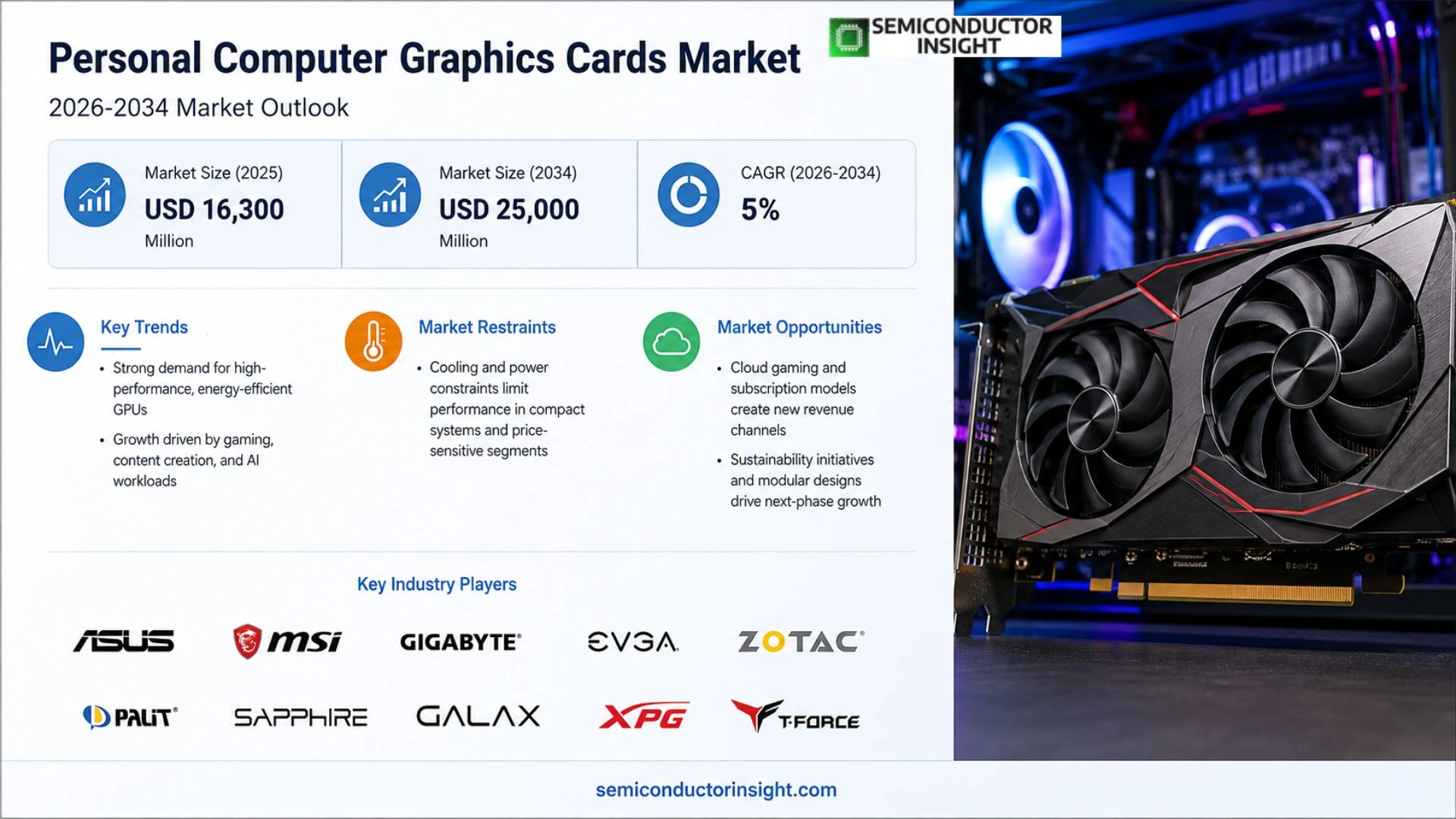
MARKET DRIVERS
Gaming‑centric demand
Competitive gaming, esports tournaments, and live‑streaming platforms are forcing consumers to upgrade to higher‑frequency, higher‑resolution graphics solutions. Personal Computer Graphics Cards Market has responded by expanding its high‑performance tier, while pricing strategy shifts accommodate budget‑conscious players who still demand smooth gameplay. This demand creates a steady pipeline of sales for manufacturers that invest in robust silicon yield and efficient cooling designs.
Emergence of AI‑driven workloads
Large‑scale machine‑learning pipelines, autonomous driving simulation, and real‑time ray‑traced rendering now rely on GPU‑accelerated inference and training. Businesses that host AI clusters are reporting a measurable uptick in demand for cards that combine high single‑precision throughput with low‑latency memory access. The market reflects this shift, with a growing share of sales fueled by data‑center and enterprise segments that look beyond traditional gaming.
➤ Private cloud providers accelerating GPU density are creating an urgent need for local, high‑frequency cards that deliver predictable performance.
As streaming services introduce higher definition tiers, gamers and creators push for consistent 120–144 Hz refresh rates. This steady pressure leads vendors to further refine product lines,balancing price, power, and performance,to secure foothold in progressively segmented market niches.
MARKET CHALLENGES
Supply Chain Vulnerability
Fabrication facilities face bottlenecks due to regional labor shortages, restricted access to advanced lithography tools, and volatile raw‑material prices. These elements cause cascading delays that heighten risk for earlier delivery commitments and widen price variance among competing suppliers.
Other Challenges
Geopolitical tensions in the semiconductor sector
Tensions close critical shipping lanes and force manufacturers to switch to more expensive alternatives, thereby inflating unit costs.
Impact of trade sanctions on component availability
Sanction‑imposed restrictions on key silicons and memory modules have prompted businesses to identify costlier substitutes, adding pressure on profit margins.
Rising TDP requirements leading to thermal bottlenecks
Higher power drawing cards must be paired with efficient cooling,an investment that limits adoption in smaller form factors and dampens traction within the mainstream consumer‑tech segment.
MARKET RESTRAINTS
Cooling and Power Constraints
A top‑end graphics card can consume upwards of 350 W and require >7 V power delivery, which forces a design burden on both the power‑supply unit and the chassis cooling architecture. When these requirements conflict with slim case designs, users face throttled performance or must invest in aftermarket solutions,steps that reduce the attractiveness of higher‑tier hardware in price‑sensitive markets.
MARKET OPPORTUNITIES
Cloud Gaming and Subscription Models
The surge in cloud‑gaming offerings creates a channel where GPU vendors can supply certified chips that are pre‑validated for the provider’s mix of streaming software and streaming‑throughput constraints. By bundling hardware with subscription tiers, manufacturers open a recurring revenue pathway that supplements the traditional one‑shot sales model. Alongside this, a shift toward recyclable packaging and modular component design aligns with growing consumer eco‑concern, positioning suppliers who adopt greener strategies as market leaders.
Personal Computer Graphics Cards Market Trends
Shift Toward Integrated and High‑Performance GPUs
Personal Computer Graphics Cards Market has entered a phase where demand for high‑performance, energy‑efficient GPUs outweighs broader PC growth. Despite a 16.5% decline in global PC shipments in 2022, the 15.5 bn USD market valuation in 2024 indicates that consumers and professionals are still willing to invest in premium graphics solutions. This trend mirrors a shift from commodity components to specialised accelerators that deliver immersive visual experiences for gaming, VR, and data‑intensive workloads. The contraction in volume has nudged manufacturers to prioritize features such as higher VRAM capacity, improved thermal designs, and optimized power delivery. As a result, entry‑level cards are acquiring advanced capabilities typically found in mid‑ or high‑tier models, narrowing the traditional performance curve and altering pricing dynamics across the supply chain. Technological convergence with software ecosystems further conditions pricing, enforcing a balanced strategy between performance and affordability.
Other Trends
Rise of AI‑Driven Rendering Workloads
Artificial‑intelligence technologies are reshaping rendering pipelines, compelling vendors to embed tensor cores and dedicated inference units into mainstream GPUs. The demand for real‑time ray tracing and neural up‑scaling has accelerated adoption among content creators and design firms. Consequently, graphics card specifications now routinely feature mixed‑precision compute units, expanding their appeal beyond gaming into professional applications such as CAD, simulation, and AI training. This convergence drives a higher average selling price and elevates the importance of backward compatibility for legacy software ecosystems. Customers also demand that GPUs stay within strict power budgets for workstations, prompting a focus on silicon‑level efficiency.
Regional Divergence and Emerging Market Adoption
While North America and Europe retain leadership in GPU adoption, emerging economies in Asia and Latin America display accelerated uptake of gaming consoles and cloud‑based rendering services, reducing dependency on local PC spend. In China and India, growth in e‑sports tournaments and mobile GPU integration is stimulating instant demand for mid‑tier cards that balance performance and cost. Companies are tailoring product lines to meet regional bandwidth and power constraints, creating differentiated portfolios that capture previously untapped segments. These emerging markets also spur demand for bundled solutions incorporating localchip co‑processors, extending the reach of mid‑tier cards into the industrial sector.
Sustainability and Chip‑Scale Integration
Manufacturers are addressing power consumption through advanced lithography and chip‑scale packaging that reduces energy cost per frame. Implementing 7‑nm and 5‑nm nodes has lowered idle power by up to 30 % while maintaining throughput. Simultaneously, supply‑chain resilience is being increased by localizing key raw‑material processing and expanding contract‑manufacturing partnerships. These initiatives reduce long‑term operational risk, allowing firms to price competitively and maintain margin stability under volatile input costs. By integrating AI inference directly onto the GPU die, vendors provide a seamless interface for developers, reducing the fragment‑ation of support tools.
COMPETITIVE LANDSCAPE
Key Industry Players
Personal Computer Graphics Cards Competitive Dynamics
The upper tier of the PC graphics market is overwhelmingly shaped by the dual powers of NVIDIA and AMD. NVIDIA’s GeForce line, bolstered by its CUDA ecosystem and aggressive AI‑accelerated game‑rendering, continues to command a majority of the high‑end segment, with its 2024 revenue share eclipsing 45% of the global market. AMD, leveraging its RDNA architecture and open‑source driver strategy, captures the mid‑tier and the burgeoning AI inference niche, securing a combined 30–35% slice of volume. The interplay between GPU hardware innovation and software ecosystem maturity has escalated the capital intensity required to maintain competitive relevance, pushing these firms towards accelerated R&D cycles, strategic partnerships with console developers, and vertical integration of chip manufacturing capabilities. Players that fail to keep pace risk obsolescence as consumer expectations for real‑time ray tracing and machine‑learning workloads climb \(,\) a trend that is already reshaping supply chain dynamics nationwide and globally.
Behind the flagship duopoly lies a network of OEMs and specialized manufacturers that drive cost‑effective solutions and tailored use‑case offerings. ASUS and MSI, both entrenched distributors for the mainstream market, have diversified into high‑refresh straight‑digital‑gaming rigs that appeal to e‑sports athletes. Gigabyte, EVGA, and Zotac have carved out niche territories through aggressive overclocking support and boutique aesthetics. European brands like Palit and Sapphire maintain strong footholds in European and Asian automotive‑grade models, respectively. Emerging players such as GALAX, POWERTECH, XPG, and T‑Force extend the demography of budget and entry‑level cards, leveraging localized supply chains to deliver competitive pricing. These actors tailor their product portfolios to regional regulations, local chipset integration, and consumer cooling preferences, creating a segmented market where procurement decisions hinge on cost‑performance ratios rather than flagship performance.
List of Key Personal Computer Graphics Card Companies Profiled
Segment Analysis:
| Segment Category | Sub-Segments | Key Insights |
| By Type |
|
Mid-level Card dominates the market by balancing cost and performance, enabling mainstream gamers and creators to adopt newer visual technologies without premium price pressure. • Provides sufficient processing power for modern titles at 1080p–1440p resolutions. • Supports emerging features such as DLSS and ray‑tracing at a scalable level. • Encourages ecosystem growth through broad software compatibility and driver stability. |
| By Application |
|
Game Competition is the most dynamic application segment, driving rapid adoption of high‑performance graphics cards. • Tournaments and esports leagues demand consistent frame rates and low latency. • Influences manufacturers to prioritize driver optimizations for competitive titles. • Sparks ancillary services such as streaming platforms and peripheral ecosystems. |
| By End User |
|
Gamers remain the primary driver of product upgrades, seeking immersive visuals and high refresh rates. • Continuous demand for new titles with sophisticated graphics engines. • Community forums and influencer reviews shape purchasing decisions. • Preference for modular upgrades supports a vibrant aftermarket. |
| By Performance Tier |
|
Real‑time Ray Tracing is emerging as a decisive differentiator, encouraging developers to integrate physically accurate lighting. • Elevates visual fidelity in both gaming and professional visualization. • Stimulates firmware and hardware innovations focused on dedicated ray‑tracing cores. • Aligns with broader industry trends toward photorealistic content creation. |
| By Form Factor |
|
Desktop GPUs continue to attract the majority of performance‑seeking users due to upgrade flexibility and thermal headroom. • Supports higher power envelopes and multi‑GPU configurations. • Drives a robust ecosystem of aftermarket cooling and overclocking solutions. • Remains central to enthusiast communities and benchmark culture. |
Regional Analysis: Personal Computer Graphics Cards Market
Enthusiasm for immersive gaming, the expansion of AI‑enhanced content creation, and the rise of professional visualization services converge to lift demand for ever‑more powerful graphics cards across the continent.
Domestic fab initiatives, tightened export controls, and a shift toward on‑shoring of assembly operations shape a supply chain that balances resilience with the need for rapid technology refresh cycles.
Energy‑efficiency standards, waste‑reduction mandates, and targeted tax incentives for high‑performance computing influence product design and pricing strategies for GPU makers operating in the United States and Canada.
Nvidia, AMD, and Intel vie for leadership, while a wave of specialty startups seeks niche footholds in AI acceleration and edge‑compute graphics, intensifying the battle for market share.
Europe
European markets exhibit a measured yet sophisticated appetite for graphics solutions. The EU’s digital agenda emphasizes sustainable computing, prompting manufacturers to prioritize power‑aware architectures that satisfy both performance expectations and regulatory thresholds. Gaming remains a cornerstone, particularly in Germany, the United Kingdom, and the Nordic countries, where esports ecosystems generate steady demand for mid‑range to high‑end GPUs. Simultaneously, the automotive sector’s transition toward autonomous driving platforms drives interest in professional‑grade graphics acceleration for simulation and training workloads. Local content creators, attracted by robust broadband infrastructure, further reinforce the need for reliable visual‑compute hardware. Cross‑border collaboration among research labs and a network of specialized system integrators enable rapid diffusion of emerging standards, ensuring Europe retains a pivotal role in shaping product roadmaps.
Asia‑Pacific
The Asia‑Pacific region blends massive consumer volumes with a thriving manufacturing base, creating a dual‑sided market pressure for Personal Computer Graphics Cards Market. Nations such as China, South Korea, and Japan host dense gaming populations that gravitate toward high‑frequency refresh rates and advanced ray‑tracing capabilities. At the same time, the region’s semiconductor fabs supply a significant share of the global GPU ecosystem, giving local manufacturers leverage to negotiate pricing and accelerate time‑to‑market. Emerging economies in Southeast Asia add a price‑sensitive layer, where affordable, energy‑efficient cards gain traction for both education and entry‑level gaming. The confluence of robust esports viewership, strong developer communities, and an entrenched supply chain positions Asia‑Pacific as a catalyst for both demand surges and innovation cycles.
South America
South American economies display a gradual ascent in graphics‑card adoption, driven largely by a youthful demographic that embraces console and PC gaming alike. While import duties inflate retail prices, a growing middle class fuels demand for mid‑range GPUs that balance cost with acceptable performance for popular titles. Regional distributors increasingly partner with global OEMs to offer bundled solutions that include localized service and warranty support, softening the impact of price sensitivities. Additionally, the rise of remote work and digital content creation in Brazil and Argentina introduces a modest but steady appetite for professional‑grade graphics hardware, suggesting a slow diversification beyond pure entertainment use cases.
Middle East & Africa
In the Middle East and Africa, the graphics‑card market remains niche but exhibits promising signs of expansion. Wealth‑generated data‑center projects in the Gulf Cooperation Council states incorporate high‑throughput GPUs to accelerate cloud‑based AI services, while government‑backed digital‑transformation programs create pockets of demand for advanced visualization tools. African markets, though constrained by limited distribution networks, see incremental growth as gaming cafés and university labs acquire affordable GPUs to support both entertainment and educational workloads. Trade barriers and logistical complexities temper the pace, yet ongoing infrastructure investments and a gradual easing of import duties hint at a trajectory toward broader market participation.
Report Scope
This market research report provides a comprehensive analysis of the Personal Computer Graphics Cards Market , covering the forecast period 2026–2034. It offers detailed insights into market dynamics, technological advancements, competitive landscape, and key trends shaping the industry.
Key focus areas of the report include:
- Market Overview: The report begins with an overview outlining its current market scenario, key growth indicators, and industry transformation drivers. It discusses macroeconomic factors, demand–supply balance, regulatory landscape, and the strategic role of semiconductors in powering advancements across industries such as automotive, telecommunications, consumer electronics, and industrial automation.
- Market Size & Forecast: Historical data and future projections for revenue, unit shipments, and market value across major regions and segments.
- Segmentation Analysis: Detailed breakdown by product type, technology, application, and end-user industry to identify high-growth segments and investment opportunities.
- Regional Insights: Insights into market performance across North America, Europe, Asia-Pacific, Latin America, and the Middle East & Africa, including country-level analysis where relevant.
- Competitive Landscape: Profiles of leading market participants, including their product offerings, R&D focus, manufacturing capacity, pricing strategies, and recent developments such as mergers, acquisitions, and partnerships.
- Technology Trends & Innovation: Assessment of emerging technologies, integration of AI/IoT, semiconductor design trends, fabrication techniques, and evolving industry standards.
- Market Drivers & Restraints: Evaluation of factors driving market growth along with challenges, supply chain constraints, regulatory issues, and market-entry barriers.
- Stakeholder Insights: Insights for component suppliers, OEMs, system integrators, investors, and policymakers regarding the evolving ecosystem and strategic opportunities.
Primary and secondary research methods are employed, including interviews with industry experts, data from verified sources, and real-time market intelligence to ensure the accuracy and reliability of the insights presented.
FREQUENTLY ASKED QUESTIONS:
What is the current market size of Personal Computer Graphics Cards Market?
-> Personal Computer Graphics Cards market is projected to grow from USD 16 300 million in 2026 to USD 25 000 million by 2034, exhibiting a CAGR of 5%
Which key companies operate in Personal Computer Graphics Cards Market?
-> Key players include Nvidia, AMD, ASUS, MSI, Gigabyte, EVGA, Zotac, PNY, Palit, among others.
What are the key growth drivers?
-> Key growth drivers include rising demand for high‑performance graphics in gaming, AI, and professional visualization, continued PC adoption despite shipment fluctuations, and expanded use of GPUs in cloud and data‑center workloads.
Which region dominates the market?
-> Asia‑Pacific holds the largest market share, driven by strong demand in China, Japan, and South Korea, while North America and Europe remain significant contributors.
What are the emerging trends?
-> Emerging trends include increased adoption of ray‑tracing and AI‑accelerated rendering, growth of entry‑level and mid‑level cards for the home segment, and expanding use of high‑level cards for competitive gaming and professional applications.

Get Sample Report PDF for Exclusive Insights
Report Sample Includes
- Table of Contents
- List of Tables & Figures
- Charts, Research Methodology, and more...
 Download Sample Report PDF