PCB Heat Sinks Market Insights
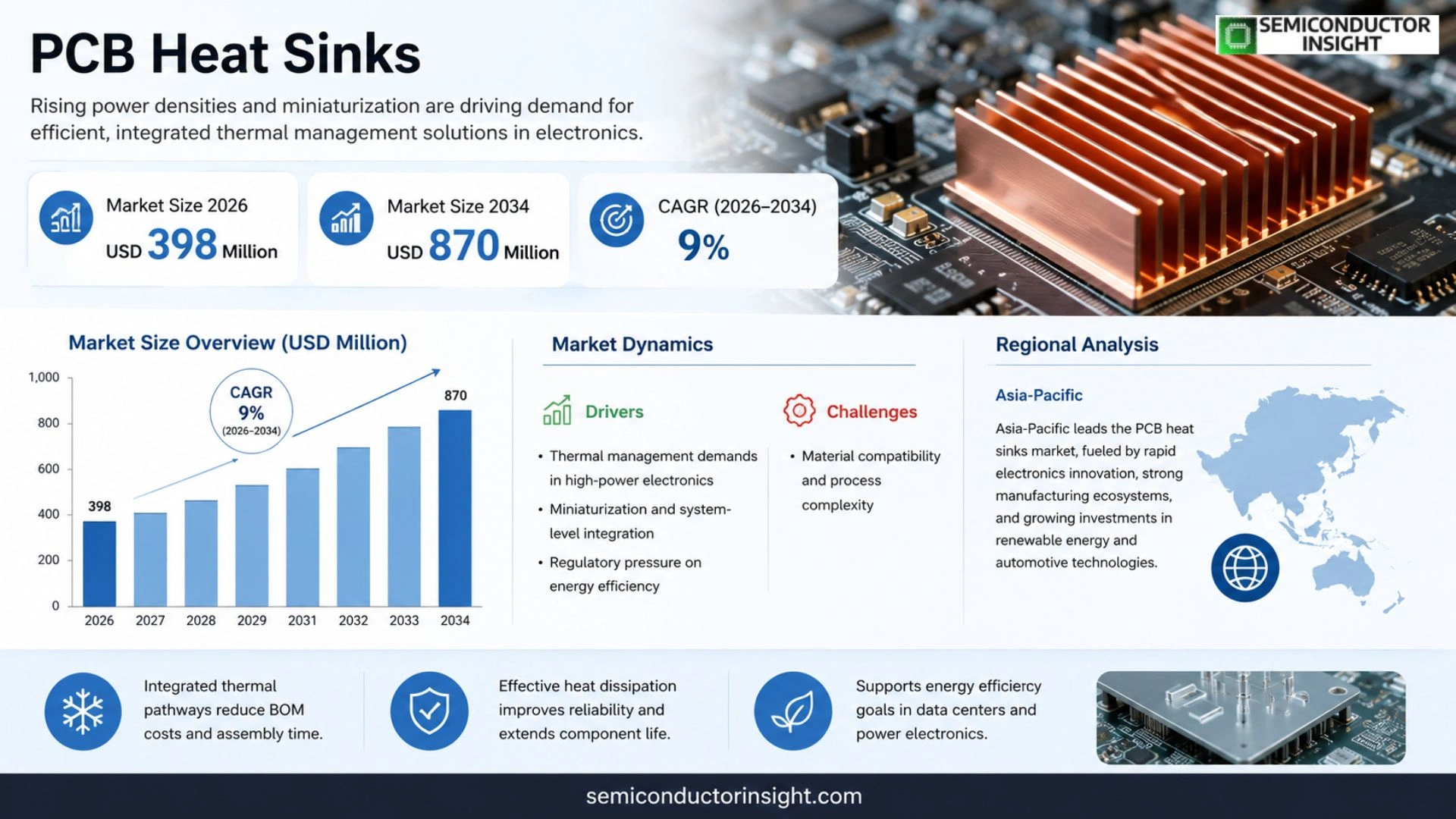
Global PCB Heat Sinks market size was valued at USD 396 million in 2025. The market is projected to grow from USD 398 million in 2026 to USD 870 million by 2034, exhibiting a CAGR of approximately 9% during the forecast period.
PCB heat sinks are thermal management components that transfer heat generated by surface‑mount devices on printed circuit boards into a cooling medium, primarily through conduction.
The expansion is supported by rising demand for high‑performance electronics such as AI processors and electric‑vehicle power modules
MARKET DRIVERS
Thermal Management Demands in High‑Power Electronics
Modern power converters and high‑frequency modules generate heat densities that exceed the removal capacity of conventional copper planes. Design engineers are therefore turning to specialized PCB heat sinks to maintain temperature margins, a shift that feeds directly into PCB Heat Sinks Market. The move is grounded in reliability concerns: excess heat accelerates dielectric breakdown and shortens component life cycles.
Miniaturization and System‑Level Integration
As devices shrink, the footprint available for passive cooling shrinks as well. Compact thermal solutions that can be embedded within multilayer boards are becoming a prerequisite for advanced automotive and telecom equipment. This trend pushes manufacturers to adopt low‑profile, high‑conductivity heat‑sink structures, reinforcing demand for PCB Heat Sinks Market.
➤ “Integrating thermal pathways directly into the PCB reduces the need for external heat‑sinks, trimming both BOM cost and assembly time.”
Regulatory pressure on energy efficiency, especially in data‑center power supplies, adds another layer of urgency. By managing junction temperatures more effectively, system designers can meet tighter efficiency standards without sacrificing performance, a dynamic that directly fuels market activity.
MARKET CHALLENGES
Material Compatibility and Process Complexity
Embedding thermal fins into FR‑4 substrates often requires a blend of high‑conductivity copper alloys and specialized adhesives. Supply chain constraints on these materials can increase lead times, while the additional processing steps raise production costs for board manufacturers.
Other Challenges
Design Verification Overheads
Thermal simulation tools must be calibrated against real‑world prototypes, a task that can extend development cycles. Companies that lack in‑house expertise may need to outsource validation, adding further expense.
MARKET RESTRAINTS
High Initial Investment for Tooling
Introducing PCB‑integrated heat sinks often requires new stamping dies or laser‑drilling equipment. Capital outlays can deter small‑to‑mid‑size manufacturers, limiting the breadth of adoption across the industry.
Thermal Performance Trade‑offs
While integrated heat sinks reduce the need for external cooling, their effectiveness is bounded by board thickness and copper density. In ultra‑high‑power applications, the thermal resistance may still exceed the threshold required for safe operation, prompting designers to retain conventional heat‑sink modules.
Reliability Concerns under Mechanical Stress
Embedding metal structures can alter board flexural rigidity, making the assembly more susceptible to vibration‑induced fatigue. OEMs often conduct additional mechanical qualification, which can slow time‑to‑market.
MARKET OPPORTUNITIES
Advanced Materials and Additive Manufacturing
Emerging copper‑graphite composites and 3‑D printed metal lattices present a pathway to higher thermal conductivity without a proportional increase in board weight. Early adopters can differentiate their product lines, creating a niche within PCB Heat Sinks Market that commands premium pricing.
Standardization of Design Guidelines
Industry consortia are drafting unified thermal‑design standards for PCB‑integrated heat sinks. Once widely accepted, these guidelines will simplify engineering trade‑offs, lower design risk, and accelerate market penetration across automotive, aerospace, and industrial sectors.
OEM Partnerships for Integrated Power Modules
Collaborations between board fabricators and power‑module suppliers are fostering turnkey solutions where the heat sink is co‑engineered with the semiconductor. Such partnerships reduce integration effort for end customers and open a channel for bundled sales, expanding the addressable volume of PCB Heat Sinks Market.
PCB Heat Sinks Market Trends
Thermal Management Demands Accelerate Innovation
The surge in high‑frequency processors, power‑dense modules and electric‑vehicle control units has forced designers to rethink board‑level cooling strategies. As component packages shrink while output power climbs, the margin for thermal error narrows dramatically. Engineers are therefore prioritising heat‑sink geometries that maximize surface area without inflating board real‑estate. This shift is evident in the growing adoption of fin‑dense aluminum structures coupled with copper heat‑pipes, which together balance conductivity and weight. The consequence for suppliers is a race to shorten design cycles and offer customizable tooling that can be integrated early in the product development timeline.
Other Trends
Materials Diversification
Beyond the traditional aluminum‑only approach, manufacturers are experimenting with copper‑based alloys and composite substrates to address specific conductivity challenges. Copper’s superior thermal conductivity makes it attractive for power‑component clusters, while newer composite cores provide resistance to corrosion in humid environments. The diversification of material portfolios reduces reliance on a single commodity market and allows OEMs to fine‑tune thermal paths for distinct application zones. Companies that can rapidly source and certify these alternatives gain a competitive edge in niche segments such as aerospace and medical devices.
Regional Production Shifts Influence Pricing
China’s dominance in PCB fabrication translates into a concentrated heat‑sink supply chain, yet rising labor costs and tighter environmental regulations are prompting some manufacturers to relocate portions of production to Southeast Asia and Eastern Europe. This geographic redistribution is reshaping cost structures: while material expenses remain relatively stable, logistics and compliance overheads are becoming more pronounced. Clients operating global design houses must therefore monitor regional policy trends and adjust their sourcing strategies to avoid surprise cost escalations. The net effect is a more fragmented market where price competitiveness will hinge on the ability to balance localized manufacturing benefits against the efficiencies of scale.
COMPETITIVE LANDSCAPE
Key Industry Players
Competitive Overview of PCB Heat Sinks Market
Advanced Thermal Solutions dominates the upper tier of the PCB heat‑sink arena, leveraging a broad portfolio that spans lightweight aluminum extrusions to high‑conductivity copper modules. Its ability to secure long‑term design‑win agreements with major OEMs in the AI‑driven server and 5G infrastructure segments translates into a stable revenue base and a margin advantage over smaller rivals. The firm’s recent investment in automated stamping facilities in mainland China has shortened lead times, allowing it to respond quickly to the surge in demand from Chinese PCB manufacturers who together account for the largest share of global output. This scale advantage also gives the company leverage in negotiating raw‑material contracts, a critical factor as copper prices experience periodic volatility.
Beyond the market leader, a constellation of specialized firms sustains competitive pressure. Ohmite and CTS Corporation, both headquartered in the United States, focus on high‑power applications where copper heat sinks are indispensable, and they have differentiated themselves through rigorous reliability testing regimes that appeal to aerospace and defense customers. Moko Technology and CUI Devices cater to compact, high‑density boards typical of automotive electric‑drive modules, emphasizing miniaturized aluminum solutions with integrated thermal vias. European players such as Fischer Elektronik and Broadlake excel in niche markets like medical imaging, where compliance with stringent regulatory standards offsets their relatively modest production volumes. Asian manufacturers,including Shenzhen Mingsihai, Pada Engineering, and Heatell,operate with aggressive cost structures, targeting mid‑range consumer electronics and capitalizing on the proximity to PCB fabs in Taiwan and South Korea.
List of Key PCB Heat Sinks Companies Profiled
- Advanced Thermal Solutions
- Ohmite
- CTS Corporation
- Moko Technology
- CUI Devices
- Boyd
- Fischer Elektronik
- Broadlake
- Pada Engineering
- Heatell
- Shenzhen Mingsihhai
- Fujikura Ltd
Segment Analysis:
| Segment Category | Sub-Segments | Key Insights |
| By Type |
|
Aluminum Heat Sinks dominate the market because they combine light weight with adequate thermal conductivity, making them suitable for a wide range of PCB designs.
|
| By Application |
|
Power Components emerge as a leading application segment due to ever‑increasing power densities in modern converters and electric‑vehicle architectures.
|
| By End User |
|
Consumer Electronics drive demand because of the proliferation of high‑performance smartphones, wearables, and gaming devices that generate localized hotspots on compact PCBs.
|
| By Design Configuration |
|
Heat Pipe Integrated Sinks are gaining traction as designers pursue higher thermal performance without enlarging the PCB footprint.
|
| By Thermal Performance Tier |
|
High‑Performance tier is the focal point for emerging AI and 5G hardware where tight thermal budgets dictate component selection.
|
Regional Analysis: PCB Heat Sinks Market
Asia‑Pacific
Companies are integrating micro‑channel structures directly into copper cores, achieving a finer temperature gradient without increasing bulk. This approach aligns with the push for slimmer PCB profiles, allowing device architects to allocate board real‑estate to additional functionality.
New fab lines equipped with high‑speed extrusion and precision stamping are being commissioned in Shenzhen and Busan, effectively raising throughput while preserving tight tolerances required for high‑frequency applications.
Multisourcing strategies now blend domestic aluminium billets with recycled copper alloys, mitigating geopolitical shocks and reducing lead times for critical heatsink components.
Regional standards are converging around RoHS‑compliant heat‑sink finishes, prompting manufacturers to certify processes that meet both environmental and reliability benchmarks.
North America
In North America, PCB Heat Sinks Market is shaped by the strategic emphasis on high‑performance computing and defense electronics. End‑users prioritize reliability under extreme thermal cycles, prompting suppliers to adopt premium alloy blends and rigorous validation protocols. The presence of several Tier‑1 automotive manufacturers accelerates demand for robust heat‑sink solutions that can endure harsh operating environments while supporting electric‑vehicle power‑train efficiencies. Collaborative research programmes between universities and industry players foster incremental improvements in thermal interface materials, reinforcing the region’s reputation for innovation‑driven value creation.
Europe
European stakeholders are navigating a market where regulatory scrutiny dovetails with a push for sustainable manufacturing. The EU’s tightened directives on hazardous substances compel heat‑sink producers to transition toward greener copper‑aluminium hybrids, enhancing recyclability without sacrificing thermal performance. Simultaneously, the automotive sector’s electrification agenda fuels demand for compact, lightweight solutions that meet strict weight‑budget constraints. Companies that can demonstrate a carbon‑footprint advantage while delivering consistent heat dissipation are gaining preferential access to OEM supply chains, reshaping procurement dynamics across the continent.
South America
South America’s PCB heat‑sink landscape is increasingly influenced by the expansion of renewable‑energy installations and telecom roll‑outs. Utilities upgrading solar‑inverter farms require robust thermal management to sustain inverter efficiency under tropical conditions. Moreover, the rollout of 4G/5G networks in Brazil and Argentina creates a steady demand for heat‑sink designs that can cope with high‑power radio‑frequency modules. Local distributors are consolidating to provide end‑to‑end logistics, allowing manufacturers to enter the market with reduced overhead while delivering customized thermal solutions tailored to regional climate nuances.
Middle East & Africa
In the Middle East and Africa, the market narrative revolves around rapid data‑center construction and oil‑and‑gas instrumentation upgrades. Extreme ambient temperatures necessitate heat‑sink configurations that incorporate enhanced fin density and finned‑base geometries to maintain component stability. Government‑backed smart‑city initiatives are prompting telecom operators to adopt advanced PCB cooling technologies for dense antenna arrays. Suppliers that can integrate corrosion‑resistant finishes to counteract saline environments gain a decisive edge, positioning themselves as preferred partners in a region where infrastructure development is accelerating.
Report Scope
This market research report provides a comprehensive analysis of the PCB Heat Sinks Market , covering the forecast period 2026–2034. It offers detailed insights into market dynamics, technological advancements, competitive landscape, and key trends shaping the industry.
Key focus areas of the report include:
- Market Overview: The report begins with an overview outlining its current market scenario, key growth indicators, and industry transformation drivers. It discusses macroeconomic factors, demand–supply balance, regulatory landscape, and the strategic role of semiconductors in powering advancements across industries such as automotive, telecommunications, consumer electronics, and industrial automation.
- Market Size & Forecast: Historical data and future projections for revenue, unit shipments, and market value across major regions and segments.
- Segmentation Analysis: Detailed breakdown by product type, technology, application, and end-user industry to identify high-growth segments and investment opportunities.
- Regional Insights: Insights into market performance across North America, Europe, Asia-Pacific, Latin America, and the Middle East & Africa, including country-level analysis where relevant.
- Competitive Landscape: Profiles of leading market participants, including their product offerings, R&D focus, manufacturing capacity, pricing strategies, and recent developments such as mergers, acquisitions, and partnerships.
- Technology Trends & Innovation: Assessment of emerging technologies, integration of AI/IoT, semiconductor design trends, fabrication techniques, and evolving industry standards.
- Market Drivers & Restraints: Evaluation of factors driving market growth along with challenges, supply chain constraints, regulatory issues, and market-entry barriers.
- Stakeholder Insights: Insights for component suppliers, OEMs, system integrators, investors, and policymakers regarding the evolving ecosystem and strategic opportunities.
Primary and secondary research methods are employed, including interviews with industry experts, data from verified sources, and real-time market intelligence to ensure the accuracy and reliability of the insights presented.
FREQUENTLY ASKED QUESTIONS:
What is the current market size of PCB Heat Sinks Market?
-> PCB Heat Sinks market size is projected to grow from USD 398 million in 2026 to USD 870 million by 2034
Which key companies operate in PCB Heat Sinks Market?
-> Key players include Advanced Thermal Solutions, Ohmite, CTS Corporation, Moko Technology, CUI Devices, Boyd, Fischer Elektronik, Broadlake, Pada Engineering, Heatell, Shenzhen Mingsihai.
What are the key growth drivers?
-> Key growth drivers include the rapid adoption of AI, 5G, and new energy vehicles, which drive demand for efficient PCB cooling solutions.
Which region dominates the market?
-> Asia dominates PCB Heat Sinks Market, with Chinese manufacturers holding the largest share.
What are the emerging trends?
-> Emerging trends include advanced aluminum and copper heat sink designs, smart thermal‑management integration, and lightweight high‑efficiency solutions.

Get Sample Report PDF for Exclusive Insights
Report Sample Includes
- Table of Contents
- List of Tables & Figures
- Charts, Research Methodology, and more...
 Download Sample Report PDF