PCB for Military and Defense market Insights
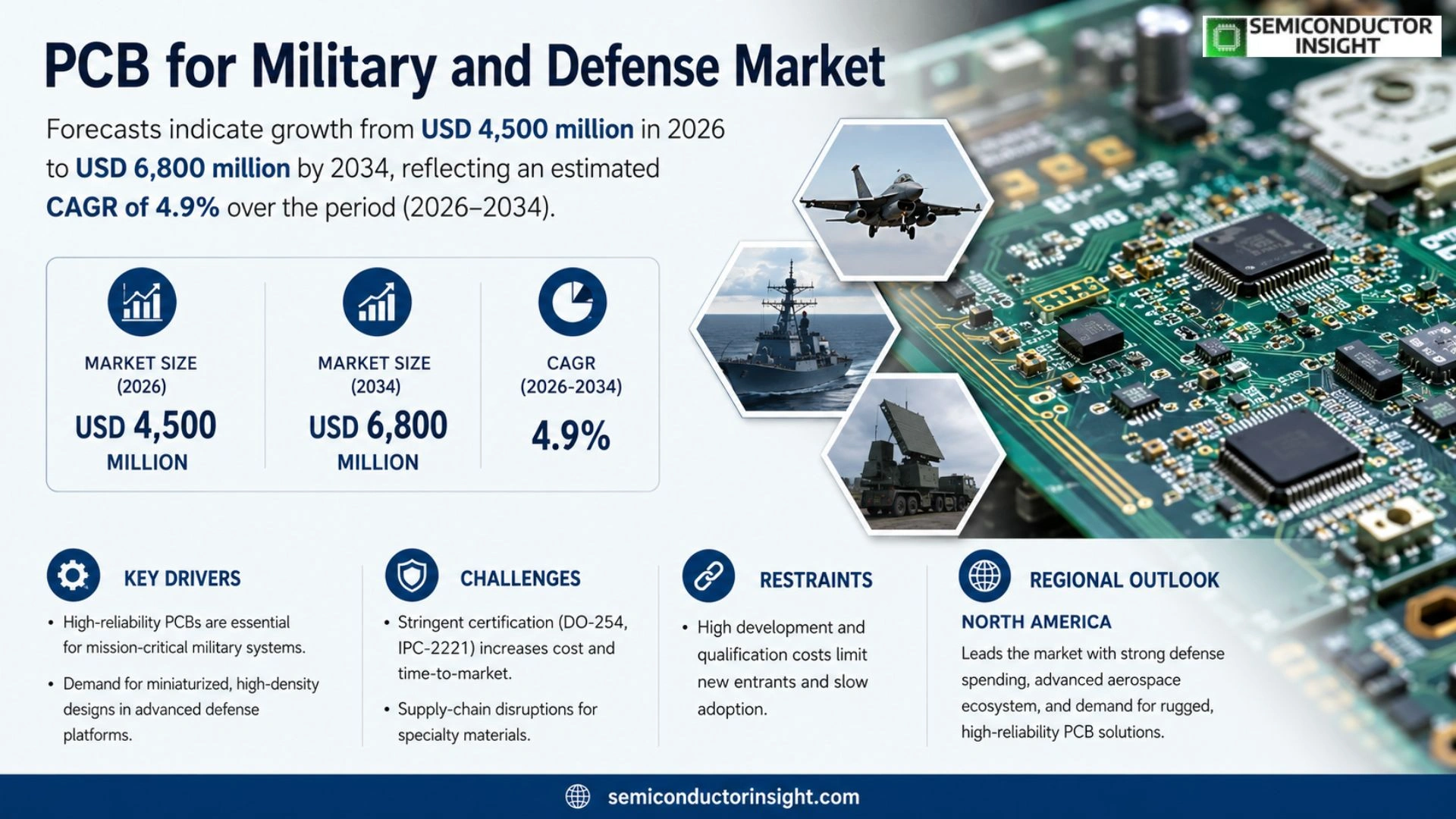
PCB for Military and Defense market was valued at USD 4,200 million in 2024. Forecasts indicate growth from USD 4,500 million in 2025 to USD 6,800 million by 2034, reflecting an estimated CAGR of approximately 4.9 % over the period.
Printed circuit boards (PCBs) dedicated to military and defense applications are engineered to satisfy rigorous standards of reliability, thermal endurance, electromagnetic compatibility,and shock resistance.These boards support critical subsystems such as avionics control units,the armored‑vehicle communication modules,the naval radar processors,and space‑weapon guidance electronics.
The upward trajectory is underpinned by rising defense budgets worldwide,the accelerated adoption of artificial‑intelligence‑enabled sensors,and growing demandfor high‑frequency RF performancein next‑generation combat platforms.Consequently manufacturers are investing heavilyin advanced materials like PTFE laminatesand low‑loss dielectric substratesto meet mission‑critical specifications.
MARKET DRIVERS
Strategic Necessity of High‑Reliability PCBs
PCB for Military and Defense market is propelled by nation‑state priorities that demand electronic assemblies capable of withstanding extreme thermal, mechanical, and electromagnetic stresses. Suppliers that certify compliance with MIL‑STD specifications win contracts that span land, sea, and air platforms, giving them a distinct competitive edge.
Shift Toward Miniaturized, High‑Density Designs
Modern combat systems increasingly rely on sensor fusion and real‑time data processing, which compresses functionality into smaller footprints. This trend forces manufacturers to adopt advanced substrate technologies and multilayer architectures, driving up demand for sophisticated PCB solutions.
➤ “Capability gaps are closed when designers replace legacy copper‑clad boards with ceramic‑based multilayers that survive shock loads beyond 200 g.”
Because procurement cycles are long and budget allocations are scrutinized, defense agencies prioritize vendors with proven track records in lifecycle support. Companies that can guarantee traceability, rapid redesign, and low failure rates tend to secure repeat business, reinforcing the market’s upward trajectory.
MARKET CHALLENGES
Stringent Certification Pathways
Achieving compliance with defense standards such as DO‑254 and IPC‑2221 demands extensive testing, documentation, and iterative redesign. The cost and time burden of these processes can deter new entrants, consolidating market share among a limited set of seasoned providers.
Other Challenges
Supply‑Chain Vulnerabilities
Geopolitical tensions and export‑control regimes frequently disrupt the flow of specialty materials,particularly high‑temperature laminates and rare‑earth alloys,forcing manufacturers to maintain oversized inventories or seek alternative sources, both of which erode margins.
MARKET RESTRAINTS
Cost Sensitivity Amid Budgetary Pressures
Defense budgets, while substantial, are subject to fiscal scrutiny and competing priorities such as personnel costs and emerging cyber capabilities. High‑end PCB technologies, especially those employing low‑loss dielectric materials, carry price tags that can exceed the cost thresholds of certain program managers.
When procurement officers apply rigorous cost‑benefit analyses, they may favor legacy designs that meet baseline performance, thereby slowing the adoption rate of next‑generation board architectures.
MARKET OPPORTUNITIES
Emergence of Unmanned Systems
The rapid fielding of unmanned aerial, ground, and maritime platforms creates a fresh demand envelope for lightweight, high‑reliability PCBs that can operate under continuous vibration and temperature cycling. Vendors that tailor multilayer flex‑rigid hybrids for these applications are positioned to capture incremental revenue streams.
Additionally, the integration of artificial‑intelligence accelerators within edge‑computing modules requires high‑frequency signal integrity, encouraging the development of advanced substrate stacks that can support GHz‑range performance without compromising durability.
PCB for Military and Defense Market Trends
Increasing Demand for Radiation‑Hardened, Miniaturized Boards
The defense sector’s push toward compact, high‑performance platforms has made radiation‑hardened and lightweight boards a strategic priority. Manufacturers are re‑engineering stack‑up architectures to meet the stringent reliability thresholds set by avionics, ground‑based radar and space‑borne sensors. Because the global PCB supply chain is heavily concentrated in East Asian hubs, buyers are reassessing risk exposure and negotiating longer‑term contracts that embed redundancy clauses. This shift forces suppliers to invest in advanced substrate technologies and to certify production lines against stringent military standards, thereby raising entry barriers for new entrants and rewarding firms with proven compliance records. The overall effect is a tightening of the value chain where procurement strategies now hinge on both technical capability and geopolitical stability.
Other Trends
Emergence of Flexible and Rigid‑Flex Form Factors
Operational environments that demand conformal fitting,such as unmanned aerial vehicles and wearable soldier systems,have sparked a surge in flexible and rigid‑flex solutions. These form factors allow designers to route circuitry around complex geometries without sacrificing signal integrity. As a result, component suppliers are expanding their portfolio of high‑temperature, low‑dielectric‑loss materials to accommodate the thermal stresses typical of combat scenarios. For system integrators, the move translates into reduced weight budgets and a lower parts count, which shortens assembly cycles and improves maintainability in the field. Companies that can rapidly prototype and scale these hybrid boards are gaining a competitive edge, especially in programs with aggressive deployment timelines.
Sustainability and Electronic‑Warfare Readiness
Environmental regulations and the growing emphasis on electronic‑warfare resilience are reshaping procurement criteria across PCB for Military and Defense market. Defense budgets now allocate funds for greener manufacturing practices, prompting major players to adopt recyclable laminates and to minimize hazardous waste streams. Simultaneously, the rise of spectrum‑denial tactics forces engineers to design boards with enhanced shielding and adaptive filtering capabilities. This dual pressure creates a niche for firms that can merge ecological compliance with high‑frequency performance, positioning them as preferred partners for next‑generation defense contracts. The convergence of these imperatives suggests that future investment will prioritize end‑to‑end lifecycle management, from material sourcing to field‑level service support.
COMPETITIVE LANDSCAPE
Key Industry Players
Competitive Outlook of PCB for Military & Defense
TTM Technologies dominates the defense‑oriented PCB segment thanks to its deep heritage in high‑reliability multilayer construction and a portfolio that aligns with stringent MIL‑STD requirements. Its global footprint, spanning North America, Europe and Asia, enables the firm to serve classified programs while maintaining a diversified supply base. The company’s ability to combine scale with bespoke engineering has forced many smaller outfits to specialize or pursue niche certifications, shaping a market where a handful of large integrators command the majority of volume and revenue. Chinese manufacturers, particularly those based in Shenzhen and Dongguan, collectively hold the largest share of production capacity, but they often partner with Western firms to meet export‑control criteria, creating a hybrid ecosystem that balances cost efficiency with compliance.
Beyond the lead tier, a cluster of midsize players supplies highly specific form‑factors or technology‑focused solutions. US Circuit Inc and Advanced Circuits, for example, have leveraged rapid prototyping capabilities to capture contracts for avionics and ground‑system upgrades where lead time is decisive. Companies such as Amitron Corp and Rigiflex Technology have carved out reputations around flexible and rigid‑flex assemblies that meet the weight‑critical demands of aerospace platforms. Meanwhile, regional specialists like Unimicron (Taiwan) and Shenzhen Longhai Circuit Technology Co. concentrate on high‑volume, low‑profile boards for naval applications, positioning themselves as preferred partners for OEMs seeking cost‑effective yet compliant components. This tiered competitive fabric encourages continuous innovation around material science, miniaturization and traceability, compelling all participants to refine quality‑management systems and invest in secure manufacturing footprints.
List of Key PCB Companies Profiled
- TTM Technologies
- US Circuit Inc
- Advanced Circuits
- Amitron Corp
- Rigiflex Technology
- Unimicron
- Shenzhen Longhai Circuit Technology Co.
- Millennium Circuits Limited
- Venture Electronics
- Speeda Technology
- Electromechpk
- PCBMay
- Twisted Traces
- Almatron Electronics
- NOD Electronics
Segment Analysis:
| Segment Category | Sub-Segments | Key Insights |
| By Type |
|
Rigid PCB serves as the backbone for high‑reliability platforms, offering structural stability and resistance to harsh environmental stressors. ‑ Preferred in missile guidance units where dimensional accuracy and vibration tolerance are critical. ‑ Supports thick copper layers for power‑intensive subsystems such as radar transmitters.Flexible PCB enables conformal integration on curved or moving surfaces, essential for wearable sensors in soldier‑centric systems. ‑ Provides weight savings and enhanced ergonomics for aerospace helmets and unmanned aerial vehicle (UAV) skin panels. ‑ Facilitates rapid redesign cycles for emerging electronic warfare applications. Rigid‑flex PCB combines the best of both worlds, delivering flexible interconnects alongside rigid support sections, crucial for complex avionics racks. |
| By Application |
|
Aviation demands PCBs that can withstand rapid pressure changes, extreme temperatures, and strict electromagnetic compatibility. ‑ Boards are engineered for mission‑critical flight control computers and advanced radar arrays. ‑ Emphasis on lightweight construction aligns with fuel‑efficiency initiatives.Ground Activities focus on ruggedized PCBs for armored vehicles, portable command consoles, and field‑deployed communication hubs. ‑ Designs prioritize shock resistance, thermal stability, and ease of maintenance in austere environments. ‑ Integration with hardened power management modules is a key differentiator. Naval Applications require corrosion‑resistant substrates and protective coatings to survive salt‑water exposure. Space Weapons represent the most demanding segment, where radiation hardness, out‑gassing control, and zero‑defect tolerance are mandatory. Others encompass niche domains such as unmanned ground robotics and portable electronic warfare kits, where rapid prototyping and low‑observable materials are valued. |
| By End User |
|
Armed Forces seek PCBs that can be field‑repaired and upgraded with minimal downtime, driving a preference for modular architectures. ‑ Emphasis on supply‑chain security leads to domestic sourcing of critical components. ‑ Integration with legacy weapon platforms remains a strategic priority.Defense Contractors focus on innovation cycles, leveraging advanced materials such as ceramic substrates to achieve higher performance thresholds. ‑ Close collaboration with military R&D labs accelerates technology transfer. ‑ Compliance with stringent procurement standards shapes design choices. Government Agencies overseeing procurement policies prioritize traceability, cyber‑resilience, and lifecycle support. |
| By Technology Trend |
|
AI‑enabled signal processing drives the need for high‑density interconnects that can host edge‑computing accelerators on the PCB itself. ‑ Designers embed low‑latency pathways to support real‑time threat analysis. ‑ Thermal management strategies evolve to dissipate heat from on‑board AI chips.5G‑compatible communication links require impedance‑controlled traces and advanced dielectric materials to maintain signal integrity at millimeter‑wave frequencies. ‑ Integration of antenna‑on‑board modules reduces system footprint for tactical radios. ‑ Robust shielding techniques mitigate interference in congested electromagnetic environments. Quantum‑resistant cryptographic modules are being incorporated into secure defense communication boards, necessitating tamper‑detectable laminates and controlled‑access firmware layers. |
| By Compliance Requirement |
|
MIL‑STD‑810 shapes mechanical design criteria, enforcing rigorous testing for shock, vibration, and extreme temperature cycles. ‑ PCB manufacturers embed reinforced stitching and toughened substrates to meet these standards. ‑ Documentation of test results becomes a critical part of the supplier qualification process.ITAR/EAR export controls dictate that certain high‑performance materials and design information remain within authorized jurisdictions. ‑ Companies implement strict data‑flow governance and compartmentalized production lines. ‑ This compliance influences the geographic placement of fabrication facilities for sensitive PCB variants. RoHS & REACH exemptions for defense allow the use of lead‑based solders and specialty flame‑ retardants when performance outweighs environmental concerns. |
Regional Analysis: PCB for Military and Defense Market
North America
Recent procurement cycles emphasize modularity and lifecycle affordability, prompting buyers to request PCBs that can be upgraded without full system redesign. Suppliers that offer configurable stack‑ups and interchangeable firmware gain favor, as they align with the armed forces’ push for adaptable platforms.
The diffusion of AI‑enabled sensors and quantum‑grade encryption demands tighter trace geometries and novel dielectric materials. Companies investing in high‑frequency laminate R&D are better positioned to meet the stringent signal‑integrity criteria of next‑gen combat systems.
Recent geopolitical frictions have reinforced the need for a localized component base. Fabricators that maintain dual‑source strategies for copper and epoxy resins can mitigate disruptions, preserving delivery commitments to critical defense programs.
Compliance with ITAR and EAR regulations shapes design choices, especially concerning trace concealment and anti‑tamper features. Manufacturers that embed compliance checks early in the layout process avoid costly redesigns downstream.
Europe
European defence agencies are consolidating procurement across NATO partners, creating a demand for standardized PCB architectures that balance performance with cross‑national certification. German and French manufacturers leverage strong engineering clusters to produce high‑reliability boards for land‑based systems, while the United Kingdom focuses on integrating electronic warfare capabilities into naval platforms. The region’s regulatory landscape, anchored by CE marking and specific military standards, forces suppliers to adopt rigorous validation protocols. As defence budgets tilt toward modernization of legacy fleets, PCB providers that can retrofit existing designs with enhanced shielding and miniaturized components find fertile ground for growth.
Asia‑Pacific
In the Asia‑Pacific, expanding defence spending is matched by a surge in indigenous electronics development programs. Nations such as Japan, India, and South Korea prioritize self‑reliance, prompting local PCB makers to upscale capabilities in high‑density interconnect and rugged coating technologies. The strategic emphasis on maritime security drives demand for boards that can survive prolonged exposure to saline environments. Moreover, regional collaborations on fifth‑generation fighter projects create opportunities for joint‑venture PCB production, where knowledge transfer accelerates adoption of advanced material stacks.
South America
South American defence markets remain comparatively modest, yet they are experiencing a shift from legacy procurement toward upgrade cycles for existing air and ground assets. Countries like Brazil and Colombia are investing in modernizing command‑and‑control infrastructure, which requires PCBs with enhanced thermal management for extended field deployment. Local manufacturers are beginning to partner with North‑American firms to acquire certification pathways, allowing them to supply boards that meet both regional and international standards.
Middle East & Africa
The Middle East & Africa region shows a distinct pattern of high‑visibility defense projects, often funded through sovereign wealth initiatives. Clients demand PCBs that can operate reliably in extreme temperature ranges and dusty conditions common to desert deployments. United Arab Emirates and Saudi Arabia are particularly interested in integrating unmanned combat aerial systems, which call for lightweight, high‑frequency boards with built‑in redundancy. African nations, while operating on tighter budgets, are focusing on durable, low‑maintenance solutions for border surveillance, opening a niche for PCB suppliers that can deliver cost‑effective yet robust designs.
Report Scope
This market research report provides a comprehensive analysis of the PCB for Military and Defense Market , covering the forecast period 2026–2034. It offers detailed insights into market dynamics, technological advancements, competitive landscape, and key trends shaping the industry.
Key focus areas of the report include:
- Market Overview: The report begins with an overview outlining its current market scenario, key growth indicators, and industry transformation drivers. It discusses macroeconomic factors, demand–supply balance, regulatory landscape, and the strategic role of semiconductors in powering advancements across industries such as automotive, telecommunications, consumer electronics, and industrial automation.
- Market Size & Forecast: Historical data and future projections for revenue, unit shipments, and market value across major regions and segments.
- Segmentation Analysis: Detailed breakdown by product type, technology, application, and end-user industry to identify high-growth segments and investment opportunities.
- Regional Insights: Insights into market performance across North America, Europe, Asia-Pacific, Latin America, and the Middle East & Africa, including country-level analysis where relevant.
- Competitive Landscape: Profiles of leading market participants, including their product offerings, R&D focus, manufacturing capacity, pricing strategies, and recent developments such as mergers, acquisitions, and partnerships.
- Technology Trends & Innovation: Assessment of emerging technologies, integration of AI/IoT, semiconductor design trends, fabrication techniques, and evolving industry standards.
- Market Drivers & Restraints: Evaluation of factors driving market growth along with challenges, supply chain constraints, regulatory issues, and market-entry barriers.
- Stakeholder Insights: Insights for component suppliers, OEMs, system integrators, investors, and policymakers regarding the evolving ecosystem and strategic opportunities.
Primary and secondary research methods are employed, including interviews with industry experts, data from verified sources, and real-time market intelligence to ensure the accuracy and reliability of the insights presented.
FREQUENTLY ASKED QUESTIONS:
What is the current market size of PCB for Military and Defense Market?
-> PCB for Military and Defense market forecasts indicate growth from USD 4,500 million in 2026 to USD 6,800 million by 2034, reflecting an estimated CAGR of approximately 4.9 %
Which key companies operate in PCB for Military and Defense Market?
-> Key players include TTM Technologies, US Circuit Inc, Ampel Inc, Millennium Circuits Limited, RUSH PCB Inc, OnBoard Circuits, Advanced Circuits, Amitron Corp, Electromechpk, Rigiflex Technology, Venture Electronics, PCBMay, Twisted Traces, Almatron Electronics, NOD Electronics, Speeda Technology, Unimicron, Shenzhen Longhai Circuit Technology Co.
What are the key growth drivers?
-> Key growth drivers include advancements in artificial intelligence (AI), deployment of 5G networks, and the rise of new energy vehicles, all of which stimulate demand for high‑performance military‑grade PCBs.
Which region dominates the market?
-> Asia (particularly China) dominates the market, with Chinese local PCB manufacturers holding the largest share. Europe and the United States also represent significant, though comparatively smaller, market portions.
What are the emerging trends?
-> Emerging trends include integration of AI and IoT capabilities into PCB designs, increasing reliance on 5G‑compatible substrates, and development of lightweight, high‑frequency flexible PCBs for defense aerospace applications.
Get Sample Report PDF for Exclusive Insights
Report Sample Includes
- Table of Contents
- List of Tables & Figures
- Charts, Research Methodology, and more...
 Download Sample Report PDF