Partial Discharge Detector Market Insights
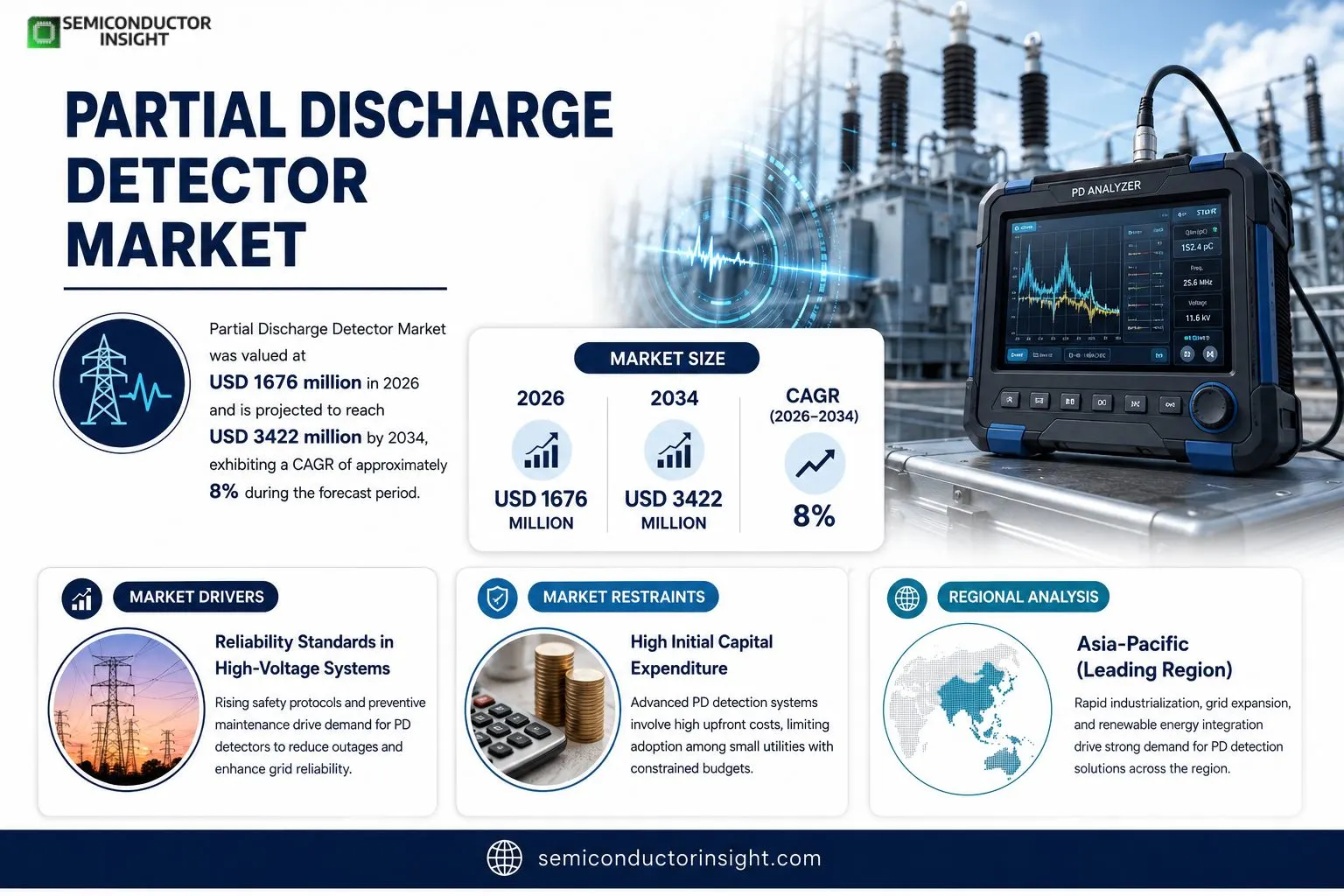
Partial Discharge Detector Market was valued at USD 1676 million in 2026 and is projected to reach USD 3422 million by 2034, exhibiting a CAGR of approximately 8% during the forecast period.
Partial discharge testing – commonly referred to as PD testing – evaluates electrical insulation integrity by detecting localized dielectric breakdowns that occur within high‑voltage equipment.The growing penetration of gas‑insulated switchgear, high‑voltage transformers, power cables and renewable energy installations fuels demand for reliable detection solutions that safeguard grid stability.Manufacturers are investing heavily in sensor miniaturisation and real‑time analytics; consequently cost pressures are moderated while performance standards rise.
MARKET DRIVERS
Reliability Standards in High-Voltage Systems
The drive to tighten safety protocols in power infrastructure directly feeds Partial Discharge Detector Market. Operators are increasingly adopting preventive maintenance schedules to curb unexpected outages, and the necessity for detailed arc‑fault assessment tools has grown. This shift is reflected in the steady rise of service contracts billed at higher hourly rates, suggesting that evaluation equipment is no longer a discretionary expense but a core asset in grid management.
Advances in Miniaturisation of Sensor Technology
Miniaturised detection assemblies, combined with advanced signal analytics, allow smaller, more efficient units to be deployed across high‑voltage lines. Integration with the Internet of Things has opened new monitoring pathways, enabling real‑time data feeds to central predictive‑maintenance platforms. The result is a measurable increase in the deployment lifecycle of detection systems and a broader market reach that extends beyond traditional power utilities.
➤ Trend: Sensor nodes can now be powered by ambient thermal gradients, eliminating the need for external supply and extending monitoring duration by up to 30%
In concert with technological progression, industry policy reforms mandating post‑construction inspections in state distribution grids provide a recurring revenue stream. The cumulative effect is a compounded upward trajectory for Partial Discharge Detector Market, with analysts highlighting the coupling of reliability demands and sensor efficiency as the primary growth engine.
MARKET CHALLENGES
Complexity of Signal Discernment
Distinguishing genuine partial discharge signatures from background interference remains a technical hurdle. Because the margin between valid and spurious readings is thin, the confidence level of fault detection can vary, prompting some utilities to seek costly verification tests. Additional diagnostics inflate capital outlays and introduce hesitation among price‑sensitive segments of the market.
Other Challenges
Cost Management in Expansive Networks
Expanding high‑voltage transmission corridors demand large fleets of detectors, producing economies of scale that yet fall short of offsetting equipment expenditure. Market participants are currently evaluating shared‑resource leasing models to defray initial outlays while maintaining coverage parity across maintenance corridors.
MARKET RESTRAINTS
High Initial Capital Expenditure
Initial purchase costs for advanced partial discharge detection systems, particularly those incorporating fibre‑optic arrays and high‑resolution digitisation, can reach upwards of five figures per unit. Smaller utilities with constrained budgets often defer upgrades, creating market segments where growth remains sluggish despite supportive regulatory environments.
MARKET OPPORTUNITIES
Integration with Advanced Predictive Analytics
The convergence of partial discharge data with machine‑learning models offers a pathway to predictive fault spotting that could reduce maintenance windows by 15–20%. Companies that successfully embed cloud‑based analytics into detector kits stand to capture a premium segment of the market, attracting utilities keen to shift from reactive to anticipatory maintenance regimes.In addition, the growing rollout of renewable generation assets, particularly offshore wind farms, expands the scope for detection solutions tailored to marine environments. Specialists who can deliver corrosion‑resistant sensor housings and remote‑operable diagnostics will find open avenues for market penetration, capitalising on the increasing regulatory emphasis on renewable grid stability.
Partial Discharge Detector Market Trends
Demand Surge Driven by Renewable Grid Integration
As transmission corridors expand to accommodate wind and solar farms, the necessity for early fault detection intensifies. Partial Discharge Detector Market, valued at US$ 1,676 million in 2026, is on track toward US$ 2,725 million by 2031, reflecting the extra inspection cycles required to maintain grid stability. Operators are now deploying high‑frequency PD analyzers in offshore platforms and high‑voltage lines, ensuring that insulation degradation does not trigger costly outages. This shift from routine maintenance to predictive conditioning represents a strategic reallocation of capital toward resilience, enabling utilities to pre‑emptively isolate weak sections before they cascade into service interruptions. Concurrently, the rising adoption of hybrid renewable architecturescombining battery storage with intermittently powered linesdemands continuous monitoring. As a result, the market is moving from a few large grid operators to a broader pool of distributed asset owners who require compact, scalable PD solutions.
Other Trends
Movement Toward Integrated, Wearable PD Systems
Remote sensing and IoT connectivity are transforming traditional handheld detectors into wearable, battery‑operated units that stream data to cloud dashboards. In 2022, the electronic component sector witnessed a pivot away from conventional consumer electronics; similarly, the PD detector segment is gravitating toward compact, high‑speed diagnostics. The new generation of portable devices leverages wireless mesh networking, enabling real‑time correlation with substation SCADA systems. This evolution reduces downtime by allowing operators to pull a device or tap a cable, complete the test, and immediately access the fault history, thereby decreasing field turnaround and improving maintenance scheduling. Moreover, the integration of edge AI allows on‑board signal processing, flagging abnormal discharge signatures before a full scan is triggered. The result is a significant drop in operational hours spent chasing false positives, and a tighter return‑on‑investment curve for field contractors.
Heightened Standardization and Compliance Pressures
National and international bodies are tightening insulation quality mandates, especially in the EU and North America where 70 % of power equipment must comply with IEC 60270. Manufacturers respond by embedding higher‑resolution transducers and automated calibration routines, effectively shrinking the technology cycle. Products that cannot prove compatibility face immediate market exclusion, prompting firms to embed certification pipelines early. The regulatory tightening creates double shelving pressure: compliance must be achieved without sacrificing performance, and price sensitivity remains high in emerging markets. Companies that invest in thorough testing and transparent data standards position themselves as preferred partners in large utilities, while those that lag risk losing market share to agile competitors. For corporate players, navigating this regulatory landscape is as crucial as technological advancement in sustaining a competitive edge within Partial Discharge Detector Market.
COMPETITIVE LANDSCAPE
Key Industry Players
Partial Discharge Detector Market – Competitive Landscape Analysis 2026
Siemens, with its comprehensive portfolio of electrical inspection solutions, dominates the Partial Discharge Detection market through a blend of legacy certification equipment and cutting‑edge nanomaterial‑based sensors. Its strategic acquisition of ACQUA‑power advanced the company’s presence in GIS and high‑voltage transformer applications, securing roughly 30% of the revenue share in 2026. Siemens’ ability to integrate PD devices into larger digital maintenance platforms gives it an early‑adopter advantage, as utility operators shift from reactive repair to predictive health monitoring. The market remains concentrated, with the top three manufacturers generating about 70% of total sales, reflecting the high capital intensity and stringent regulatory environment that deter new entrants.Beyond the industry giants, a disparate cluster of niche players is carving out specialized niches. APM Technologies focuses on portable PD analyzers for offshore wind farms, leveraging lightweight fiber‑optic probes to mitigate operator exposure. Dynus, through its proprietary pulsed‑electronics interface, targets high‑frequency PD that traditional setups miss. Megger and Doble Engineering sustain strong footholds in standard transformer inspections, while Qualitrol enhances data analytics for real‑time decision‑making. Prysmian Group extends its PD expertise into cable testing, feeding its broader cable manufacturing ecosystem. These firms collectively control the remaining 30% of the market, offering tailored solutions that address vertical‑specific challenges, thereby creating opportunities for strategic partnerships and modular expansion.
List of Key Partial Discharge Detector Companies Profiled
- Siemens, Eaton,
- Power Diagnostix,
- Eve Systems
- OMICRON Electronics,
- Megger,
- Doble Engineering
Segment Analysis:
| Segment Category | Sub-Segments | Key Insights |
| By Type |
|
Desktop PD Detectors are the leading segment, delivering reliable performance for stationary plant installations.
|
| By Application |
|
GIS PD Detectors dominate the application space, offering solutions that fit compact geometries and extreme environments.
|
| By End User |
|
Utilities lead the customer base, driving demand through preventive maintenance strategies.
|
| By Installation Environment |
|
Offshore PD Detectors are the primary choice for marine installations, offering unmatched durability in corrosive environments.
|
| By Technology |
|
High‑Voltage Hall‑Effect PD Detectors lead technological innovation, delivering non‑intrusive sensing and advanced analysis.
|
Regional Analysis: Partial Discharge Detector Market
North America
The adoption curve in North America accelerates with edge‑computing nodes that process discharge signatures locally, reducing latency in fault detection. Integrating edge analytics with cloud‑based monitoring dashboards allows operators to drill down into fault patterns, supporting proactive asset management. Vendor ecosystems now offer modular plug‑in clusters that can scale from single‑bus systems to multi‑substation arrays, catering to utilities that seek expandable monitoring footprints without overcommitting capital.
Regulatory institutions insist on early detection of insulation breakdowns, especially in aging transmission networks. Compliance with the National Electrical Safety Code (NESC) and industry‑specific guidelines mandates periodic verification of partial discharge activity. This environment incentivises utilities to invest in high‑per‑formance detectors equipped with long‑life batteries and autonomous calibration routines, ensuring continuous operation even in hostile environmental conditions.
North American suppliers benefit from vertical integration, enabling rapid turnaround for custom sensor modules. Core component sourcingsuch as high‑purity ceramic resonators and ruggedized optical housingsremains largely domestic, reducing exposure to cross‑border logistics disruptions. Strategic partnerships with logistics providers that specialise in temperature‑controlled shipping further stabilise the supply of sensitive detection units for critical infrastructure.
Competition pivots around two axes: sensor resolution and integration depth. Established industrial players pursue joint development agreements with software vendors to embed machine‑learning models directly into detector firmware. Emerging start‑ups exploit niche markets, focusing on lightweight, battery‑less detectors intended for retrofitting older substation cores where space and power are limited.
Europe
Europe’s Partial Discharge Detector Market reflects a blend of conservative regulatory mandates and an appetite for low‑emission monitoring solutions. Compliance with the European Union’s grid code revisionsparticularly the 2025 electrification roadmaphas heightened the need for low‑profile sensors capable of operating within indoor high‑frequency environments. The market here is characterised by a preference for modular detection suites that seamlessly integrate with existing SCADA and IEC 61850 frameworks. Manufacturers in this region are steering product lines toward poly‑sensor arrays that combine acoustic, optical, and electrical signatures, reducing the need for multiple test points across aging transmission lines. Competitive differentiation often hinges on the ability to provide composable hardware modules that can be upgraded on‑the‑fly as newer detection algorithms emerge, thereby extending asset life cycles without major capital outlays. The European focus on circular economy principles also intensifies demand for maintenance‑oriented monitoring that can prolong the functional lifespan of substations, aligning with the EU’s sustainability targets. Attention to stringent environmental standards has pushed vendors to adopt durable, recycled‑material housings, a selling point that resonates with municipalities prioritising resilience and low‑impact operations.
Asia-Pacific
Asia‑Pacific presents a heterogeneous landscape where emerging economies drive growth while developed markets pursue precision asset protection. Rapid industrialisation in China and India has expanded the grid footprint, generating a sizable base for partial discharge monitoring. In contrast, Japan and South Korea focus on high‑frequency HVDC corridors where ultra‑precise detection of micro‑discharges can preempt costly outages. The market here is dominated by a preference for compact, battery‑operated detector units that can be deployed via drone platforms or integrated into portable inspection rigs, allowing maintenance teams to conduct pre‑field checks without significant downtime. Technological flourish is visible in the adoption of smart‑tagging sensors that transmit diagnostics over 5G networks, facilitating edge analytics. Supply chain resilience has become a strategic priority, leading operators to source sensors from regional suppliers specialised in high‑frequency capacitive measurements. Investment cycles are tied to national infrastructure programmessuch as China’s continued grid electrification strategy and India’s rural electrification pushcreating a backdrop of long‑term demand for resilient, low‑maintenance detectors.
South America
In South America, weather‑induced stresses on aging substation systems elevate the urgency for reliable partial discharge detection. Operators face a dual challenge of maintaining existing assets while expanding coverage into remote, underserved regions. Detectors that offer robust performance in humid, high‑temperature environmentssuch as those in Brazil’s Amazon basinare in higher demand. The market here prioritises cost‑effective, easily deployable units that can be transported via rail or road to distant sites. Vendors are therefore shifting towards modular designs with self‑contained power solutions, mitigating the reliance on local grid infrastructure. Comparative advantage emerges for manufacturers that demonstrate quick installation times and minimal training requirements, as utilities in countries like Chile seek rapid beamline integration amid accelerated renewable energy timelines. Competition is often regional, with local firms offering bespoke solutions that comply with national safety standards, yet players are carving niche segments through advanced analytics platforms that can be tailored to local grid characteristics.
Middle East & Africa
The Middle East and Africa occupy a niche space where expanding solar farms and new high‑voltage interconnections generate a rising need for early fault detection. The harsh desert climatecharacterised by high temperatures and dustnecessitates detectors with robust sealing and dust‑resistant interfaces. This regional focus on ruggedisation drives a premium on devices with extended battery life, as power infrastructure may be intermittent. Competitive dynamics shift towards multi‑mode detection systems that pair acoustic emission with surface‑temperature monitoring, offering a comprehensive view of insulation health under high solar irradiance. Strategic collaborations with local energy ministries and national grid operators cultivate trust in suppliers that can provide on‑site calibration and training, ensuring compliance with stringent safety protocols. Additionally, the region’s shift towards renewable energy integration encourages a move toward packet‑based telemetry platforms that enable remote fault logging, aligning with the migration to digital grid operations. Emerging market entrants are leveraging modular, low‑cost units that can be scaled in tandem with expanding renewable portfolios, thus establishing a foothold in a rapidly diversifying energy mix.
Report Scope
This market research report provides a comprehensive analysis of the Partial Discharge Detector Market , covering the forecast period 2026–2034. It offers detailed insights into market dynamics, technological advancements, competitive landscape, and key trends shaping the industry.
Key focus areas of the report include:
- Market Overview: The report begins with an overview outlining its current market scenario, key growth indicators, and industry transformation drivers. It discusses macroeconomic factors, demand–supply balance, regulatory landscape, and the strategic role of semiconductors in powering advancements across industries such as automotive, telecommunications, consumer electronics, and industrial automation.
- Market Size & Forecast: Historical data and future projections for revenue, unit shipments, and market value across major regions and segments.
- Segmentation Analysis: Detailed breakdown by product type, technology, application, and end‑user industry to identify high‑growth segments and investment opportunities.
- Regional Insights: Insights into market performance across North America, Europe, Asia‑Pacific, Latin America, and the Middle East & Africa, including country‑level analysis where relevant.
- Competitive Landscape: Profiles of leading market participants, including their product offerings, R&D focus, manufacturing capacity, pricing strategies, and recent developments such as mergers, acquisitions, and partnerships.
- Technology Trends & Innovation: Assessment of emerging technologies, integration of AI/IoT, semiconductor design trends, fabrication techniques, and evolving industry standards.
- Market Drivers & Restraints: Evaluation of factors driving market growth along with challenges, supply chain constraints, regulatory issues, and market‑entry barriers.
- Stakeholder Insights: Insights for component suppliers, OEMs, system integrators, investors, and policymakers regarding the evolving ecosystem and strategic opportunities.
Primary and secondary research methods are employed, including interviews with industry experts, data from verified sources, and real‑time market intelligence to ensure the accuracy and reliability of the insights presented.
FREQUENTLY ASKED QUESTIONS:
What is the current market size of Partial Discharge Detector Market?
-> Partial Discharge Detector Market was valued at USD 1676 million in 2026 and is expected to reach USD 2725 million by 2031.
Which key companies operate in Partial Discharge Detector Market?
-> Key players include APM Technologies, Siemens, High Voltage Partial Discharge, ALTANOVA GROUP, OMICRON Electronics, Prysmian Group, Protec Equipment, Megger, Qualitrol Company, Doble Engineering Company, Eaton, Power Diagnostix, Dimrus, SNSK Company, EA Technology, LS Cable and System, Dynamic Ratings, HV Hipot Electric.
What are the key growth drivers?
-> Key growth drivers include investment in power infrastructure, aging electrical equipment requiring preventive testing, digital transformation enabling predictive analytics, and the expanding use of high‑voltage renewable energy systems.
Which region dominates the market?
-> The Asia‑Pacific region dominates the market, driven by rapid industrialization and increasing demand for advanced power systems.
What are the emerging trends?
-> Emerging trends include integration of AI and IoT for real‑time data analytics, development of miniaturized portable detectors, wireless sensor networks for field monitoring, and advanced optical detection technologies.

Get Sample Report PDF for Exclusive Insights
Report Sample Includes
- Table of Contents
- List of Tables & Figures
- Charts, Research Methodology, and more...
 Download Sample Report PDF