Panel Level Redistribution Layer (RDL) Market Insights
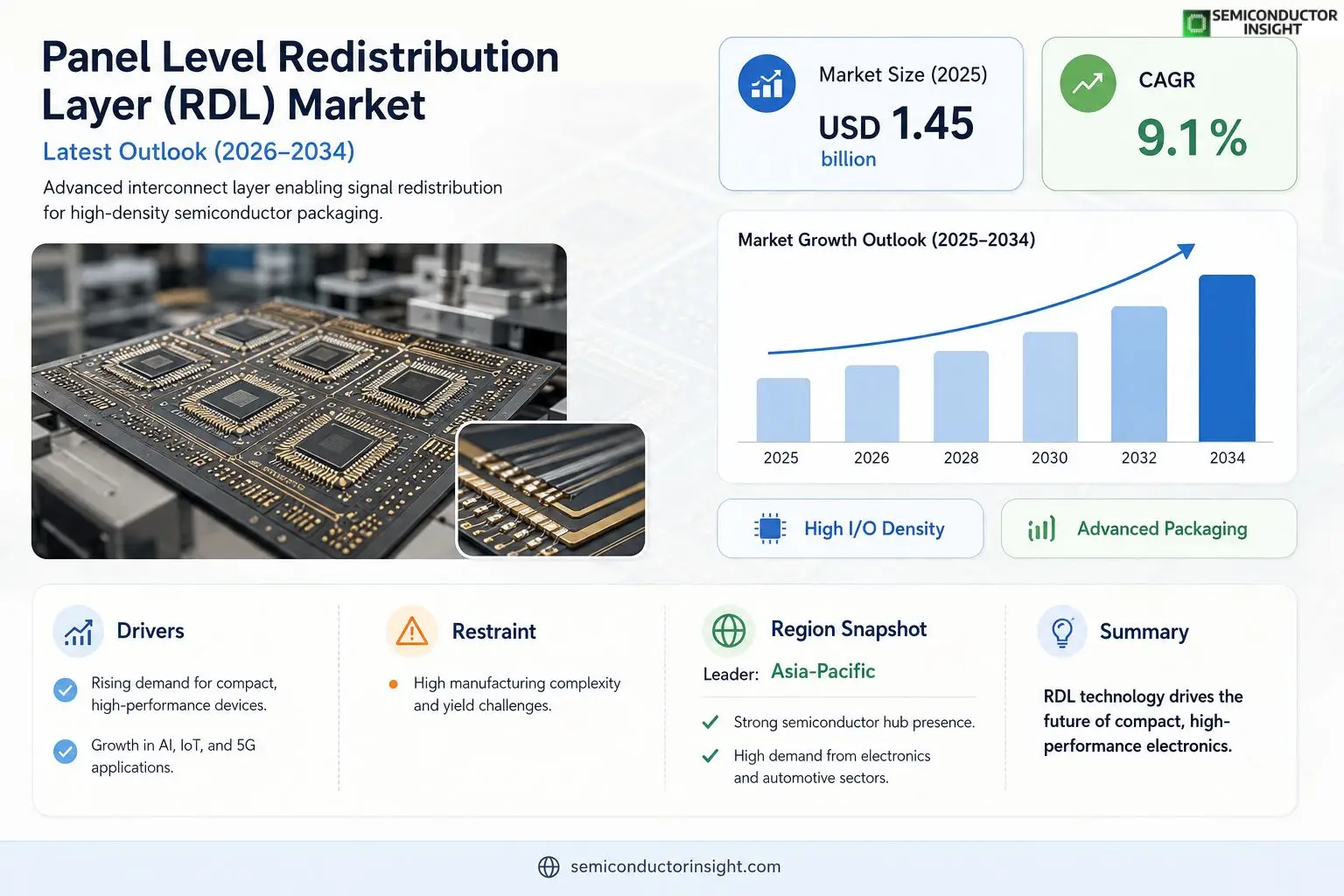
Global Panel Level Redistribution Layer (RDL) market size was valued at USD 1.45 billion in 2025. The market is projected to grow from USD 1.58 billion in 2026 to USD 3.12 billion by 2034, exhibiting a CAGR of 9.1% during the forecast period.
A Panel Level Redistribution Layer (RDL) is an advanced interconnect technology used in semiconductor packaging, enabling high-density routing of electrical signals between integrated circuits (ICs) and external components. RDL acts as a critical intermediary layer that redistributes input/output (I/O) connections from fine-pitch bumps on a die to larger, more manageable pitches on a substrate or printed circuit board (PCB). This technology supports fan-out wafer-level packaging (FOWLP), system-in-package (SiP), and heterogeneous integration, facilitating miniaturization, improved electrical performance, and cost efficiency in electronic devices such as smartphones, automotive electronics, and high-performance computing systems.
The rapid expansion of the Panel Level RDL market is driven by surging demand for compact, high-performance electronic devices and the proliferation of advanced packaging technologies across industries. The shift toward panel-level processing,where multiple dies are packaged simultaneously on large panels rather than individual wafers,enhances scalability and reduces manufacturing costs, making it increasingly attractive for mass production. Furthermore, the growing adoption of artificial intelligence (AI), Internet of Things (IoT), and 5G technologies is accelerating the need for efficient signal redistribution solutions with higher I/O density and lower latency. Strategic collaborations among key industry players are also propelling innovation; for example, in March 2024, ASE Group announced an expansion of its panel-level RDL production capacity in Taiwan to meet rising demand from AI server applications.
MARKET DRIVERS
Proliferation of 3D Stacking and Heterogeneous Integration
Global semiconductor industry is witnessing a paradigm shift towards 3D stacking and heterogeneous integration, which significantly fuels Panel Level Redistribution Layer (RDL) Market. As companies strive to maximize transistor density and reduce signal latency, RDL technologies provide essential vertical interconnects that bridge multiple dies within a single package.
Advancements in interconnect performance allow for improved signal integrity over longer traces, facilitating the development of high-performance graphic processing units (GPUs) and application processors. This transition is critical for supporting next-generation AI applications that require massive parallel processing capabilities.
Increasing Demand for Advanced Mobile Devices
Surging consumer demand for smartphones, tablets, and wearable electronics with superior functionality necessitates robust packaging solutions. The ability of PLP to integrate passive components onto the redistribution layer streamlines the production of advanced mobile devices, reducing the overall form factor.
➤ Adoption of panel-level processes allows for higher throughput compared to die-level redistribution, reducing overall manufacturing costs per unit.
Ultimately, the relentless pursuit of performance enhancement in computing and communication sectors serves as the fundamental engine propelling the industry forward.
MARKET CHALLENGES
Manufacturing Complexity and Yield Management
Implementing panel-level redistribution involves managing complex alignment tasks over large substrate areas, which significantly hampers yield rates during mass production. The scale of panel-level processing increases the probability of defect accumulation, requiring sophisticated process controls and real-time monitoring systems.
High Capital Expenditure Requirements
Investing in the capital equipment necessary for panel wafer processing, such as high-precision panel printers and advanced inspection systems, represents a massive hurdle for smaller foundries. The return on investment is often delayed until high volumes are achieved, deterring potential entrants and slowing market penetration.
Other Challenges
Thermal Management Constraints
Maintaining optimal thermal efficiency presents significant difficulties when bonding dies to large substrates, potentially affecting long-term reliability in high-load applications.
MARKET RESTRAINTS
Cost Inefficiency for Mid-Sized Chips
For standard mid-sized chips, the cost of implementing panel-level redistribution technology remains higher than traditional packaging methods due to the lower economies of scale at which panels are processed. This economic barrier significantly slows the migration of smaller logic devices to this technology.
Slow Adoption in Legacy Foundries
Established semiconductor fabrication facilities are deeply invested in existing process flows, resulting in a reluctance to modify infrastructure for panel-level solutions. The lack of industry-wide standardization further exacerbates the slow pace of adoption, creating a fragmented market landscape.
MARKET OPPORTUNITIES
Expansion in Advanced Driver Assistance Systems (ADAS)
The automotive sector is emerging as a critical sector for growth, driven by the integration of complex sensors, microcontrollers, and display modules. Panel Level Redistribution Layer (RDL) Market is poised to benefit from the surge in ADAS demand, where high-reliability and advanced packaging are paramount for safety and functionality.
Chiplet Economy and Inorganic Integration
The shift towards the chiplet architecture allows for modular design philosophy, breaking down large, complex chips into smaller, manageable components. Panel-level RDL serves as an ideal candidate for interconnecting these chiplets, offering scalable solutions for future computing architectures and reducing time-to-market.
Panel Level Redistribution Layer (RDL) Market Trends
Panel Level Redistribution Layer (RDL) Market is experiencing significant growth, driven by the increasing demand for compact and high-performance electronic devices. This advanced interconnect technology is crucial for facilitating miniaturization and improving electrical performance in various applications.
Other Trends
Panel-Level Processing Adoption
The industry is witnessing a strong shift toward panel-level processing. This approach, where multiple dies are packaged on large panels, enhances scalability and offers the potential for reduced manufacturing expenses, making it a compelling solution for mass production of sophisticated electronic components.
Growing Demand from Advanced Packaging
The proliferation of advanced packaging technologies, including fan-out wafer-level packaging (FOWLP) and system-in-package (SiP), is a key driver for the Panel Level RDL market. These technologies rely heavily on efficient signal redistribution, boosting the need for high I/O density and low latency solutions in products like smartphones and automotive electronics.
Strategic Collaborations and Capacity Expansion
Strategic partnerships among key players are fueling innovation and market expansion. For instance, major manufacturers are actively expanding their panel-level RDL production capacities to address the escalating demand, particularly from emerging sectors like artificial intelligence (AI) and 5G applications.
The consistent advancements in Panel Level Redistribution Layer (RDL) technology are enabling the development of more powerful and efficient electronic devices. This trend is expected to continue shaping the landscape of the electronics industry, underscoring the importance of RDL in future innovations.
COMPETITIVE LANDSCAPEKey Industry Players
Panel Level Redistribution Layer (RDL) Market
Global Panel Level Redistribution Layer (RDL) market is characterized by a mix of established semiconductor packaging companies and specialized RDL solution providers. Key players are focusing on expanding their manufacturing capacities and technological capabilities to cater to the growing demand from high-performance electronic devices. The market is witnessing significant investments in R&D to develop advanced RDL materials and processes for demanding applications like AI and 5G. Strategic partnerships and collaborations are also becoming increasingly important for companies to gain a competitive edge and accelerate innovation in this rapidly evolving market. Several companies are expanding their footprint in regions like Taiwan and China to be closer to the manufacturing hubs of electronic devices.
Competition in the Panel Level RDL market is intensifying with the emergence of new players and existing companies expanding their product portfolios. The focus is shifting towards offering customized RDL solutions that meet the specific requirements of different applications and customer segments. Companies are also emphasizing quality, reliability, and cost-effectiveness to gain market share. The increasing adoption of panel-level processing is driving the need for scalable and efficient RDL manufacturing, leading to investments in advanced equipment and processes.
List of Key Panel Level RDL Companies Profiled
- ASE Group
- Amkor Technology
- Shelli Technology Co., Ltd.
- Nan Ya Plastics Corporation
- JC Microelectronics Inc.
- Epcos (Murata Electronics)
- Toyota Motor Corporation
- TDK Corporation
- Vishay Intertechnology, Inc.
- Kymopack Co., Ltd.
- Powertech Technology Co., Ltd.
- ChipMOS Technologies Inc.
- GlobalWafers Inc.
- Linx Technology Corp.
- Rising Star Technology Co., Ltd.
Segment Analysis:
| Segment Category | Sub-Segments | Key Insights |
| By Type |
|
Leading Segment is Organic RDL, favored for its flexibility and compatibility with various semiconductor materials. This type is widely utilized in consumer electronics and automotive applications due to its cost-effectiveness and ease of processing. |
| By Application |
|
Leading Segment application is in Smartphones, driven by the need for smaller, more powerful devices with advanced connectivity features. RDL enables the integration of multiple functionalities within a compact form factor, contributing to thinner designs and enhanced performance. |
| By End User |
|
Leading Segment end user is Consumer Electronics Manufacturers, who are continuously seeking advanced packaging solutions to meet the demands for miniaturization and improved performance in their products. The adoption of RDL facilitates the integration of complex circuits and components into smaller devices. |
| By Node Size |
|
Leading Segment for advanced nodes is driven by the increasing complexity of modern integrated circuits, which necessitates higher I/O density and improved signal integrity. RDL plays a crucial role in enabling advanced packaging techniques required for these nodes. |
| By Packaging Technology |
|
Leading Segment for FOWLP and SiP is in High-Performance Computing, where the need for high bandwidth and low latency interconnects is paramount. RDL is a key enabler for these advanced packaging technologies. |
Regional Analysis: North America
United States
The primary drivers for the RDL market in the United States include stringent data privacy laws (like CCPA), the rise of big data, and the increasing adoption of cloud computing.
Ongoing advancements in encryption, blockchain, and artificial intelligence are fueling innovation in RDL solutions, leading to enhanced security and efficiency.
The US RDL market features a mix of established players and emerging startups, all vying for market share through product differentiation and strategic partnerships.
The future of the RDL market in the United States appears promising, with continued growth expected across different industry verticals.
Europe
The European Panel Level Redistribution Layer (RDL) Market presents a dynamic landscape shaped by stringent data protection regulations like GDPR. Businesses across Europe are increasingly focused on implementing robust RDL solutions to ensure data sovereignty and compliance. The market is witnessing a growing demand for privacy-enhancing technologies within RDL frameworks. Key trends include the adoption of federated learning and differential privacy techniques to protect sensitive data while enabling data sharing for analysis. The rise of the Internet of Things (IoT) is also driving the need for secure RDL solutions to manage data generated by connected devices.
Asia-Pacific
The Asia-Pacific region is emerging as a high-growth market for Panel Level Redistribution Layer (RDL) solutions. Rapid digitalization and increasing data generation across industries like e-commerce, finance, and telecommunications are fueling this growth. Government initiatives promoting data localization and cross-border data transfer are also contributing to market expansion. The adoption of cloud computing and edge computing architectures is driving demand for RDL solutions that can manage data at scale and across distributed environments.
South America
The South American RDL Market is in its nascent stage but holds significant potential for growth. Increased awareness of data privacy and security concerns, coupled with the expansion of digital infrastructure, is creating a favorable environment for RDL solutions. The adoption of RDL for financial services and government sectors is expected to be a key growth driver. Challenges include limited investment in technology infrastructure and regulatory complexities in certain countries.
Middle East & Africa
The Middle East and Africa RDL market is characterized by increasing investments in digital transformation and cybersecurity. The growing adoption of cloud services and the rise of data-intensive industries are driving demand for RDL solutions. Government initiatives to promote data localization and economic diversification are also contributing to market growth. The healthcare sector is expected to be a key adopter of RDL for patient data management and privacy.
Report Scope
This market research report provides a comprehensive analysis of the Panel Level Redistribution Layer (RDL) Market , covering the forecast period 2026–2034. It offers detailed insights into market dynamics, technological advancements, competitive landscape, and key trends shaping the industry.
Key focus areas of the report include:
- Market Overview: The report begins with an overview outlining its current market scenario, key growth indicators, and industry transformation drivers. It discusses macroeconomic factors, demand–supply balance, regulatory landscape, and the strategic role of semiconductors in powering advancements across industries such as automotive, telecommunications, consumer electronics, and industrial automation.
- Market Size & Forecast: Historical data and future projections for revenue, unit shipments, and market value across major regions and segments.
- Segmentation Analysis: Detailed breakdown by product type, technology, application, and end-user industry to identify high-growth segments and investment opportunities.
- Regional Insights: Insights into market performance across North America, Europe, Asia-Pacific, Latin America, and the Middle East & Africa, including country-level analysis where relevant.
- Competitive Landscape: Profiles of leading market participants, including their product offerings, R&D focus, manufacturing capacity, pricing strategies, and recent developments such as mergers, acquisitions, and partnerships.
- Technology Trends & Innovation: Assessment of emerging technologies, integration of AI/IoT, semiconductor design trends, fabrication techniques, and evolving industry standards.
- Market Drivers & Restraints: Evaluation of factors driving market growth along with challenges, supply chain constraints, regulatory issues, and market-entry barriers.
- Stakeholder Insights: Insights for component suppliers, OEMs, system integrators, investors, and policymakers regarding the evolving ecosystem and strategic opportunities.
Primary and secondary research methods are employed, including interviews with industry experts, data from verified sources, and real-time market intelligence to ensure the accuracy and reliability of the insights presented.
FREQUENTLY ASKED QUESTIONS:
What is the current market size of Panel Level Redistribution Layer (RDL) Market?
-> Panel Level Redistribution Layer (RDL) Market was valued at USD 1.45 billion in 2025 and is expected to reach USD 3.12 billion by 2034, reflecting a CAGR of 9.1% over the forecast period.
Which key companies operate in Panel Level Redistribution Layer (RDL) Market?
-> Key players include ASE Group, among others.
What are the key growth drivers?
-> Key growth drivers include rising demand for compact high‑performance electronic devices, the rapid adoption of advanced packaging technologies such as fan‑out wafer‑level packaging and system‑in‑package, and the proliferation of AI, IoT and 5G applications that require higher I/O density and lower latency.
Which region dominates the market?
-> Asia‑Pacific holds the largest market share, driven by the concentration of semiconductor fabs and panel‑level production facilities in the region.
What are the emerging trends?
-> Emerging trends include increased panel‑level RDL capacity expansions, integration of RDL with heterogeneous integration and SiP solutions, and the development of AI‑server specific RDL processes to meet the computing demands of next‑generation data centers.

Get Sample Report PDF for Exclusive Insights
Report Sample Includes
- Table of Contents
- List of Tables & Figures
- Charts, Research Methodology, and more...
 Download Sample Report PDF