ORing Controller Market Insights
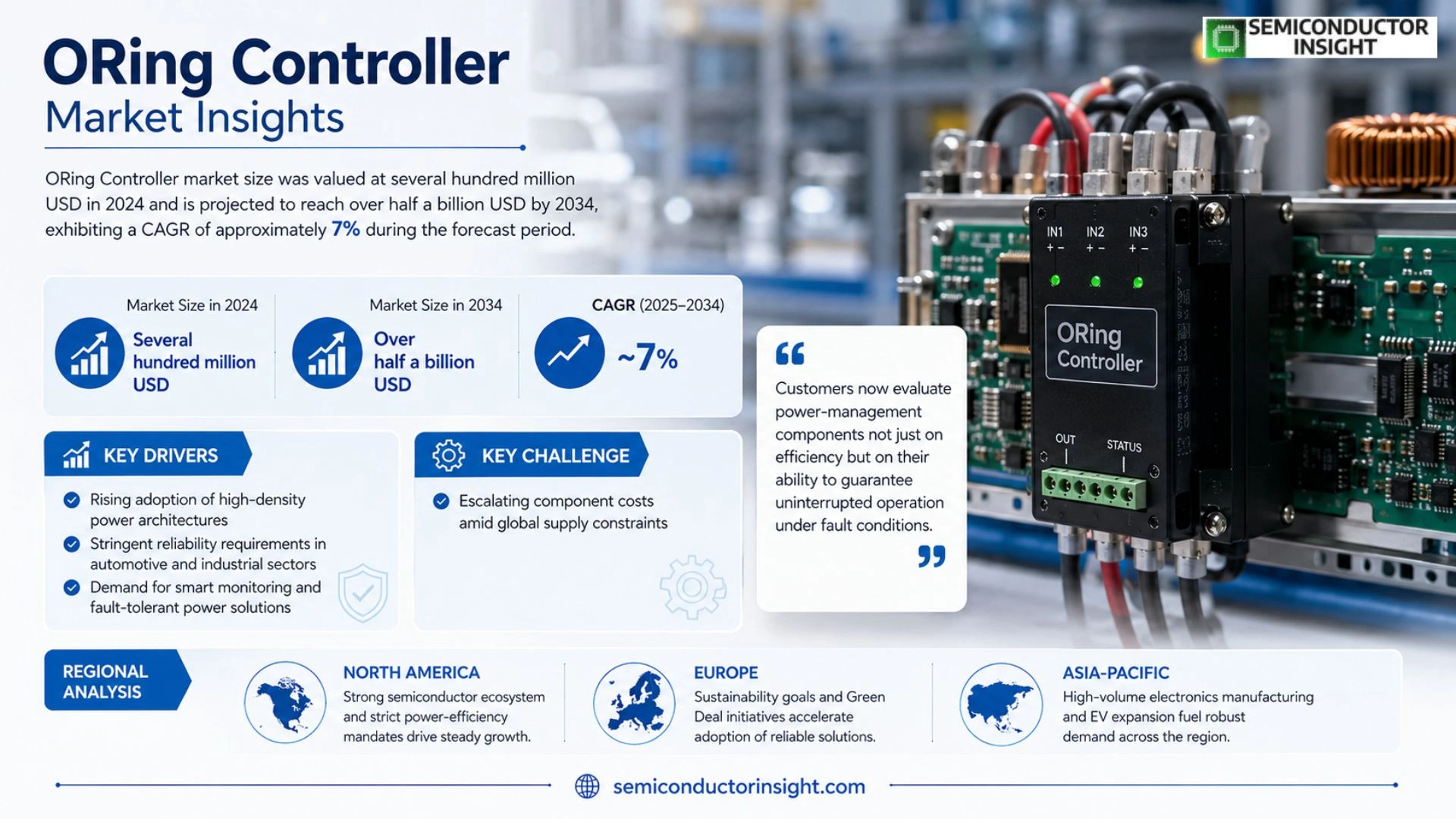
ORing Controller market size was valued at several hundred million USD in 2024. The market is projected to reach over half a billion USD by 2034, exhibiting a CAGR of approximately 7% during the forecast period.
An ORing controller, also known as an ideal diode controller, creates near‑perfect diodes using signal or back‑to‑back N‑channel or P‑channel MOSFETs. These devices enable low‑loss OR connections of multiple power supplies, thereby improving overall system efficiency, reducing heat dissipation and minimizing voltage drop across the OR’ing circuit.
The outlook remains strong because industrial automation continues to expand, data‑center reliability demands grow, and IoT‑driven smart‑city projects require robust power management solutions. Recent product launches from Analog Devices and Texas Instruments illustrate accelerating adoption, while key players such as Analog Devices, Texas Instruments, Diodes Incorporated, Renesas Electronics, Infineon Technologies, Vicor, Silergy, Bel Fuse and Joulwatt drive competitive innovation.
MARKET DRIVERS
Increasing Adoption of High‑Density Power Architectures
Designers of complex electronic systems are consolidating power distribution to reduce board space and improve efficiency. This shift pushes manufacturers to integrate ORing controllers that can reliably manage multiple supply rails, a move that directly boosts demand for the ORing Controller Market.
Stringent Reliability Requirements in Automotive and Industrial Sectors
Regulatory bodies are tightening fault‑tolerance standards for electric vehicles and factory automation equipment. As a result, OEMs prioritize redundancy solutions, creating a clear preference for ORing controllers capable of seamless load sharing during supply anomalies.
➤ “Customers now evaluate power‑management components not just on efficiency but on their ability to guarantee uninterrupted operation under fault conditions.”
Manufacturers that embed smart monitoring and remote‑diagnostic features into ORing controllers are gaining a competitive edge, prompting a noticeable shift in purchasing criteria across the ORing Controller Market.
MARKET CHALLENGES
Escalating Component Costs Amid Global Supply Constraints
Raw‑material shortages are driving up the price of silicon and high‑performance passives, which translates into higher bill‑of‑materials for ORing solutions. Smaller system integrators, in particular, find it difficult to absorb these increments without eroding margins.
Other Challenges
Design Complexity
Integrating ORing controllers into multi‑rail topologies demands precise coordination of voltage thresholds and timing, a task that often exceeds the expertise of traditional design teams.
Furthermore, the lack of standardized reference designs forces engineers to spend additional development cycles on validation, slowing time‑to‑market for new products.
MARKET RESTRAINTS
Limited Awareness of Advanced ORing Features
Many end‑users remain focused on basic over‑current protection and overlook newer capabilities such as dynamic load‑balancing and predictive fault analytics. This knowledge gap curtails the willingness to invest in higher‑priced, feature‑rich controllers.
In addition, legacy designs that rely on discrete diode arrays continue to dominate in cost‑sensitive segments, restricting the overall penetration rate of modern ORing solutions.
Regulatory compliance testing can also be a deterrent; the certification process for novel ORing architectures is often perceived as cumbersome, discouraging early adoption.
MARKET OPPORTUNITIES
Emergence of Edge‑Computing Platforms
The proliferation of edge devices demands compact, reliable power‑management blocks. ORing controllers that combine fault isolation with telemetry can serve as a critical enabler for distributed AI workloads, opening a sizable revenue channel.
Another promising avenue lies in the rollout of 5G infrastructure, where base stations require ultra‑stable power inputs. Tailoring ORing solutions to meet the stringent uptime criteria of telecom operators could unlock long‑term contracts.
Finally, partnerships between semiconductor firms and cloud‑service providers are fostering the development of firmware‑updatable ORing controllers, a feature that aligns with the increasing preference for remote maintenance and lifecycle extension.
ORing Controller Market Trends
Efficiency Gains through Ideal Diode Architecture
The shift toward ideal‑diode implementations is reshaping power‑management strategies across a wide range of equipment. By replacing traditional Schottky diodes with MOSFET‑based ORing controllers, designers achieve markedly lower forward voltage, which translates into measurable reductions in heat generation. In high‑density data‑center racks, even a 0.1 V drop per rail can save several kilowatts of cooling power, directly improving total‑cost‑of‑ownership. This efficiency imperative is prompting original equipment manufacturers to adopt ORing controllers as a default component rather than an after‑thought, especially in platforms that must meet stringent energy‑consumption standards.
Other Trends
Industrial Automation Adoption
Factories embracing Industry 4.0 are integrating redundant power architectures to safeguard programmable logic controllers and sensor networks. ORing controllers provide a seamless “N+1” redundancy scheme, allowing a standby supply to assume load instantly without interruption. The practical benefit is a measurable lift in equipment uptime, which manufacturers quantify as a reduction in lost production minutes. As robotic cells become more autonomous, the need for fault‑tolerant power distribution drives procurement teams to favor solutions with built‑in voltage‑monitoring and fast‑switching capabilities.
IoT‑Enabled Smart Infrastructure
Smart‑city deployments and edge‑computing nodes are proliferating in environments where space and power budgets are limited. ORing controllers, with their compact footprint and low quiescent current, enable designers to fit multiple power sources into confined enclosures while maintaining compliance with thermal constraints. This architectural flexibility supports the roll‑out of distributed sensing arrays that require uninterrupted operation despite fluctuations in mains quality. Consequently, vendors are bundling ORing solutions with communication modules, creating a single‑point power‑management offering that aligns with the modular design philosophy of modern IoT hardware.
COMPETITIVE LANDSCAPE
Key Industry Players
ORing Controller Market: Competitive Dynamics and Strategic Positioning
Texas Instruments dominates the ORing controller segment through a combination of deep analog expertise and a portfolio that spans low‑voltage to high‑voltage families. Its controllers are frequently bundled with broader power‑management ICs, which gives system designers a single‑source option and reduces BOM complexity. Analog Devices follows closely, leveraging its signal‑conditioning heritage to embed advanced fault‑detection algorithms that appeal to data‑center and telecom customers seeking higher reliability. Both firms benefit from global sales networks that enable rapid rollout of next‑generation silicon, squeezing out smaller rivals that lack comparable scale.
Beyond the two market leaders, a cluster of specialists intensifies competition in niche applications. Diodes Incorporated and Infineon Technologies offer cost‑effective solutions for automotive and industrial redundancy, while Renesas and Vicor focus on high‑power, high‑voltage designs required in smart‑grid equipment. Silergy and Bel Fuse concentrate on compact, low‑loss devices prized by edge‑computing platforms. Emerging players such as Joulwatt and Microchip Technology target IoT‑enabled power‑distribution hubs, whereas NXP Semiconductors, ON Semiconductor and ROHM Semiconductor provide hybrid portfolios that blend ORing control with broader connectivity functions. This fragmented landscape forces incumbents to differentiate through architectural innovation, firmware integration, and targeted application support.
List of Key ORing Controller Companies Profiled
- Texas Instruments
- Analog Devices
- Diodes Incorporated
- Infineon Technologies
- Renesas Electronics
- Vicor Corporation
- Silergy Corp.
- Bel Fuse Inc.
- Joulwatt Ltd.
- Microchip Technology Inc.
- NXP Semiconductors
- ROHM Semiconductor
Segment Analysis:
| Segment Category | Sub-Segments | Key Insights |
| By Type |
|
Low Voltage Controllers are favored in compact consumer and IoT devices because they enable minimal voltage drop and heat generation, which is critical for battery‑powered equipment.
|
| By Application |
|
Data Centers and Servers drive the most sophisticated ORing solutions, emphasizing ultra‑low loss pathways to sustain high‑density compute loads.
|
| By End User |
|
Industrial Automation benefits from ORing controllers that guarantee uninterrupted power across distributed control systems.
|
| By Voltage Range |
|
Above 12 V Solutions are pivotal for large‑scale power distribution in data centers and telecom back‑haul.
|
| By Emerging Use Cases |
|
Smart Cities Infrastructure presents a fertile ground for ORing controllers as municipalities demand resilient power routing for lighting, traffic management and public Wi‑Fi.
|
Regional Analysis: ORing Controller Market
Stringent safety standards such as UL 2580 and IEC 62660 compel manufacturers to embed ORing devices that can isolate faulty cells without compromising overall pack performance. Compliance audits now require demonstrable fault‑recovery times, prompting design houses to prioritize controller architectures that can react within microseconds. This regulatory pressure creates a premium on verified solutions, rewarding vendors with extensive certification portfolios.
The transition toward silicon‑carbide and wide‑bandgap power devices is reshaping controller topologies, allowing higher voltage operation with lower thermal footprints. Early adopters in the automotive space are pairing these advances with ORing modules that can handle fast‑charge spikes, thereby extending battery longevity. Such technology diffusion is spilling over into stationary storage, where grid‑balance requirements demand similarly resilient protection schemes.
Established power‑IC firms leverage deep R&D pipelines to bundle ORing functionality with comprehensive battery‑management suites, while niche players differentiate through ultra‑compact footprints or bespoke firmware. The interplay between scale and specialization forces larger suppliers to acquire or partner with boutique innovators, accelerating consolidation in a market that still values application‑specific agility.
OEMs prioritize protection schemes that can be validated quickly on production lines, reducing time‑to‑market for new battery designs. Cost remains important, yet the willingness to pay a modest premium for proven reliability reflects a broader industry shift toward risk‑averse engineering, especially as warranty costs for high‑energy packs climb.
Europe
European manufacturers are channeling sustainability objectives into the ORing Controller Market, aligning product roadmaps with the EU’s Green Deal targets. Energy‑storage projects across Germany and France increasingly require controllers that can sustain high‑cycle counts while meeting strict electromagnetic‑compatibility norms. Additionally, the region’s fragmented standard landscape—spanning IEC, VDE, and national codes—drives demand for flexible solutions that can be re‑programmed for divergent certification pathways. As automotive OEMs ramp up electric‑vehicle output, they press suppliers for modular controller families that can be scaled across vehicle classes, creating a fertile environment for firms that combine regulatory fluency with rapid design iteration.
Asia‑Pacific
In Asia‑Pacific, the ORing Controller Market is shaped by a blend of high‑volume consumer electronics and a fast‑growing electric‑vehicle sector, especially in China, South Korea, and Japan. Manufacturers face intense pressure to keep component costs low while still delivering the safety performance demanded by densely packed battery packs. This paradox fuels a wave of innovation around integrated controller‑ORing hybrids that reduce bill‑of‑materials counts. Meanwhile, regional governments incentivize domestic production of advanced power‑management chips, encouraging joint‑ventures that embed ORing functionality directly into system‑on‑chip solutions, thereby tightening supply chains and accelerating time‑to‑market.
South America
South American markets are gradually elevating the profile of ORing controllers as renewable‑energy projects proliferate in Brazil, Chile, and Argentina. Grid‑interconnection pilots for solar farms demand fault‑tolerant battery arrays, compelling local system integrators to source controllers capable of autonomous isolation without manual intervention. Although price sensitivity remains high, the perceived value of reduced downtime and extended battery life is prompting utilities to allocate premium spend toward proven protection modules, nudging regional distributors toward partnerships with global vendors that can guarantee long‑term support.
Middle East & Africa
The Middle East & Africa region presents a distinctive mix of harsh environmental conditions and emerging off‑grid power initiatives. Desert deployments require ORing controllers that can endure extreme temperature swings while maintaining swift fault response. In Africa, micro‑grid pilots are leveraging lithium‑ion storage to stabilize intermittent solar generation, creating pockets of demand for reliable isolation circuitry. Investors are attracted to the low‑maintenance profile of such controllers, which aligns with projects where service access is limited. Consequently, vendors that can certify products for both temperature resilience and remote diagnostics enjoy a competitive edge in this fast‑evolving landscape.
Report Scope
This market research report provides a comprehensive analysis of the ORing Controller Market , covering the forecast period 2026–2034. It offers detailed insights into market dynamics, technological advancements, competitive landscape, and key trends shaping the industry.
Key focus areas of the report include:
- Market Overview: The report begins with an overview outlining its current market scenario, key growth indicators, and industry transformation drivers. It discusses macroeconomic factors, demand–supply balance, regulatory landscape, and the strategic role of semiconductors in powering advancements across industries such as automotive, telecommunications, consumer electronics, and industrial automation.
- Market Size & Forecast: Historical data and future projections for revenue, unit shipments, and market value across major regions and segments.
- Segmentation Analysis: Detailed breakdown by product type, technology, application, and end-user industry to identify high-growth segments and investment opportunities.
- Regional Insights: Insights into market performance across North America, Europe, Asia-Pacific, Latin America, and the Middle East & Africa, including country-level analysis where relevant.
- Competitive Landscape: Profiles of leading market participants, including their product offerings, R&D focus, manufacturing capacity, pricing strategies, and recent developments such as mergers, acquisitions, and partnerships.
- Technology Trends & Innovation: Assessment of emerging technologies, integration of AI/IoT, semiconductor design trends, fabrication techniques, and evolving industry standards.
- Market Drivers & Restraints: Evaluation of factors driving market growth along with challenges, supply chain constraints, regulatory issues, and market-entry barriers.
- Stakeholder Insights: Insights for component suppliers, OEMs, system integrators, investors, and policymakers regarding the evolving ecosystem and strategic opportunities.
Primary and secondary research methods are employed, including interviews with industry experts, data from verified sources, and real-time market intelligence to ensure the accuracy and reliability of the insights presented.
FREQUENTLY ASKED QUESTIONS:
What is the current market size of ORing Controller Market?
-> ORing Controller market size is projected to reach over half a billion USD by 2034, exhibiting a CAGR of approximately 7% during the forecast period.
Which key companies operate in ORing Controller Market?
-> Key players include Analog Devices (ADI), Texas Instruments, Diodes Incorporated, Renesas Electronics, Infineon Technologies, Vicor, Silergy, Bel Fuse, and Joulwatt, among others.
What are the key growth drivers?
-> Growth is driven by increasing demand for energy‑efficient power management in industrial automation, the expansion of Industry 4.0 and IoT deployments, and rising adoption of smart manufacturing and smart‑city solutions.
Which region dominates the market?
-> Asia-Pacific holds the largest market share, propelled by strong electronics manufacturing bases in China, Japan, and South Korea, while North America and Europe remain important secondary markets.
What are the emerging trends?
-> Emerging trends include integration of ORing controllers with AI‑enabled power‑management algorithms, development of ultra‑low‑loss MOSFET architectures, and expanding applications in data centers, telecom infrastructure, and renewable‑energy systems.
Get Sample Report PDF for Exclusive Insights
Report Sample Includes
- Table of Contents
- List of Tables & Figures
- Charts, Research Methodology, and more...
 Download Sample Report PDF