Non-Isolated Regulated DC-DC Converter Module Market Insights
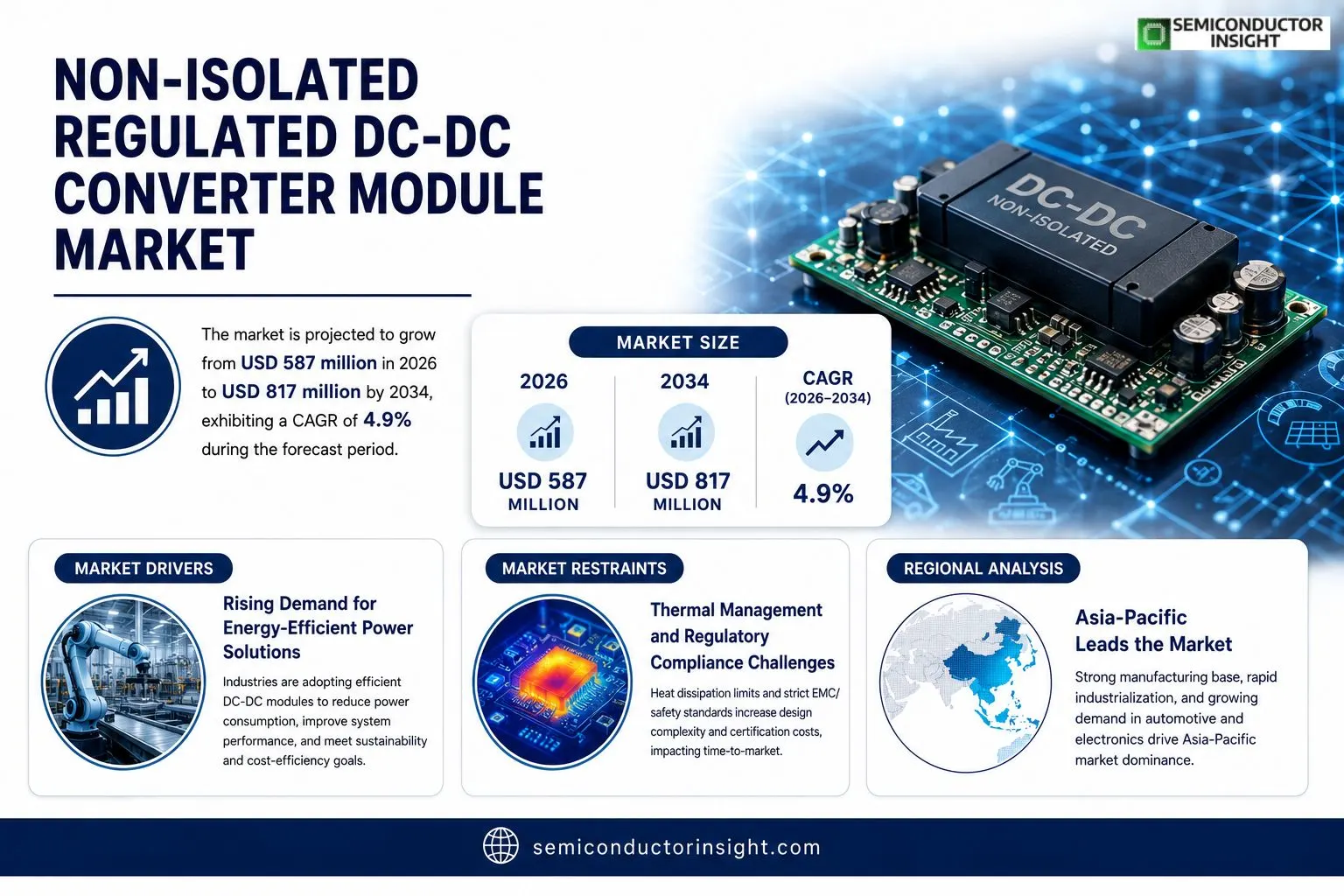
Non-Isolated Regulated DC-DC Converter Module market size was valued at USD 615 million in 2025. The market is projected to grow from USD 615 million in 2025 to USD 945 million by 2034, exhibiting a CAGR of approximately 4.9 % during the forecast period.
The Non‑Isolated Regulated DC‑DC Converter Module is an integrated power‑conversion solution that steps voltage up or down without galvanic isolation while maintaining tight regulation of output voltage and current.Typical architectures include buck, boost and buck‑boost topologies, packaged with magnetic components, control ICs and protection features for compact deployment across electronics.The market expands as automotive electrification, industrial automation and renewable‑energy storage demand higher efficiency and smaller footprints.Key manufacturers such as Murata, TDK, Vicor Corporation, Artesyn Embedded Technologies (Advanced Energy), Texas Instruments, Beijing Suplet Co., FLEX Ltd., Torex Semiconductor and ABB are actively launching higher‑density modules and securing design wins with OEMs.
MARKET DRIVERS
Growing Demand for Energy‑Efficient Power Solutions
Manufacturers across consumer electronics, industrial automation, and telecommunications are replacing legacy linear regulators with Non‑Isolated Regulated DC‑DC Converter Modules to cut standby power consumption. The shift reflects tighter corporate sustainability targets and the increasing cost pressure on utility bills, prompting design teams to prioritize high‑efficiency conversion topologies.
Integration with Emerging Automotive Architectures
Modern electric and hybrid vehicles are adopting multi‑voltage platforms that rely on compact, isolated‑free converters to feed infotainment, ADAS, and climate‑control subsystems. By eliminating isolation barriers, engineers achieve lower part counts and reduced board spacecritical advantages as vehicle architectures become more modular.
➤ Designers value the balance of cost efficiency and performance that non‑isolated modules deliver, especially when thermal budgets are tight.
In parallel, the proliferation of IoT edge nodes, which operate on constrained power supplies, creates a fertile environment for these converters. Their ability to provide stable output over a wide input range directly translates into longer device lifespans and lower maintenance cycles.
MARKET CHALLENGES
Thermal Management Constraints
Non‑isolated designs concentrate power dissipation within a single silicon die, raising the risk of hotspot formation in densely packed modules. Companies that cannot implement effective heat‑spreading techniques may encounter derating, which limits the usable power envelope and drives up system‑level cooling costs.
Other Challenges
Supply‑Chain Volatility
Component shortages for magnetic cores and high‑frequency MOSFETs have squeezed lead times, forcing OEMs to hold larger inventories or qualify alternate partsa process that adds engineering overhead and delays product launches.
MARKET RESTRAINTS
Regulatory Compliance Hurdles
Although non‑isolated converters simplify design, they must still satisfy stringent EMC and safety standards across regions. Certification processes such as IEC 61000‑4‑2 or UL 60950‑1 demand extensive testing, and any failure can restrict market entry, particularly in the medical and aerospace sectors where compliance tolerances are narrow.
MARKET OPPORTUNITIES
Shift Toward Edge‑Computing Devices
The rapid deployment of edge‑computing infrastructure creates a niche for compact, high‑efficiency power modules. Edge servers and ruggedized gateways often operate in remote or harsh environments where power availability is intermittent; the ability of Non‑Isolated Regulated DC‑DC Converter Modules to maintain voltage stability under wide input swings positions them as a preferred choice for these applications.
Non-Isolated Regulated DC-DC Converter Module Market Trends
Growth of Buck‑Type Modules in High‑Density Systems
The market, valued at $587 million in 2026, is forecasted to reach $817 million by 2034, reflecting a steady 4.9 % annual increase. Demand for buck‑type converters is gaining momentum because modern industrial equipment and data‑center power supplies favor compact, high‑efficiency solutions that minimize thermal load. As manufacturers press for tighter form factors, the buck segment is becoming the default choice for 12 V to 5 V conversions in server racks, robotics, and renewable‑energy linkages. This preference reshapes supply chains: component suppliers are prioritizing silicon‑based MOSFETs and integrated magnetics, while original equipment manufacturers (OEMs) reorder inventory cycles to match the accelerated rollout of 400‑Gbps networking gear. The net effect is a more responsive pricing environment and shorter lead times for end‑users seeking to upgrade legacy platforms.
Other Trends
Automotive Power‑Management Migration
Electrified powertrains and advanced driver‑assistance systems (ADAS) are forcing a redesign of vehicle electrical architectures. Non‑isolated regulated DC‑DC converter modules now appear in high‑voltage battery‑to‑low‑voltage domains, where they supply stable rails for infotainment, sensor suites, and climate control. The shift is underpinned by stricter efficiency standards and the need to reduce weight without compromising reliability. Consequently, Tier‑1 suppliers are partnering with semiconductor firms such as Murata and TDK to co‑develop modules that meet automotive‑grade qualification, while also integrating fault‑tolerance features that align with safety‑critical requirements. This trend creates a clear entry point for new entrants that can certify to ISO 26262 and deliver cost‑effective volume production.
Consolidation Among Leading OEMs
The competitive landscape is tightening as the top five players captured roughly 45 % of revenue in 2025. Strategic acquisitions, joint ventures, and technology‑licensing deals are allowing incumbents like Texas Instruments and Vicor to broaden their portfolio breadth while leveraging shared R&D pipelines. Smaller niche players are either being absorbed or forced to specialize in high‑margin applications such as aerospace or medical devices, where certification barriers protect margins. This consolidation is prompting a re‑evaluation of pricing strategies: larger firms can negotiate bulk component discounts, yet they must also invest in differentiated thermal‑management technologies to avoid commoditization. For customers, the result is a market with fewer, but more capable, suppliers offering end‑to‑end design‑win services that encompass simulation, layout support, and after‑sales firmware updates.
COMPETITIVE LANDSCAPE
Key Industry Players
Competitive Structure of the Non‑Isolated Regulated DC‑DC Converter Module Market
Murata and TDK dominate the upper tier of the market, leveraging extensive semiconductor portfolios and distribution networks to secure the majority of high‑volume contracts in automotive and industrial control applications. Their ability to integrate magnetic components with power‑management ICs creates a compelling value proposition for OEMs seeking to reduce bill‑of‑materials costs while meeting stringent efficiency standards. Texas Instruments, with its deep analog expertise, occupies a parallel position by supplying reference designs that accelerate time‑to‑market for customers in communications and consumer electronics. The concentration of revenue among these three firms forces mid‑size participants to differentiate through niche specialization, such as high‑temperature operation or ultra‑compact form factors, rather than competing on price alone. This stratification shapes pricing dynamics and influences the pace of innovation, as leading players invest heavily in Si‑based architectures that promise incremental efficiency gains.Beyond the top tier, a diverse set of regional and application‑focused companies enriches the competitive landscape. Vicor Corporation and Artesyn Embedded Technologies (Advanced Energy) capture a share of the high‑power, data‑center segment by offering modular solutions with built‑in thermal management. European firms such as RECOM Power GmbH and Würth Elektronik anchor the European market through compliance‑first designs that satisfy EMC and safety directives. Asian manufacturersincluding Beijing Suplet Co., Ltd., Mornsun Guangzhou Science & Technology Co., Ltd., and Delta Electronics, Inc.exploit cost‑advantageous production ecosystems to serve fast‑growing markets in China and Southeast Asia. Smaller innovators like Flex Ltd., Torex Semiconductor, and SynQor pursue aggressive product‑roadmap updates, targeting emerging uses in renewable‑energy storage and electric‑vehicle charging infrastructure. The resulting mosaic of capabilities ensures that customers can source solutions aligned with specific regulatory, performance, or geographic requirements.
List of Key Non‑Isolated Regulated DC‑DC Converter Module Companies Profiled
- Murata
- TDK
- Vicor Corporation
- Artesyn Embedded Technologies (Advanced Energy)
- Texas Instruments
- Beijing Suplet Co., Ltd.
- Flex Ltd.
- Torex Semiconductor
- ABB
- Mornsun Guangzhou Science & Technology Co., Ltd.
- Eaton
- Renesas Electronics Corporation
- XP Power
- RECOM Power GmbH
- Würth Elektronik
- Delta Electronics, Inc.
- SynQor
- Infineon Technologies
- Guangzhou Zhiyuan Electronics Co.,Ltd.
- Bothhand Enterprise Inc.
- Bel Power Solutions
Segment Analysis:
| Segment Category | Sub-Segments | Key Insights |
| By Type |
|
Buck Type dominates because it delivers efficient step‑down conversion for many industrial and automotive power‑train applications. – Engineers favor buck topology for its simplicity and low component count. – Its thermal performance aligns well with constrained enclosure designs. – Reliability concerns are mitigated through mature silicon‑based control ICs. |
| By Application |
|
Industrial Control emerges as the leading application due to the pervasive need for robust, compact power conversion in factory automation and process control. – Tight regulation of voltage improves sensor accuracy. – Module form factor simplifies board integration in PLCs. – Long‑term reliability aligns with maintenance‑free expectations of industrial equipment. |
| By End User |
|
OEM Manufacturers drive demand as they embed modules directly into new product platforms, emphasizing design‑for‑cost and rapid time‑to‑market. – Preference for standardized footprints accelerates production. – Close collaboration with silicon vendors ensures optimal thermal management. – Strategic sourcing decisions prioritize long‑term supply stability. |
| By Voltage Range |
|
Medium Voltage modules capture most attention because they align with emerging electric‑vehicle platforms and renewable‑energy inverter architectures. – Designers appreciate the balance between efficiency and insulation requirements. – The voltage window supports both automotive 48 V systems and industrial DC bus applications. – Compatibility with emerging wide‑bandgap semiconductor devices fosters innovation. |
| By Integration Level |
|
System‑In‑Package is gaining traction as product architects seek to minimize board space while preserving high performance. – SiP solutions bundle magnetic, filter and control functions, reducing BOM complexity. – They enable rapid prototyping for emerging IoT and edge‑computing devices. – Thermal coupling strategies within SiP enhance overall module efficiency. |
Regional Analysis: Non-Isolated Regulated DC-DC Converter Module Market
North America
Federal and provincial standards in the United States and Canada emphasize electromagnetic compatibility and thermal resilience, forcing manufacturers to adopt stricter quality‑management protocols. Compliance testing is often integrated early in the development cycle, which shortens time‑to‑market for modules that satisfy these criteria. European‑type approvals are also pursued, allowing firms to leverage the same product line across multiple jurisdictions with minimal redesign.
End‑users prioritize compact footprints and wide input voltage ranges to accommodate both automotive battery packs and industrial busbars. The trend toward higher switching frequencies encourages the use of advanced magnetic materials, which in turn reduces overall module size without sacrificing efficiency. Designers also value integrated protection features that eliminate the need for auxiliary components.
Proximity to silicon wafer fabs and passive‑component foundries gives North American assemblers a logistical advantage. Just‑in‑time inventory practices are reinforced by robust logistics networks, but occasional geopolitical tensions can still ripple through raw‑material sourcing, prompting firms to diversify suppliers across the continent.
Automotive tier‑1 suppliers are the largest purchasers, driven by the need for reliable power rails in electric‑vehicle architectures. Simultaneously, industrial automation firms appreciate the ease of integration that non‑isolated modules provide for sensor‑rich control panels, while telecom operators view them as cost‑effective upgrades for edge‑computing sites.
Europe
European manufacturers operate within a tightly regulated environment that emphasizes energy‑efficiency directives and circular‑economy principles. The automotive sector, particularly in Germany and France, is transitioning toward higher voltage platforms, prompting a shift from traditional isolated topologies to non‑isolated solutions that reduce component count. Industrial customers in the UK and Scandinavia value the modularity of these converters for retrofitting legacy machinery, where space constraints are acute. Moreover, the region’s strong focus on sustainability drives designers to select modules that minimize copper usage and support easy recycling at end‑of‑life, creating a niche for eco‑optimized product lines.
Asia‑Pacific
The Asia‑Pacific region benefits from a vast manufacturing base and aggressive cost‑control strategies. Chinese and Taiwanese OEMs leverage economies of scale to produce high‑volume non‑isolated modules that serve both domestic automotive plants and export markets. In India, the burgeoning renewable‑energy sector demands reliable DC‑DC conversion for solar‑plus‑storage installations, steering specifications toward wider temperature tolerances. Southeast Asian nations, with their rapidly expanding data‑center footprint, favor compact designs that simplify rack integration. Competitive pressures compel suppliers to accelerate product cycles, often at the expense of incremental performance gains.
South America
South American adoption is shaped by localized industrial growth and a cautious approach to electrification. Brazil’s automotive fleet, slowly moving toward hybrid powertrains, creates pockets of demand for non‑isolated modules that can be inserted into existing assembly lines with minimal retooling. In countries like Argentina and Chile, renewable‑energy projects, especially wind farms, rely on power‑electronics converters that must operate reliably under harsh climatic conditions. The region’s fragmented distribution channels encourage partnerships with regional distributors who can provide after‑sales support and compliance documentation tailored to local standards.
Middle East & Africa
In the Middle East, high ambient temperatures and dust exposure dictate robust thermal management within converter modules. Oil‑field automation and emerging solar‑park developments both require power solutions that can endure extreme conditions while maintaining tight voltage regulation. African markets, still in the early stages of infrastructure modernization, view non‑isolated regulated modules as an affordable entry point for off‑grid telecom towers and mini‑grid projects. Limited local production capacity means most shipments are imported, emphasizing the importance of reliable logistics and clear certification pathways to avoid bottlenecks.
Report Scope
This market research report provides a comprehensive analysis of the Non-Isolated Regulated DC-DC Converter Module Market , covering the forecast period 2026–2034. It offers detailed insights into market dynamics, technological advancements, competitive landscape, and key trends shaping the industry.
Key focus areas of the report include:
- Market Overview: The report begins with an overview outlining its current market scenario, key growth indicators, and industry transformation drivers. It discusses macroeconomic factors, demand–supply balance, regulatory landscape, and the strategic role of semiconductors in powering advancements across industries such as automotive, telecommunications, consumer electronics, and industrial automation.
- Market Size & Forecast: Historical data and future projections for revenue, unit shipments, and market value across major regions and segments.
- Segmentation Analysis: Detailed breakdown by product type, technology, application, and end-user industry to identify high-growth segments and investment opportunities.
- Regional Insights: Insights into market performance across North America, Europe, Asia-Pacific, Latin America, and the Middle East & Africa, including country-level analysis where relevant.
- Competitive Landscape: Profiles of leading market participants, including their product offerings, R&D focus, manufacturing capacity, pricing strategies, and recent developments such as mergers, acquisitions, and partnerships.
- Technology Trends & Innovation: Assessment of emerging technologies, integration of AI/IoT, semiconductor design trends, fabrication techniques, and evolving industry standards.
- Market Drivers & Restraints: Evaluation of factors driving market growth along with challenges, supply chain constraints, regulatory issues, and market-entry barriers.
- Stakeholder Insights: Insights for component suppliers, OEMs, system integrators, investors, and policymakers regarding the evolving ecosystem and strategic opportunities.
Primary and secondary research methods are employed, including interviews with industry experts, data from verified sources, and real-time market intelligence to ensure the accuracy and reliability of the insights presented.
FREQUENTLY ASKED QUESTIONS:
What is the current market size of Non-Isolated Regulated DC-DC Converter Module Market?
-> Non-Isolated Regulated DC-DC Converter Module Market was valued at USD 587 million in 2026 and is expected to reach USD 817 million by 2034 at a CAGR of 4.9% during the forecast period.
Which key companies operate in Non-Isolated Regulated DC-DC Converter Module Market?
-> Key players include Murata, TDK, Vicor Corporation, Artesyn Embedded Technologies (Advanced Energy), Texas Instruments, Beijing Suplet Co., Ltd., FLEX Ltd., Torex Semiconductor, ABB, Mornsun Guangzhou Science & Technology Co., Ltd.
What are the key growth drivers?
-> Key growth drivers include increasing demand for energy‑efficient power conversion in automotive electrification, renewable energy storage, industrial automation, and IoT devices.
Which region dominates the market?
-> Asia‑Pacific holds the largest market share, driven by strong demand in China and other emerging economies.
What are the emerging trends?
-> Emerging trends include adoption of GaN/SiC technologies for higher efficiency, development of compact high‑density modules, and integration of AI‑enabled power management solutions.
Get Sample Report PDF for Exclusive Insights
Report Sample Includes
- Table of Contents
- List of Tables & Figures
- Charts, Research Methodology, and more...
 Download Sample Report PDF