Non-Isolated DC-DC Power Conversion Chip Market Insights
Non-Isolated DC-DC Power Conversion Chip market size was valued at USD 600 million in 2025. The market will increase from USD 630 million in 2026 to USD 935 million by 2034, showing a CAGR of approximately 5% during the forecast period.
Non‑Isolated DC‑DC Power Conversion Chips are semiconductor devices that step down voltage without galvanic isolation, typically using synchronous rectification or charge‑pump techniques. They are offered mainly in plastic or potting packages and act as essential power‑management blocks within industrial control equipment, automotive electronics, consumer gadgets and energy‑storage systems.
The upward trend stems from expanding IoT deployments that demand compact yet efficient power solutions, alongside rising automotive electrification where space‑constrained designs favor non‑isolated converters. Furthermore, analog‑IC growth,evidenced by double‑digit gains in signal‑conversion segments,creates additional demand for discrete power devices that complement system‑on‑chip offerings.
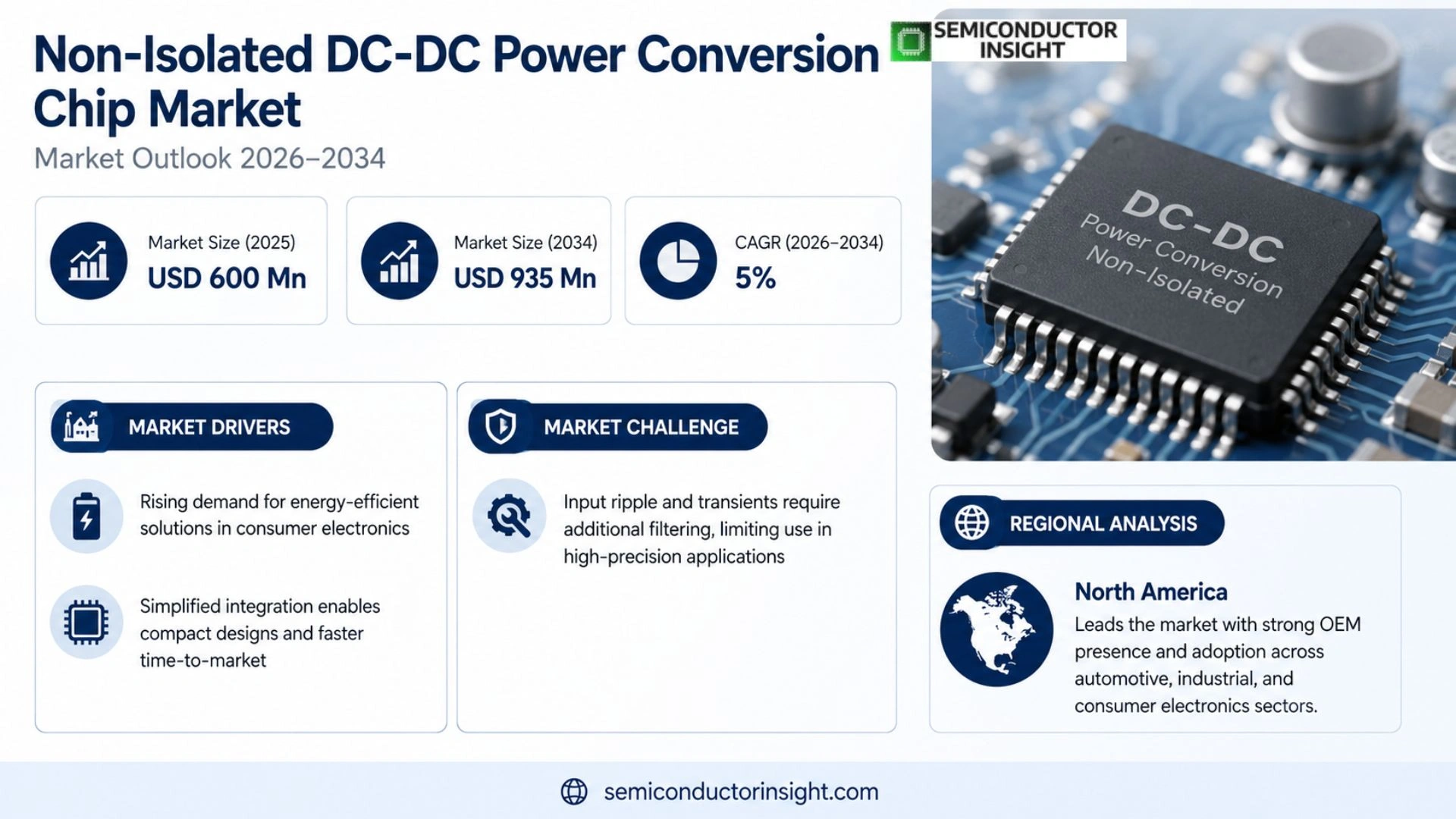
MARKET DRIVERS
Increasing Energy‑Efficiency Requirements in Consumer Electronics
Non-Isolated DC-DC Power Conversion Chip Market is buoyed by OEMs that must meet stricter energy‑loss thresholds in smartphones, wearables, and portable media. Designers are gravitating toward chips that can deliver conversion efficiencies above 90 % while occupying minimal board space, because every percentage point of saved power translates directly into longer battery life and reduced thermal budgets. This pressure reshapes component selection criteria, pushing suppliers to prioritize silicon‑on‑silicon technologies that marry high efficiency with low quiescent current.
Simplified Integration Favoring Compact Designs
System‑level engineers value the reduced component count that non‑isolated converters provide. By eliminating external isolation stages, a single chip can handle step‑down duties and voltage regulation, which shortens design cycles and cuts BOM expenses. The resulting time‑to‑market advantage is especially compelling for fast‑moving consumer segments where product refreshes occur annually.
➤ “Design teams that replace multi‑stage solutions with a single non‑isolated converter often shave weeks from prototype validation, directly influencing launch schedules.”
Beyond cost and speed, the ability to embed protection features,such as over‑current shutdown and thermal throttling,within the same silicon package reduces reliance on discrete components, further tightening the form factor of next‑generation gadgets.
MARKET CHALLENGES
Technical Barriers to Wider Adoption
Non‑isolated architectures expose downstream circuitry to input ripple and transients, compelling designers to implement additional filtering. In high‑precision applications,such as medical instrumentation,the extra shielding can erode the perceived advantage of a simplified topology, prompting a fallback to isolated solutions despite higher costs.
Other Challenges
Thermal Management Constraints
Elevated power densities generate heat that must be dissipated within cramped enclosures. Without adequate thermal paths, reliability can degrade, forcing manufacturers to oversize heat sinks or redesign chassis, thereby negating some of the integration benefits.
MARKET RESTRAINTS
Regulatory and Safety Compliance Pressure
Certification bodies in Europe and North America impose stringent limits on electromagnetic emissions and leakage currents for power conversion devices. Non‑isolated chips, by nature of their direct connection to the source, must incorporate advanced shielding techniques to meet these standards, which can inflate development costs and delay product rollout.
Moreover, the expansion of safety directives,particularly those governing portable equipment,means that manufacturers must invest in thorough validation programs to demonstrate compliance, a resource commitment that can deter smaller firms from entering the space.
Supply‑chain volatility, especially for critical substrate materials, adds another layer of uncertainty. When lead times extend, companies may be forced to secure higher inventory levels, tightening cash flow and limiting flexibility in price negotiations.
MARKET OPPORTUNITIES
Growth in Edge‑Computing and 5G Infrastructure
The rollout of edge‑computing nodes and 5G base stations creates a demand for power solutions that can operate efficiently across a wide input voltage range while maintaining a compact footprint. Non‑isolated DC‑DC chips, with their streamlined architecture, are well positioned to meet the power‑density requirements of these densely packed installations.
Automotive electrification presents a parallel avenue. As electric vehicle architectures shift toward modular platforms, designers seek converters that can deliver rapid voltage scaling for auxiliary systems without the bulk of traditional isolated modules. This niche offers a pathway for suppliers to capture a share of the burgeoning automotive electronics spend.
Finally, the proliferation of IoT sensors in industrial settings introduces a market segment that values ultra‑low quiescent current. Tailoring non‑isolated converters for sub‑milliwatt standby operation opens a revenue stream that aligns with the broader push toward pervasive, energy‑aware connectivity.
Non-Isolated DC-DC Power Conversion Chip Market Trends
Escalating Demand from Edge Computing and Automotive Electrification
The proliferation of edge‑oriented servers in data‑center outskirts and the rapid adoption of electric‑drive architectures in passenger vehicles have generated a noticeable uptick in power‑conversion density. Designers now require chips that can deliver stable rail voltages while occupying minimal board real‑estate, a combination that favors non‑isolated DC‑DC solutions. This shift is not merely a reaction to higher power budgets; it reflects a broader engineering calculus where thermal envelope, bill‑of‑materials cost, and time‑to‑market dominate decision‑making. As a result, OEMs are prioritizing converters that integrate tight regulation loops with low‑EMI footprints, prompting suppliers to accelerate their silicon‑design cycles and broaden portfolio options. The overall effect is a re‑allocation of capital toward components that can sustain the voltage scaling trends seen in both AI‑infused edge nodes and automotive power‑train control units. Stakeholders who overlook this migration risk lagging behind in product road‑maps that increasingly hinge on efficient, compact power delivery.
Other Trends
Shift Toward Integrated Plastic Packages
Manufacturers are moving away from traditional metal‑lead frames in favor of molded‑plastic encapsulation for non‑isolated converters. Plastic packages provide superior dielectric isolation, lower parasitic inductance, and easier automated assembly, which aligns with the high‑volume production requirements of consumer‑electronics and industrial‑control sectors. Moreover, the environmental push for RoHS‑compliant solutions accelerates this transition, as plastic housings reduce the reliance on lead‑based alloys. Suppliers that have already qualified plastic‑package lines report shorter lead times and a measurable drop in unit cost, enabling downstream designers to meet aggressive pricing targets without compromising performance. The trend also opens opportunities for embedding additional passive components within the package, further shrinking board footprints and simplifying bill‑of‑materials structures.
Emergence of Tier‑One Consolidation in the Supply Chain
Consolidation among tier‑one distributors and original equipment manufacturers is reshaping the procurement landscape for the Non‑Isolated DC‑DC Power Conversion Chip Market. Large system integrators are negotiating portfolio‑wide agreements that bundle multiple chip families, leveraging volume discounts to offset the modest margin pressure inherent in commodity‑type silicon. This bargaining power forces smaller fabless players to differentiate through application‑specific features rather than price alone. For end‑users, the consolidation translates into a more predictable supply chain and streamlined technical support, but it also raises the bar for innovation, as only firms that can demonstrate clear value‐added functionality retain shelf space. Companies that anticipate these dynamics and align their R&D pipelines with the emerging standards,such as wide‑input voltage ranges for emerging 48 V automotive architectures,will be better positioned to capture market share as the ecosystem matures.
COMPETITIVE LANDSCAPE
Key Industry Players
Non‑Isolated DC‑DC Power Conversion Chip Market – Competitive Outlook
Murata Manufacturing and Texas Instruments dominate the upper tier of the market, each leveraging extensive analog‑power portfolios and deep IoT customer relationships. Their ability to offer highly integrated, low‑noise regulators across industrial, automotive and consumer segments creates a barrier to entry for smaller firms. Both companies have expanded design‑win programs that couple reference designs with software support, accelerating time‑to‑market for end‑users and reinforcing their leadership position. The market structure reflects a classic tiered model: a handful of global power‑IC giants capture the majority of revenue, while a second tier of regional specialists fills niche applications such as high‑current, low‑voltage conversion for automotive power‑train modules.
Beyond the top tier, a diverse set of players adds depth to the competitive field. Vicor Corporation, Flex Ltd., and RECOM Power GmbH specialize in high‑efficiency, high‑power density modules that serve data‑center and telecom back‑office deployments. European firms like Würth Elektronik and ABB concentrate on ruggedized solutions for industrial control and military uses, often tailoring packaging to meet harsh‑environment certifications. Asian manufacturers,including TDK, Infineon Technologies, and Delta Electronics,focus on cost‑effective, high‑volume offerings that align with the rapid expansion of consumer‑electronics and energy‑storage platforms. This dispersion of capabilities forces incumbents to continuously innovate while providing customers with a broad spectrum of performance, price and reliability options.
List of Key Non‑Isolated DC‑DC Power Conversion Chip Companies Profiled
- Murata Manufacturing
- Texas Instruments
- Vicor Corporation
- Flex Ltd.
- RECOM Power GmbH
- Würth Elektronik
- ABB
- TDK
- Infineon Technologies
- Delta Electronics, Inc.
- Renesas Electronics Corporation
- XP Power
- Beijing Suplet Co., Ltd.
- Guangzhou Zhiyuan Electronics Co., Ltd.
- Bothhand Enterprise Inc.
Segment Analysis:
| Segment Category | Sub-Segments | Key Insights |
| By Type |
|
Plastic Package emerges as the dominant sub‑segment because of its cost‑effectiveness, ease of integration into compact IoT devices, and compatibility with high‑volume manufacturing.
|
| By Application |
|
Industrial Control leads this category as factories adopt smart sensors and edge computing nodes that rely on efficient power conversion.
|
| By End User |
|
OEMs of Consumer Devices dominate end‑user demand because compact wearables, portable chargers, and smart home hubs all require efficient, low‑cost power conversion.
|
| By Packaging |
|
Surface‑Mount Device (SMD) is the preferred packaging due to its ease of placement on automated assembly lines and proven reliability in high‑volume products.
|
| By Functional Feature |
|
Integrated Protection is gaining traction as system designers seek to simplify board layouts while enhancing reliability across harsh operating environments.
|
Regional Analysis: Non-Isolated DC-DC Power Conversion Chip Market
North America
The rise of electric‑propulsion systems in passenger and commercial vehicles fuels demand for compact, high‑efficiency non‑isolated converters that can operate across wide input ranges while meeting stringent thermal constraints. Tier‑one suppliers are embedding these chips directly into power‑train control units, reducing board count and improving reliability.
Factories embracing Industry 4.0 architectures rely on distributed intelligence that requires localized voltage regulation. Non‑isolated DC‑DC devices provide the fastest response times for motor‑drive control loops, enabling smoother integration of robotics and sensor networks.
Portable gadgets continue to shrink, pushing manufacturers toward power‑chips that deliver high power density without sacrificing standby current. The non‑isolated architecture simplifies PCB layout, a benefit that accelerates time‑to‑market for wearables and smart‑home hubs.
Energy‑efficiency standards in the United States are increasingly referencing overall system performance rather than component‑level metrics, prompting designers to adopt non‑isolated converters that can be tuned for optimal loss reduction across diverse load profiles.
Europe
European manufacturers benefit from a coordinated regulatory environment that emphasizes sustainability and modular design. Automotive clusters in Germany and France are experimenting with mixed‑signal power‑management chips to meet upcoming Euro VI emissions targets, while the United Kingdom’s focus on advanced manufacturing drives collaborations between universities and low‑cost foundries. The region’s mature supply‑chain network eases sourcing of ancillary components, allowing system integrators to iterate quickly and align product roadmaps with evolving EU directives on energy consumption.
Asia‑Pacific
The Asia‑Pacific landscape is defined by rapid scaling of consumer electronics production and a burgeoning renewable‑energy sector. Chinese OEMs harness the cost advantage of large‑volume fabrication to embed non‑isolated converters in smart‑city infrastructure, whereas Indian start‑ups are leveraging open‑source design kits to shorten development cycles for IoT devices. The convergence of aggressive pricing pressure and a growing appetite for locally sourced silicon fuels a competitive environment that rewards innovative thermal management approaches.
South America
In South America, market momentum is driven primarily by the telecommunications rollout and increasing adoption of solar micro‑grids. Companies are attracted to the simplicity of non‑isolated DC‑DC chips, which reduce bill‑of‑materials costs in remote deployments. Brazil’s emerging semiconductor clusters are beginning to offer design‑service partnerships, enabling regional players to customize voltage‑regulation solutions without dependence on overseas IP.
Middle East & Africa
The Middle East & Africa region sees selective growth tied to defense and oil‑field automation projects. Non‑isolated converters are favored for rugged edge equipment that must endure extreme temperature swings while maintaining high efficiency. Strategic investments by sovereign wealth funds into local semiconductor incubation programs are beginning to create a modest ecosystem of design houses capable of supporting bespoke power‑management requirements for regional infrastructure initiatives.
Report Scope
This market research report provides a comprehensive analysis of the Non-Isolated DC-DC Power Conversion Chip Market , covering the forecast period 2026–2034. It offers detailed insights into market dynamics, technological advancements, competitive landscape, and key trends shaping the industry.
Key focus areas of the report include:
- Market Overview: The report begins with an overview outlining its current market scenario, key growth indicators, and industry transformation drivers. It discusses macroeconomic factors, demand–supply balance, regulatory landscape, and the strategic role of semiconductors in powering advancements across industries such as automotive, telecommunications, consumer electronics, and industrial automation.
- Market Size & Forecast: Historical data and future projections for revenue, unit shipments, and market value across major regions and segments.
- Segmentation Analysis: Detailed breakdown by product type, technology, application, and end-user industry to identify high-growth segments and investment opportunities.
- Regional Insights: Insights into market performance across North America, Europe, Asia-Pacific, Latin America, and the Middle East & Africa, including country-level analysis where relevant.
- Competitive Landscape: Profiles of leading market participants, including their product offerings, R&D focus, manufacturing capacity, pricing strategies, and recent developments such as mergers, acquisitions, and partnerships.
- Technology Trends & Innovation: Assessment of emerging technologies, integration of AI/IoT, semiconductor design trends, fabrication techniques, and evolving industry standards.
- Market Drivers & Restraints: Evaluation of factors driving market growth along with challenges, supply chain constraints, regulatory issues, and market-entry barriers.
- Stakeholder Insights: Insights for component suppliers, OEMs, system integrators, investors, and policymakers regarding the evolving ecosystem and strategic opportunities.
Primary and secondary research methods are employed, including interviews with industry experts, data from verified sources, and real-time market intelligence to ensure the accuracy and reliability of the insights presented.
FREQUENTLY ASKED QUESTIONS:
What is the current market size of Non-Isolated DC-DC Power Conversion Chip Market?
-> Non-Isolated DC-DC Power Conversion Chip market will increase from USD 630 million in 2026 to USD 935 million by 2034, showing a CAGR of approximately 5%
Which key companies operate Non-Isolated DC-DC Power Conversion Chip Market?
-> Key players include Murata, TDK, Vicor Corporation, Artesyn Embedded Technologies (Advanced Energy), Texas Instruments, Beijing Suplet Co., Ltd., FLEX LTD., Torex Semiconductor, ABB, Mornsun Guangzhou Science & Technology Co., Ltd., Eaton, Renesas Electronics Corporation, XP Power, RECOM Power GmbH, Würth Elektronik, Delta Electronics, Inc., SynQor, Infineon Technologies, Guangzhou Zhiyuan Electronics Co.,Ltd., Bothhand Enterprise Inc., Bel Power Solutions.
What are the key growth drivers?
-> Key growth drivers include rising adoption of IoT‑based electronics, increasing demand for power management and signal‑conversion solutions in automotive and industrial applications, and steady growth of the analog IC segment driving demand for discrete power devices.
Which region dominates the market?
-> Asia‑Pacific holds the largest share of Non-Isolated DC-DC Power Conversion Chip market, propelled by strong manufacturing bases in China, Japan, and South Korea and expanding demand from automotive and consumer electronics sectors.
What are the emerging trends?
-> Emerging trends include advanced analog signal conversion technologies, automotive‑specific analog applications, and integrated power‑management solutions targeting high‑efficiency, low‑power IoT devices.

Get Sample Report PDF for Exclusive Insights
Report Sample Includes
- Table of Contents
- List of Tables & Figures
- Charts, Research Methodology, and more...
 Download Sample Report PDF