Noise Suppression Microphone Market Insights
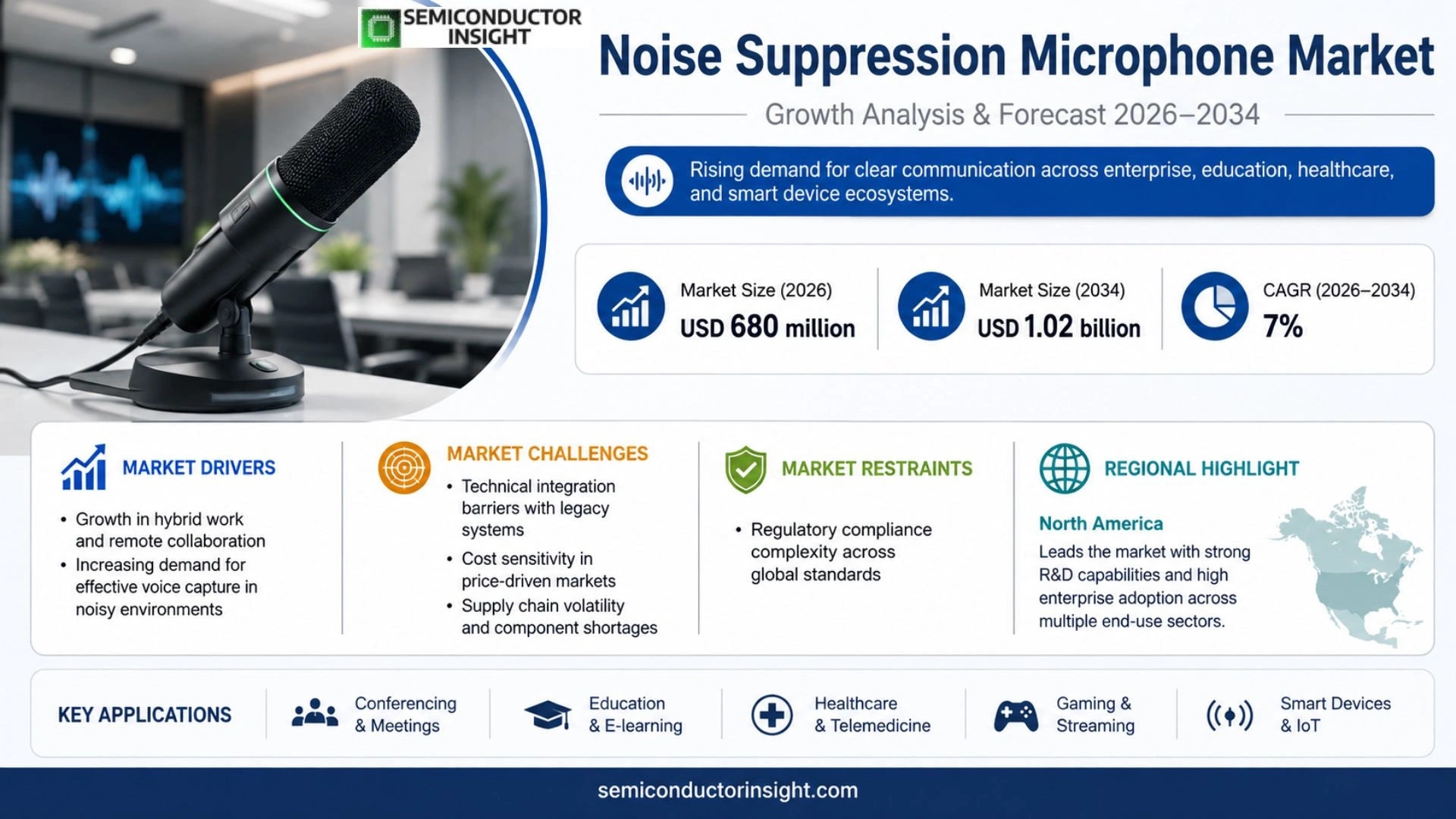
Noise Suppression Microphone market size was valued at USD 620 million in 2024. The market is expected to increase from USD 680 million in 2026 to USD 1.02 billion by 2034, exhibiting a CAGR of about 7 % during the forecast period.
A noise‑suppression microphone is a microphone that is designed to filter ambient noise.
The market is experiencing rapid growth due to several factors, including increased remote‑work adoption, rising demand for high‑definition audio in gaming and video‑conferencing, and advancements in digital signal‑processing algorithms. Moreover, expanding call‑center operations and stricter noise‑control regulations in aviation add further momentum. Initiatives by leading manufacturers such as Sennheiser, Audio‑Technica, AKG, Shure Incorporated and Sony are likely to reinforce this upward trend.
MARKET DRIVERS
Increasing Remote Collaboration Demand
The shift toward hybrid work environments has intensified the need for crystal‑clear audio in virtual meetings. Companies are replacing legacy conference equipment with intelligent microphones that can isolate speech from background chatter, thereby reducing fatigue for participants and improving meeting efficiency. This adoption fuels growth across enterprise, education, and healthcare segments of Noise Suppression Microphone Market.
Advancements in DSP Algorithms
Recent breakthroughs in digital signal processing enable real‑time filtering of ambient sounds without sacrificing voice fidelity. Manufacturers are embedding these algorithms directly into silicon, which lowers latency and cuts power consumption,critical factors for mobile and IoT devices. The technical edge creates a compelling value proposition for OEMs seeking to differentiate their product lines.
➤ Operators that integrate adaptive noise suppression into existing platforms report up to a 30% reduction in user‑reported audio complaints.
As businesses prioritize employee productivity and customer experience, the superior acoustic performance offered by modern microphones becomes a strategic asset. The cumulative effect is a steady expansion of Noise Suppression Microphone Market across both consumer and professional domains.
MARKET CHALLENGES
Technical Integration Barriers
Legacy conferencing rigs often rely on analog audio chains, making the retrofit of digital noise‑suppression units complex and costly. Engineers must reconcile divergent firmware standards, which can delay rollout schedules and inflate project budgets. Consequently, some organizations defer upgrades until a full platform refresh becomes inevitable.
Other Challenges
Cost Sensitivity
Price‑conscious buyers in emerging markets weigh the incremental expense of advanced microphones against basic functional requirements. While premium solutions deliver measurable audio gains, the return on investment calculation can stall adoption in price‑driven segments.
Supply Chain Volatility
Component shortages, particularly for high‑precision MEMS sensors, have introduced lead‑time uncertainties. Vendors that lack diversified sourcing risk stockouts, which can erode confidence among enterprise customers seeking reliable delivery schedules.
MARKET RESTRAINTS
Regulatory Compliance Complexity
Audio equipment destined for global distribution must satisfy a mosaic of electromagnetic compatibility (EMC) and safety standards. Navigating this regulatory landscape requires dedicated testing and certification, adding both time and expense to product launches. Firms that misjudge compliance requirements may face costly redesigns or market entry delays.
In addition, privacy regulations in certain jurisdictions impose strict limits on on‑device processing of voice data. Manufacturers need to embed robust encryption and data‑handling safeguards, which further burdens the development cycle and can deter smaller players from entering the market.
MARKET OPPORTUNITIES
AI‑Enhanced Adaptive Filtering
Machine‑learning models that continuously learn a user’s vocal profile enable microphones to distinguish speech from intermittent noises such as keyboard clicks or HVAC hum. Companies that package this capability as a SaaS add‑on can monetize ongoing service fees, opening a recurring‑revenue stream beyond the hardware sale.
By partnering with platform providers in the automotive and smart‑home sectors, microphone manufacturers can embed noise suppression directly into infotainment consoles and voice assistants. This cross‑industry integration expands the addressable base of Noise Suppression Microphone Market and aligns product roadmaps with broader ecosystem strategies.
Furthermore, the rise of 5G‑enabled edge computing offers the possibility of off‑loading heavy audio processing to nearby servers, reducing on‑device power draw while preserving high‑quality suppression. Early adopters that design hardware to leverage edge resources will differentiate themselves in a market where energy efficiency is increasingly prized.
Noise Suppression Microphone Market Trends
Active Noise‑Cancellation Gains Ground in Professional Audio
The most visible shift in Noise Suppression Microphone Market is the migration from purely passive designs toward actively controlled solutions. Manufacturers are embedding miniature DSP chips that generate anti‑phase signals to cancel ambient sound in real time. This evolution is a response to rising expectations from content creators, broadcasters, and enterprise clients who demand clearer voice transmission even in bustling studios or open‑plan offices. By eliminating background chatter at the source, active microphones reduce the need for post‑production editing, shortening production cycles and cutting operational costs. Suppliers that have re‑engineered product lines to include firmware‑updatable architectures are positioning themselves as preferred partners for firms seeking future‑proof tooling.
Other Trends
Remote‑Work Headset Segment Expands Rapidly
The proliferation of hybrid work arrangements has forced IT departments to revisit audio ergonomics. Companies are standardising on headsets equipped with noise‑suppression microphones because they improve meeting clarity without requiring costly room‑level acoustic treatment. Vendors are now offering modular kits that allow enterprises to scale headsets across thousands of employees while maintaining a uniform audio profile. This trend encourages OEMs to tighten quality‑control loops and to provide bulk‑order support services, thereby creating a new revenue stream that is less dependent on consumer cycles.
AI‑Driven Beamforming Shapes the Gaming and Simulation Sectors
Artificial‑intelligence algorithms are increasingly being fused with microphone arrays to direct acoustic pickup toward a single speaker’s mouth while ignoring surrounding noise sources. In competitive gaming, where split‑second communication can affect outcomes, such technology yields a discernible advantage. Similarly, flight‑sim and racing simulators benefit from microphones that isolate pilot or driver speech despite high‑decibel engine roar. The implication for Noise Suppression Microphone Market is a pivot toward higher‑margin, technology‑heavy products that command premium pricing and require close collaboration with software developers. Companies that fail to integrate AI capabilities risk losing ground to newcomers that bundle hardware with cloud‑based acoustic models.
COMPETITIVE LANDSCAPE
Key Industry Players
Noise Suppression Microphone Market: Competitive Overview
The market is anchored by a handful of global brands whose engineering depth and distribution networks create a high barrier to entry. Sennheiser, with its legacy of precision acoustic design, commands the premium professional segment by pairing proprietary digital signal‑processing algorithms with robust passive‑isolation housings. Shure Incorporated leverages an extensive dealer channel in North America and Europe, positioning its active‑noise‑canceling headsets as the de‑facto choice for broadcast studios and call‑center operators. Audio‑Technica and Sony complement this core by offering hybrid solutions that blend passive diaphragms with programmable DSP, enabling OEMs to integrate tailored suppression profiles into consumer‑grade devices. The concentration of R&D spend among these four firms translates into a market structure where incremental innovations,such as adaptive beamforming microphones,are quickly monetized, pressuring smaller rivals to either specialize or pursue strategic partnerships.
Beyond the dominant quartet, a diverse set of niche players fuels segment‑specific growth. Blue Microphones has carved out a loyal following among content creators by emphasizing aesthetic design and plug‑and‑play simplicity, while RODE focuses on the video‑gaming and live‑streaming communities with compact active models that integrate seamlessly with popular streaming rigs. Asian manufacturers such as SUPERLUX and LEWITT exploit cost advantages to supply high‑volume passive units for automotive and maritime applications. Meanwhile, firms like SE Electronics, Samson, Beyerdynamic, InMusic Brands, MIPRO Electronics, Takstar, Audix, DPA Microphones, Feilo and Lane differentiate through specialized form factors,ranging from helmet‑mounted cockpit mics to ultra‑low‑profile lapel solutions,thereby addressing emerging use‑cases in aviation, motorsport and remote‑learning environments. Their collective emphasis on price‑performance and rapid iteration keeps the overall market dynamic, ensuring that innovation is not confined to the top tier.
List of Key Noise Suppression Microphone Companies Profiled
- Sennheiser
- Shure Incorporated
- Audio‑Technica
- Sony
- AKG
- Yamaha
- RODE
- Blue Microphones
- LEWITT
- SUPERLUX
- SE Electronics
- Samson
- Beyerdynamic
- InMusic Brands
- MIPRO Electronics
- Takstar
- Audix
- DPA Microphones
- Feilo
- Lane
Segment Analysis:
| Segment Category | Sub-Segments | Key Insights |
| By Type |
|
Passive microphones dominate early adoption due to simplicity and reliability.
|
| By Application |
|
Call center headsets are the leading application segment.
|
| By End User |
|
Enterprise communications lead the end‑user landscape.
|
| By Technology Integration |
|
Integrated headset modules are gaining momentum.
|
| By Market Drivers |
|
Remote work adoption fuels demand across segments.
|
Regional Analysis: Noise Suppression Microphone Market
North America
The United States and Canada host a dense cluster of OEMs that specialize in acoustic components, benefiting from a skilled labor pool and proximity to algorithmic talent. Supply‑chain resilience is reinforced by diversified sourcing of MEMS sensors, enabling manufacturers to scale production without lengthy lead times. This infrastructure supports rapid prototype turnover for Noise Suppression Microphone Market participants seeking to test new designs in real‑time environments.
Large‑scale corporations prioritize audio clarity to reduce meeting fatigue and improve transcription accuracy. Procurement teams favor platforms that embed machine‑learning based suppression, viewing them as cost‑effective alternatives to hiring additional staff for post‑meeting editing. This preference fuels demand for integrated microphone arrays that can be managed centrally across dispersed workforces.
Voice‑activated assistants and gaming headsets have become testing grounds for next‑generation noise control. Early adopters in North America influence global perception, prompting manufacturers to align product aesthetics with lifestyle branding while embedding sophisticated suppression algorithms that react to changing acoustic environments.
Federal guidelines stress acoustic privacy, requiring manufacturers to disclose data handling practices. Compliance frameworks have been embraced as a competitive advantage, allowing firms to market their microphones as both high‑performance and privacy‑aware, which resonates with security‑conscious enterprises and consumers alike.
Europe
European markets exhibit a balanced mix of high‑end studio equipment and mid‑range office solutions. Nations such as Germany and the United Kingdom channel engineering expertise into acoustic modeling, while Scandinavia emphasizes sustainable design, prompting manufacturers to explore eco‑friendly housings for microphone assemblies. Cross‑border collaborations within the EU accelerate standardization of audio codecs, reducing fragmentation and encouraging broader deployment of suppression technology across multiple industries, from broadcast to automotive cabins.
Asia‑Pacific
The Asia‑Pacific region is characterized by rapid product iteration cycles, especially in China, South Korea, and Japan. Local manufacturers benefit from low‑cost component ecosystems, enabling aggressive pricing strategies that broaden market penetration. Simultaneously, burgeoning remote‑work cultures in Australia and India increase demand for affordable yet reliable noise control, prompting multinational players to tailor feature sets for diverse connectivity conditions prevalent across the region.
South America
South American adoption is driven by a growing appetite for digital transformation in education and public sector communication. Brazil and Mexico lead investments in cloud‑based conferencing solutions, where integrated microphones with built‑in suppression become a differentiator. Supply‑chain constraints have encouraged regional assemblers to partner with North American design houses, fostering technology transfer that elevates local capabilities without sacrificing performance.
Middle East & Africa
In the Middle East, high‑value hospitality and oil‑field communication networks demand rugged microphones capable of handling extreme ambient noise. Companies are exploring hybrid solutions that combine hardware suppression with cloud‑enhanced algorithms to meet these conditions. African markets, still emerging, are seeing early adoption in mobile banking call centers, where clear voice capture is essential for regulatory compliance and customer trust, prompting vendors to introduce entry‑level models that balance cost and acoustic fidelity.
Report Scope
This market research report provides a comprehensive analysis of the Noise Suppression Microphone Market , covering the forecast period 2026–2034. It offers detailed insights into market dynamics, technological advancements, competitive landscape, and key trends shaping the industry.
Key focus areas of the report include:
- Market Overview: The report begins with an overview outlining its current market scenario, key growth indicators, and industry transformation drivers. It discusses macroeconomic factors, demand–supply balance, regulatory landscape, and the strategic role of semiconductors in powering advancements across industries such as automotive, telecommunications, consumer electronics, and industrial automation.
- Market Size & Forecast: Historical data and future projections for revenue, unit shipments, and market value across major regions and segments.
- Segmentation Analysis: Detailed breakdown by product type, technology, application, and end-user industry to identify high-growth segments and investment opportunities.
- Regional Insights: Insights into market performance across North America, Europe, Asia-Pacific, Latin America, and the Middle East & Africa, including country-level analysis where relevant.
- Competitive Landscape: Profiles of leading market participants, including their product offerings, R&D focus, manufacturing capacity, pricing strategies, and recent developments such as mergers, acquisitions, and partnerships.
- Technology Trends & Innovation: Assessment of emerging technologies, integration of AI/IoT, semiconductor design trends, fabrication techniques, and evolving industry standards.
- Market Drivers & Restraints: Evaluation of factors driving market growth along with challenges, supply chain constraints, regulatory issues, and market-entry barriers.
- Stakeholder Insights: Insights for component suppliers, OEMs, system integrators, investors, and policymakers regarding the evolving ecosystem and strategic opportunities.
Primary and secondary research methods are employed, including interviews with industry experts, data from verified sources, and real-time market intelligence to ensure the accuracy and reliability of the insights presented.
FREQUENTLY ASKED QUESTIONS:
What is the current market size of Noise Suppression Microphone Market?
-> Noise Suppression Microphone market is expected to increase from USD 680 million in 2026 to USD 1.02 billion by 2034, exhibiting a CAGR of about 7 %
Which key companies operate in Noise Suppression Microphone Market?
-> Key players include Sennheiser, Audio-Technica, AKG, Shure Incorporated, Blue Microphones, Yamaha, Sony, RODE, LEWITT, SUPERLUX, among others.
What are the key growth drivers?
-> Key growth drivers include increased demand for ambient‑noise reduction in communication devices, growth of remote work and virtual collaboration, and advancements in active noise‑cancellation technologies.
Which region dominates the market?
-> North America (particularly the United States) shows strong market presence, while Asia (especially China) is emerging rapidly.
What are the emerging trends?
-> Emerging trends include integration of AI‑enhanced noise suppression, development of hybrid passive‑active microphone solutions, and expansion into specialized applications such as helicopter pilot and race‑car driver headsets.

Get Sample Report PDF for Exclusive Insights
Report Sample Includes
- Table of Contents
- List of Tables & Figures
- Charts, Research Methodology, and more...
 Download Sample Report PDF