Nerve Cuff (Recording + Stimulation) SoC Market Insights
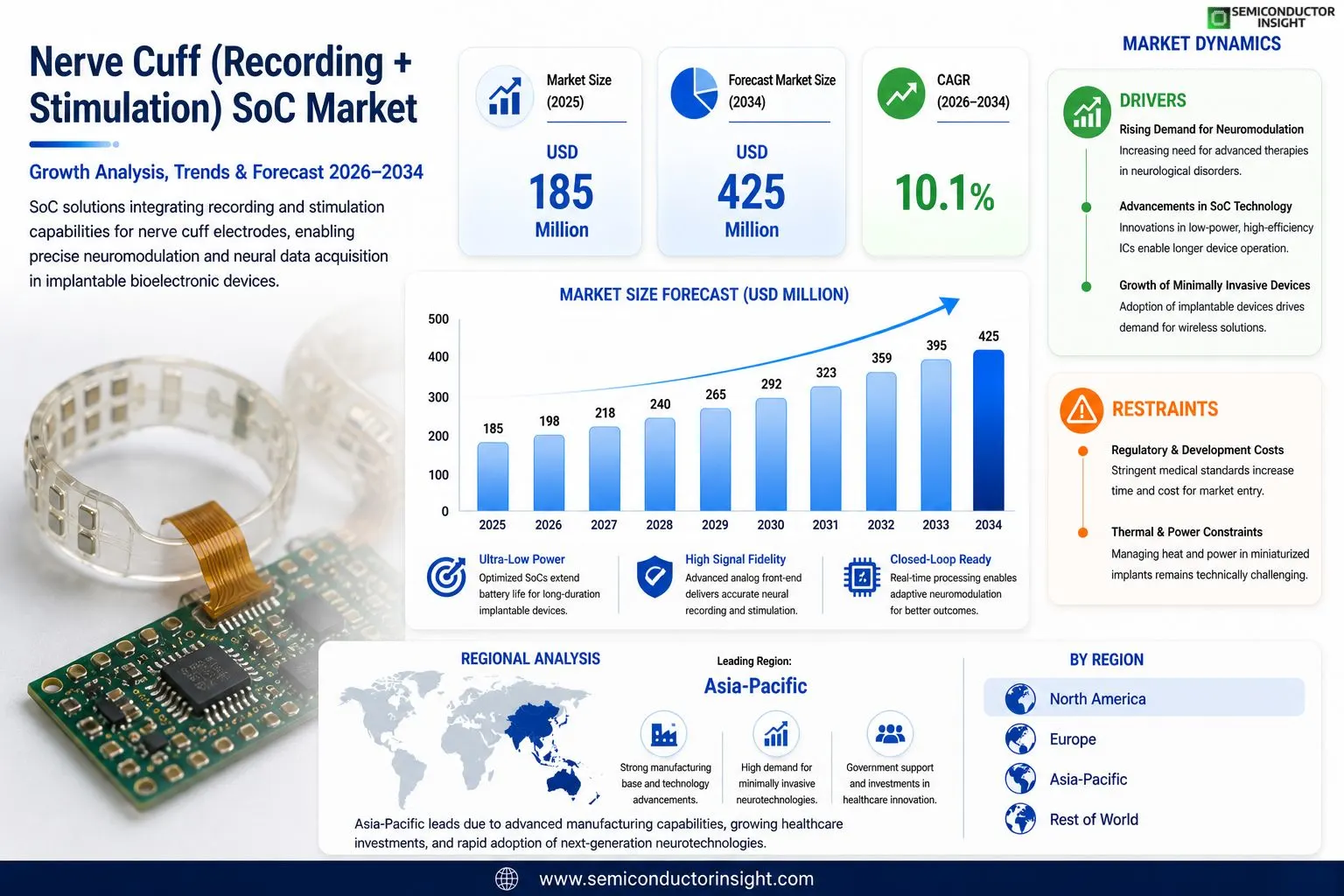
Global Nerve Cuff (Recording + Stimulation) SoC market size was valued at USD 185 million in 2025. The market is projected to grow from USD 198 million in 2026 to USD 425 million by 2034, exhibiting a CAGR of 10.1% during the forecast period.
Nerve Cuff (Recording + Stimulation) SoC refers to specialized system-on-chip solutions designed for integration with cuff electrodes that encircle peripheral nerves. These compact integrated circuits enable precise bidirectional interfacing, capturing neural signals through recording channels while delivering controlled electrical pulses for stimulation. By combining analog front-end amplifiers, signal processing units, stimulation drivers, and power management on a single chip, these SoCs support high-fidelity neural data acquisition and targeted neuromodulation in a miniaturized, power-efficient form factor suitable for implantable applications.
The market is experiencing steady growth driven by rising demand for advanced neuromodulation therapies and the increasing prevalence of neurological disorders such as chronic pain, epilepsy, and movement disorders. Advancements in microelectronics and flexible materials have enhanced the biocompatibility and long-term stability of nerve cuff interfaces, making integrated SoC solutions more viable for clinical use. Furthermore, the push toward closed-loop systems that can both record and respond to neural activity in real time is accelerating adoption, as these capabilities offer improved therapeutic outcomes compared to open-loop stimulation approaches. Key players continue to invest in refining low-power designs and selective fascicular targeting, which broaden potential applications in bioelectronic medicine and neural prosthetics. While the technology faces challenges related to regulatory pathways and surgical implantation complexities, ongoing innovations in conformable electrode materials and wireless telemetry are expected to support sustained expansion of the Nerve Cuff (Recording + Stimulation) SoC ecosystem globally.
MARKET DRIVERS
Rising Demand for Advanced Peripheral Nerve Interfaces
Nerve Cuff (Recording + Stimulation) SoC Market is propelled by the growing need for bidirectional neural interfaces that enable simultaneous recording and stimulation of peripheral nerves. These compact System-on-Chip solutions support applications in neuromodulation, neuroprosthetics, and closed-loop therapies for conditions such as chronic pain, motor disorders, and organ regulation through electroceuticals.
Technological Advancements in Miniaturized SoC Designs
Integration of low-power analog front-ends, efficient stimulation circuits, and wireless capabilities into single-chip architectures has significantly improved device performance. Innovations in CMOS processes allow for high-channel-count recording with low noise while maintaining compact footprints suitable for chronic implantation around peripheral nerves.
➤ Development of inductively powered and battery-assisted SoC prototypes has demonstrated reliable long-term operation in freely behaving models, driving adoption in both research and clinical translation.
Expanding indications in vagus nerve stimulation, sacral neuromodulation, and peripheral nerve injury recovery further accelerate market momentum as healthcare providers seek minimally invasive, selective interfaces that outperform traditional bulk stimulation approaches.
MARKET CHALLENGES
Technical Complexity in Achieving High Selectivity and Signal Quality
Peripheral nerve anatomy presents difficulties for cuff-based interfaces, where achieving high signal-to-noise ratios in recording and precise fascicular selectivity in stimulation remains technically demanding despite SoC integration.
Other Challenges
Biocompatibility and Long-Term Stability
Chronic implantation requires materials that minimize tissue response, mechanical mismatch, and signal degradation over extended periods, posing ongoing engineering hurdles for Nerve Cuff (Recording + Stimulation) SoC systems.
Integration and Power Management Constraints
Balancing power efficiency, wireless data transmission, and stimulation charge delivery within ultra-low-power budgets limits full clinical deployment in fully implantable formats.
MARKET RESTRAINTS
High Development Costs and Regulatory Hurdles
Nerve Cuff (Recording + Stimulation) SoC Market faces significant barriers from the substantial investment required for custom ASIC design, preclinical validation, and lengthy regulatory approval processes for implantable neural devices. These factors slow the pace of commercialization for novel integrated solutions.
Limited Clinical Evidence and Reimbursement Challenges
While research prototypes demonstrate promise, widespread clinical adoption is restrained by the need for robust long-term human data on safety and efficacy. Reimbursement policies for advanced bidirectional peripheral nerve interfaces remain inconsistent across healthcare systems, impacting market penetration.
MARKET OPPORTUNITIES
Expansion into Closed-Loop Neuromodulation and Bioelectronic Medicine
Nerve Cuff (Recording + Stimulation) SoC Market holds strong potential through the development of closed-loop systems that use real-time nerve recording to dynamically adjust stimulation parameters. This approach can enhance therapeutic outcomes in chronic disease management and reduce side effects associated with open-loop devices.
Emerging Applications in Regenerative Medicine and Neuroprosthetics
Advances in stretchable, conformable cuff materials combined with SoC technology open avenues for interfacing with smaller nerves and supporting nerve regeneration protocols. Growing interest in electroceuticals for organ-specific modulation presents additional growth pathways beyond traditional pain and movement disorder treatments.
Nerve Cuff (Recording + Stimulation) SoC Market Trends
Advancements in Conformable and Softening Materials for Enhanced Bidirectional Interfacing
Nerve Cuff (Recording + Stimulation) SoC Market is witnessing significant momentum from innovations in ultraconformable and softening cuff electrode designs that improve long-term stability and signal fidelity when integrated with advanced system-on-chip solutions. These developments enable precise neural recording and targeted stimulation by allowing cuffs to better adapt to nerve morphology, reducing mechanical mismatch and inflammation over extended implantation periods. Integration of such flexible interfaces with compact SoCs supports high-channel count bidirectional communication while maintaining low power consumption essential for implantable neuromodulation devices.
Other Trends
Shift Toward Closed-Loop Neuromodulation Systems
Closed-loop architectures represent a key evolution in Nerve Cuff (Recording + Stimulation) SoC Market, where real-time neural signal recording informs adaptive stimulation parameters. SoC designs incorporating analog front-ends, signal processing, and stimulation drivers on a single chip facilitate this responsive approach, offering superior therapeutic outcomes for conditions like chronic pain and movement disorders compared to traditional open-loop methods. Enhanced selective fascicular targeting further refines stimulation precision, expanding applications in bioelectronic medicine.
Focus on Long-Term Stability and Biocompatibility
Long-term performance data from high-density nerve cuff implants demonstrate robust channel responsiveness in active patient scenarios, with design optimizations such as improved connector assemblies and lead configurations contributing to reduced failure rates. When paired with power-efficient SoCs, these interfaces exhibit sustained recording and stimulation capabilities, addressing previous limitations in chronic peripheral nerve applications and supporting broader clinical adoption.
Integration of Low-Power Electronics and Wireless Capabilities
Progress in microelectronics continues to drive Nerve Cuff (Recording + Stimulation) SoC Market through the development of miniaturized, low-noise amplifiers and efficient power management units. These SoC features enable wireless telemetry and reduced tethering forces, minimizing tissue stress while supporting multi-channel neural data acquisition from small-diameter nerves. Complementary advancements in thin-film and hydrogel-based cuff materials enhance overall system biocompatibility, paving the way for more reliable implantable solutions in neural prosthetics and peripheral neuromodulation therapies.
COMPETITIVE LANDSCAPE
Key Industry Players
Nerve Cuff (Recording + Stimulation) SoC Market Analysis
Nerve Cuff (Recording + Stimulation) SoC Market features a competitive landscape dominated by established medical device leaders with deep expertise in neuromodulation alongside specialized firms advancing integrated circuit solutions for peripheral nerve interfaces. Medtronic and Boston Scientific Corporation stand out as leading players, leveraging their extensive portfolios in implantable neurostimulation technologies to integrate bidirectional recording and stimulation capabilities with cuff electrodes. These companies drive market structure through significant R&D investments in low-power SoC designs, closed-loop systems, and regulatory approvals, enabling broader adoption in therapies for chronic pain, epilepsy, and movement disorders.
Other significant niche players include innovative startups and mid-sized firms focusing on advanced electrode materials, custom ASICs, and high-density cuff interfaces that complement SoC integration. Companies such as CorTec, Ripple Neuro, and Neuspera Medical contribute specialized solutions for flexible, biocompatible cuffs paired with precise signal processing and stimulation drivers. Academic and research-oriented entities along with emerging bioelectronics firms continue to push boundaries in miniaturized, power-efficient SoCs, fostering partnerships with larger players to accelerate commercialization in bioelectronic medicine and neural prosthetics.
List of Key Nerve Cuff (Recording + Stimulation) SoC Companies Profiled
- Medtronic
- Boston Scientific Corporation
- Abbott Laboratories
- Nevro Corp.
- SPR Therapeutics
- Neuspera Medical
- CorTec GmbH
- Ripple Neuro
- Nalu Medical
- Curonix LLC
- B. Braun SE
- Axonics, Inc.
- NeuroNexus
- Microprobes for Life Science
- Neuros Medical
Segment Analysis:
| Segment Category | Sub-Segments | Key Insights |
| By Type |
|
Bidirectional Integrated SoC leads the segment due to its ability to seamlessly combine high-fidelity neural signal recording with precise electrical stimulation on a single compact chip. This integration enables real-time closed-loop neuromodulation, allowing the system to detect abnormal neural activity and deliver targeted responses instantaneously. The design minimizes power consumption through efficient analog front-end amplifiers and signal processing units while supporting selective fascicular targeting for improved therapeutic precision. Enhanced biocompatibility and long-term stability further strengthen its position, making it highly suitable for chronic implantable applications in bioelectronic medicine. |
| By Application |
|
Pain Management emerges as the leading application owing to the capability of nerve cuff SoCs to provide targeted neuromodulation for chronic pain relief through bidirectional interfacing. These solutions support closed-loop systems that record peripheral nerve signals and deliver controlled stimulation pulses, offering superior therapeutic outcomes compared to traditional open-loop approaches. The technology’s miniaturized form factor and power efficiency facilitate long-term implantation with minimal patient discomfort. Advancements in flexible materials enhance electrode conformability around nerves, improving signal fidelity and stimulation selectivity while reducing potential side effects associated with non-specific activation. |
| By End User |
|
Hospitals and Clinics represent the dominant end user segment as they serve as primary hubs for implantation procedures and ongoing management of neuromodulation therapies. These facilities benefit from the integration of advanced SoC technology that enables precise recording and stimulation, supporting multidisciplinary teams in delivering personalized bioelectronic treatments. The compact and power-efficient design of nerve cuff SoCs simplifies surgical workflows and enhances post-operative monitoring capabilities. Continuous innovation in wireless telemetry and low-power operation further aligns with clinical requirements for reliable, long-term patient care in managing neurological disorders. |
| By Technology Integration |
|
Closed-Loop Systems stand out as the leading category by leveraging real-time neural recording to dynamically adjust stimulation parameters. This adaptive approach significantly enhances therapeutic efficacy for conditions requiring responsive neuromodulation, such as epilepsy and movement disorders. The SoC architecture integrates sophisticated signal processing that enables immediate feedback mechanisms, optimizing energy use and reducing unnecessary stimulation. Flexible material advancements contribute to better nerve interface stability, allowing sustained performance in dynamic physiological environments and supporting broader adoption in precision bioelectronic medicine. |
| By Electrode Configuration |
|
Conformable Flexible Designs lead due to their superior ability to achieve intimate contact with peripheral nerves while minimizing mechanical stress and tissue damage. Integrated with advanced SoCs, these configurations enhance both recording fidelity and stimulation selectivity through better alignment with nerve fascicles. The use of flexible materials promotes long-term biocompatibility and stability, crucial for chronic applications in neural prosthetics and bioelectronic therapies. This design supports high-channel count interfaces in a miniaturized footprint, facilitating more natural and effective bidirectional communication between the implant and the nervous system. |
Regional Analysis: Nerve Cuff (Recording + Stimulation) SoC Market
North America
North America leads Nerve Cuff (Recording + Stimulation) SoC Market due to its advanced healthcare infrastructure and strong focus on neurotechnology innovation. The region benefits from robust research ecosystems in leading academic institutions and medical centers that actively drive development of next-generation nerve cuff system-on-chip solutions for precise neural recording and stimulation. Major players in the medical device sector continue to invest heavily in integrating advanced semiconductor technologies with biocompatible materials, enabling more sophisticated closed-loop neuromodulation applications.Collaborative efforts between technology firms, startups, and clinical research organizations accelerate the translation of laboratory breakthroughs into clinically viable products. Regulatory pathways in the United States support innovation while maintaining high safety standards, fostering confidence among healthcare providers adopting these advanced nerve interface systems. The presence of specialized talent pools in bioelectronics and microelectronics further strengthens the ecosystem, allowing for rapid iteration in designing smaller, more power-efficient SoC platforms tailored for long-term implantable nerve cuff applications. Growing clinical interest in treating neurological disorders through targeted neural modulation continues to push demand for high-performance recording and stimulation capabilities integrated into compact nerve cuff solutions.
The region maintains its edge through continuous advancements in low-power analog front-end designs and signal processing algorithms specifically optimized for nerve cuff interfaces. Companies prioritize developing SoC architectures that deliver superior signal-to-noise ratios for accurate neural recording while supporting precise stimulation parameters, enhancing therapeutic outcomes across various neurological conditions.
Healthcare providers in North America show strong willingness to integrate innovative nerve cuff (recording + stimulation) SoC technologies into standard care protocols. This adoption is supported by extensive clinical trial networks and key opinion leaders who champion the benefits of minimally invasive, high-resolution neural interfaces for improved patient management.
Venture capital and corporate investment flows remain favorable for companies developing next-generation nerve cuff SoC platforms. Strategic partnerships between semiconductor specialists and neuromodulation device manufacturers help accelerate product development cycles and commercialization efforts in this specialized market.
A well-established yet adaptive regulatory environment enables efficient pathway for approving advanced nerve cuff technologies incorporating sophisticated system-on-chip designs. This balance between innovation support and patient safety continues to position North America as the preferred launch market for cutting-edge neural interface solutions.
Europe
Europe represents a sophisticated and highly regulated market for Nerve Cuff (Recording + Stimulation) SoC technologies. The region benefits from strong academic and research institutions focused on bioelectronics and neural engineering, driving innovation in biocompatible materials and miniaturized SoC designs suitable for chronic nerve interfacing. Countries with advanced healthcare systems demonstrate growing interest in adopting these solutions for neuromodulation therapies targeting chronic pain, movement disorders, and other neurological conditions. Collaborative EU-funded research initiatives continue to support development of next-generation nerve cuff platforms that combine high-fidelity recording with precise stimulation capabilities. However, the diverse regulatory landscape across member states requires careful navigation for market entry and expansion strategies. Medical device manufacturers in Europe emphasize long-term safety, reliability, and seamless integration with existing clinical workflows when developing nerve cuff SoC solutions.
Asia-Pacific
The Asia-Pacific region is emerging as a dynamic player in Nerve Cuff (Recording + Stimulation) SoC Market, characterized by rapid technological advancement and expanding healthcare infrastructure. Several countries are investing significantly in neurotechnology research and domestic manufacturing capabilities for advanced medical electronics. Growing awareness among clinicians regarding the potential of targeted neural recording and stimulation through sophisticated cuff-based interfaces is creating new opportunities. The region benefits from a strong semiconductor industry base that supports development of cost-effective yet high-performance SoC solutions tailored for nerve cuff applications. Local innovation hubs are increasingly focusing on adapting global technologies to address region-specific clinical needs while exploring novel materials for improved nerve-electrode interfaces. Strategic government initiatives aimed at advancing precision medicine further catalyze adoption of these advanced neuromodulation technologies across leading healthcare centers.
South America
South America shows steady but selective interest in Nerve Cuff (Recording + Stimulation) SoC Market developments, primarily concentrated in major urban medical centers with advanced neurological care capabilities. The region is gradually building expertise in neurotechnology through international collaborations and knowledge transfer programs. Healthcare providers are increasingly recognizing the value of precise neural interfacing solutions for managing complex neurological disorders. While infrastructure challenges exist in certain areas, leading institutions are actively evaluating and piloting innovative nerve cuff systems that integrate recording and stimulation functionalities on advanced SoC platforms. Market growth is supported by rising investments in specialized medical equipment and growing partnerships with global technology providers. Local stakeholders focus on solutions that offer reliable performance in diverse clinical settings while addressing cost considerations important to regional healthcare economics.
Middle East & Africa
The Middle East and Africa region presents an evolving landscape for Nerve Cuff (Recording + Stimulation) SoC Market with opportunities centered around improving neurological care infrastructure. Select countries with advanced healthcare visions are prioritizing acquisition of cutting-edge neurotechnologies, including sophisticated nerve interface systems. Medical centers in key hubs are showing interest in solutions that enable precise recording and stimulation through minimally invasive cuff designs powered by efficient SoC technology. International partnerships play a crucial role in technology transfer and clinician training programs focused on advanced neuromodulation techniques. While overall adoption remains in early stages compared to more mature markets, strategic investments in specialized medical facilities are creating pockets of demand for high-performance nerve cuff solutions. The focus remains on technologies that deliver reliable long-term performance and integrate well with developing digital health ecosystems in the region.
Report Scope
This market research report provides a comprehensive analysis of Nerve Cuff (Recording + Stimulation) SoC Market, covering the forecast period 2026–2034. It offers detailed insights into market dynamics, technological advancements, competitive landscape, and key trends shaping the industry.
Key focus areas of the report include:
- Market Overview: The report begins with an overview outlining its current market scenario, key growth indicators, and industry transformation drivers. It discusses macroeconomic factors, demand–supply balance, regulatory landscape, and the strategic role of semiconductors in powering advancements across industries such as automotive, telecommunications, consumer electronics, and industrial automation.
- Market Size & Forecast: Historical data and future projections for revenue, unit shipments, and market value across major regions and segments.
- Segmentation Analysis: Detailed breakdown by product type, technology, application, and end-user industry to identify high-growth segments and investment opportunities.
- Regional Insights: Insights into market performance across North America, Europe, Asia-Pacific, Latin America, and the Middle East & Africa, including country-level analysis where relevant.
- Competitive Landscape: Profiles of leading market participants, including their product offerings, R&D focus, manufacturing capacity, pricing strategies, and recent developments such as mergers, acquisitions, and partnerships.
- Technology Trends & Innovation: Assessment of emerging technologies, integration of AI/IoT, semiconductor design trends, fabrication techniques, and evolving industry standards.
- Market Drivers & Restraints: Evaluation of factors driving market growth along with challenges, supply chain constraints, regulatory issues, and market-entry barriers.
- Stakeholder Insights: Insights for component suppliers, OEMs, system integrators, investors, and policymakers regarding the evolving ecosystem and strategic opportunities.
Primary and secondary research methods are employed, including interviews with industry experts, data from verified sources, and real-time market intelligence to ensure the accuracy and reliability of the insights presented.
FREQUENTLY ASKED QUESTIONS:
What is the current market size of Nerve Cuff (Recording + Stimulation) SoC Market?
-> Nerve Cuff (Recording + Stimulation) SoC Market was valued at USD 185 million in 2025 and is expected to reach USD 425 million by 2034, exhibiting a CAGR of 10.1%.
Which key companies operate in Nerve Cuff (Recording + Stimulation) SoC Market?
-> Key players include leading developers of neuromodulation and neural interface technologies; however, specific company names are not detailed in the reference content.
What are the key growth drivers?
-> Key growth drivers include rising demand for advanced neuromodulation therapies, increasing prevalence of neurological disorders such as chronic pain and epilepsy, and advancements in microelectronics and flexible materials enhancing biocompatibility and long-term stability.
Which region dominates the market?
-> The reference content describes global expansion of the market; however, it does not specify a dominant region.
What are the emerging trends?
-> Emerging trends include adoption of closed-loop neuromodulation systems, innovations in conformable electrode materials, and advances in wireless telemetry for implantable neurotechnology.

Get Sample Report PDF for Exclusive Insights
Report Sample Includes
- Table of Contents
- List of Tables & Figures
- Charts, Research Methodology, and more...
 Download Sample Report PDF