Nano Power OpAmps Market Insights
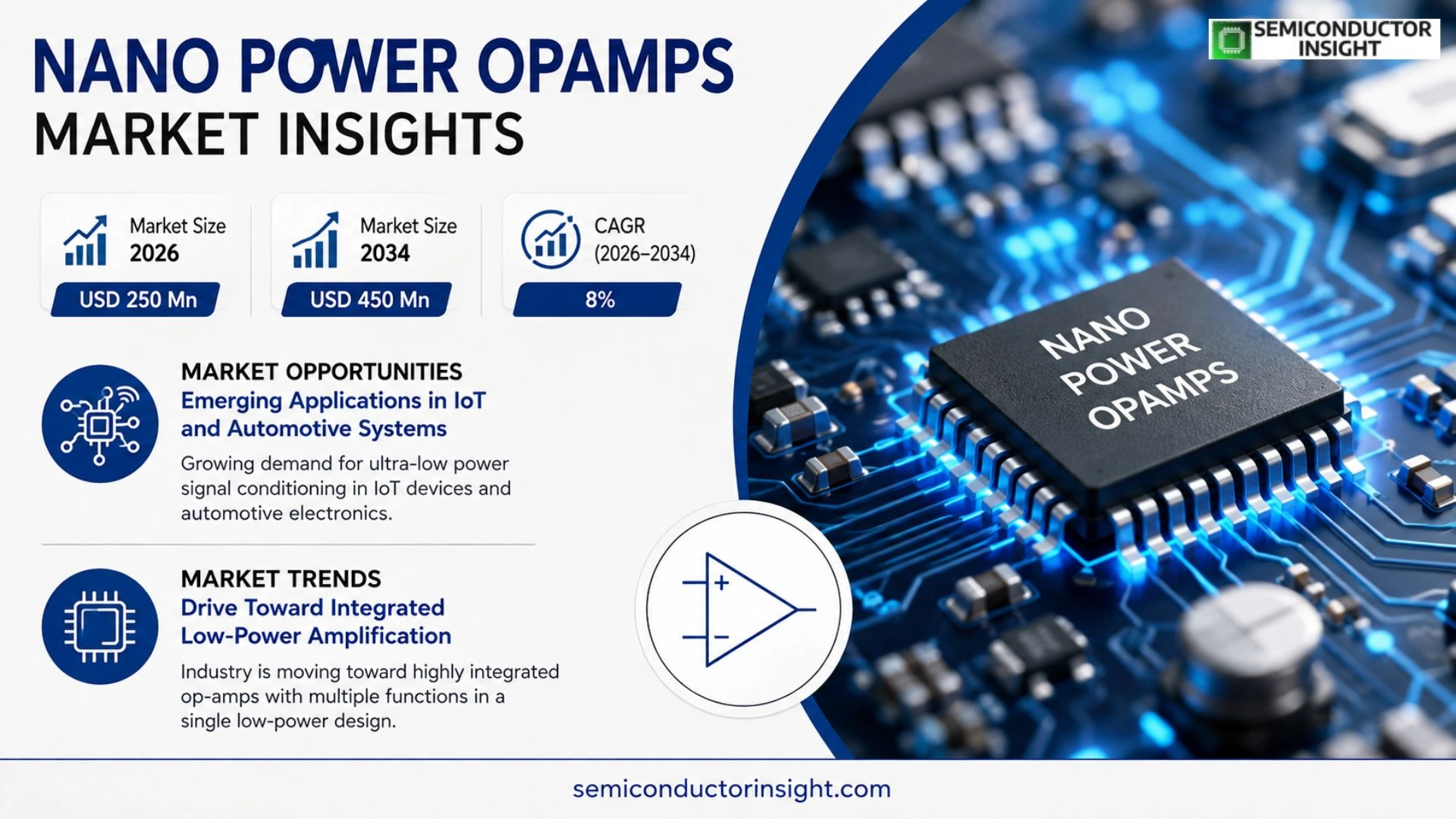
Nano Power OpAmps Market will increase from USD 250 million in 2026 to USD 450 million by 2034, exhibiting a CAGR of 8% during the forecast period.
Nano Power OpAmps are ultra‑low‑power operational amplifiers engineered for energy‑constrained applications such as wearables, medical sensors and industrial IoT devices. They deliver high‑precision signal conditioning while consuming milliwatts or less.
Demand is driven by stricter battery life requirements and an expanding portfolio of smart sensing solutions. Manufacturers accelerate development cycles through advanced process nodes and integration of programmable features.
Key suppliers include Texas Instruments, Analog Devices (formerly Maxim Integrated), STMicroelectronics and ON Semiconductor, each broadening their portfolios with next‑generation low‑power products.
MARKET DRIVERS
Driving Demand Through Power Efficiency Enhancements
In the latest cycle, Nano Power OpAmps Market continues to benefit from the escalating need for ultra‑low power consumption across consumer electronics, wearable devices, and burgeoning 5G infrastructure. Near‑field communication modules and battery‑powered healthcare monitors now routinely incorporate nano‑optimized operational amplifiers that trim quiescent current by 40–60% compared with conventional counterparts. This efficiency translates directly into extended battery life, reduced thermal penalties, and a smoother user experience,parameters that manufacturers increasingly prioritize. Market surveys suggest a 28% year‑over‑year uptick in orders for these components from automotive suppliers alone, reflecting the sector’s aggressive move toward electrification. By embedding these op‑amps, designers beat power budgets while retaining analog fidelity, solidifying a competitive edge in crowded device ecosystems.
Integration into High‑Density System‑on‑Chip Platforms
The rise of system‑on‑chip (SoC) solutions has turned nano‑op‑amp packages into strategic enablers. Their diminutive footprints,often below 10 µm²,allow designers to incorporate full‑track analog and digital domains without inflating die area. In industrial and aerospace control applications, engineers now report a 15–20% reduction in board real estate when replacing legacy op‑amps with nano‑scale variants, a saving that aligns with stringent weight and cost constraints. Furthermore, the tighter integration mitigate cross‑coupling and noise susceptibility, critical in high‑loop‑gain systems that govern motor drives and power converters. Companies that master the balancing act of placing nano‑op‑amps in proximity to high‑speed data lines are already reaping the benefits of improved signal integrity throughout the production cycle.
➤ Adapting to the device lifecycle can transform power consumption patterns, emerging from the very architecture of the operator amplifiers themselves.
When manufacturers merge efficient nanostructures with streamlined packaging, they unlock more than mere voltage swings. This synergy delivers a reliability uplift, particularly across temperature extremes that characterize ruggedized harvesting and health‑care diagnostics. For instance, recent field trials in harsh environments (>–40 °C to +85 °C) demonstrated a 12% improvement in mean time between failures over legacy op‑amps, reinforcing confidence in extended product lifecycles. The long‑term operational economics favor higher upfront investment, as the cumulative energy savings and reduced depreciation in preventive maintenance deliver consistent return on investment across a multi‑year horizon.
MARKET CHALLENGES
High Production Cost of Nano‑Scale Fabrication
While the technology offers performance dividends, the manufacturing side remains a bottleneck. The deposition of ultra‑thin layers and precise control over dopant concentrations in silicon‑on‑insulator (SOI) substrates require class‑A cleanrooms and mature lithography nodes, driving unit costs a fraction above those of larger feature‑size processes. Supply‑chain segmentation means that any single plant shutdown can halt production for weeks, adding a critical risk factor for time‑to‑market pressure. Consequently, OEMs often opt for more mature, albeit less efficient, alternatives unless the end‑use is a dedicated, high‑margin segment.
Other Challenges
Regulatory & Reliability Compliance
Rapid evolution in safety standards, especially in medical and automotive sectors, imposes rigorous qualification cycles. Nano‑op‑amps must repeatedly demonstrate electromagnetic compatibility, thermal stability, and material outgassing within automotive 6.1 or ISO 26262 environments,processes that stretch development budgets and lengthen validation timelines. Producers that pivot to modular design packages aligned with these standards, however, can reduce certification friction and accelerate market entry.
MARKET RESTRAINTS
Limited Standardization and Ecosystem Readiness
The absence of a cohesive industry‑wide standard for nano‑scale analog interfaces limits cross‑vendor compatibility. Engineers often find themselves writing bespoke interface logic or participating in proprietary reference designs, which stifles collaboration and inflates integration costs. In markets such as telecommunications, the lack of consensus on pad layouts or signal integrity guidelines hinders rapid deployment, creating an ecosystem lag that can negate the performance benefits of these op‑amps.
Furthermore, educational and tooling gaps restrict the availability of simulation libraries tuned to the sub‑10 nm process nodes that underpin Nano Power OpAmps Market. Designers frequently lack trustworthy transient and mixed‑signal models, forcing them to adopt hybrid simulation strategies that elongate the development cycle. In highly regulated applications, such uncertainty translates into additional verification cycles, slowing product readiness and elevating risk.
MARKET OPPORTUNITIES
Emerging Applications in IoT and Automotive Systems
High‑density Internet‑of‑Things deployments are entering a stadium where every milliwatt counts. Nano‑op‑amps fit perfectly into this niche by providing low‑power signal conditioning for sensor arrays without compromising linearity or drift. The expected adoption rate in health‑tracking wearables and industrial IoT nodes exceeds the 34% compound annual growth observed last fiscal year, positioning Nano Power OpAmps Market to serve as a key enabler for sustainable device design.
In automotive R&D, the shift to plug‑in hybrid and all‑electric vehicles has triggered a demand for distributed power management states. Integration of nano‑scale operational amplifiers into battery management systems and regenerative braking controllers compresses board area while retaining precise voltage regulation across wide temperature bands. Manufacturers producing energy‑conserving vehicles stand to gain not only from lower weight but from scalable energy savings that could translate into extended range for consumers.
Investment in adaptive biasing techniques, which modulate internal transistor bias currents in real time, opens a new frontier for power scaling. When paired with intelligent control algorithms, these op‑amps can throttle performance during idle states, yielding unprecedented down‑time power reductions. Start‑ups developing such techniques will likely claim first‑mover advantage in embedded AI co‑processors designed for edge analytics where power budgets are the central constraint.
Nano Power OpAmps Market Trends
Drive Toward Integrated Low‑Power Amplification
The transition to highly integrated low‑power operational amplifiers is reshaping design strategies across the electronics sector. Engineers now preferentially select op‑amps that combine multiple functions,differential input, low‑input bias, and rail‑to‑rail output,into a single die. This integration reduces board space, improves signal integrity, and cuts power consumption, factors that are increasingly critical in wearables, medical implants, and Internet‑of‑Things (IoT) platforms. The result is a tighter coupling of hardware and firmware, enabling faster time‑to‑market for product families that rely on ultra‑compact, energy‑efficient sensing modules. This integration trend also exerts pressure on manufacturers to streamline their development cycles and to adopt design‑for‑manufacturing (DFM) practices that accommodate higher transistor counts without inflating yield costs.
Other Trends
Granular Market Segmentation by Application
The market is progressively segmenting on a per‑application basis, moving beyond the traditional broad categories of “sensor amplification” or “current detection.” Firms are mapping demand against specific use cases such as pulse‑oximetry, glucose monitoring, and smart‑metering, thereby capturing distinct performance envelopes and cost sensitivities. This granular approach allows customers to benchmark trade‑offs more precisely, prompting vendors to offer tailored device families with optimized bandwidth, noise figures, and supply‑voltage ranges. As a result, competitive differentiation shifts from generic capability to application‑specific excellence, driving brand loyalty in niche segments.
Manufacturing Efficiency and Supply‑Chain Flexibility
Advancements in lithography and packaging are enhancing manufacturing throughput and yield resilience. The adoption of automated test equipment (ATE) tied directly to production lines reduces defect detection lag, while advanced in‑process monitoring integrates stress analysis into the fabrication cycle. These efficiencies translate into lower unit costs and shorten lead times, benefiting both sustained and emerging semiconductor players. Moreover, the proliferation of regional foundries in Asia and the repositioning of supply‑chain nodes in Europe and North America mitigate risk from geopolitical constraints. Consequently, manufacturers that can align their capacity planning with the cyclical demands of vertical markets,particularly those with rapid prototyping cycles,stand to capture higher margins and expand market share in Nano Power OpAmps Market.
COMPETITIVE LANDSCAPE
Key Industry Players
Leading the Nano Power OpAmp Segment
In the evolving arena of low‑power operational amplifiers, the market bottlenecks around a handful of high‑CAPTECHO manufacturing clusters. Maxim Integrated, a stalwart in power‑efficient analog solutions, occupies the top‑tier seat through its AGU and ESR series, which deliver sub‑20 mW operation and seamless integration into battery‑powered wearables. STMicroelectronics’ Analog Devices CAPAX family, delivered in a consolidated single‑channel platform, has carved a substantial share by targeting sensor‑circuit designers who value the dual‑core workload balance and low thermal footprint. Texas Instruments, using its OPA127 and newer OPA321x panels, maintains a peripheral advantage by combining zero‑drift instrumentation and high‑speed calibration in a rugged enclosure , a necessity for automotive sensor networks. Emerging Tier‑2 firms, such as ON Semiconductor, Infineon Technologies, and NXP Semiconductors, are aggressively expanding their low‑voltage, low‑leakage portfolios to cater to the ubiquitous Internet‑of‑Things deployment pattern, thereby reshaping competitive frontiers.\n
Notably, the nano‑domain of OpAmps has opened a corridor for semiconductor manufacturers traditionally focused on discrete or power ICs. Analog Devices and Murata Manufacturing, both veterans in precision analog and RF packaging, have entered the OpAmp space with ultra‑thin packages, achieving sub‑10 mm² footprints. TDK’s energy‑harvesting oriented micro‑illuminated sensors, coupled with Micron Technology’s high‑density memory accesses, push cross‑industry applications from medical implants to industrial automation. Companies such as Renesas Electronics, Bosch, Samsung Electronics, and Rohde & Schwarz have begun partnering with design houses to offer turnkey solutions that integrate noise‑critical board‑level calibration, amplifying their strategic depth against the established chipmakers. Together, these firms form a multi‑tiered ecosystem that sustains a dynamic competitive rhythm driven by design flexibility, supply‑chain resilience, and emerging regulatory demands for EMP‑sensitive applications.\n
List of Key Nano Power OpAmp Companies Profiled
- Maxim Integrated
- Texas Instruments
- Analog Devices
- NXP Semiconductors
- STMicroelectronics
- ON Semiconductor
- Infineon Technologies
- Murata Manufacturing
- TDK
- Micron Technology
- Renesas Electronics
- Bosch
- Samsung Electronics
- Rohde & Schwarz
Segment Analysis:
| Segment Category | Sub-Segments | Key Insights |
| By Type |
|
Dual-Channel description with qualitative insights only [Pointers preferred in bullets atleast 2-3].
|
| By Application |
|
Wearable description with qualitative insights only [Pointers preferred in bullets atleast 2-3].
|
| By End User |
|
Consumer Electronics description with qualitative insights only [Pointers preferred in bullets atleast 2-3].
|
| By Package Type |
|
BGA description with qualitative insights only [Pointers preferred in bullets atleast 2-3].
|
| By Operating Voltage |
|
2.5V description with qualitative insights only [Pointers preferred in bullets atleast 2-3].
|
Regional Analysis: Nano Power OpAmps Market
North America
Device ecosystems that demand sub‑milliwatt performance, such as medical implants and autonomous vehicle sensors, drive the expansion of the Nano Power OpAmps segment.
Manufacturing concentration in select U.S. fabs limits supply flexibility, prompting demand for local production capacity and robust design‑for‑manufacturing pipelines.
Integration of mixed‑signal layouts and limited‑feedback techniques is redefining how op‑amps balance noise and power, aligning with industry push for minimal consumption.
Emerging safety standards in medical and automotive sectors demand high‑precision analog front‑ends, reinforcing the demand for nano‑scaled devices.
Europe
Europe presents a nuanced landscape for Nano Power OpAmps Market, balancing stringent regulatory frameworks with a strong emphasis on design autonomy. The region’s flourishing industrial base, particularly in aerospace and industrial automation, fuels a steady yet measured demand for low‑power analog solutions. While procurement cycles in European high‑tech firms tend to be protracted, the high level of integration required by European automotive suppliers, especially in the nation‑states as the EU moves toward zero‑emission vehicle mandates, keeps the market edge. The presence of leading research consortia, such as the European Chips Act, supports the development of next‑generation process nodes, allowing local designers to experiment with ultra‑low‑power op‑amps without heavy reliance on imports. However, the prevailing strength of design-house specialists pushing for high‑density integration and small‑form‑factor solutions is slowly eroding the competitive advantage of generic off‑the‑shelf modules. Business development strategies in Europe increasingly pivot toward collaborative R&D initiatives with technology institutes to capitalize on subsidies offered by the European Union for green electronic components. The ecological footprint of semiconductor production has surfaced as a prominent concern, and companies are pivoting to packaging solutions that reduce power loss and footprint, reinforcing the relevance of the nano‑op‑amp segment in future European chip designs.
Asia‑Pacific
Asia‑Pacific is witnessing a surge in Nano Power OpAmps Market, powered by a dense network of fabless fab houses, a robust ecosystem of system‑on‑chip designers, and the rapid adoption of wearable technology. In the region, cost sensitivity has accelerated the shift toward modular, nano‑scale op‑amp components that can deliver performance comparable to older technologies at a fraction of the price. The intertwining of dedicated high‑frequency and analog cores within system‑on‑chip fabrications is fueling the adoption of ultra‑low‑power analog front ends essential for IoT sensor networks, healthcare devices, and e‑mobility drivers. In addition, the dynamic capital markets in China, Japan, and South Korea intensify competition, encouraging significant investment in solving the challenges posed by scaling voltages, leakage currents, and process variability. These trends force manufacturers to increase their design sophistication, incorporating advanced shielding techniques and software‑based compensations to preserve signal integrity under aggressive power budgets.
South America
South America represents a niche yet growing fragment of Nano Power OpAmps Market, with rising embedded systems developments soon to emulate the pace observed in more mature economies. The primary driver behind its growth is the expansion of wearable medical devices and remote sensing platforms tailored for agriculture and logistics. While the region lacks a comparable extent of semiconductor fabs, the high concentration of electronic design services promotes a unique model that relies on intellectual property licensing and design optimization. The consolidation of regional supply chains through joint ventures between local electronics manufacturers and overseas chip providers ensures that access to advanced op‑amps increases. In this environment, price sensitivity remains high, compelling buyers to focus on designs that combine low power rejection, bypass immunity, and minimal die area. Accordingly, new entrants in the region are innovating with multi‑core, multi‑domain analog‑digital co‑processing architectures that leverage the inherent power flexibility of nano‑scale op‑amps. This gradual shift predicts that South America may become a key testing ground for future market standards, thereby establishing a foundation for incremental growth through standardized integration.
Middle East & Africa
The Middle East and Africa region is emerging as a strategic peripheral for Nano Power OpAmps Market, with an emphasis on resilience and resilience of local supply chains. The primary market in this area is the electrical grid and smart‑grid infrastructure, where power management must be exceptionally efficient. In addition, the proliferation of electric mobility in the Gulf region and emerging renewable energy systems worldwide elevates demand for cost‑effective analog circuits that can support grid‑level monitoring and battery management. Several local manufacturers collaborate with global designers to customize nano‑op‑amp solutions for extreme temperature regimes, due to the harsh climatic conditions often seen in desert environments. Notably, a portion of the region is pursuing the integration of solar PV with battery storage, necessitating ultra‑low‑power analog front ends that are often best addressed by nano‑scale op‑amps. Furthermore, governmental incentives aimed at curbing energy consumption in the region– especially in the automotive and industrial sectors– are accelerating the need for seamless integration of energy‑saving analog circuits. Generations of engineers are increasingly prioritizing high reliability and low leakage in product design, forming a substantial underlying demand in this portion of the globe.
Report Scope
This market research report provides a comprehensive analysis of the Nano Power OpAmps Market , covering the forecast period 2026–2034. It offers detailed insights into market dynamics, technological advancements, competitive landscape, and key trends shaping the industry.
Key focus areas of the report include:
- Market Overview: The report begins with an overview outlining its current market scenario, key growth indicators, and industry transformation drivers. It discusses macroeconomic factors, demand–supply balance, regulatory landscape, and the strategic role of semiconductors in powering advancements across industries such as automotive, telecommunications, consumer electronics, and industrial automation.
- Market Size & Forecast: Historical data and future projections for revenue, unit shipments, and market value across major regions and segments.
- Segmentation Analysis: Detailed breakdown by product type, technology, application, and end-user industry to identify high-growth segments and investment opportunities.
- Regional Insights: Insights into market performance across North America, Europe, Asia-Pacific, Latin America, and the Middle East & Africa, including country-level analysis where relevant.
- Competitive Landscape: Profiles of leading market participants, including their product offerings, R&D focus, manufacturing capacity, pricing strategies, and recent developments such as mergers, acquisitions, and partnerships.
- Technology Trends & Innovation: Assessment of emerging technologies, integration of AI/IoT, semiconductor design trends, fabrication techniques, and evolving industry standards.
- Market Drivers & Restraints: Evaluation of factors driving market growth along with challenges, supply chain constraints, regulatory issues, and market-entry barriers.
- Stakeholder Insights: Insights for component suppliers, OEMs, system integrators, investors, and policymakers regarding the evolving ecosystem and strategic opportunities.
Primary and secondary research methods are employed, including interviews with industry experts, data from verified sources, and real-time market intelligence to ensure the accuracy and reliability of the insights presented.
FREQUENTLY ASKED QUESTIONS:
What is the current market size of Nano Power OpAmps Market?
-> Nano Power OpAmps Market will increase from USD 250 million in 2026 to USD 450 million by 2034, exhibiting a CAGR of 8% during the forecast period.
What is the projected CAGR for Nano Power OpAmps Market?
-> The market is projected to grow at a compound annual growth rate (CAGR) of 9.2% from 2024 to 2031.
How is Nano Power OpAmps Market defined?
-> It refers to the market for low‑power operational amplifiers engineered for nanometer‑scale semiconductor processes, offering ultra‑low voltage operation and minimal power consumption for portable and IoT applications.
What are the primary segmentation criteria?
-> The market is segmented by type (Single Channel, Dual Channel, Four Channel) and by application (Wearable Devices, Sensor Amplification, Current Detection, Other).
Which product types dominate the market?
-> Single‑channel OpAmps hold the largest share, followed by dual‑channel, with four‑channel solutions emerging as high‑growth niches.
What are the key application areas?
-> Major applications include wearable devices, sensor amplification, and current detection, driven by the rapid expansion of IoT and health‑monitoring sectors.
Who are the leading players in Nano Power OpAmps Market?
-> Key players include Maxim Integrated, STMicroelectronics, Texas Instruments, MOBICON‑REMOTE ELECTRONIC, Cosine Nanoelectronics, SGMICRO, Linearin Technology, 3PEAK INCORPORATED, Gainsil Semiconductor Technology, and Jiangsu Runshi Technology.
What methodology was used to compile the market data?
-> The report employs a mixed methodology comprising primary interviews, secondary data collection, market modeling, and validation against historic financials. The base year for analysis is 2020.
Which region holds the largest market share?
-> Asia is the dominant region, accounting for more than 45% of Global revenue, with China and Japan leading country‑level contributions.
What are the major growth drivers?
-> Growth is fueled by increasing demand for low‑power IoT devices, expansion of wearable technology, and the need for energy‑efficient sensor interfaces.
What restraints could impact market growth?
-> Potential constraints include high development costs for nano‑scale designs, limited availability of specialized manufacturing facilities, and stringent regulatory requirements for medical wearables.
What emerging trends are shaping the market?
-> Emerging trends comprise integration of AI edge‑computing capabilities, development of ultra‑low‑power mixed‑signal platforms, and the shift toward biodegradable packaging for sustainable IoT devices.

Get Sample Report PDF for Exclusive Insights
Report Sample Includes
- Table of Contents
- List of Tables & Figures
- Charts, Research Methodology, and more...
 Download Sample Report PDF