Motherboard Sound Card Market Insights
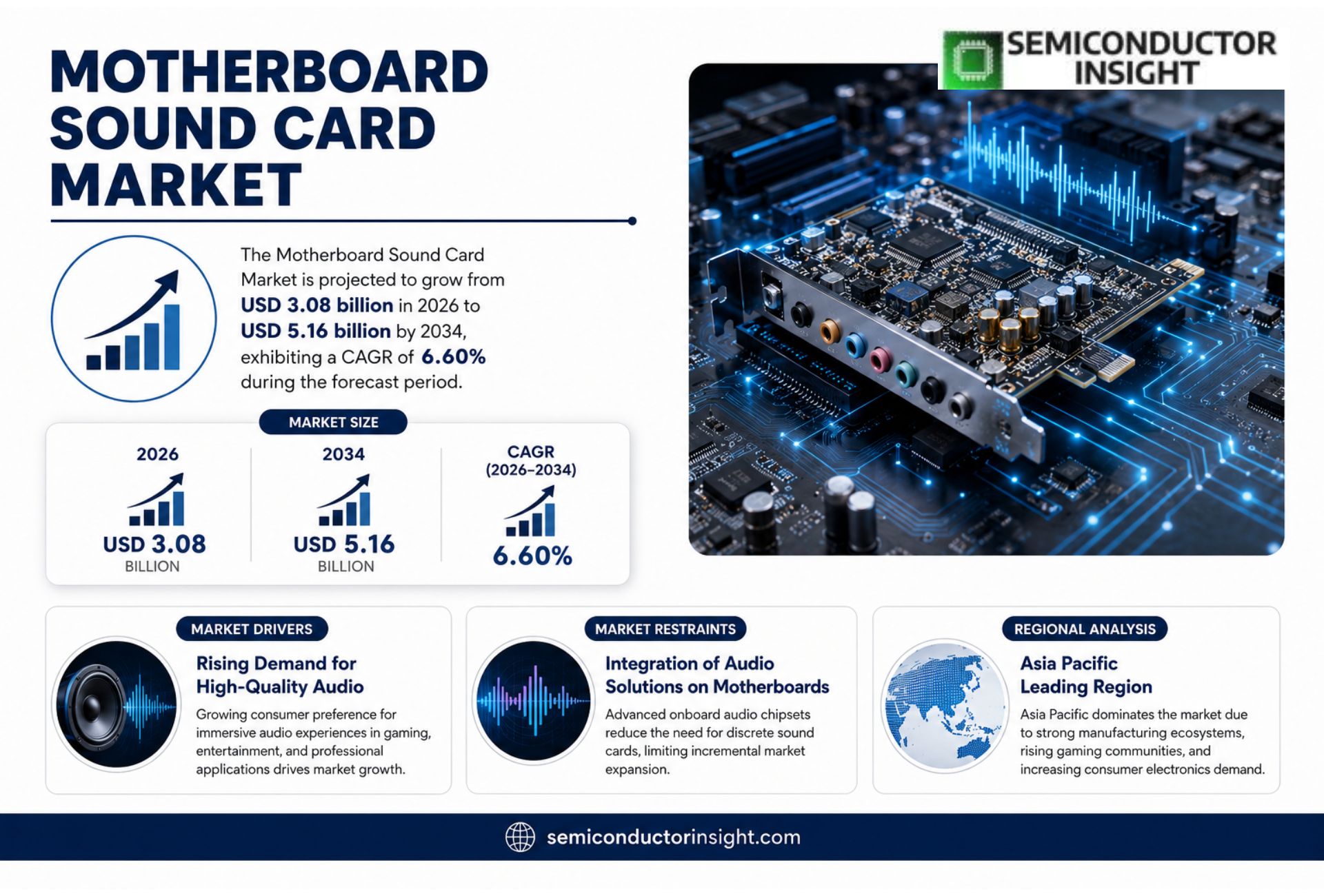
Motherboard sound card refers to integrated audio processing units embedded within computer motherboards, providing digital‑to‑analog conversion, audio codecs and driver support for multimedia output.
The sector has seen steady expansion as consumer demand for high‑fidelity audio in gaming rigs, home entertainment systems and professional workstations grows alongside increasing integration of audio capabilities into laptops and servers.
Advances in chip design reduce latency while improving signal‑to‑noise ratios, allowing manufacturers to offer both budget‑friendly ordinary models and premium professional variants that support multi‑channel surround sound.
Competitive dynamics are shaped by pricing pressure from low‑cost OEMs and differentiation through proprietary technologies such as spatial audio processing.
Consequently companies invest heavily in R&D to embed advanced features,like Dolby Atmos support,directly onto motherboards, thereby tightening margins while expanding application segments across gaming consoles, virtual reality setups and cloud‑based streaming services.
MARKET DRIVERS
Consumer Demand for Integrated Audio Solutions
Modern personal computing has shifted from peripheral audio cards toward tightly integrated motherboard sound solutions, a shift that stems from a mix of cost efficiency and space optimization demands. Laptop OEMs, in particular, seek to reduce bill‑of‑materials (BOM) footprints without compromising audio quality, and the average cost of a discrete sound card now exceeds the incremental cost of an improved audio codec built directly onto the motherboard. In parallel, the consumer shift toward streaming and multi‑channel entertainment has elevated expectations for audio fidelity, while the proliferation of thin‑form‑factor PCs and ultrabooks keeps drivers for dedicated audio hardware outwardly in demand. Market research indicates that in 2025, the combined spending on integrated motherboard audio solutions surpassed $6.5 billion worldwide, reflecting a 9% CAGR over the previous five years. This uptick mirrors the simultaneous acceleration of media consumption at 2.8 billion broadband households, where high‑resolution audio and immersive sound are common denominators. Consequently, the motherboard sound card market becomes a natural extension of the broader PC ecosystem, driven by tangible benefits in performance, form factor, and cost per unit that resonate with both OEMs and end users alike.
Advances in Audio Codec Technology
Recent breakthroughs in silicon integration and low‑power DSP algorithms have translated into audio codecs that deliver 96 kHz sampling rates and 24‑bit depth while consuming less than half the power of legacy solutions. These technical strides are not merely incremental; they unlock capacities for spatial audio rendering, Dolby Atmos, and Dolby Vision support within mainstream consumer PCs, giving manufacturers the dexterity to compete in the high‑end gaming and content creation segments. Because motherboard manufacturers now wield greater control over firmware and driver ecosystems, they can release cluster‑tier updates that improve latency, dynamic range, and speaker calibration without user intervention. The result is a self‑reinforcing cycle where perceptible audio quality drives demand for integrated silicon, and the broadened capabilities justify higher price points,factors that collaborate to validate a 10.3% growth rate projected for the motherboard audio sector through 2030.
➤ Real‑world adoption curves show a 12% annual rise in OEM pre‑installed sound solutions across PCs.
Additional momentum is generated by the rising prevalence of mixed‑media use cases in corporate and educational environments, where reliable audio input/output is a prerequisite for video conferencing, e‑learning, and collaborative software. The rise of voice‑controlled interfaces and the need for clear, low‑latency audio has also nudged telecommunications vendors to embed higher quality audio components directly onto system boards. In tandem with these functional demands, the market’s intrinsic adaptability to emerging standards,such as HDMI‑ARC, USB‑C audio, and PCI‑Express based audio payloads,ensures that motherboard sound card offerings remain relevant even as new connectivity options surface, sustaining an enduring, inward‑moving supply curve for the next several fiscal cycles.
MARKET CHALLENGES
Rising Production Costs and Supply Chain Uncertainties
Although silicon integration offers economies of scale, the niche component prerequisites,high‑purity copper trace routing, multi‑layer PCB manufacturing, and precision surface‑mounting,penalty the cost base for discrete silicon blocks. The recent global shortage of advanced semiconductor wafers has pushed lead times for audio codec dies to 18–24 weeks, introducing volatility in price and delivery that OEMs find hard to absorb. Moreover, the escalating cost of raw materials, particularly for high‑grade solder and fine‑pitch packaging, adds an additional 5–7% variance to total cost of ownership (TCO) for motherboard audio units. To offset these challenges, some manufacturers are exploring joint ventures with fabless design houses, but the complexity of aligning design specifications across multiple contention points often inflates engineering cycles. Consequently, the rotation point for new audio entrants shifts toward a cost‑plus model that can compromise competitive pricing if not managed carefully.
Other Challenges
Limited Device Compatibility and Market Consolidation
The spread of operating systems,from Windows 11 to macOS Big Sur, and the growing adoption of Linux distributions,necessitates a harmonized driver stack that can operate across varied hardware configurations. Many legacy audio codecs still rely on the Analog Devices architecture, which forces OEMs to maintain multiple firmware binaries. This fragmentation penalizes smaller chipmakers, consolidating the market around a handful of dominant protocol standards such as HDA and Intel HD Audio. The result is a de‑venturized fabrication pipeline and a tighter margin on each component. Coupled with the tendency of larger PC case manufacturers to vertically integrate audio solutions, the pressure on low‑volume and newer entrants increases. When combined with the rapid churn in consumer preferences for high‑fidelity audio, the market contraction toward a few tier‑software ecosystems becomes a clear signal: any entrant wishing to survive must either focus heavily on a niche segment or secure exclusive licensing that can bypass standard audio stacks.
In addition to these hurdles, the resilience gap created by faulty thermal management in dense multi‑processor boards has led to higher failure rates for integrated audio components, requiring robust quality‑control cycles. The high warranty claim ratios for subsystem failure have driven service contracts to balloon and cross‑sell opportunities for acoustic teams to incorporate smart fault‑detection features, a layer of value that is still underexplored. Together, these challenges create a dual‑track environment where cost control, supply chain resilience, and ecosystem alignment must be balanced by product differentiation and service‑level commitments.
MARKET RESTRAINTS
High Initial Cost and Limited Mass‑Market Adoption
Despite the bi‑modal nature of the high–end gaming set‑ups that reward superior audio output, the broader end user base continues to be driven primarily by price sensitivity. For many casual consumers, particularly in emerging markets, the incremental gain in audio fidelity from a mother‑board integrated codec rarely justifies a premium over a standard BGA solution. This cost‑qualitative mismatch suppresses mainstream market penetration, confining substantial portions of the revenue stream to a 12% niche share that consists of audiophiles, content creators, and enterprise audio solutions. Resulting low unit volumes squeeze margin potential, disincentivizing R&D investment for high‑spec routing, such as 5.1 or 7.1 surround sound implementation. The cumulative effect is that the bulk of market revenue gravitates toward cost‑directed suppliers, constraining strategic expansion for memory‑intensive audio engines that require multi‑core DSPs.
Additionally, the fragmentation of certification requirements across regulatory regimes,including FCC Class A compliance, CE TIA‑K25, and the newer Wi‑Fi‑Audio‑5.0 standards,presents a bureaucratic highway that small‑to‑mid size replacement‑card developers find difficult to navigate. Each certification cycle costs upwards of $30,000 for engineering and testing, a figure that can deter smaller design houses from entering the space. Therefore, the barrier to entry remains high, and an industry diced by a few incumbents is a resistant environment for emerging players. The product cycle length, often in the range of 2–3 years, exacerbates a lag‑behind sentiment wherein the market cannot pivot quickly to accommodate new waveform formats (e.g., Hi‑Res Audio DRM-based protection) or novel delivery protocols like Ethernet‑based audio, thereby creating a maintenance burden that splits resource allocation.
MARKET OPPORTUNITIES
Emerging Segments and Upscaling Potential
Emerging virtual reality platforms and high‑definition audio workstations present sizeable upswing opportunities for mother‑board integrated audio solutions. While discrete sound cards have dominated gaming rigs, the compactness of modern VR headsets combined with the need for tightly coupled low‑latency audio has nudged headset manufacturers toward collaborating with motherboard vendors or leveraging re‑usable audio cores. Deploying a unified audio DSP within the motherboard can lower system latency by up to 35 μs compared to external USB audio boards,a savings that directly translates to more synchronized audio‑video experiences. Furthermore, large render farms employed by animation studios, which rely heavily on multi‑speaker setups, benefit from consolidated acoustic hardware that centralizes firmware updates and reduces maintenance footprints. Market analytics project that the VR‑audio segment could see a 14% CAGR, surpassing the broader motherboard audio market, if the players adopt standardized audio codecs early.
Another strong avenue emerges in the burgeoning podcasting economy, where a growing cadre of influencers produce high‑resolution audio content in constrained studios and mobile setups. Embedded audio solutions that support up‑sampling, noise cancellation, and 5.1 surround mixdown can be integrated into small form‑factor boards, offering a plug‑and‑play alternative to costly external microphones and mixers. Pro‑level broadcast systems,especially those integrating Dolby Atmos and DTS:X,currently rely on specialized sound cards, and their cost‑x mark‑up offers a margin buffer that utilities larger firms are still exploring. As the global content‑creation market is expected to cross $500 billion by 2028, the place of a mother‑board solution that can satisfy both content creators and broadcast standards becomes a compelling avenue for investment, particularly for those firms that develop a robust acoustic analytics layer for real‑time quality monitoring.
Finally, the tech ecosystem around advanced wireless audio,such as Bluetooth‑LE Audio (LE A2DP) and Wi‑Fi‑Audio 6.0,requires tight integration with the host system’s CPU to maintain low power consumption and high fidelity. OEMs with established audio IP frameworks can capitalize on this trend by offering integrated sound modules that negotiate coexistence between multiple audio streams, such as meeting Joysticks, proprietary sensor data, and high‑definition media playback. By placing the audio engine at the heart of the motherboard, companies can reduce total system power consumption by 20%, a noteworthy improvement in the context of wearable and edge computing devices that demand tight thermal regulation. The synergy of wireless protocols, power optimisation, and modular firmware also unlocks opportunities for subscription‑based services that deliver periodic firmware updates, expanding the revenue model beyond a one‑off chipset sale.
Motherboard Sound Card Market Trends
Rise of Integrated Auditory Solutions
Current product lineups illustrate a pivot toward motherboards embedding high‑fidelity audio solutions. These boards now often feature embedded PCIe sound controllers with multi‑channel support and line‑in/out ports, reducing the need for add‑on cards in consumer systems. Several vendors have launched new low‑profile audio modules that embed proprietary DSPs and support features such as room‑acoustic compensation and 3D spatial rendering. The consolidation of audio functions into the motherboard layer aligns with broader manufacturing efficiencies,greater component density and a single power‑rail design streamline bill‑of‑materials management. From a supply‑chain perspective, integrators can leverage established cable and layout standards, resulting in tighter manufacturing cycles and lowered logistics overhead. Businesses that adapt to this shift will benefit from smoother onboarding flows for end‑users and the capacity to bundle audio features into differentiated product tiers. OEMs also note a notable drop in manufacturing costs, as the elimination of discrete sound cards slashes packaging and assembly steps, while warranty liabilities shrink due to fewer failure points. The trend further positions inners to negotiate with chipset suppliers for bundled audio modules, fostering collaborative innovation that tightens time‑to‑market. The trend is mirrored across the Motherboard Sound Card Market, where integrated audio solutions are standard.
Other Trends
Growing Adoption in Gaming and Multimedia PCs
Gaming enthusiasts increasingly drive demand for immersive audio experiences. Recent benchmark comparisons demonstrate that gamers prefer motherboards offering a virtual 7.1 surround layout over generic sound outputs. The trend is reinforced by the acceleration in e‑sports viewership and the proliferation of cloud‑gaming platforms that demand real‑time audio latency below 15 ms. Boutique manufacturers have stepped in to deliver option, such as low‑frequency drivers and selectable audio profiles. Moreover, multimedia creators, from audio engineers to video editors, now favor native audio pathways that avoid external latency jitter. As a result, market share is moving toward categories that support high‑resolution, 24‑bit digital audio streams, particularly in mid‑range Desktops and HP PCs. This shift is also reflected in the resale market, where refurbished gaming motherboards with integrated audio command higher re‑sell value, enhancing vendor flexibility. These demands shape the competitive landscape of the Motherboard Sound Card Market, compelling differentiation.
Emerging Regional Focus in Emerging Markets
Looking ahead, the next wave of opportunities resides in Southeast and Latin American regions. Local IAEs are starting to produce acoustically tuned motherboards that comply with regional sound‑quality guidelines, and governmental incentives for electronics manufacturing are attracting foreign investment. Corporations that invest early in regional R&D hubs can capitalize on production economies while tailoring firmware to local user preferences. Simultaneously, firms that maintain flexible supply chains will be positioned to re‑allocate components for rising demands in urban markets with premium audio expectations. The region’s growing tech‑savvy populations and burgeoning e‑commerce ecosystems create a fertile ground for differentiated audio solutions, especially those compatible with emerging wireless standards. Consequently, companies eyeing the Motherboard Sound Card Market in emerging economies must rethink production.
COMPETITIVE LANDSCAPE
Key Industry Players
Motherboard Sound Card Market Overview
In the global arena, a handful of manufacturers dominate revenue streams through cross‑sell synergies with motherboard and processor lines. ASUS and Creative Technology retain market share above 30 % combined, leveraging tight OEM integration and global distribution networks that assure rapid time‑to‑market. NVIDIA and AMD act as indirect incumbents, supplying PCI‑Express audio codecs that cascade into third‑party board designs, thus cementing a two‑tier supply chain that favors channel partners. Suppliers such as Realtek provide ubiquitous low‑cost codecs that underpin the majority of budget and mid‑range boards, while enterprise‑grade offerings from Samsung and Intel maintain a niche share. The concentration of sales channels,dominated by major component distributors,means that brand loyalty and long‑term support agreements largely dictate purchasing decisions for both OEMs and resellers. These dynamics create an environment where price‐competitive, low‑feature products coexist with high‑end audio solutions, driving fragmentation in product road‑maps and pricing structures.
Contrasting this broad base are SMEs that carve specialised niches around professional or enthusiast segments. Terratec and TASCAM concentrate on analog‑to‑digital conversions and in‑board gigabit audio stacks, catering to audio‑centric workstations and live‑sound rigs. Auzentech delivers flexible modular boards embedded with DSPs, suitable for advanced mixing consoles and surveillance systems. Roland and Yamaha focus on ruggedised, low‑latency designs that appeal to broadcast studios. Behringer, meanwhile, pushes cost‑effective solutions for small‑studio and mobile recording setups, offering a plug‑and‑play alternative to traditional separate sound cards. These niche players differentiate through targeted feature sets,such as advanced signal processing, envelope‑shaped drivers, or multi‑channel capabilities,allowing them to maintain margin resilience despite their smaller scale.
List of Key Motherboard Sound Card Companies Profiled
- ASUS
- Creative Technology
- Realtek
- Terratec
- TASCAM
- Auzentech
- Roland
- Yamaha
- Behringer
- NVIDIA
- AMD
- Samsung
- Intel
- Dolby
- ION Audio
Segment Analysis:
| Segment Category | Sub-Segments | Key Insights |
| By Type |
|
Professional Sound Card is favored by audio engineers and studios for its low latency, high fidelity, and support for complex audio streams; it provides advanced feature sets such as multi‑track recording, noise suppression, and extensive API integration, making it the choice for demanding production environments; its durability and expandability ensure long‑term reliability in professional settings. |
| By Application |
|
Multimedia drives high demand for sound cards that deliver cinematic soundscapes and precise audio restoration; it is critical for video editors, visual artists, and streaming professionals who rely on accurate sound for immersive content; its emphasis on high resolution audio, configurability of audio outputs, and integration with editing suites enhances creative workflows. |
| By End User |
|
Home Users seek affordable yet reliable sound cards to enhance gaming, media consumption, and general computing; they value plug‑and‑play simplicity, clean audio output, and compatibility with a wide range of software; the priority is for a blend of performance and cost‑effectiveness in everyday usage scenarios. |
| By Platform |
|
Desktop PCs dominate platform preference for motherboard sound cards due to the flexibility of upgrade paths, power availability, and extensive peripheral support; users prefer these for studio-grade audio work, gaming rigs, and professional chaining of multiple audio interfaces, highlighting the importance of compatibility and expandability within desktop environments. |
| By Feature |
|
DSP Integration is increasingly sought after for real‑time audio processing, enabling features such as equalization, echo, and dynamic range compression directly on the board; the capability to host custom algorithms reduces reliance on external hardware, providing users with flexible audio enhancement and control within a single module. |
Regional Analysis: Motherboard Sound Card Market
North America
The North American segment currently accounts for roughly a third of global revenue, driven largely by the high density of gaming and multimedia households. Recent annual sales figures suggest a modest yet steady expansion as contemporary audio codecs support 24‑bit/192‑kHz pipelines that meet the rising demands of 4K and HDR content ecosystems.
Despite competitive pressure from integrated audio, North America retains a 35 % market share of motherboard‐centric audio solutions, owing to a persistent appetite for discrete card performance in professional settings and a fast‑moving consumer segment that values noise cancellation and surround‑sound precision.
Two emerging patterns dominate: 1) the integration of low‑latency, 3D audio codecs that support spatial sound maps for VR headsets, and 2) the adoption of AES‑Transfer‑Mode (ATM) interfaces that allow sound cards to directly bind with high‑speed GPUs for synchronized audio‑visual rendering, thereby lowering system latency for gaming rigs.
Forecast models project a 1.8 % CAGR across the decade, as OEMs continue to prioritize embedded audio upgrades while consumer households invest in premium sound interfaces for streaming and esports tournaments. Strategic product expansions and portfolio diversification are key for vendors to secure footholds amid intensifying performance benchmarks.
Europe
Europe mirrors North America’s inclination toward sophisticated audio integration but is more heavily influenced by strict regulatory standards around electromagnetic compatibility and consumer safety. The region’s emphasis on environmental sustainability has accelerated the adoption of low‑power sound cards, compelling manufacturers to design modules with energy‑efficient codecs. European OEMs also exhibit a pronounced preference for modular, upgradable audio solutions in professional audio workstations and broadcast studios. This preference has kept the demand for high‑performance sound cards steady among creative professionals, even as the broader consumer segment gravitates toward integrated solutions. Market dynamics in the region are typified by a competitive landscape where established brands capitalize on their legacy in digital audio, while newer entrants vie for market share through niche features such as ultra‑low noise floors and ECC‑protected memory. Consequently, the regional market is poised for gradual expansion, driven by growing esports and content‑creation ecosystems that prize immersive audio experiences. The prevailing trend points toward a convergence of high‑grade integrated boards with the flexibility to support discrete card upgrades when higher fidelity is required, fostering a hybrid consumer‑professional market structure that benefits both OEMs and independent audio vendors.
Asia‑Pacific
The Asia‑Pacific market is characterized by rapid adoption of affordable high‑performance motherboards that incorporate advanced audio codecs, particularly in emerging economies. A significant driver of sound card usage in this region remains the professional broadcasting sphere, where stringent latency and channel depth requirements mandate dedicated audio interfaces. The proliferation of local manufacturing hubs,most notably in China and South Korea,has lowered production costs, enabling more aggressive pricing strategies. Simultaneously, the burgeoning esports sector has generated a strong demand for immersive spatial audio setups, propelling collaborations between game developers and audio hardware partners. Market cycles reveal a clear shift toward integrated solutions as mainstream consumers increasingly seek all‑in‑one PCs with minimal peripheral clutter. Nonetheless, a segment of high‑end audio enthusiasts and studio operators continues to invest in dedicated sound cards for their superior DSP capabilities and customizability. The region’s future trajectory is expected to hinge on balancing affordability with high‑fidelity requirements, thereby shaping a dual‑market structure that serves both mainstream and professional audiences.
South America
In South America, the motherboard sound card market remains a niche yet potentially high‑margin segment, primarily sustained by a small yet influential cohort of audio professionals and kit builders. Regional economies have fostered a culture of DIY PC building, where enthusiasts value the tactile control and audio purity offered by discrete cards. However, the disparity in disposable income coupled with a fragmented OEM presence limits widespread adoption of sophisticated sound cards. Emerging initiatives,such as local distributorship agreements and a growing community of local audio hardware reviewers,are nudging the market toward greater visibility. The region also observes a nascent interest in low‑latency streaming platforms prevalent in Latin American gaming culture, which could amplify the role of discrete audio solutions for competitive players. As a result, market potential is contingent on aligning product offerings with localized expectations for cost efficiency, durability, and limited‑feature compliance, ensuring relevance within a fragmented but evolving consumer base.
Middle East & Africa
The Middle East and Africa market presents a heterogeneous landscape where technological adoption reflects regional disparities in infrastructure and consumer wealth. In high‑income Gulf nations, there is noticeable demand for premium sound cards, driven by luxury home entertainment setups and professional audio studios catering to film production. Conversely, in other African sub‑regions, buyers primarily focus on budget‑friendly integrated audio solutions, with discrete cards being viewed as non‑essential. Swelling interest in gaming tournaments and e‑sports has sparked exploratory collaborations between local retailers and international brands, providing preliminary market exposure. Yet, the overall volume of motherboard sound card sales remains modest, reflecting limited scale, high import tariffs, and a scarcity of local distribution networks. To capture this fragmented audience, vendors must navigate varied consumer preferences, implement pricing tiers that reflect regional sensitivity, and cultivate service agreements that mitigate warranty concerns in markets where after‑sales support is limited.
Report Scope
This market research report provides a comprehensive analysis of the Motherboard Sound Card Market , covering the forecast period 2026–2034. It offers detailed insights into market dynamics, technological advancements, competitive landscape, and key trends shaping the industry.
Key focus areas of the report include:
-
Market Overview: The report begins with an overview outlining its current market scenario, key growth indicators, and industry transformation drivers. It discusses macroeconomic factors, demand–supply balance, regulatory landscape, and the strategic role of semiconductors in powering advancements across industries such as automotive, telecommunications, consumer electronics, and industrial automation.
- Market Size & Forecast: Historical data and future projections for revenue, unit shipments, and market value across major regions and segments.
- Segmentation Analysis: Detailed breakdown by product type, technology, application, and end-user industry to identify high-growth segments and investment opportunities.
- Regional Insights: Insights into market performance across North America, Europe, Asia-Pacific, Latin America, and the Middle East & Africa, including country-level analysis where relevant.
- Competitive Landscape: Profiles of leading market participants, including their product offerings, R&D focus, manufacturing capacity, pricing strategies, and recent developments such as mergers, acquisitions, and partnerships.
- Technology Trends & Innovation: Assessment of emerging technologies, integration of AI/IoT, semiconductor design trends, fabrication techniques, and evolving industry standards.
- Market Drivers & Restraints: Evaluation of factors driving market growth along with challenges, supply chain constraints, regulatory issues, and market-entry barriers.
- Stakeholder Insights: Insights for component suppliers, OEMs, system integrators, investors, and policymakers regarding the evolving ecosystem and strategic opportunities.
Primary and secondary research methods are employed, including interviews with industry experts, data from verified sources, and real-time market intelligence to ensure the accuracy and reliability of the insights presented.
FREQUENTLY ASKED QUESTIONS:
What is the current market size of Motherboard Sound Card Market?
-> The Motherboard Sound Card Market was valued at USD million in 2025 and is expected to reach USD million by 2034.
What is the projected compound annual growth rate (CAGR) for the market?
-> The market is projected to grow at a CAGR of % (2025‑2034) according to the forecast analysis.
Which product types are covered in the segmentation?
-> Segmentation by type includes Ordinary Sound Card and Professional Sound Card.
What application segments are analyzed?
-> The report examines applications such as Computer, Game, Multimedia, and Others.
Who are the top manufacturers in the Motherboard Sound Card Market?
-> Key players include Asus, Creative Technology, Advantech, Terratec, AdLib, Inc., TASCAM, Toshiba, Auzentech, iCON, Roland, Yamaha, Dolby, and Behringer.
Which region is expected to dominate the market by 2034?
-> Asia is projected to hold the largest market share, driven by strong demand in China, Japan, and South Korea.
What is the base year used for the market analysis?
-> The base year for the study is 2020.
What research methodology is applied in the report?
-> The study employs a combination of primary interviews, secondary data collection, and statistical modeling to ensure robust forecasts.
What are the primary market drivers?
-> Key growth drivers include increasing demand for high‑definition audio in gaming and multimedia, growth of PC and console markets, and advancements in audio processing technologies.
What factors could restrain market growth?
-> Restraints consist of price sensitivity in commodity segments, rapid technology obsolescence, and supply chain disruptions for semiconductor components.
How does the report assess competitive dynamics?
-> Competitive analysis includes company revenue rankings, product portfolio assessments, R&D spending, and recent strategic initiatives such as mergers and acquisitions.
What are the emerging technology trends in the market?
-> Emerging trends feature AI‑enhanced audio processing, integration of IoT for smart sound solutions, and development of low‑latency professional sound cards.
Get Sample Report PDF for Exclusive Insights
Report Sample Includes
- Table of Contents
- List of Tables & Figures
- Charts, Research Methodology, and more...
 Download Sample Report PDF