Mobile NAND (UFS 4.0, 5.0) Controller Market Insights
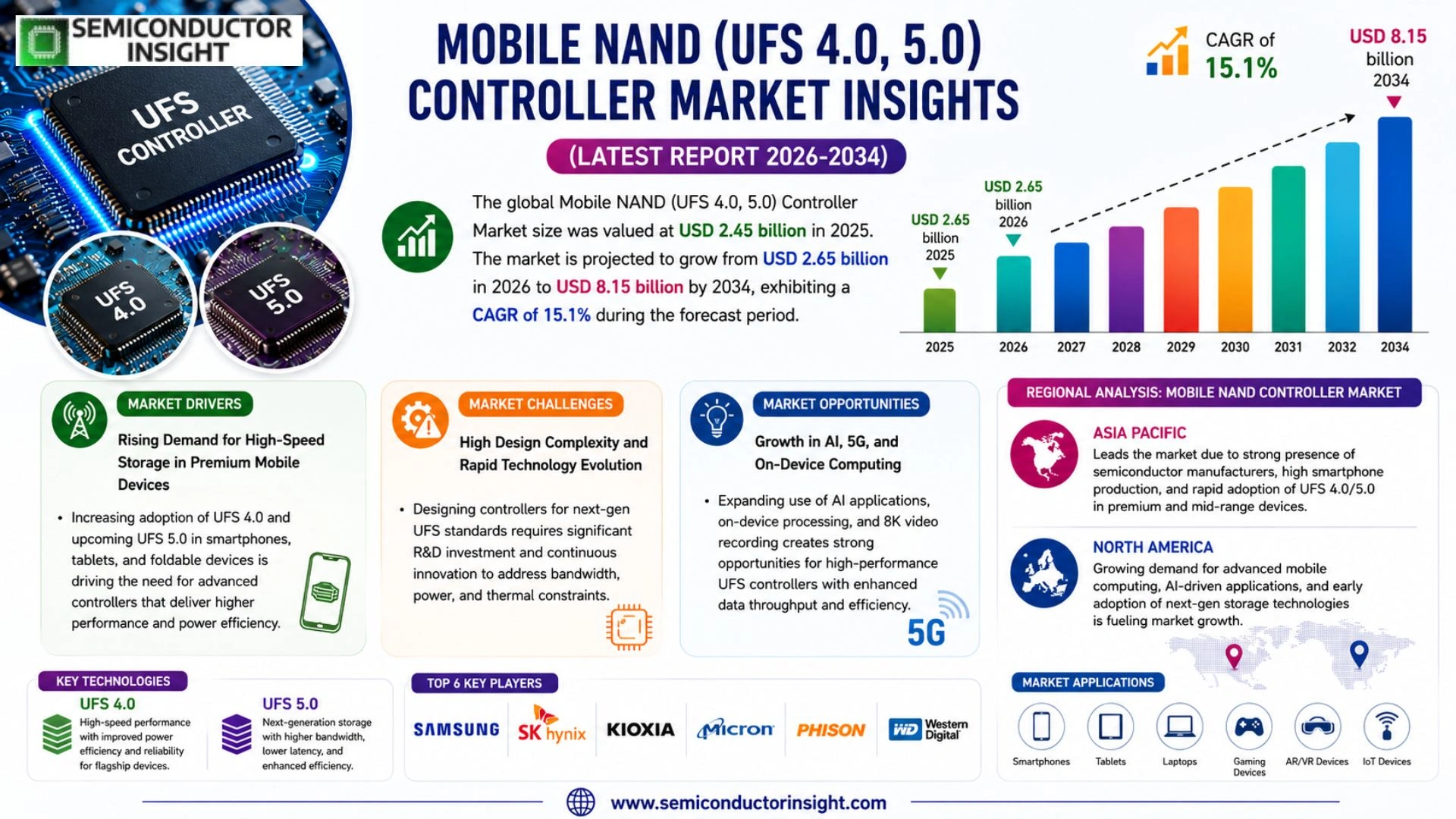
Global Mobile NAND (UFS 4.0, 5.0) Controller Market size was valued at USD 2.45 billion in 2025. The market is projected to grow from USD 2.65 billion in 2026 to USD 8.15 billion by 2034, exhibiting a CAGR of 15.1% during the forecast period.
Mobile NAND controllers for UFS 4.0 and 5.0 are specialized integrated circuits that manage high-speed data transfer between the host processor and NAND flash memory in smartphones, tablets, and other portable devices. These controllers optimize performance, power efficiency, and reliability while supporting advanced features such as multi-lane MIPI M-PHY interfaces, error correction, wear leveling, and AI-enhanced workload management essential for modern mobile applications.
The market is experiencing robust growth due to several factors, including the rapid adoption of 5G-enabled smartphones, increasing demand for high-resolution content and gaming, and the proliferation of on-device AI capabilities that require faster storage access. Furthermore, advancements in 3D NAND technology and the transition to UFS 4.0 and upcoming UFS 5.0 standards are driving the need for more sophisticated controllers capable of delivering sequential read speeds exceeding 4,300 MB/s. Initiatives by key players in the market are also expected to fuel growth. Silicon Motion and Phison Electronics continue to expand their portfolios with next-generation UFS controllers supporting higher densities and lower power consumption. Samsung Electronics, SK Hynix, and other leading semiconductor firms operate in the market with comprehensive solutions tailored for flagship and mainstream mobile devices.
MARKET DRIVERS
Rising Demand for High-Performance Storage in Smartphones
Mobile NAND (UFS 4.0, 5.0) Controller Market is propelled by the accelerating adoption of UFS interfaces in flagship and mid-range smartphones. UFS 4.0 delivers sequential read speeds up to 4,200 MB/s, enabling faster app loading, 8K video recording, and enhanced gaming experiences. Major OEMs are transitioning from eMMC to UFS solutions to meet consumer expectations for superior performance and efficiency.
Proliferation of On-Device AI and 5G Applications
Advancements in on-device AI require high-speed, low-latency storage for larger LLMs and multimodal processing. UFS 5.0, with theoretical speeds reaching 10.8 GB/s, supports these workloads effectively, driving controller innovation. The expansion of 5G networks further amplifies demand for reliable high-throughput storage in mobile devices.
➤ Automotive and IoT sectors are increasingly adopting UFS 4.0/5.0 controllers for ADAS, infotainment systems, and edge computing, expanding the addressable market beyond traditional mobile applications.
Overall market growth for related UFS controller segments reflects strong momentum, with projections indicating robust CAGRs fueled by these technological shifts and increasing storage capacities in premium devices.
MARKET CHALLENGES
Intense Competition and Technological Complexity
Mobile NAND (UFS 4.0, 5.0) Controller Market faces stiff competition from vertically integrated players like Samsung, SK Hynix, and Kioxia, who develop in-house solutions. Independent controller providers must continuously innovate to match performance while managing complex protocol implementations for successive UFS generations.
Other Challenges
Supply Chain Volatility
Fluctuations in NAND flash supply, geopolitical tensions, and foundry capacity constraints create procurement uncertainties and lead time variability for UFS controllers.
High Development Costs
Advancing to UFS 5.0 requires substantial R&D investment in advanced process nodes, extensive validation, and power optimization, posing barriers particularly for smaller market participants.
MARKET RESTRAINTS
High Manufacturing and Integration Costs
Elevated costs associated with advanced 3D NAND integration, controller tape-outs on leading-edge nodes, and rigorous OEM qualification processes limit broader adoption, especially in cost-sensitive mid-tier and entry-level mobile segments. These factors contribute to higher bill-of-materials expenses compared to legacy eMMC solutions.
Supply Concentration Risks
Reliance on a limited number of specialized foundries and materials suppliers exposes the market to disruptions from geopolitical issues and cyclical NAND industry dynamics, potentially delaying UFS 4.0/5.0 controller ramps and impacting overall market expansion.
MARKET OPPORTUNITIES
Expansion into Emerging Applications and Regions
Mobile NAND (UFS 4.0, 5.0) Controller Market presents significant opportunities in automotive electronics, wearables, and industrial IoT, where high-speed, reliable storage is increasingly critical. Growing smartphone penetration in emerging markets and the shift toward higher-density solutions in foldables and AR/VR devices offer additional growth avenues.
Technological Advancements in AI-Optimized Controllers
Development of AI-enhanced firmware, improved power management, and support for next-generation interfaces position controllers for substantial value uplift. Early movers in UFS 5.0 solutions are poised to capture share as flagship devices incorporate on-device generative AI capabilities.
Trends
Rapid Integration of High-Speed UFS Controllers in Mobile Ecosystems
Mobile NAND controllers for UFS 4.0 and 5.0 serve as critical integrated circuits that efficiently manage high-speed data transfer between the host processor and NAND flash memory in smartphones, tablets, and portable devices. These controllers enhance overall system performance, power efficiency, and data reliability through advanced capabilities including multi-lane MIPI M-PHY interfaces, robust error correction, wear leveling algorithms, and AI-enhanced workload management tailored for demanding mobile applications.
Other Trends
Expansion Driven by 5G, AI, and High-Performance Applications
The market continues to expand as smartphone manufacturers incorporate 5G connectivity alongside rising consumer expectations for high-resolution content consumption and advanced mobile gaming experiences. The proliferation of on-device AI features further accelerates demand for faster storage access, pushing controller designs to support sequential read speeds exceeding 4,300 MB/s while maintaining optimized power consumption for extended battery life in portable devices.
Advancements in 3D NAND Technology and Interface Standards
Progress in 3D NAND architecture combined with the transition toward UFS 4.0 and the emerging UFS 5.0 specifications requires increasingly sophisticated controller solutions. These developments enable higher storage densities and improved data throughput, addressing the intensive storage requirements of modern mobile operating systems and applications.
Strategic Initiatives by Leading Semiconductor Providers
Industry participants such as Silicon Motion and Phison Electronics are actively broadening their UFS controller portfolios with next-generation solutions focused on higher densities and reduced power usage. Meanwhile, major players including Samsung Electronics and SK Hynix deliver comprehensive controller technologies optimized for both flagship and mainstream mobile devices, supporting seamless integration across diverse product segments. This collaborative innovation environment fosters continuous improvements in controller performance, reliability, and compatibility with evolving mobile hardware architectures, positioning the sector for sustained technical advancement amid growing global demand for premium storage solutions.
COMPETITIVE LANDSCAPE
Key Industry Players
Mobile NAND (UFS 4.0, 5.0) Controller Market Analysis
Mobile NAND (UFS 4.0, 5.0) Controller Market is characterized by a mix of vertically integrated giants and specialized merchant controller suppliers. Samsung Electronics stands as the dominant leading player, leveraging its comprehensive in-house ecosystem of advanced 3D NAND production, proprietary controller design, and UFS module integration to serve flagship smartphones and high-end devices. The market structure remains oligopolistic at the NAND level, with a handful of manufacturers controlling the majority of supply, while merchant controller firms like Silicon Motion and Phison Electronics play critical roles in providing flexible, high-performance solutions for diverse OEM requirements.
Other significant players include SK Hynix, Micron Technology, and Kioxia, which combine NAND fabrication expertise with tailored controller technologies optimized for power efficiency and high-speed data transfer. Niche and emerging contributors such as Marvell Technology further enhance the competitive dynamics through specialized IP and firmware innovations supporting AI-enhanced workloads and next-generation UFS standards.
List of Key Mobile NAND Controller Companies Profiled
- Samsung Electronics
- SK Hynix
- Micron Technology
- Silicon Motion Technology
- Phison Electronics
- KIOXIA Holdings Corporation
- Western Digital Corporation
- Marvell Technology
- YMTC (Yangtze Memory Technologies)
- Hyperstone
- JMicron Technology
- Realtek Semiconductor
- Maxio Technology
- ASMedia Technology
- InnoGrit
Segment Analysis:
| Segment Category | Sub-Segments | Key Insights |
| By Type |
|
UFS 5.0 Controllers represent the cutting edge of mobile storage technology with superior data throughput capabilities essential for demanding modern applications. These controllers excel in handling complex AI workloads and high-resolution multimedia processing through advanced error correction and intelligent workload management. Manufacturers prioritize them for next-generation devices seeking seamless multitasking and rapid app loading experiences. Their power optimization features make them particularly attractive for battery-sensitive portable ecosystems while maintaining exceptional reliability under sustained heavy usage. |
| By Application |
|
Flagship Smartphones dominate adoption as they require the highest performance standards to support premium features like advanced gaming, 8K video recording, and sophisticated on-device artificial intelligence. These applications demand controllers that deliver ultra-fast read and write speeds alongside robust thermal management. Integration with 5G connectivity further amplifies the need for responsive storage solutions that prevent bottlenecks during data-intensive tasks. Leading implementations focus on seamless user experiences that differentiate high-end devices in competitive markets. |
| By End User |
|
Smartphone OEMs are the primary drivers of innovation and volume in controller deployment due to their relentless pursuit of performance differentiation. They collaborate closely with controller specialists to customize solutions that align with specific processor architectures and software ecosystems. This segment emphasizes long-term reliability, firmware upgradability, and power efficiency optimizations tailored for diverse usage patterns across global user bases. Strategic partnerships enable rapid iteration cycles that keep pace with evolving mobile technology demands. |
| By Technology |
|
AI-Enhanced Controllers are gaining significant traction by incorporating machine learning capabilities for predictive data management and adaptive resource allocation. These solutions intelligently prioritize frequently accessed data while optimizing background operations to extend battery life. They provide superior handling of mixed workloads typical in contemporary mobile usage including photography, video editing, and real-time AI applications. The technology enables more responsive device behavior and better overall system efficiency through proactive error detection and correction mechanisms. |
| By Performance Tier |
|
Premium Tier solutions lead market preferences through their ability to support multi-lane high-speed interfaces and advanced NAND flash management techniques. They deliver exceptional sequential and random access performance critical for immersive gaming experiences and professional content creation on mobile platforms. These controllers incorporate sophisticated thermal throttling prevention and endurance optimization features that ensure consistent performance over the device lifecycle. Their development reflects the industry shift toward storage as a key differentiator in user satisfaction and device longevity. |
Regional Analysis: Mobile NAND (UFS 4.0, 5.0) Controller Market
Asia-Pacific
Asia-Pacific hosts premier research and development centers focused on advancing Mobile NAND (UFS 4.0, 5.0) Controller Market technologies. Collaborative efforts between academia and industry drive breakthroughs in controller firmware, error correction algorithms, and interface protocols, ensuring seamless compatibility with evolving NAND flash generations while prioritizing energy efficiency.
The region’s integrated supply chain ecosystem enables efficient sourcing of critical components and rapid iteration of Mobile NAND (UFS 4.0, 5.0) Controller Market solutions. Proximity between foundries, packaging facilities, and device assembly plants minimizes lead times and supports customization for diverse market segments.
High consumer appetite for feature-rich smartphones accelerates the integration of advanced UFS controllers throughout Asia-Pacific. Manufacturers prioritize solutions that deliver exceptional read/write performance, supporting demanding applications such as high-resolution video recording, gaming, and AI-enhanced features.
Sustained capital investment in semiconductor capabilities and talent development positions Asia-Pacific for continued leadership Mobile NAND (UFS 4.0, 5.0) Controller Market. Focus areas include next-generation interface standards and enhanced security features for mobile storage controllers.
North America
North America maintains a significant role Mobile NAND (UFS 4.0, 5.0) Controller Market through its emphasis on design innovation and high-end device ecosystems. The region excels in software-hardware co-development, where controller firmware is optimized for premium user experiences and seamless integration with advanced mobile operating systems. Strong focus on data security and privacy drives demand for sophisticated error handling and encryption capabilities within UFS controllers. Leading technology companies invest heavily in research to push performance boundaries, particularly for professional and gaming-oriented smartphones. Collaboration between semiconductor specialists and device brands ensures that North American market requirements influence global controller roadmaps, even as manufacturing often occurs elsewhere. The region’s mature consumer base appreciates the reliability and speed advantages delivered by UFS 4.0 and 5.0 technologies in daily device usage.
Europe
Europe demonstrates steady progress Mobile NAND (UFS 4.0, 5.0) Controller Market with particular attention to sustainability and regulatory compliance. Regional players prioritize energy-efficient controller designs that align with stringent environmental standards while maintaining competitive performance levels. The automotive crossover influence brings additional expertise in reliability engineering to mobile applications. European manufacturers focus on creating differentiated solutions for mid-to-high-end devices popular in the region, emphasizing thermal management and long-term durability. Strategic partnerships with Asian supply partners help bridge innovation gaps, allowing Europe to contribute meaningfully to global standards development. Growing interest in secure mobile storage for enterprise and government applications further shapes controller requirements in this sophisticated market.
South America
South America shows emerging potential Mobile NAND (UFS 4.0, 5.0) Controller Market as smartphone penetration deepens across key economies. The region benefits from increasing demand for affordable yet capable devices that incorporate modern storage controllers for improved user experiences. Local distribution networks and assembly operations adapt global technologies to meet specific market preferences, such as enhanced performance in challenging network conditions. While still developing its technological infrastructure, South America represents an important growth frontier where cost-effective UFS controller implementations can drive broader adoption. Rising digital content consumption and mobile application usage create opportunities for manufacturers to introduce optimized solutions tailored to regional usage patterns and economic considerations.
Middle East & Africa
The Middle East and Africa region exhibits dynamic growth patterns Mobile NAND (UFS 4.0, 5.0) Controller Market fueled by expanding mobile connectivity and digital transformation initiatives. Urban centers with rising disposable incomes drive demand for devices featuring advanced storage controllers that support multimedia-rich applications and efficient data management. The region’s youthful demographic shows strong affinity for gaming and social media experiences that benefit from high-speed UFS technologies. Infrastructure development projects enhance the overall mobile ecosystem, creating favorable conditions for premium controller adoption. Market participants focus on solutions that deliver reliable performance across diverse climatic conditions and varying network qualities, making the region an increasingly relevant player in global Mobile NAND controller strategies.
Report Scope
This market research report provides a comprehensive analysis of the Mobile NAND (UFS 4.0, 5.0) Controller Market , covering the forecast period 2026–2034. It offers detailed insights into market dynamics, technological advancements, competitive landscape, and key trends shaping the industry.
Key focus areas of the report include:
- Market Overview: The report begins with an overview outlining its current market scenario, key growth indicators, and industry transformation drivers. It discusses macroeconomic factors, demand–supply balance, regulatory landscape, and the strategic role of semiconductors in powering advancements across industries such as automotive, telecommunications, consumer electronics, and industrial automation.
- Market Size & Forecast: Historical data and future projections for revenue, unit shipments, and market value across major regions and segments.
- Segmentation Analysis: Detailed breakdown by product type, technology, application, and end-user industry to identify high-growth segments and investment opportunities.
- Regional Insights: Insights into market performance across North America, Europe, Asia-Pacific, Latin America, and the Middle East & Africa, including country-level analysis where relevant.
- Competitive Landscape: Profiles of leading market participants, including their product offerings, R&D focus, manufacturing capacity, pricing strategies, and recent developments such as mergers, acquisitions, and partnerships.
- Technology Trends & Innovation: Assessment of emerging technologies, integration of AI/IoT, semiconductor design trends, fabrication techniques, and evolving industry standards.
- Market Drivers & Restraints: Evaluation of factors driving market growth along with challenges, supply chain constraints, regulatory issues, and market-entry barriers.
- Stakeholder Insights: Insights for component suppliers, OEMs, system integrators, investors, and policymakers regarding the evolving ecosystem and strategic opportunities.
Primary and secondary research methods are employed, including interviews with industry experts, data from verified sources, and real-time market intelligence to ensure the accuracy and reliability of the insights presented.
FREQUENTLY ASKED QUESTIONS:
What is the current market size of Mobile NAND (UFS 4.0, 5.0) Controller Market?
-> Mobile NAND (UFS 4.0, 5.0) Controller Market was valued at USD 2.45 billion in 2025 and is expected to reach USD 8.15 billion by 2034.
Which key companies operate Mobile NAND (UFS 4.0, 5.0) Controller Market?
-> Key players include Silicon Motion, Phison Electronics, Samsung Electronics, SK Hynix, among others.
What are the key growth drivers?
-> Key growth drivers include rapid adoption of 5G-enabled smartphones, increasing demand for high-resolution content and gaming, and proliferation of on-device AI capabilities.
Which region dominates the market?
-> Asia-Pacific is the fastest-growing region with strong presence of key semiconductor players.
What are the emerging trends?
-> Emerging trends include transition to UFS 5.0 standards, AI-enhanced workload management, and advancements in 3D NAND technology.

Get Sample Report PDF for Exclusive Insights
Report Sample Includes
- Table of Contents
- List of Tables & Figures
- Charts, Research Methodology, and more...
 Download Sample Report PDF