Mobile GPU (Adreno, Mali, Apple GPU) Market Insights
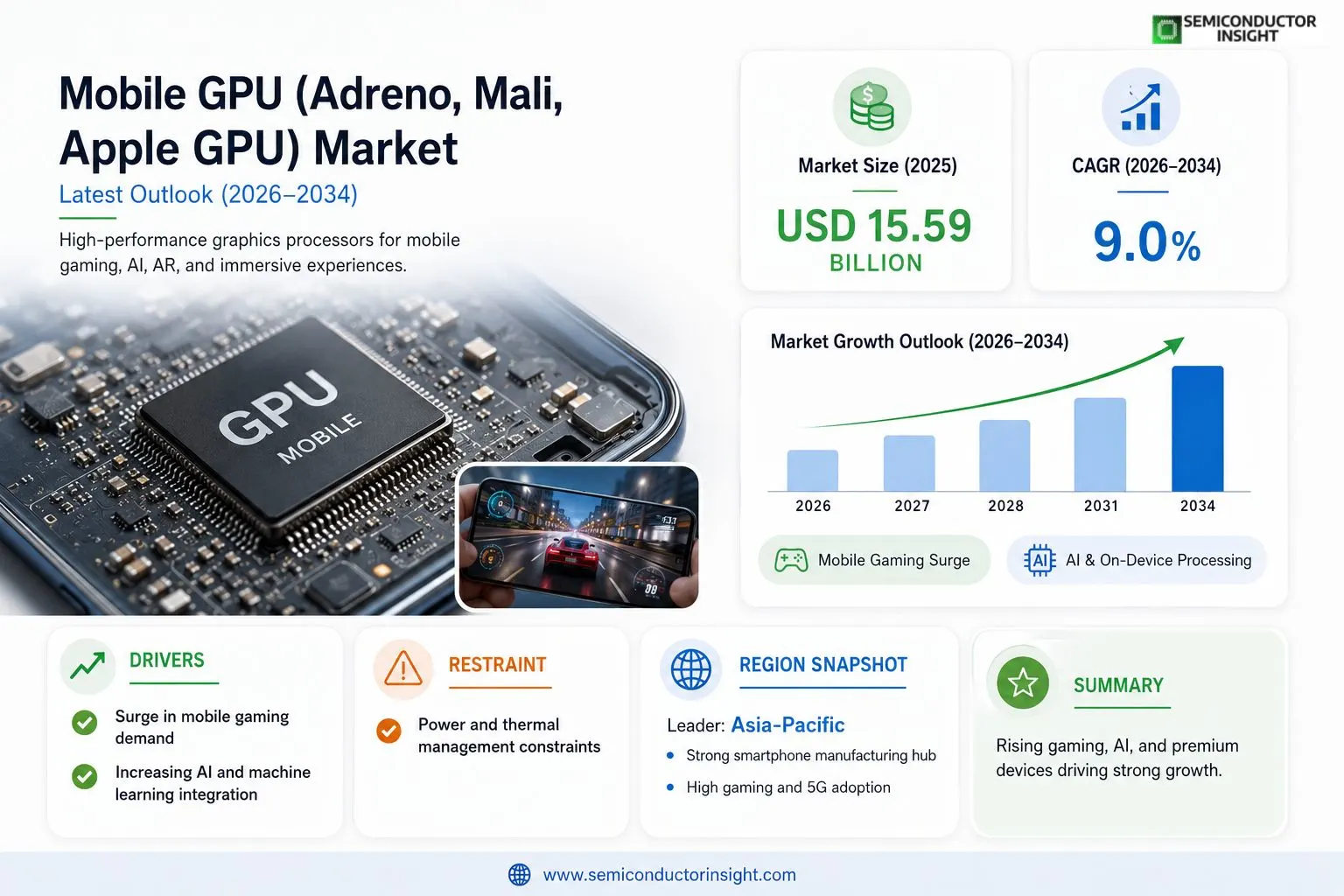
Global Mobile GPU (Adreno, Mali, Apple GPU) Market size was valued at USD 15.59 billion in 2025. The market is projected to grow from USD 16.80 billion in 2026 to USD 32.50 billion by 2034, exhibiting a CAGR of 9.0% during the forecast period.
Mobile GPUs, including Qualcomm’s Adreno, ARM’s Mali, and Apple’s custom GPUs, are specialized processors designed to handle graphics rendering, computational tasks, and visual processing in smartphones, tablets, and other portable devices. These integrated graphics solutions play a critical role in delivering smooth gaming experiences, supporting advanced camera features, enabling augmented reality applications, and powering on-device AI capabilities while maintaining excellent power efficiency.
The market is experiencing robust growth due to several factors, including the surge in mobile gaming, rising demand for high-resolution displays, and increasing integration of AI and machine learning features in consumer devices. Furthermore, advancements in 5G connectivity and the proliferation of premium smartphones continue to drive the need for more powerful yet energy-efficient graphics solutions. However, challenges such as thermal management and the need for optimized software ecosystems remain key considerations for manufacturers.
Key players continue to innovate with new architectures that push the boundaries of mobile graphics performance. For instance, recent generations feature hardware-accelerated ray tracing, improved AI tensor operations, and better scalability across device segments. Qualcomm, Apple, and ARM, along with their partners, maintain strong portfolios that address diverse market needs from flagship to entry-level devices, supporting sustained expansion in this competitive landscape.
MARKET DRIVERS
Rising Demand for High-Performance Mobile Gaming
Mobile GPU (Adreno, Mali, Apple GPU) Market is propelled by the explosive growth in mobile gaming, where graphically intensive titles demand advanced rendering capabilities. Flagship devices featuring Qualcomm Adreno GPUs in Snapdragon platforms and Apple’s custom GPUs deliver console-like experiences with features such as hardware-accelerated ray tracing and high frame rates, driving consumer upgrades and premium device sales.
Integration of AI and On-Device Processing
Advancements in AI applications require efficient parallel processing that modern mobile GPUs excel at providing. Adreno and Apple GPU architectures support enhanced neural network inference, while Mali GPUs scale across diverse Android devices, enabling features like real-time image enhancement, voice recognition, and generative AI tools directly on smartphones without heavy cloud dependency.
➤ The proliferation of 5G connectivity further amplifies these drivers by enabling seamless streaming of high-quality graphics and cloud-hybrid rendering solutions.
Additionally, expanding use in automotive infotainment and AR applications contributes to sustained market momentum, with the sector showing robust double-digit growth projections through the coming decade.
MARKET CHALLENGES
Power Efficiency and Thermal Management Constraints
Delivering high graphical performance in compact mobile form factors remains difficult due to strict power and heat limitations. Even advanced Adreno, Mali, and Apple GPU designs must balance peak performance with battery life, often resulting in thermal throttling during extended gaming or compute-heavy sessions.
Other Challenges
Rapid Technological Obsolescence
Intense competition among Qualcomm, ARM, Apple, and other players leads to short product cycles, pressuring manufacturers to continuously invest in R&D for new architectures supporting ray tracing and AI acceleration.
Fragmented Ecosystem and Optimization
Diverse hardware implementations across Adreno-powered Android devices, Mali-licensed chipsets, and Apple’s tightly integrated ecosystem create challenges for developers seeking consistent cross-platform performance.
MARKET RESTRAINTS
High Development Costs and Manufacturing Complexity
Transitioning to advanced process nodes for superior Mobile GPU (Adreno, Mali, Apple GPU) performance significantly raises production costs. Achieving optimal power efficiency while incorporating hardware ray tracing and expanded compute units requires substantial capital investment, limiting accessibility primarily to premium market segments.
Supply chain complexities and dependency on limited advanced semiconductor foundry capacity further constrain volume scaling for cutting-edge solutions, impacting overall market penetration in mid-range and budget devices.
MARKET OPPORTUNITIES
Expansion into AR/VR and Emerging Applications
Mobile GPU (Adreno, Mali, Apple GPU) Market presents significant growth potential through augmented and virtual reality applications. Enhanced GPUs enable immersive experiences in mobile AR, driving demand across consumer entertainment, enterprise training, and retail sectors.
Opportunities also arise in edge AI computing, automotive displays, and wearable devices, where efficient Mali, Adreno, and Apple GPU architectures support real-time processing needs while maintaining power efficiency. Continued innovation in software ecosystems and API optimizations will further unlock these avenues for sustained expansion.
Mobile GPU (Adreno, Mali, Apple GPU) Market Trends
Rising Demand for Advanced Graphics Capabilities in Mobile Devices
Mobile GPU (Adreno, Mali, Apple GPU) Market continues to evolve rapidly as manufacturers prioritize superior visual performance and computational efficiency in smartphones and tablets. Qualcomm’s Adreno, ARM’s Mali, and Apple’s custom GPUs serve as critical components that deliver smooth gaming experiences, support advanced camera processing, and enable augmented reality applications while optimizing power consumption for extended battery life.
Other Trends
Surge in Mobile Gaming and High-Resolution Displays
Mobile gaming has become a dominant driver for graphics processor advancements. Consumers increasingly expect console-like experiences on portable devices, pushing Adreno, Mali, and Apple GPU solutions to handle complex rendering tasks at higher frame rates. The proliferation of high-resolution displays further necessitates more capable mobile GPUs that maintain visual clarity without compromising thermal or energy efficiency across various device segments.
Integration of AI and Machine Learning Features
AI and machine learning capabilities are being deeply integrated into mobile GPUs. These processors now support enhanced on-device AI operations, including real-time image enhancement, intelligent camera features, and personalized user experiences. Hardware-accelerated tensor operations in modern Adreno, Mali, and Apple GPU architectures allow for efficient processing of AI workloads directly on the device, reducing latency and improving privacy by minimizing cloud dependency.
Advancements in 5G and Premium Device Ecosystems
The widespread adoption of 5G connectivity has accelerated the need for powerful yet energy-efficient graphics solutions. As premium smartphones proliferate, Mobile GPU (Adreno, Mali, Apple GPU) technologies are advancing to support seamless streaming, immersive AR applications, and sophisticated visual effects. Manufacturers focus on new architectures that incorporate hardware-accelerated ray tracing and improved scalability, addressing requirements from flagship devices down to mid-range and entry-level segments.
Key industry players continue to refine their GPU designs to overcome challenges such as thermal management while expanding software ecosystem optimization. These efforts ensure that Adreno, Mali, and Apple GPUs maintain strong positions in delivering next-generation mobile experiences. The competitive landscape fosters continuous innovation, supporting sustained growth as consumer expectations for graphics performance and efficiency rise in tandem with technological progress.
COMPETITIVE LANDSCAPE
Key Industry Players
Dynamic Competition Driving Innovation in Mobile GPU Architectures
Mobile GPU Market is led by a concentrated group of innovators including Qualcomm with its Adreno series, Apple with its custom-designed GPUs integrated in A-series chips, and ARM with its widely licensed Mali and Immortalis architectures. These players dominate through vertical integration and IP licensing strategies, enabling high-performance graphics rendering, ray tracing capabilities, and efficient AI acceleration while optimizing power consumption for smartphones and tablets. The competitive dynamics are shaped by rapid advancements in process nodes and software ecosystems that support demanding applications like mobile gaming and AR/VR experiences.
Other significant contributors include Imagination Technologies with PowerVR GPUs, MediaTek integrating advanced graphics in Dimensity SoCs, Samsung developing custom solutions for Exynos processors, and emerging efforts from companies like NVIDIA and AMD in specialized mobile segments. These players address diverse market tiers from flagship devices to cost-effective solutions, fostering a vibrant ecosystem of partnerships and technological differentiation focused on performance-per-watt leadership and ecosystem optimization.
List of Key Mobile GPU Companies Profiled
- Qualcomm Incorporated (Adreno)
- Apple Inc.
- ARM Limited (Mali/Immortalis)
- Imagination Technologies (PowerVR)
- MediaTek Inc.
- Samsung Electronics Co., Ltd.
- NVIDIA Corporation
- Advanced Micro Devices, Inc. (AMD)
- Intel Corporation
- Broadcom Inc.
- Huawei Technologies Co., Ltd. (Kirin)
- Google (Tensor)
- Rockchip Electronics Co., Ltd.
- Unisoc (Spreadtrum)
Segment Analysis:
| Segment Category | Sub-Segments | Key Insights |
| By Type |
|
Adreno GPUs stand out for their exceptional balance of graphics rendering power and computational flexibility, making them highly suitable for diverse mobile workloads. They excel in delivering fluid gaming experiences with robust support for advanced visual effects while optimizing power consumption during intensive tasks. Their seamless integration with Snapdragon platforms enables superior on-device AI acceleration and efficient handling of high-resolution displays. Manufacturers appreciate the scalability across device tiers, allowing consistent performance characteristics from premium flagships to capable mid-range models. |
| By Application |
|
Mobile Gaming represents the dominant application driving innovation in mobile GPUs. These processors deliver console-like graphics fidelity with smooth frame rates and detailed textures even in graphically demanding titles. They support complex lighting models, particle effects, and real-time physics simulations that enhance player immersion. Advanced features such as hardware-accelerated ray tracing bring unprecedented visual realism to handheld gaming, while efficient thermal management ensures sustained performance during extended play sessions without compromising battery life. |
| By End User |
|
Smartphones constitute the primary end-user segment leveraging sophisticated mobile GPU capabilities. Flagship devices demand cutting-edge graphics performance to support premium display technologies and multitasking environments. These GPUs enable professional-grade photo and video editing directly on the device with real-time previews and effects. They also facilitate immersive multimedia consumption, from high-resolution streaming to interactive content, while maintaining the thin form factors and extended battery life that consumers expect in modern smartphones. |
| By Architecture |
|
Custom Proprietary Designs lead through tight hardware-software optimization that unlocks maximum efficiency. Apple’s integrated approach delivers exceptional performance-per-watt ratios tailored specifically for their ecosystem. These architectures excel at handling specialized workloads with minimal overhead. They provide consistent user experiences across applications by leveraging deep integration between the GPU, CPU, and neural engines, resulting in superior responsiveness and visual quality. |
| By Performance Tier |
|
Premium Flagship tier drives the adoption of the most advanced mobile GPU features available. These solutions incorporate the latest rendering technologies and highest core counts to support emerging use cases like real-time ray tracing and sophisticated AI enhancements. They set new benchmarks for visual fidelity and computational capability in portable devices. Manufacturers utilize these high-performance GPUs to differentiate their top-tier products, creating compelling experiences that justify premium positioning in the market while influencing the evolution of capabilities in lower tiers. |
Regional Analysis: Mobile GPU (Adreno, Mali, Apple GPU) Market
Asia-Pacific
Asia-Pacific’s integrated supply chains enable tight collaboration between foundries and Mobile GPU developers, resulting in highly customized silicon solutions. This synergy supports rapid deployment of next-generation Adreno and Mali architectures optimized for local device requirements, while Apple GPU advancements benefit from regional precision manufacturing expertise.
Surging interest in mobile gaming, high-resolution content consumption, and AI features propels demand for sophisticated graphics processing. Regional users prioritize smooth visuals and efficiency, encouraging manufacturers to push boundaries in Mobile GPU (Adreno, Mali, Apple GPU) capabilities tailored to vibrant, high-density population markets.
Strategic investments in research centers accelerate breakthroughs in ray tracing, upscaling technologies, and energy-efficient designs. Proximity between hardware engineers and software developers creates fertile ground for holistic Mobile GPU enhancements that address both performance and sustainability priorities.
Intense rivalry among regional players drives continuous refinement of graphics architectures. This environment fosters business strategies focused on differentiation through superior visual fidelity and power management in Mobile GPU implementations across various price segments.
North America
North America maintains a strong position in Mobile GPU (Adreno, Mali, Apple GPU) Market through premium innovation and enterprise application development. The region excels in creating high-end gaming titles and professional creative tools that leverage advanced graphics capabilities, particularly Apple GPUs within the iOS ecosystem. Strategic partnerships between semiconductor firms and content creators emphasize seamless user experiences and cutting-edge features like real-time rendering. Business strategies focus on software-hardware co-optimization to deliver exceptional performance in flagship devices, while growing interest in AR/VR applications expands the role of mobile graphics processors. Regulatory emphasis on energy efficiency influences design choices toward sustainable yet powerful solutions.
Europe
Europe demonstrates measured yet sophisticated growth in Mobile GPU (Adreno, Mali, Apple GPU) Market, prioritizing privacy-focused applications and sustainable technology development. The region values balanced performance across gaming, productivity, and accessibility features, encouraging manufacturers to refine Mali and Adreno implementations for diverse user needs. Strong emphasis on regulatory compliance drives innovations in power management and thermal solutions. Collaborative efforts between academia and industry accelerate research into efficient graphics architectures suitable for premium and mid-tier smartphones. Market strategies highlight user-centric design and seamless integration with emerging 5G and edge computing capabilities.
South America
South America shows promising expansion in Mobile GPU (Adreno, Mali, Apple GPU) Market fueled by increasing smartphone penetration and digital entertainment adoption. Growing urban consumer bases drive demand for affordable yet capable graphics solutions, particularly Mali-based implementations in value-oriented devices. Local distributors and brands adapt global technologies to address connectivity challenges and varying network conditions. Business approaches center on localization of content and optimization for popular regional gaming trends, creating opportunities for inclusive growth across different economic segments.
Middle East & Africa
The Middle East and Africa region exhibits dynamic evolution in Mobile GPU (Adreno, Mali, Apple GPU) adoption, supported by youth demographics and expanding digital infrastructure. Demand centers on entertainment, education, and social applications where efficient graphics processing enhances user engagement. Strategies focus on durability and performance under challenging environmental conditions, with emphasis on cost-effective Adreno and Mali solutions. Emerging markets benefit from technology transfer initiatives that build local expertise while introducing advanced mobile graphics features progressively.
Report Scope
This market research report provides a comprehensive analysis of the Mobile GPU (Adreno, Mali, Apple GPU) Market , covering the forecast period 2026–2034. It offers detailed insights into market dynamics, technological advancements, competitive landscape, and key trends shaping the industry.
Key focus areas of the report include:
- Market Overview: The report begins with an overview outlining its current market scenario, key growth indicators, and industry transformation drivers. It discusses macroeconomic factors, demand–supply balance, regulatory landscape, and the strategic role of semiconductors in powering advancements across industries such as automotive, telecommunications, consumer electronics, and industrial automation.
- Market Size & Forecast: Historical data and future projections for revenue, unit shipments, and market value across major regions and segments.
- Segmentation Analysis: Detailed breakdown by product type, technology, application, and end-user industry to identify high-growth segments and investment opportunities.
- Regional Insights: Insights into market performance across North America, Europe, Asia-Pacific, Latin America, and the Middle East & Africa, including country-level analysis where relevant.
- Competitive Landscape: Profiles of leading market participants, including their product offerings, R&D focus, manufacturing capacity, pricing strategies, and recent developments such as mergers, acquisitions, and partnerships.
- Technology Trends & Innovation: Assessment of emerging technologies, integration of AI/IoT, semiconductor design trends, fabrication techniques, and evolving industry standards.
- Market Drivers & Restraints: Evaluation of factors driving market growth along with challenges, supply chain constraints, regulatory issues, and market-entry barriers.
- Stakeholder Insights: Insights for component suppliers, OEMs, system integrators, investors, and policymakers regarding the evolving ecosystem and strategic opportunities.
Primary and secondary research methods are employed, including interviews with industry experts, data from verified sources, and real-time market intelligence to ensure the accuracy and reliability of the insights presented.
FREQUENTLY ASKED QUESTIONS:
What is the current market size of Mobile GPU (Adreno, Mali, Apple GPU) Market?
-> Mobile GPU (Adreno, Mali, Apple GPU) Market was valued at USD 15.59 billion in 2025 and is expected to reach USD 32.50 billion by 2034.
Which key companies operate in Mobile GPU (Adreno, Mali, Apple GPU) Market?
-> Key players include Qualcomm (Adreno), ARM (Mali), Apple (custom GPU), among others.
What are the key growth drivers?
-> Key growth drivers include surge in mobile gaming, rising demand for high-resolution displays, and increasing integration of AI and machine learning features.
Which region dominates the market?
-> Asia-Pacific is the fastest-growing region, while Asia-Pacific remains a dominant market.
What are the emerging trends?
-> Emerging trends include hardware-accelerated ray tracing, improved AI tensor operations, and better scalability across device segments.

Get Sample Report PDF for Exclusive Insights
Report Sample Includes
- Table of Contents
- List of Tables & Figures
- Charts, Research Methodology, and more...
 Download Sample Report PDF