Military RF Power Amplifier Market Insights
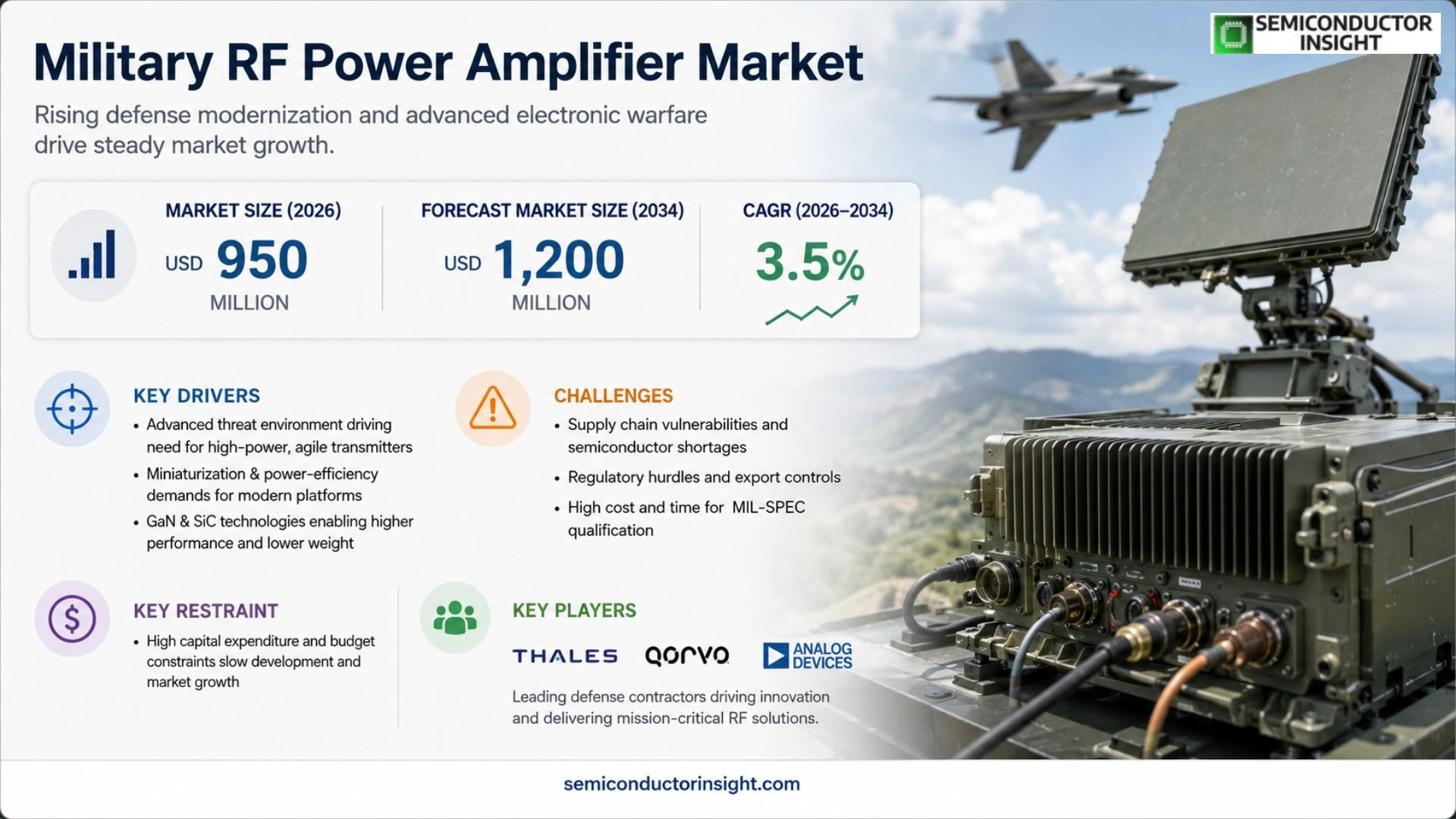
Military RF Power Amplifier market is projected to grow from USD 950 million in 2026 to USD 1,200 million by 2034, exhibiting a CAGR of 3.5% during the forecast period.
Military RF Power Amplifiers are high‑power solid‑state or vacuum‑tube devices that boost low‑level radio‑frequency signals for defense platforms such as radar systems, satellite communications links, electronic warfare suites and emerging directed‑energy weapons. Designed to operate over demanding frequency bands,including L‑band, S‑band, C‑band and X‑band,these amplifiers deliver stable output while tolerating extreme temperature swings and vibration typical of airborne or naval installations. Their role in extending range, improving signal clarity and supporting jam‑resistant transmission makes them a cornerstone component of contemporary military electronic architectures.
MARKET DRIVERS
Advanced Threat Environment
The escalation of near‑peer confrontations has forced defense ministries to prioritize high‑power, frequency‑agile transmitters capable of counter‑measuring sophisticated electronic warfare. Systems that can sustain high peak output while retaining low probability of intercept are now a procurement cornerstone, pushing suppliers to accelerate R&D pipelines.
Miniaturization and Power‑Efficiency Demands
Platform weight constraints on next‑generation combat aircraft and unmanned systems demand amplifiers that deliver greater wattage per kilogram. Innovations in GaN and SiC semiconductor technologies are delivering that leap, prompting original equipment manufacturers to revise bill‑of‑materials in favor of newer, lighter modules.
➤ “Integration of solid‑state amplifiers directly into phased‑array radars reduces system latency and improves target tracking fidelity.”
This technical advantage translates into operational superiority, encouraging armed forces to allocate higher budget shares to RF power solutions that can be retrofitted into legacy platforms without extensive redesign.
MARKET CHALLENGES
Supply Chain Vulnerabilitie
Global shortages of high‑purity semiconductor wafers have stalled some production lines, forcing manufacturers to re‑evaluate inventory strategies and seek alternative sources. Delays in component delivery extend system integration timelines, raising lifecycle costs for defense programs.
Other Challenges
Regulatory Hurdles
Export controls governing high‑frequency components impose stringent licensing procedures, limiting the ability of vendors to service allied customers quickly. Compliance costs erode margins and can deter smaller firms from entering the niche.
Cost‑Intensity of Qualification
Achieving MIL‑SPEC certification demands exhaustive testing under extreme temperature and vibration conditions. The financial outlay for qualification often exceeds the revenue potential for low‑volume variants, curbing diversification.
MARKET RESTRAINTS
High Capital Expenditure
Developing next‑generation RF power amplifiers requires multi‑year R&D programs funded by sizable government appropriations. When defense budgets tighten, projects in the early development phase are the first to experience cuts, creating a bottleneck that slows overall market expansion.
MARKET OPPORTUNITIES
Integration with Directed Energy Systems
As directed‑energy weapons transition from prototype to fielded status, the demand for high‑efficiency, broadband amplifiers capable of delivering sustained power spikes is rising. Suppliers that can align their product roadmaps with laser and microwave weapon programs stand to capture a sizable share of future contracts.
Additionally, the push toward network‑centric warfare creates a need for modular, software‑defined RF blocks that can be reconfigured on demand. Companies that invest in open‑architecture designs will be positioned to service multiple platform families, expanding their addressable market without proportional cost increases.
Military RF Power Amplifier Market Trends
Shift Toward Gallium Nitride (GaN) Amplifier Designs
Military RF Power Amplifier Market is witnessing a pronounced migration from traditional silicon‑based power stages to gallium nitride (GaN) technologies. GaN devices deliver higher power density, tighter efficiency margins, and superior thermal tolerance, which directly enable lighter, more compact payloads for both airborne and ground platforms. This migration is fueled by the defence community’s demand for longer mission endurance without compromising signal fidelity, especially in contested electromagnetic environments. Suppliers that have fast‑tracked their GaN roadmaps are capturing design wins with prime contractors seeking to shrink logistical footprints while preserving high‑power output. At the same time, legacy players feel pressure to re‑tool fabrication lines or forge strategic partnerships to stay competitive.
Other Trends
Integration of Software‑Defined Radio (SDR) Capabilities
Embedding SDR functions within RF power amplifiers is reshaping how communication suites are fielded. By consolidating waveform generation and power delivery into a single module, operators gain the agility to re‑configure mission parameters on‑the‑fly, reducing the need for multiple discrete radios. This convergence lowers overall system weight and simplifies certification processes, a crucial advantage for platforms undergoing rapid hardware refresh cycles. Vendors that provide open‑architecture firmware alongside robust amplification are attracting contracts that prioritize future‑proofing, while traditional siloed designs risk obsolescence as forces move toward more adaptable spectra utilisation strategies.
Modular Architecture Gains Momentum
Modularity has become a decisive attribute in new amplifier families, allowing field units to swap out power blocks, frequency bands, or cooling solutions without redesigning the entire system. This approach aligns with defence procurement’s emphasis on incremental upgrades and cost‑effective sustainment. Companies that deliver plug‑and‑play modules can shorten acquisition timelines and provide clearer upgrade paths, which in turn supports budgeting cycles that favour predictable expenditures. As a result, the market is tilting toward vendors that embed standardised interfaces and scalable thermal management, positioning them to capture a larger share of forthcoming platform refresh programs.
COMPETITIVE LANDSCAPE
Key Industry Players
Military RF Power Amplifier market – competitive positioning and strategic depth
The market is anchored by a small cohort of large, diversified defense contractors that combine deep engineering expertise with extensive program portfolios. Thales Group commands a leading share thanks to its long‑standing relationships with European armed forces and its integrated suite of L‑band and S‑band amplifiers for tactical communications. Qorvo leverages its semiconductor scale to supply high‑performance GaN devices that underpin next‑generation radar architectures, while Analog Devices (ADI) distinguishes itself through a broad portfolio of linear and switching amplifiers that serve both legacy and emerging platforms. These incumbents benefit from recurring government contracts, which provide predictable cash flows and enable sustained R&D investment, reinforcing a market structure where scale and cross‑program integration are decisive competitive advantages.
Beyond the dominant tier, a constellation of specialist firms adds depth and regional nuance. Ametek’s focused line of solid‑state amplifiers captures niche radar upgrades in North America, whereas Teledyne Defense Electronics supplies custom‑engineered solutions for airborne electronic warfare suites. German‑based BONN Elektronik holds a strong position in the European S‑band segment, while Japanese NEC contributes high‑frequency Ka‑band modules for maritime surveillance. Companies such as Kratos, Advantech, and Shenzhen Huada Microwave Technology pursue aggressive product‑line extensions in unmanned systems and low‑cost export markets, challenging incumbents on price and time‑to‑market. The cumulative effect is a competitive ecosystem where large integrators coexist with agile specialists, each shaping procurement decisions through technology differentiation, regional compliance, and lifecycle support strategies.
List of Key Military RF Power Amplifier Companies Profiled
- Thales Group
- Qorvo
- Ametek
- Teledyne Defense Electronics
- Analog Devices (ADI)
- NXP Semiconductors
- BONN Elektronik GmbH
- General Dynamics
- Kratos Defense & Security Solutions
- NEC Corporation
- Advantech
- Shenzhen Huada Microwave Technology
- Skyworks Solutions
- Infineon Technologies
- L3Harris Technologies
Segment Analysis:
| Segment Category | Sub-Segments | Key Insights |
| By Type |
|
L-band & S-band is recognized as the leading type because it supports a broad range of mission‑critical communications and radar functions.
|
| By Application |
|
Radar dominates application demand due to its central role in detection, tracking and targeting.
|
| By End User |
|
Armed Forces are the primary end‑user, driving rigorous performance standards.
|
| By Frequency Band |
|
Mid Frequency (C‑band) is gaining prominence because it balances bandwidth and atmospheric attenuation.
|
| By Technology Platform |
|
Solid‑State Amplifiers are the leading technology platform due to their reliability and ease of maintenance.
|
Regional Analysis: Military RF Power Amplifier Market
North America
Federal budgets allocate a significant portion of resources to high‑frequency communication systems, prompting manufacturers to focus on amplifiers that meet rigorous power‑efficiency criteria. This funding flow not only sustains existing suppliers but also attracts new entrants seeking to exploit niche technical gaps.
Integration of silicon‑based MMICs with traditional gallium nitride (GaN) technologies is reshaping product portfolios. Companies that can demonstrate seamless hybrid architectures gain a competitive edge in contracts that demand both high peak power and compact form factors.
Recent geopolitical tensions have prompted OEMs to diversify sourcing strategies, encouraging domestic production of critical semiconductor components. This shift reduces lead times and mitigates exposure to export controls, influencing supplier selection in procurement cycles.
Stringent electromagnetic compatibility (EMC) standards compel manufacturers to adopt rigorous testing regimes. Firms that embed compliance into early design stages can accelerate time‑to‑market, an advantage in fast‑paced procurement environments.
Europe
European defense ministries, particularly in the United Kingdom, France, and Germany, are emphasizing modularity and interoperability across NATO platforms. This drives demand for amplifiers that can be tuned across multiple frequency bands without compromising performance. Collaborative R&D programs, such as the European Defence Fund, incentivize joint ventures that pool expertise in GaN power devices and advanced packaging. As legacy radar installations reach end‑of‑life, European contractors focus on upgrading to digitally‑controlled amplifiers that support network‑centric warfare concepts, reinforcing the continent’s role as a technology incubator.
Asia‑Pacific
The Asia‑Pacific region exhibits a heterogeneous landscape, with advanced economies like Japan and South Korea investing heavily in indigenous missile and unmanned aerial vehicle (UAV) programs. Simultaneously, emerging markets in Southeast Asia accelerate procurement to modernize aging arsenals. This duality creates opportunities for both high‑end and cost‑effective amplifier solutions. Regional supply chains are increasingly localized, reducing dependence on North American suppliers and fostering a competitive ecosystem that encourages rapid product iteration.
South America
South American defence spending is characterized by selective modernization, primarily focused on maritime surveillance and border security. Nations such as Brazil and Chile prioritize rugged amplifiers capable of operating in tropical climates, where temperature stability is critical. Partnerships with European and North American firms provide technology transfer pathways, yet local assembly plants are emerging to satisfy domestic content requirements, gradually reshaping the market structure.
Middle East & Africa
In the Middle East, sovereign wealth funds channel resources into advanced air‑defence systems, creating a niche for high‑power amplifiers that support long‑range radar and electronic warfare suites. African states, while operating on tighter budgets, concentrate on upgrading communication links for peacekeeping missions. Both sub‑regions benefit from strategic alliances with established manufacturers, but the growing preference for turnkey solutions signals a shift toward integrated system contracts rather than isolated component purchases.
Report Scope
This market research report provides a comprehensive analysis of the Military RF Power Amplifier Market , covering the forecast period 2026–2034. It offers detailed insights into market dynamics, technological advancements, competitive landscape, and key trends shaping the industry.
Key focus areas of the report include:
- Market Overview: The report begins with an overview outlining its current market scenario, key growth indicators, and industry transformation drivers. It discusses macroeconomic factors, demand–supply balance, regulatory landscape, and the strategic role of semiconductors in powering advancements across industries such as automotive, telecommunications, consumer electronics, and industrial automation.
- Market Size & Forecast: Historical data and future projections for revenue, unit shipments, and market value across major regions and segments.
- Segmentation Analysis: Detailed breakdown by product type, technology, application, and end-user industry to identify high-growth segments and investment opportunities.
- Regional Insights: Insights into market performance across North America, Europe, Asia-Pacific, Latin America, and the Middle East & Africa, including country-level analysis where relevant.
- Competitive Landscape: Profiles of leading market participants, including their product offerings, R&D focus, manufacturing capacity, pricing strategies, and recent developments such as mergers, acquisitions, and partnerships.
- Technology Trends & Innovation: Assessment of emerging technologies, integration of AI/IoT, semiconductor design trends, fabrication techniques, and evolving industry standards.
- Market Drivers & Restraints: Evaluation of factors driving market growth along with challenges, supply chain constraints, regulatory issues, and market-entry barriers.
- Stakeholder Insights: Insights for component suppliers, OEMs, system integrators, investors, and policymakers regarding the evolving ecosystem and strategic opportunities.
Primary and secondary research methods are employed, including interviews with industry experts, data from verified sources, and real-time market intelligence to ensure the accuracy and reliability of the insights presented.
FREQUENTLY ASKED QUESTIONS:
What is the current market size of Military RF Power Amplifier Market?
-> Global Military RF Power Amplifier market is projected to grow from USD 950 million in 2026 to USD 1,200 million by 2034, exhibiting a CAGR of 3.5%
Which key companies operate in Military RF Power Amplifier Market?
-> Key players include Thales Group, Qorvo, Ametek, Teledyne Defense Electronics, ADI, NXP, BONN Elektronik GmbH, General Dynamics, Kratos, NEC, among others.
What are the key growth drivers?
-> Key growth drivers include increasing defense spending, modernization of military communication systems, growing demand for advanced radar and electronic warfare capabilities, and technological advancements in RF power amplification.
Which region dominates the market?
-> North America, particularly the United States, holds a substantial share of the market, while China is emerging as a major growth market in the Asia region.
What are the emerging trends?
-> Emerging trends include development of L‑band & S‑band high‑power amplifiers, integration of AI‑enabled signal processing, and increased focus on compact, lightweight designs for airborne and space applications.
Get Sample Report PDF for Exclusive Insights
Report Sample Includes
- Table of Contents
- List of Tables & Figures
- Charts, Research Methodology, and more...
 Download Sample Report PDF