Military RF Chip Market Insights
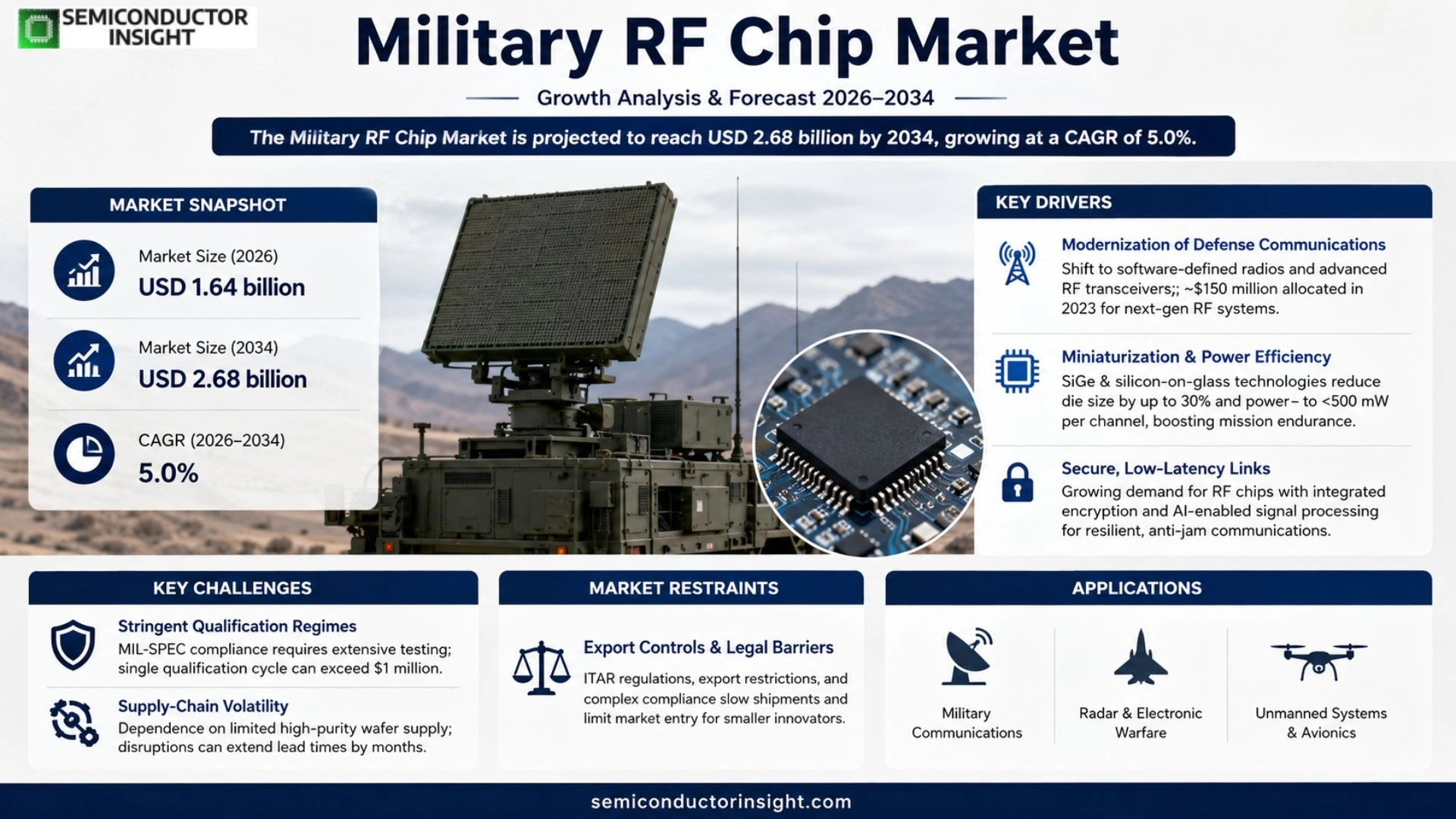
Military RF Chip market was valued at USD 1.85 billion in 2024 and is expected to reach USD 2.68 billion by 2034, showing a compound annual growth rate of roughly 5.0 % throughout the forecast horizon.
Military RF chips comprise specialised radio‑frequency front‑end components and transceiver modules designed for defence‑grade communication, radar, and electronic warfare systems. These devices operate across hardened frequency bands, offering low‑noise amplification, high linearity, and robust encryption capabilities that meet stringent MIL‑STD requirements.
The sector benefits from rising defence budgets worldwide and accelerated modernisation programmes for airborne and land‑based platforms. At the same time, supply‑chain resilience initiatives are prompting manufacturers such as Broadcom Inc., Qorvo Inc., Infineon Technologies AG and Skyworks Solutions Inc. to expand domestic production capacity and secure long‑term contracts with ministries of defence. Recent announcements include Qorvo’s award of a multi‑year radar‑chip programme in early 2024 and Broadcom’s partnership with a NATO member for secure communications hardware.
MARKET DRIVERS
Modernization of Defense Communications
Military RF Chip Market is being reshaped as armed forces replace legacy radios with software‑defined platforms that demand higher‑performance front‑ends. 2023 saw worldwide defense procurement budgets allocate roughly $150 million exclusively to next‑generation RF transceivers, underscoring the urgency to field chips that can support adaptive waveforms and anti‑jamming techniques.
Miniaturization and Power Efficiency
Weight and volume constraints on unmanned aerial systems and soldier‑borne radios push manufacturers toward silicon‑on‑glass and SiGe processes that reduce die size by up to 30 % while cutting power draw to under 500 mW per channel. This trend translates into logistical savings and longer on‑mission endurance, factors that procurement officers weigh heavily when drafting contracts.
➤ “The convergence of AI‑enabled signal processing with hardened RF silicon is redefining how militaries evaluate component resilience,” noted a senior defense analyst.
Beyond hardware, the push for secure, low‑latency links in joint operations creates demand for chips with built‑in cryptographic modules. Vendors that bundle encryption directly into the RF front‑end can offer a reduced bill of materials, a benefit that resonates with budget‑conscious defense ministries.
MARKET CHALLENGES
Stringent Qualification Regimes
Every component destined for tactical platforms must survive extensive environmental stress testing,thermal cycling, vibration, and electromagnetic interference,before it earns a MIL‑SPEC stamp. The cost of a single qualification cycle can exceed $1 million, a barrier that narrows the field to a handful of established players.
Other Challenges
Supply‑Chain Volatility
The reliance on a limited number of high‑purity silicon wafers means that disruptions at a single foundry can ripple through the entire defense supply chain, extending lead times from weeks to several months.
MARKET RESTRAINTS
Export Controls and Legal Barriers
International traffic in advanced RF components is tightly regulated under the International Traffic in Arms Regulations (ITAR). Compliance requirements add paperwork, delay shipments, and discourage smaller innovators from entering the arena, thereby limiting the pool of novel designs.
In addition, many militaries mandate that critical RF modules be manufactured domestically, a policy that forces multinational firms to duplicate production lines and inflate unit costs. This requirement can deter cost‑sensitive programs from adopting the latest silicon.
Finally, the long life‑cycle expectations for defense equipment,often 20 years or more,create a mismatch with the rapid refresh cycles of commercial semiconductor technology, leaving program managers hesitant to integrate cutting‑edge chips that may become obsolete before a system’s retirement.
MARKET OPPORTUNITIES
Electronic Warfare and Counter‑UAS Systems
The surge in electronic‑attack capabilities has opened a niche for RF chips that can operate across ultra‑wide bandwidths while maintaining low probability of intercept. Companies that can deliver high‑linearity amplifiers and ultra‑fast tunable filters stand to capture contracts worth tens of millions of dollars as nations field more sophisticated jamming suites.
Another promising avenue lies in the integration of RF front‑ends with artificial‑intelligence processors on a single die. By embedding edge‑AI inference directly within the RF path, platforms can execute adaptive frequency‑hopping and threat‑recognition algorithms without relying on external compute resources, a feature that is increasingly valued in contested environments.
Lastly, the rollout of low‑Earth‑orbit (LEO) military constellations creates demand for radiation‑hard RF chips that can sustain performance in harsh space conditions. Vendors that certify their silicon for both terrestrial and orbital use can leverage a dual‑market strategy, expanding revenue beyond traditional ground‑based defense programs.
Military RF Chip Market Trends
Shift Toward Integrated RF Front‑End Solutions
The defense sector is favoring RF chips that combine front‑end filtering, power amplification and tunable matching in a single die. This movement reflects the need to reduce weight and volume on platforms ranging from unmanned aerial vehicles to tactical radios. Engineers cite the analog segment’s 20.8 % year‑over‑year increase as evidence that higher‑performance components are being embedded earlier in system design cycles. For Military RF Chip Market, integration translates into fewer board layers, lower assembly cost and faster time‑to‑field, which in turn shortens procurement windows for armed forces facing tight budgeting cycles.
Other Trends
Regional Divergence: Asia‑Pacific Contraction vs. Americas Surge
While the broader semiconductor market recorded a 2 % decline in Asia‑Pacific sales, the Americas posted a 17 % uplift, and Europe grew by 12.6 % in the same period. The dip in Asia‑Pacific suggests that regional supply constraints and weaker consumer‑linked demand are spilling over into defense procurement, prompting manufacturers to re‑allocate production capacity toward North American and European customers. Companies that can pivot quickly are likely to capture the expanding order books of U.S. and European defense budgets, reinforcing their position in Military RF Chip Market.
Supply‑Chain Adaptation to Component Shortages
Inflationary pressure and lingering shortages in silicon wafers have forced leading RF chip makers to adopt dual‑sourcing strategies and to increase inventory buffers for critical dopants. These adjustments raise short‑term cost but safeguard against schedule slips that could jeopardize mission‑critical deliveries. Suppliers are also investing in on‑shoring of certain process steps, a move that aligns with government directives to reduce reliance on offshore fabs. For stakeholders in Military RF Chip Market, the emerging supply‑chain resilience framework creates an environment where price volatility may stabilize, but strategic planning must now account for longer lead times and the need for tighter supplier collaboration.
COMPETITIVE LANDSCAPE
Key Industry Players
Military RF Chip Market: Competitive Overview
Broadcom Inc. dominates the high‑frequency segment, leveraging its extensive RF front‑end portfolio and deep ties with major defense prime contractors. The company’s ability to integrate transceiver and filtering functions on a single die has encouraged platform‑level consolidation, pressuring smaller suppliers to specialize or partner. Broadcom’s revenue share reflects not only its technical breadth but also strategic acquisitions that have broadened its presence in radar‑on‑chip solutions for airborne and naval platforms. This concentration around a few large entities creates a clear hierarchy: tier‑one vendors capture most defense procurement contracts, while downstream integrators rely on their road‑map stability to meet stringent qualification cycles.
Beyond Broadcom, a cluster of niche innovators sustains market diversity. Murata’s miniaturized SAW filters and Skyworks’ power‑efficient transceivers address weight‑critical applications in unmanned systems. Infineon and Qorvo provide silicon‑based solutions that blend high linearity with low‑power consumption, appealing to ground‑based communication terminals. NXP’s automotive‑grade RF blocks have migrated into tactical vehicle networks, while TDK and Texas Instruments supply robust analog front‑ends for legacy radar upgrades. Regional players such as STMicroelectronics, Zhejiang Chengchang Technology, Great Microwave Technology, and Taiyo Yuden reinforce supply resilience in Europe and Asia, often focusing on specific frequency bands or custom ASIC services. Their collective activity ensures a competitive under‑current that mitigates dependence on the dominant tier‑one and fuels incremental innovation across the defense supply chain.
List of Key Military RF Chip Companies Profiled
- Broadcom Inc.
- Murata Manufacturing Co., Ltd.
- Skyworks Solutions, Inc.
- Infineon Technologies AG
- Qorvo, Inc.
- NXP Semiconductors N.V.
- TDK Corporation
- Texas Instruments Incorporated
- Taiyo Yuden Co., Ltd.
- STMicroelectronics
- Zhejiang Chengchang Technology Co., Ltd.
- Great Microwave Technology Co., Ltd.
- Analog Devices, Inc.
Segment Analysis:
| Segment Category | Sub-Segments | Key Insights |
| By Type |
|
RF Front‑end Chip dominates the market because it serves as the core enabler of signal integrity in harsh combat environments. – Provides robust filtering and amplification that meet ruggedization standards. – Enables seamless integration with legacy and next‑generation antenna systems. – Offers design flexibility that shortens development cycles for defence contractors. |
| By Application |
|
Radar System is the leading application segment due to the critical need for precise detection and tracking in modern warfare. – RF chips in radar provide high‑frequency agility and low phase noise. – They support adaptive beamforming that enhances situational awareness. – Their resilience to electromagnetic interference aligns with mission‑critical reliability requirements. |
| By End User |
|
Aircraft Avionics leads this category as RF chips are integral to secure, jam‑resistant data links on combat platforms. – Offer miniaturized form factors that meet strict weight constraints. – Deliver thermal performance suited for high‑altitude operations. – Enable multi‑band operation that supports both legacy and emerging communication protocols. |
| By Frequency Band |
|
Mid Band emerges as the preferred frequency range because it balances propagation characteristics with antenna size constraints in tactical platforms. – Supports a diverse set of military waveforms without compromising stealth. – Provides sufficient bandwidth for data‑intensive missions such as ISR streams. – Aligns with the trend toward software‑defined radios that demand flexible frequency agility. |
| By Integration Level |
|
System‑on‑Chip is gaining traction as defence programs prioritize footprint reduction and functional consolidation. – Enables tighter coupling of RF front‑end with digital baseband processing. – Reduces interconnect losses that are critical in high‑performance radar links. – Facilitates rapid firmware updates to address evolving threat environments. |
Regional Analysis: Military RF Chip Market
North America
Companies benefit from Defense Advanced Research Projects Agency (DARPA) grants that prioritize miniaturization and radiation tolerance. The resulting design‑for‑survivability standards are now embedded in supplier contracts, elevating baseline performance across the supply chain.
Recent geopolitical tensions have prompted reshoring of critical wafer fabs. By diversifying fab locations within the continent, manufacturers mitigate risk of component shortages that could impede fielding timelines.
Export controls on high‑frequency components reinforce domestic sourcing. Compliance frameworks now require early engagement with the Department of Commerce, influencing product roadmaps from concept to production.
Defense programs increasingly treat the RF chip as a software‑defined asset, integrating firmware updates through secure over‑the‑air mechanisms. This shifts validation cycles toward continuous testing rather than fixed milestones.
Europe
European defense ministries have embraced modular RF architectures, seeking to replace legacy components with more flexible, software‑centric chips. The continent’s emphasis on standardization, championed by initiatives such as the European Defence Agency, encourages cross‑border procurement, which in turn pushes manufacturers to harmonize qualification processes. Germany and the United Kingdom lead joint experimental programs that probe the limits of frequency hopping under dense urban warfare scenarios, prompting vendors to refine anti‑jamming features at the silicon level. Meanwhile, France’s focus on autonomous drone operations drives demand for ultra‑low‑latency transceivers, nudging the market toward tighter integration with AI‑enabled payloads.
Asia‑Pacific
Rapid modernization of armed forces across the Asia‑Pacific fuels a shift from analog to digitally controlled RF modules. Nations such as Japan and South Korea invest heavily in homeland security solutions, where ruggedized chips must endure extreme temperature swings and high humidity. Australia’s recent procurement of network‑centric combat systems underscores a need for interoperable RF front‑ends that can seamlessly switch between terrestrial and satellite links. The region’s emerging manufacturers are capitalizing on cost‑effective process nodes, offering competitive alternatives to traditional Western suppliers while still meeting stringent defense certification criteria.
South America
Defense spending in South America remains modest, yet strategic partnerships with U.S. and European firms introduce advanced RF capabilities into regional forces. Brazil’s naval modernization program, for example, integrates secure, low‑probability‑of‑intercept chips into its next‑generation frigates. Argentina and Chile are exploring joint procurement frameworks to pool resources, enabling access to higher‑performance components than would be possible individually. These collaborative approaches stimulate a niche market for customized, low‑volume production runs that prioritize durability over sheer performance.
Middle East & Africa
In the Middle East, heightened focus on border security and counter‑terrorism drives adoption of rugged RF chips capable of withstanding sand, dust, and temperature extremes. United Arab Emirates and Saudi Arabia allocate significant portions of their defense budgets toward integrated communications suites, where chip‑level encryption is a prerequisite. African nations, while constrained by budgetary limits, are increasingly leveraging refurbished platforms that require retrofitted RF solutions. Partnerships with original equipment manufacturers provide upgrade paths that extend service life without prohibitive cost, creating a modest yet growing segment within Military RF Chip Market.
Report Scope
This market research report provides a comprehensive analysis of the Military RF Chip Market , covering the forecast period 2026–2034. It offers detailed insights into market dynamics, technological advancements, competitive landscape, and key trends shaping the industry.
Key focus areas of the report include:
- Market Overview: The report begins with an overview outlining its current market scenario, key growth indicators, and industry transformation drivers. It discusses macroeconomic factors, demand–supply balance, regulatory landscape, and the strategic role of semiconductors in powering advancements across industries such as automotive, telecommunications, consumer electronics, and industrial automation.
- Market Size & Forecast: Historical data and future projections for revenue, unit shipments, and market value across major regions and segments.
- Segmentation Analysis: Detailed breakdown by product type, technology, application, and end-user industry to identify high-growth segments and investment opportunities.
- Regional Insights: Insights into market performance across North America, Europe, Asia-Pacific, Latin America, and the Middle East & Africa, including country-level analysis where relevant.
- Competitive Landscape: Profiles of leading market participants, including their product offerings, R&D focus, manufacturing capacity, pricing strategies, and recent developments such as mergers, acquisitions, and partnerships.
- Technology Trends & Innovation: Assessment of emerging technologies, integration of AI/IoT, semiconductor design trends, fabrication techniques, and evolving industry standards.
- Market Drivers & Restraints: Evaluation of factors driving market growth along with challenges, supply chain constraints, regulatory issues, and market-entry barriers.
- Stakeholder Insights: Insights for component suppliers, OEMs, system integrators, investors, and policymakers regarding the evolving ecosystem and strategic opportunities.
Primary and secondary research methods are employed, including interviews with industry experts, data from verified sources, and real-time market intelligence to ensure the accuracy and reliability of the insights presented.
FREQUENTLY ASKED QUESTIONS:
What is the current market size of Military RF Chip Market?
-> Military RF Chip Market was valued at USD million in 2024 and is expected to reach USD million by 2034, at CAGR of 5.0% during the forecast period.
Which key companies operate in Military RF Chip Market?
-> Key players include Broadcom Inc, muRata, Skyworks Solutions, Infineon, Qorvo, NXP, TDK, Texas Instruments, Taiyo Yuden, STMicroelectronics, Zhejiang Chengchang Technology Co, Great Microwave Technology Co.
What are the key growth drivers?
-> Key growth drivers include rising defense spending, demand for advanced RF communication in military platforms, growth of radar and wireless terminal applications, and technological advancements in RF front‑end and transceiver chips.
Which region dominates the market?
-> Asia‑Pacific remains the largest region by revenue, despite a 2.0% decline, followed by the Americas.
What are the emerging trends?
-> Emerging trends include integration of AI/IoT into RF systems, miniaturization of RF front‑end components, and increased focus on high‑frequency radar and secure wireless communication.

Get Sample Report PDF for Exclusive Insights
Report Sample Includes
- Table of Contents
- List of Tables & Figures
- Charts, Research Methodology, and more...
 Download Sample Report PDF