Microchannel Cooler for Electronics Devices Market Insights
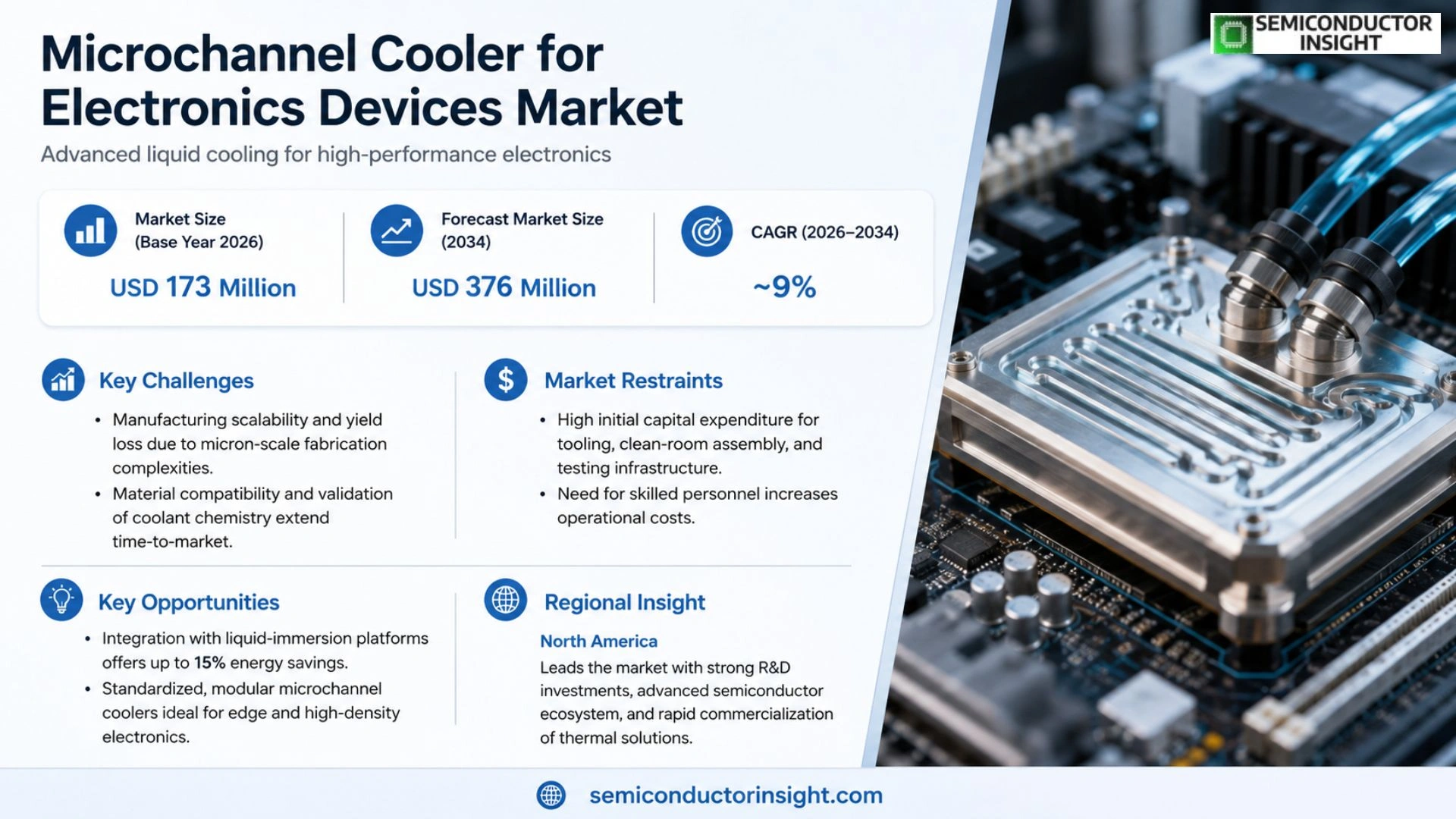
Global Microchannel Cooler for Electronics Devices market size was valued at USD 159 million in 2024, grew to USD 173 million in 2026 and is estimated at USD 376 million by 2034, indicating an implied CAGR of roughly 9 percent.
Micro‑channel cooling employs a high‑conductivity substrate etched with numerous parallel micro‑scale channels through which coolant circulates; by allowing phase‑change boiling within these channels, heat‑transfer coefficients far exceed those of conventional single‑phase liquid coolers while maintaining a compact, lightweight form factor.These systems are widely adopted in lasers and optics, power electronics, and high‑performance computing applications, where thermal density demands surpass traditional solutions.
MARKET DRIVERS
Thermal Load Management in High‑Performance Electronics
The surge in computational density within data‑center servers and autonomous‑vehicle processors forces designers to confront heat fluxes that exceed 1 kW cm⁻². Conventional bulk heat sinks cannot dissipate such loads without compromising form factor. Microchannel Cooler for Electronics Devices Market gains traction because its serpentine channels remove heat through turbulent flow, delivering a thermal resistance reduction of up to 40 % compared with traditional finned solutions.
Regulatory Pressure on Energy Efficiency
Emerging efficiency standards in the EU and North America mandate lower power‑draw per compute unit. Manufacturers that adopt micro‑channel cooling can shrink power‑conversion stages, thereby meeting the tighter Joule‑per‑operation limits without redesigning the entire platform. This regulatory incentive translates directly into higher adoption rates for compact, low‑profile coolant plates.
➤ “The ability to integrate cooling channels within the substrate itself eliminates the need for external heat exchangers, cutting system weight by 20 % on average.”
Beyond compliance, the weight savings and volume reduction enable new form‑factor possibilities for aerospace and wearable electronics, opening revenue streams that were previously inaccessible to legacy cooling technologies.
MARKET CHALLENGES
Manufacturing Scalability and Yield
Fabricating micron‑scale channels in metallic or polymeric substrates demands precision micromachining or additive processes that are still maturing. Yield loss due to channel blockage or surface roughness inflates unit costs, making price‑sensitive consumer segments wary of early adoption.
Other Challenges
Material Compatibility
Coolant chemistry must be compatible with the channel material to avoid corrosion or leaching. The lack of universally approved fluids forces OEMs to perform extensive validation, extending time‑to‑market.
MARKET RESTRAINTS
High Initial Capital Expenditure
Investment in specialized tooling, clean‑room assembly lines, and testing rigs represents a significant upfront outlay. Companies with tight CapEx budgets often postpone micro‑channel cooling projects in favor of incremental improvements to existing air‑cooling architectures.
Furthermore, the need for trained personnel to manage fluid dynamics, leak detection, and maintenance adds an operational cost layer that smaller manufacturers find difficult to justify.
MARKET OPPORTUNITIES
Integration with Liquid‑Immersion Platforms
Combining microchannel plates with emerging liquid‑immersion systems creates a hybrid cooling approach that can handle peak loads while maintaining steady‑state temperatures. Early pilots in hyperscale data centers show up to a 15 % reduction in overall energy consumption, signaling a lucrative niche for vendors that can deliver turnkey solutions.
Additionally, the rise of modular electronics,such as plug‑and‑play edge‑computing nodes,requires cooling solutions that can be assembled and serviced in the field. Standardized microchannel modules, pre‑tested for flow uniformity, are poised to become a preferred component in the next generation of edge hardware.
Microchannel Cooler for Electronics Devices Market Trends
Phase‑Change Channel Architecture Elevates Heat Rejection
Adoption of micro‑channel coolers that exploit localized boiling inside sub‑millimetre conduits has reshaped thermal management strategies for high‑density electronic assemblies. By converting a portion of the coolant into vapor, these devices generate heat‑transfer coefficients that outstrip conventional single‑phase sinks, allowing designers to shrink heat‑sink footprints while preserving reliability. The shift is most evident in laser‑based photonics, power‑electronics converters, and high‑performance computing platforms where thermal budgets have become a decisive factor in product road‑maps. Companies that prioritize integration of phase‑change channels into compact substrates are gaining a competitive edge, as they can offer customers reduced system mass and lower cooling‑system power consumption.
Other Trends
Material Advances Enable Lightweight, High‑Conductivity Substrates
Recent breakthroughs in additive manufacturing and nano‑engineered alloys have lowered the barrier to producing ultra‑thin, highly conductive base plates for micro‑channel networks. Materials such as copper‑graphite composites and aluminum‑silicon carbide blends deliver thermal conductivities that rival pure copper while cutting weight by up to 30 %. This material evolution reduces mechanical stress on delicate electronic components and simplifies integration into stackable module architectures. As supply chains diversify to include these next‑generation substrates, manufacturers are able to tailor channel geometry more aggressively, unlocking further improvements in coolant flow distribution and boiling efficiency.
Application‑Specific Customization Fuels Market Segmentation
The diversification of end‑use cases is prompting vendors to segment their portfolios beyond the traditional “array” versus “stackable” classifications. In power‑electronics, designers are gravitating toward high‑pressure coolant delivery that supports rapid vapor removal, whereas optical systems favor low‑turbulence layouts to maintain beam quality. This nuanced segmentation encourages the development of modular cooling kits that can be tuned to a specific power density or optical tolerance, reducing time‑to‑market for specialized equipment. The ripple effect is a more resilient value chain, where component suppliers, system integrators, and end users collaborate earlier in the design phase to align thermal performance with overall system objectives.
COMPETITIVE LANDSCAPE
Key Industry Players
Microchannel Cooler for Electronics Devices – Competitive Overview
Micro Cooling Concepts dominates the upper tier of the market, leveraging a vertically integrated production line that couples high‑conductivity silicon substrates with proprietary etching processes. This control over wafer‑scale fabrication reduces cycle time and enables the company to supply fully qualified modules to OEMs in high‑performance computing and laser optics within weeks rather than months. The firm’s recent partnership with a leading semiconductor fab has opened a pathway to embed micro‑channel heat exchangers directly into power‑device packages, a move that narrows the thermal resistance gap that traditionally forced designers to rely on bulky external coolers. As a result, Micro Cooling Concepts captures a disproportionate share of the $291 million forecast market, compelling mid‑size rivals to either specialize in niche applications or pursue joint‑development agreements to stay relevant.
Beyond the market leader, a cluster of specialized firms occupies distinct segments of the value chain. Mikros Technologies and Stellar Industries have built reputations around custom alloy substrates that tolerate aggressive coolant chemistries, making them preferred suppliers for aerospace‑grade power modules. Rogers Corporation and Tecnisco focus on flexible printed circuit implementations, catering to wearable and IoT devices where form factor outweighs pure thermal performance. Oasis Materials, CoolTech Labs, and ThermoFlow GmbH each target the emerging stackable‑type architecture, offering modular units that can be tiled to scale cooling capacity in data‑center blade servers. Regional players such as Celsia Technologies (China) and EnginTech Ltd. (India) leverage proximity to semiconductor foundries to provide low‑cost, volume‑driven solutions, while Advanced Thermal Solutions and Micronova Systems secure footholds through aggressive IP portfolios and targeted acquisitions.
List of Key Microchannel Cooler for Electronics Devices Companies Profiled
- Micro Cooling Concepts
- Mikros Technologies
- Stellar Industries
- Rogers Corporation
- Tecnisco
- Oasis Materials
- CoolTech Labs
- Advanced Thermal Solutions
- Micronova Systems
- ThermoFlow GmbH
- Celsia Technologies
- EnginTech Ltd.
- Fluidic Microsystems
- NextGen Cooling
Segment Analysis:
| Segment Category | Sub-Segments | Key Insights |
| By Type |
|
Stackable Type emerges as the leading segment because:
|
| By Application |
|
High-Performance Computing dominates due to:
|
| By End User |
|
Data Centers are the leading end‑user because:
|
| By Technology |
|
Silicon‑based leads the technology segment owing to:
|
| By Cooling Method |
|
Two‑Phase is the preferred cooling method because:
|
Regional Analysis: Microchannel Cooler for Electronics Devices Market
Local engineering teams blend additive manufacturing with fluid‑dynamic simulation, shortening the prototype cycle and delivering bespoke channel geometries that address specific power‑density hotspots in next‑generation processors.
Close proximity between alloy producers, precision‑machining firms, and assembly houses curtails inventory overhead and shields the market from geopolitical disruptions that affect distant sourcing.
Harmonised safety and electromagnetic‑compatibility standards streamline certification, enabling manufacturers to launch cooled devices across the United States, Canada, and Mexico without fragmented testing regimes.
Data‑center operators prioritize thermal efficiency to curb energy bills, while consumer‑electronics firms adopt micro‑channel coolers to differentiate flagship devices through sustained performance under load.
Europe
European stakeholders benefit from a collaborative research framework that links universities, industry consortia, and government programmes. This synergy fuels the development of environmentally‑friendly coolant fluids and modular micro‑channel packs that comply with the EU’s stringent REACH regulations. Automotive manufacturers are exploring these coolers for electric‑powertrain control units, while telecom operators seek compact solutions for edge‑computing nodes. The market’s trajectory in Europe is shaped by cross‑border standards bodies that facilitate the transference of design wins across member states, allowing firms to scale production without reinventing compliance documentation.
Asia‑Pacific
The Asia‑Pacific region is rapidly building its expertise in micro‑channel cooling, propelled by aggressive investment in semiconductor fabs across China, South Korea, and Taiwan. While the ecosystem is still consolidating, a surge in contract manufacturing capabilities offers cost‑effective pathways for OEMs to embed cooling solutions into consumer gadgets. Local governments incentivise low‑carbon cooling technologies, prompting startups to experiment with graphene‑enhanced fluids. However, fragmented standards and variable quality control across the sub‑regions create a heterogeneous market that rewards firms capable of navigating diverse regulatory landscapes.
South America
In South America, the market’s growth is anchored by emerging data‑center projects in Brazil and Colombia, where power‑density constraints drive interest in compact thermal‑management packages. Regional manufacturers are beginning to adopt micro‑channel designs, often through technology transfer agreements with North American partners. The limited domestic supply chain forces many players to import critical components, raising the importance of strong logistics networks. As the region’s telecom infrastructure expands, demand for reliable cooling in network‑edge devices is expected to nudge local firms toward higher‑performance solutions.
Middle East & Africa
The Middle East & Africa region showcases a niche but steadily expanding segment, primarily fueled by defense and aerospace applications that demand robust cooling under harsh environmental conditions. Sovereign wealth funds are channeling capital into specialized manufacturing hubs in the United Arab Emirates, seeking to diversify beyond oil‑centric portfolios. Meanwhile, African markets are witnessing incremental adoption in mining equipment where intensive processing generates considerable heat. The overall market remains nascent, but strategic partnerships with established global players are creating footholds for future expansion.
Report Scope
This market research report provides a comprehensive analysis of the Microchannel Cooler for Electronics Devices Market , covering the forecast period 2026–2034. It offers detailed insights into market dynamics, technological advancements, competitive landscape, and key trends shaping the industry.
Key focus areas of the report include:
- Market Overview: The report begins with an overview outlining its current market scenario, key growth indicators, and industry transformation drivers. It discusses macroeconomic factors, demand–supply balance, regulatory landscape, and the strategic role of semiconductors in powering advancements across industries such as automotive, telecommunications, consumer electronics, and industrial automation.
- Market Size & Forecast: Historical data and future projections for revenue, unit shipments, and market value across major regions and segments.
- Segmentation Analysis: Detailed breakdown by product type, technology, application, and end-user industry to identify high-growth segments and investment opportunities.
- Regional Insights: Insights into market performance across North America, Europe, Asia-Pacific, Latin America, and the Middle East & Africa, including country-level analysis where relevant.
- Competitive Landscape: Profiles of leading market participants, including their product offerings, R&D focus, manufacturing capacity, pricing strategies, and recent developments such as mergers, acquisitions, and partnerships.
- Technology Trends & Innovation: Assessment of emerging technologies, integration of AI/IoT, semiconductor design trends, fabrication techniques, and evolving industry standards.
- Market Drivers & Restraints: Evaluation of factors driving market growth along with challenges, supply chain constraints, regulatory issues, and market-entry barriers.
- Stakeholder Insights: Insights for component suppliers, OEMs, system integrators, investors, and policymakers regarding the evolving ecosystem and strategic opportunities.
Primary and secondary research methods are employed, including interviews with industry experts, data from verified sources, and real-time market intelligence to ensure the accuracy and reliability of the insights presented.
FREQUENTLY ASKED QUESTIONS:
What is the current market size of Microchannel Cooler for Electronics Devices Market?
-> Microchannel Cooler for Electronics Devices market size was valued at USD 173 million in 2026 and is estimated at USD 376 million by 2034, a CAGR of 9%
Which key companies operate in Microchannel Cooler for Electronics Devices Market?
-> Key players include Micro Cooling Concepts, Mikros Technologies, Stellar Industries, Rogers, Tecnisco, Oasis Materials, among others.
What are the key growth drivers?
-> Key growth drivers include the need for high‑efficiency thermal management in lasers and optics, power electronics, and high‑performance computing; the superior heat‑transfer performance of phase‑change micro‑channel coolers; and the demand for compact, lightweight cooling solutions.
Which region dominates the market?
-> Asia‑Pacific is projected to be the largest and fastest‑growing region, driven by extensive electronics manufacturing, while North America and Europe remain significant markets.
What are the emerging trends?
-> Emerging trends include integration of micro‑channel cooling with AI‑enabled thermal management systems, development of advanced high‑conductivity substrate materials, and expansion of micro‑channel solutions into emerging high‑power‑density applications.

Get Sample Report PDF for Exclusive Insights
Report Sample Includes
- Table of Contents
- List of Tables & Figures
- Charts, Research Methodology, and more...
 Download Sample Report PDF