Micro Coaxial Cable Connector Market Insights
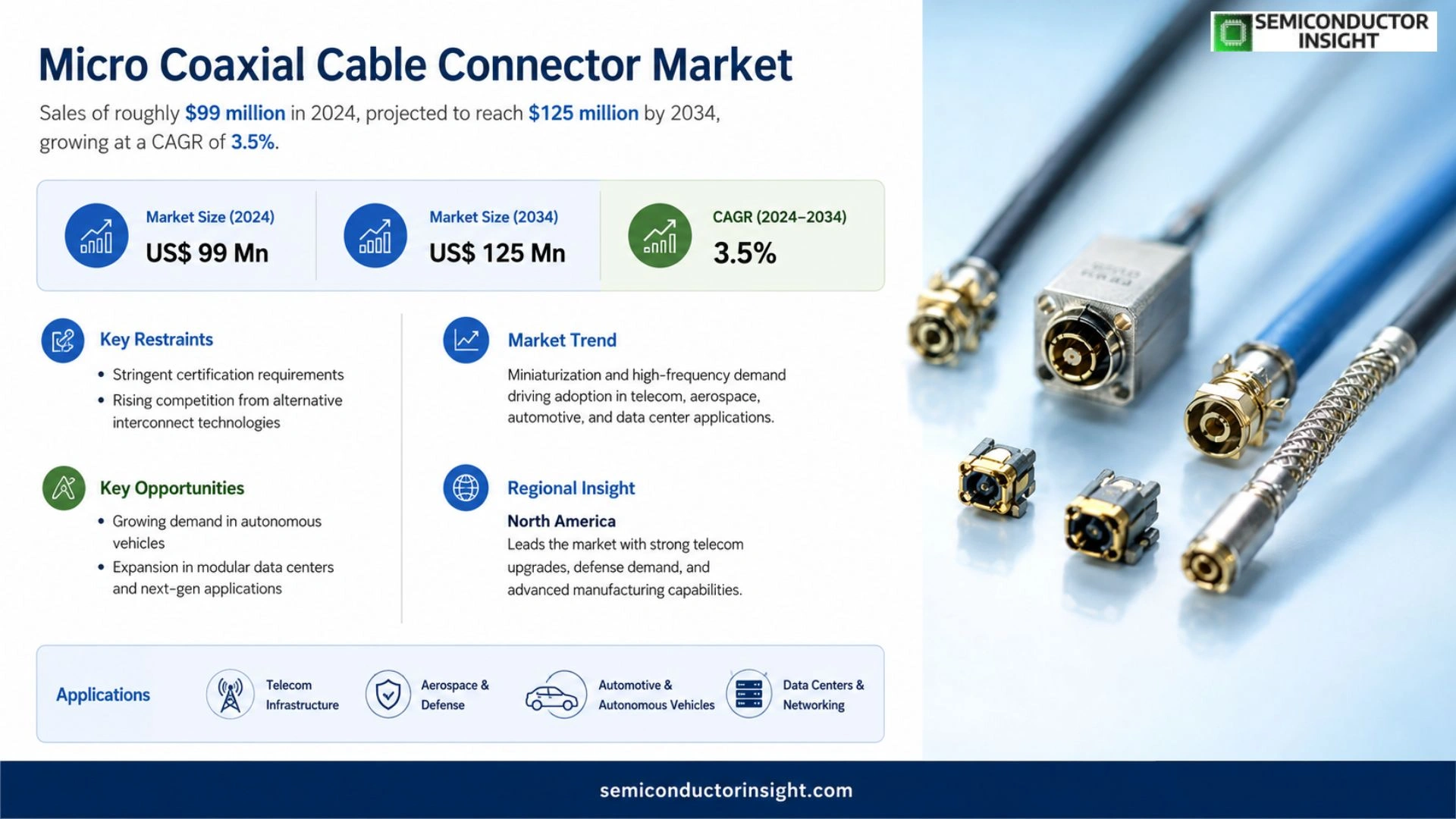
Global Micro Coaxial Cable Connector market size was valued at USD 99 million in 2024 and is projected to reach USD 125 million by 2034, exhibiting a CAGR of 3.5% during the forecast period.
Micro‑Coaxial Connectors are primarily used to link digital signals between module boards through differential transmission using micro‑coaxial cables; the center conductor carries the signal while the outer conductor is grounded via the connector shell.
The surge in high‑frequency wireless standards such as 5G, expanding IoT deployments, and growing demand for compact medical and automotive electronics are pushing manufacturers toward solutions that combine a small footprint with low loss and strong shielding.
MARKET DRIVERS
Miniaturization of High‑Frequency Devices
Manufacturers of wireless infrastructure and advanced medical imaging are compressing component dimensions to meet space‑critical designs. This pressure fuels demand for smaller yet loss‑minimized interconnects, positioning Micro Coaxial Cable Connector Market as a pivotal supply chain element. Suppliers that can guarantee sub‑millimeter tolerances gain a competitive edge because system architects increasingly view connector performance as a direct determinant of overall device efficiency.
Shift Toward 5G and Edge Computing
Roll‑out of 5G antennas and proliferation of edge compute nodes amplify the need for robust signal integrity at high frequencies. The connectors that link radios to processing boards must preserve amplitude and phase characteristics, prompting operators to favor proven coaxial solutions over alternatives. As a result, procurement budgets allocate a measurable share to high‑grade micro coaxial components, reinforcing growth momentum for the sector.
➤ “Connector reliability now directly influences network uptime; a single failure can cascade across densely packed edge sites.”
Beyond technical imperatives, regulatory scrutiny over electromagnetic emissions compels manufacturers to adopt connectors that meet stricter standards. Companies that pre‑emptively certify their products enjoy smoother market entry, while those lagging behind encounter costly redesign cycles. The cumulative effect reinforces a clear upward trajectory for Micro Coaxial Cable Connector Market.
MARKET CHALLENGES
Cost Sensitivity in High‑Volume Production
While performance requirements climb, many OEMs operate under tight margin constraints, especially in consumer‑grade IoT devices. Balancing ultra‑low insertion loss with affordable material selections remains a persistent dilemma, prompting some manufacturers to source lower‑cost alternatives that may compromise long‑term reliability.
Other Challenges
Supply‑Chain Volatility
Global shortages of specialty alloys and precision‑machining capacity create lead‑time uncertainties. End‑users must factor these delays into project schedules, which can erode confidence in the supply ecosystem and elevate the cost of inventory buffers.
The industry also grapples with the need for skilled labor capable of executing sub‑micron tolerances. Training programs lag behind the rapid adoption of newer designs, resulting in a talent gap that can stifle scaling efforts.
MARKET RESTRAINTS
Stringent Certification Requirements
Compliance with telecom and aerospace standards often entails multi‑stage testing, documentation, and audit processes. The time and financial investment required to secure certifications can deter smaller players from entering Micro Coaxial Cable Connector Market, consolidating market share among established suppliers.
Furthermore, the rapid evolution of alternative interconnect technologies, such as optical waveguides, introduces a substitution risk. Clients may defer purchases of coaxial connectors until they have clearer visibility on long‑term performance benchmarks, dampening near‑term demand.
Environmental regulations that restrict the use of certain plating chemicals add another layer of complexity. Manufacturers must redesign processes to meet these constraints, which may inflate production costs and limit price competitiveness.
MARKET OPPORTUNITIES
Emerging Applications in Autonomous Vehicles
Self‑driving platforms rely on high‑frequency radar and lidar subsystems, both of which benefit from low‑loss micro connectors. Suppliers that tailor products to automotive reliability standards stand to capture a nascent but rapidly expanding revenue stream within Micro Coaxial Cable Connector Market.
Another attractive avenue lies in modular data‑center architectures, where hot‑swap capability and limited space drive demand for plug‑and‑play connectors. Designing for easy field replacement while maintaining signal fidelity can differentiate a vendor in a competitive landscape.
Finally, partnerships with material innovators open the door to next‑generation dielectric formulations that reduce attenuation further. Early adopters of such technologies can command premium pricing and establish thought‑leadership positioning, reinforcing long‑term market relevance.
Micro Coaxial Cable Connector Market Trends
Miniaturization and High‑Frequency Demand
Micro Coaxial Cable Connector Market recorded sales of roughly $99 million in 2024. As device architectures shrink and operating frequencies climb toward the low‑mm‑wave band, the market is forecast to reach about $125 million by 2031. This trajectory reflects the engineering pressure to preserve signal integrity within ever tighter footprints. Engineers increasingly favour micro‑coaxial solutions because the central conductor can transmit high‑speed data while the outer shield provides reliable grounding, thereby curbing electromagnetic interference in compact modules.
Other Trends
Application Diversification
Beyond traditional telecom gear, micro‑coaxial connectors are finding footholds in medical imaging, automotive radar, and precision industrial sensors. The rise of edge‑computing nodes inside vehicles and the expansion of point‑of‑care diagnostic tools have raised the bar for connector performance, especially in terms of temperature stability and repeatability. Manufacturers that can certify their products for stringent medical and automotive standards are gaining market share, as OEMs prioritize components that simplify compliance across multiple product lines.
Supply‑Chain Consolidation Among Key Players
Competitive pressure is prompting a wave of strategic acquisitions and joint‑development agreements. Companies such as KEL Corporation, I‑PEX, and Molex have broadened their product portfolios through targeted purchases of niche manufacturers, thereby securing access to specialized tooling and proprietary plating processes. This consolidation reduces the fragmented supplier base, offers buyers broader end‑to‑end solutions, and creates pricing leverage that can be passed down the value chain. For customers, the trend translates into fewer qualification cycles and more predictable lead‑times, which are critical in fast‑moving consumer electronics projects.
COMPETITIVE LANDSCAPE
Key Industry Players
Micro Coaxial Cable Connector Market – Competitive Overview
The segment is anchored by KEL Corporation, whose breadth of product families and deep foothold in aerospace and defense give it a decisive edge in high‑frequency board‑to‑board connections. KEL’s vertical integration,from precision‑molded shells to copper‑plated contacts,allows the company to offer tightly‑tuned impedance solutions, a critical differentiator for customers designing 5G radios and medical imaging devices. This market leader operates a tiered pricing strategy that captures both volume‑driven OEM contracts and premium niche orders, reinforcing a fragmented yet consolidated structure where a handful of global firms command the bulk of revenue while a swarm of specialist vendors fills application‑specific gaps.
Beyond the top tier, a diverse set of innovators competes on form factor, material science, and regional presence. I‑PEX and Hirose Electric leverage miniaturization expertise to serve mobile‑device assemblers in East Asia, whereas Molex and TE Connectivity emphasize extensive distribution networks across North America and Europe. Smaller but agile players such as Microcoaxial Technology and Samtec target high‑speed data‑center modules, while 3M and Amphenol exploit their adhesive‑bonding capabilities to differentiate in rugged‑industrial deployments. The competitive mosaic reflects a market where incremental performance gains and supply‑chain reliability are prized above sheer scale.
List of Key Micro Coaxial Cable Connector Companies Profiled
- KEL Corporation
- I‑PEX
- Molex
- TE Connectivity
- Hirose Electric
- Microcoaxial Technology
- Samtec
- 3M
- Amphenol
- JAE
- AVX
- Foxconn Interconnect Solutions
- Rosenberger
Segment Analysis:
| Segment Category | Sub-Segments | Key Insights |
| By Type |
|
Horizontal
|
| By Application |
|
Automotive
|
| By End User |
|
Device Manufacturers
|
| By Frequency Range |
|
5 GHz to 10 GHz
|
| By Integration Level |
|
Board‑Level
|
Regional Analysis: Micro Coaxial Cable Connector Market
Companies in the leading region allocate significant resources to R&D, enabling rapid integration of new dielectric materials and miniaturized form factors. This accelerates time‑to‑market for connectors that meet the stringent bandwidth requirements of next‑generation networks.
A diversified supplier base, combined with near‑shore manufacturing hubs, reduces exposure to disruptions. Firms can shift production across borders without compromising lead times, preserving service levels for critical projects.
Harmonized standards across the United States and Canada simplify certification pathways. Alignment with international norms also eases cross‑border component transfer, encouraging broader adoption among multinational manufacturers.
End users demand connectors that maintain signal integrity under harsh environmental conditions. This drives suppliers to emphasize robust shielding and corrosion‑resistant alloys, differentiating those that can guarantee long‑term performance.
Europe
European stakeholders place a strong emphasis on compliance with stringent electromagnetic compatibility directives, which shapes product architecture from the outset. Established automotive and aerospace sectors have integrated micro‑coaxial connectors into safety‑critical systems, prompting manufacturers to adopt rigorous testing protocols. The region’s collaborative research initiatives, often funded through cross‑border programs, encourage the development of standardized connector families that can be readily adopted by multiple industries. Consequently, suppliers focus on modular designs that satisfy diverse certification requirements while maintaining cost efficiency.
Asia‑Pacific
In Asia‑Pacific, accelerating urbanization fuels a surge in broadband rollout, prompting telecom firms to replace legacy hardware with high‑frequency micro‑coaxial solutions. Local manufacturers leverage cost‑effective production techniques, yet they are increasingly investing in quality‑control capabilities to meet the expectations of global OEMs. The convergence of fast‑growing data‑center construction and the rise of 5G infrastructure creates a fertile ground for innovative connector designs that balance performance with scalability.
South America
South American markets are at a formative stage, where expanding connectivity projects are beginning to recognize the advantages of micro‑coaxial connectors for reliable signal transmission. Limited local manufacturing capacity leads many operators to source components from North American and European suppliers, fostering knowledge transfer. As national broadband initiatives gain momentum, there is a growing appetite for solutions that can endure the region’s diverse climatic conditions, prompting vendors to tailor material selections accordingly.
Middle East & Africa
The Middle East & Africa region presents niche opportunities linked to high‑value sectors such as oil‑and‑gas exploration and defense communications. Projects in remote locations demand connectors that can withstand extreme temperatures and humidity, making durability a key purchasing criterion. While the overall market size remains modest, strategic partnerships with global manufacturers enable local players to access advanced connector technologies, positioning the region for gradual but steady growth.
Report Scope
This market research report provides a comprehensive analysis of the Micro Coaxial Cable Connector Market , covering the forecast period 2026–2034. It offers detailed insights into market dynamics, technological advancements, competitive landscape, and key trends shaping the industry.
Key focus areas of the report include:
- Market Overview: The report begins with an overview outlining its current market scenario, key growth indicators, and industry transformation drivers. It discusses macroeconomic factors, demand–supply balance, regulatory landscape, and the strategic role of semiconductors in powering advancements across industries such as automotive, telecommunications, consumer electronics, and industrial automation.
- Market Size & Forecast: Historical data and future projections for revenue, unit shipments, and market value across major regions and segments.
- Segmentation Analysis: Detailed breakdown by product type, technology, application, and end-user industry to identify high-growth segments and investment opportunities.
- Regional Insights: Insights into market performance across North America, Europe, Asia-Pacific, Latin America, and the Middle East & Africa, including country-level analysis where relevant.
- Competitive Landscape: Profiles of leading market participants, including their product offerings, R&D focus, manufacturing capacity, pricing strategies, and recent developments such as mergers, acquisitions, and partnerships.
- Technology Trends & Innovation: Assessment of emerging technologies, integration of AI/IoT, semiconductor design trends, fabrication techniques, and evolving industry standards.
- Market Drivers & Restraints: Evaluation of factors driving market growth along with challenges, supply chain constraints, regulatory issues, and market-entry barriers.
- Stakeholder Insights: Insights for component suppliers, OEMs, system integrators, investors, and policymakers regarding the evolving ecosystem and strategic opportunities.
Primary and secondary research methods are employed, including interviews with industry experts, data from verified sources, and real-time market intelligence to ensure the accuracy and reliability of the insights presented.
FREQUENTLY ASKED QUESTIONS:
What is the current market size of Micro Coaxial Cable Connector Market?
-> Micro Coaxial Cable Connector market is projected to reach USD 125 million by 2034, exhibiting a CAGR of 3.5% during the forecast period.
Which key companies operate in Micro Coaxial Cable Connector Market?
-> Key players include KEL Corporation, I-PEX, Molex, TE Connectivity, HIROSE ELECTRIC, Microcoaxial Technology, Samtec, 3M, among others.
What are the key growth drivers?
-> Key growth drivers include rapid advancements in mobile communication, wireless networks, medical devices, consumer electronics, as well as the expanding adoption of IoT and 5G technologies driving demand for small, high‑performance connectors.
Which region dominates the market?
-> The reference does not specify a single dominant region, but highlights extensive coverage across North America, Europe, Asia, South America, and Middle East & Africa, with significant growth opportunities in all major regions.
What are the emerging trends?
-> Emerging trends include high‑frequency transmission performance, interference resistance, miniaturization for IoT and 5G applications, and the development of connectors for precision instruments and advanced communication equipment.
Get Sample Report PDF for Exclusive Insights
Report Sample Includes
- Table of Contents
- List of Tables & Figures
- Charts, Research Methodology, and more...
 Download Sample Report PDF