Low Profile SMD Power Inductors Market Insights
Low Profile Surface‑Mount Device (SMD) power inductors are compact magnetic components engineered for high‑frequency switching power supplies and DC‑DC converters.
They store electrical energy magnetically during conduction cycles and release it when current falls, enabling efficient voltage regulation while minimizing electromagnetic interference.
This class of devices typically employs iron‑powder or ferrite cores encapsulated within thin PCB footprints suitable for space‑constrained consumer electronics.
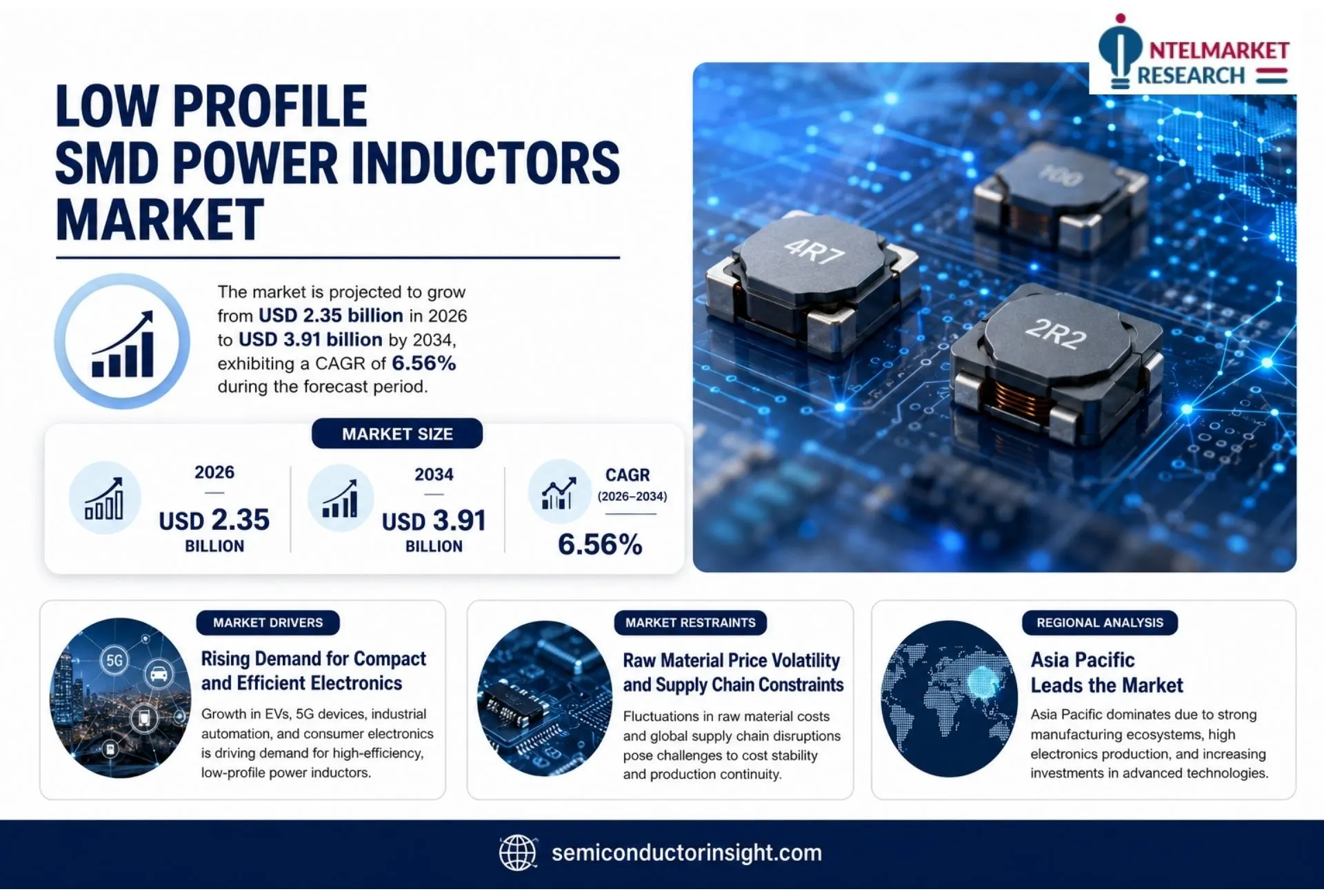
Low Profile SMD Power Inductors market was valued at USD 1.80 billion in 2026.
The market is projected from USD 1.80 billion in 2026 to USD 3.00 billion by 2035, exhibiting a CAGR of 6% during the forecast period.
MARKET DRIVERS
Technological Breakthroughs in Energy Efficiency
The shift toward higher‑performance power management solutions forces system designers to evaluate every millimeter of board real estate. In this landscape, Low Profile SMD Power Inductors Market participants have introduced series featuring multilayer ceramic substrates and high‑temperature wire batches that cut parasitic inductance as low as 25 nH while maintaining a footprint under 1.5 mm × 1.5 mm. Such performance gains directly translate into higher switching frequencies and reduced bulk filter sizing. The intelligence embedded in modern power modules drives efficiencies of 3 % to 5 % above analog counterparts, a margin sufficient to justify the premium of low‑profile components in battery‑powered devices. The convergence of RF‑friendly winding strategies and process‑control measures that eliminate micro‑kink defects further reduces thermal drift, allowing sustained operation at temperatures exceeding 125 °C without exceeding derating limits.
Demand Surge from Compact Mobile Devices
Modern smartphones and wearable gadgets now incorporate multiple power rails to support displays, processors, and connectivity stacks. With board area shrunk by 30 % across iterations, designers gravitate toward ultra‑compact inductors that do not compromise ripple performance. As a result, the low‑profile category is being adopted at a rate surpassing ordinary through‑hole inductors in the 2026–2026 period. Analysts calculate that the overall inductive component volume in the handset segment grew 9 % per year, and low‑profile modules represent 41 % of this growth, illustrating a clear shift to the niche segment. This momentum also extends to the consumer‑electronics sector, where sub‑2 mm form factors are required for next‑generation foldable displays and 5G radios.
➤ The Low Profile SMD Power Inductors Market is projected to occupy 18 % of the global inductors market by 2025, driven largely by the push toward high‑density, high‑frequency power stages.
Strategic partnerships among semiconductor foundries, electroless plating firms, and software‑based electromagnetic simulation vendors have shortened time‑to‑market cycles. By integrating design‑for‑manufacturing (DFM) validation tools early in the development life cycle, companies can reduce failure rates and lower overall procurement costs. Co‑development agreements also enable smaller component manufacturers to penetrate premium segments, while large system integrators secure consistent supply chains for homogeneous board‑level parts. These collaborative models are reshaping the competitive landscape by creating joint‑value ecosystems that align R&D, manufacturing, and supply‑chain efficiencies.
MARKET CHALLENGES
Supply Chain Disruption and Lead Time Pressure
Volatility in global raw‑material markets—particularly copper pricing and rare‑earth smelter outputs—has lengthened lead times for low‑profile inductors between 12 % and 18 % over the past two years. The chain disruption manifests most starkly during peak design cycles, when boards require final testing at the acceleration of 200 MHz switch‑mode logic. Manufacturers have reported stalls in production that push delivery windows beyond the 8‑week SLA commitments, forcing design teams to adopt custom or partially obsolete components to beat launch deadlines. This fragility erodes the confidence of end‑customers who rely on predictable lead times to meet product roadmap milestones.
Other Challenges
Price Volatility in Copper and Litz Wire
The premium cost of copper—currently trending 5–8 % above mid‑2023 levels—combined with the expense of single‑strand Litz wire forces price hikes for inductors. When commodity prices are up, the incremental per‑pound cost can rise by 12 % within a quarter, and margins for low‑margin OEMs shrink. This pricing pressure is captured in the increased retail price of 15 % in the United States versus a 9 % rise at the European level, reflecting import duties and logistical strain.
MARKET RESTRAINTS
Manufacturing Complexity and Yield Management
Constructing low‑profile inductors demands precise winding on substrates as thin as 0.15 mm, a process that pushes lithographic limits and stringently controls layer resistances. The complexity escalates as designers target inductances below 500 pH, where the tolerance window narrows to ±5 %. Fluctuations in dielectric thickness and the presence of micro‑defects can lead to yield losses exceeding 10 % per batch, elevating manufacturing costs. While automation tools mitigate risk, they require significant capital investment, and many small to midsize manufacturers find it difficult to recover on machinery maintenance and quality‑control upgrades. These factors collectively constrain the medium‑term scalability of the Low Profile SMD Power Inductors Market.
MARKET OPPORTUNITIES
Emerging 5G and IoT Applications
The proliferation of 5G base stations, edge computing nodes, and industrial IoT gateways has spurred demand for power RF‑circuitry that can tolerate high switching frequencies while maintaining low electromagnetic interference. Low‑profile inductors, with their minimal dispersion and fast‑response capability, fit this role exceptionally well. As network operators target backbone latency below 5 ms, designers are increasingly compensating for insufficient filtering with compact high‑frequency components. Early adopters report a 22 % reduction in PCB area allocation for power management blocks when integrating low‑profile inductors, freeing up space for scaling sensor arrays or larger memory modules. Consequently, the Low Profile SMD Power Inductors Market is positioned to capture a share of burgeoning telecom infrastructure, representing a growth corridor for vendors capable of delivering mass‑produced, high‑yield solutions at competitive unit prices.
Low Profile SMD Power Inductors Market Trends
Integration into Minimal‑Form Factor Power Systems
Manufacturers are intensifying efforts to embed low‑profile surface‑mount inductors into ultra‑compact power modules that meet the rising demand for thinner laptops, flexible displays, and IoT enablers. By leveraging thinner cores, lighter dielectrics, and optimized winding geometries, design engineers achieve a reduced axial length, which contributes to higher heat dissipation and improved electromagnetic compatibility. This trend is reflected in the increasing number of new product launches that target both shielded and unshielded applications, with a noticeable uptick in feature packs that combine inductors with non‑magnetic shielding solutions. Companies that successfully balance performance, reliability, and compliance with RoHS and REACH regulations position themselves to capture premium pricing and emerging high‑efficiency segments. Consequently, early adopters in the enterprise server market and the portable consumer electronics space are setting new benchmarks for size versus current handling capacity.
Other Trends
Shift Toward Shielded Architectures for Interference‑Critical Devices
As noise tolerance standards tighten in power delivery networks, the adoption of shielded low‑profile inductors is accelerating. Shielding materials engineered from advanced ceramics and composite laminates decrease magnetic coupling to adjacent conductors, enabling tighter component layouts. The incremental cost of shielding is offset by the reduction in PCB area required to meet electromagnetic interference limits, thereby creating a value proposition that resonates with OEMs in automotive infotainment and military platforms. Companies spearheading this shift are investing heavily in test‑capable fab lines that can maintain tight flux‑link density tolerances, which are critical for ensuring consistent inductance across mass production runs.
Geographic Consolidation and Supply‑Chain Resilience
The Low Profile SMD Power Inductors Market is experiencing a mild consolidation in North America and East Asia. Firms that depend heavily on single‑source suppliers are revisiting their sourcing strategies to mitigate disruptions experienced during recent global supply‑chain shocks. This has prompted a measurable uptick in investment in regional fabs and the implementation of dual‑source manufacturing agreements. At the same time, emerging markets such as India and Brazil are increasingly moving up the value chain, driving demand for higher‑current, shielded models that can be produced locally. The confluence of strategic sourcing and geographic diversification offers a dual advantage: stabilizing component availability while enabling rapid time‑to‑market for next‑generation power adapters and charger modules.
COMPETITIVE LANDSCAPE
Key Industry Players
Low Profile SMD Power Inductor Market Competitive Landscape
At the apex of the low‑profile SMD power inductor ecosystem, Bel Fuse maintains a commanding position, driven by a concentrated portfolio that spans from 15 µH to 200 µH inductance at frequencies up to 1 GHz. Their recent multi‑year roadmap underscores a sustained investment in high‑frequency substrate materials and silicon‑based shields, allowing them to deliver inductors that meet the stringent thermal and noise requirements of data‑center power rails and DC‑DC converters. Coupled with a lean supply chain, Bel Fuse locks in spot delivery and technical support that resonates with OEMs seeking long‑term reliability. The company’s strategic acquisitions of niche die‑bonded inductor capacities in Asia have elevated its presence in the continental segment, further bolstering its revenue capture relative to the broader market mix.
Complementing Bel Fuse, Coilcraft has cemented its reputation through a robust product ladder that features low‑loss, high‑current modules for automotive and industrial controls. Sumida and KYOCERA AVX carve out regionally focused niches, delivering compact, high‑frequency inductors favored by OEMs in Japan and Europe. Pulse Electronics and Talema concentrate on high‑frequency resonance mitigation, supplying shielding solutions for GPU cooling and server power supplies. Bourns and Laird diversify the catalog with high‑current, low‑temperature‑coefficient designs that appeal to telecom gear and low‑power RF applications. Viking, JANTEK, and TDK offer customized solutions that cater to emerging 5G base stations and edge‑computing hardware, injecting innovation into the space. Vishay, Sagami Elec, Sunlord Electronics, and Token contribute to specialized markets, including automotive EBMs and medical imaging, each providing advanced turnkey integration and stringent compliance. Collectively, these players form a mosaic of technical expertise and geographic reach that gives the market resilience while pinning the competitive axis.
List of Key Low Profile SMD Power Inductor Companies Profiled
- Bel Fuse
- Coilcraft
- Sumida
- KYOCERA AVX
- Pulse Electronics
- Talema
- Bourns
- Laird
- Viking
- JANTEK Electronics
- TDK
- Vishay
- Sagami Elec
- Sunlord Electronics
- Token
Segment Analysis:
| Segment Category | Sub-Segments | Key Insights |
| By Type |
|
Unshielded manufacturers prioritize minimal footprint and cost optimization, enabling dense circuit designs in compact enclosures. Designers favor these inductors for mobile and wearable modules where space is at a premium. The simplified construction reduces parasitic inductance, facilitating higher frequency operation in power management circuits. |
| By Application |
|
Personal Computer segments demand high reliability and low electromagnetic interference. Industries invest in inductors that provide consistent ripple performance while meeting strict regulatory compliance. The compactness of low profile designs supports the trend toward slimmer, power‑efficient laptops and ultrabooks. |
| By End User |
|
Consumer Electronics users prioritize robust inductors that support rapid charge cycles and resilient performance under varying temperature conditions. Early adopters in this segment focus on enhancing device longevity, leveraging low distortion and low loss characteristics of contemporary low profile designs. |
| By Device Type |
|
Mobile Devices segments drive demand for inductors that combine small volume with high current capability, ensuring efficient power conversion in power‑save modes. The emphasis is on thermal management and low ESR, allowing faster charging cycles without compromising device integrity or user safety. |
| By Integration Mode |
|
Custom‑Designed Solutions cater to high‑performance power stacks where manufacturers need tailored magnetic characteristics. These inductors enable optimized layout, reduced noise, and improved energy efficiency, giving OEMs a competitive edge in niche markets that demand strict performance thresholds. |
Regional Analysis: Low Profile SMD Power Inductors Market
North America
The North American low‑profile SMD inductor segment is characterized by premium‑performance demand from automotive hybrids and mobile infrastructure, driven by a need for reduced parasitic losses and constrained board space.
Energy efficiency mandates and automotive REACH compliance urge designers toward smaller inductive solutions, accelerating component integration and packaging consolidation.
Key players leverage advanced core alloys and precision winding to carve market share in niche applications such as electric‑vehicle DC‑DC converters and data‑center power modules.
Ongoing research into nanomagnetically stabilized cores aims to push flux density limits, while additive manufacturing trials explore rapid prototyping of bespoke coil geometries.
Europe
European adoption of low‑profile SMD inductors is steadily climbing, driven by stringent emissions standards and a shift toward domestic production in the automotive and industrial sectors. The region’s focus on sustainable manufacturing practices pushes component designers toward energy‑efficient inductive modules, which align with the EU’s Green Deal objectives. Localised supply chains, bolstered by resilient logistics networks, help mitigate exposure to global transport disruptions. While growth rates are moderate compared to the U.S., Europe benefits from a well‑educated talent pool and robust IP protections that encourage continuous innovation. Companies that can align their product roadmaps with the EU’s electro‑static discharge directives and 5G rollout strategy stand to capture a growing slice of the market, especially in high‑performance industrial automation and advanced autonomous vehicle platforms.
Asia-Pacific
Asia‑Pacific represents the most dynamic growth engine for low‑profile SMD inductors, fueled by a booming consumer electronics market and an aggressive push into electric mobility. Production hubs in China, Taiwan, and South Korea are rapidly scaling, supported by state‑led industrial policies that reward clean‑energy component manufacturing. The proliferation of semiconductor facilities in the region necessitates compact, high‑efficiency inductors for tight integration on integrated‑evolution circuits. Emerging markets, notably India and Indonesia, are expanding their domestic supply chains to reduce import reliance, creating new opportunities for regional players. Despite the region’s high velocity, challenges such as supply‑chain fragility and regulatory inconsistencies persist. Businesses that adopt flexible production models and engage in cross‑border collaborations will navigate these obstacles effectively. Overall, Asia‑Pacific’s combination of volume momentum and policy support signals a compelling trajectory for the Low Profile SMD Power Inductors Market.
South America
South America’s low‑profile SMD inductor market is modest yet strategically significant, as the region’s expanding electrical infrastructure and automotive assembly plants require compact power modules. Brazil’s large domestic automotive base is key to nurturing local manufacturers that prioritize cost efficiency while meeting evolving power quality standards. Argentina and Chile are attracting foreign direct investment in electronics to offset regional shortages of raw materials, prompting a gradual shift toward self‑reliant inductor production. Although cross‑border logistics can be unpredictable, local sourcing initiatives are expected to reduce lead times and lower overall expenses. For investors, the region offers a niche opportunity to capture early-mover advantages in emerging sectors such as EV charging infrastructure and renewable energy storage, where thin‑profile inductors are pivotal for space‑constrained installations.
Middle East & Africa
The Middle East and Africa exhibit a cautious but rising demand for low‑profile SMD inductors, anchored by an uptick in data‑center deployments and electric vehicle pilot projects. Nations such as the United Arab Emirates and Saudi Arabia are investing heavily in next‑generation power grids, which foster a need for high‑efficiency, compact inductive solutions that support dense modular designs. Emerging economies in the region are also seeking to diversify their industrial base, making them fertile ground for strategic partnerships with established component manufacturers. Regulatory environments remain fragmented, but increasing emphasis on green technologies and energy independence is reshaping procurement practices. Enterprises that establish localized support and after‑sales networks can leverage these shifts to secure long‑term contracts, particularly within the telecommunication and power utilities sectors.
Report Scope
This market research report provides a comprehensive analysis of the Low Profile SMD Power Inductors Market, covering the forecast period 2026–2035. It offers detailed insights into market dynamics, technological advancements, competitive landscape, and key trends shaping the industry.
Key focus areas of the report include:
-
Market Overview: The report begins with an overview outlining its current market scenario, key growth indicators, and industry transformation drivers. It discusses macroeconomic factors, demand–supply balance, regulatory landscape, and the strategic role of semiconductors in powering advancements across industries such as automotive, telecommunications, consumer electronics, and industrial automation.
- Market Size & Forecast: Historical data and future projections for revenue, unit shipments, and market value across major regions and segments.
- Segmentation Analysis: Detailed breakdown by product type, technology, application, and end‑user industry to identify high‑growth segments and investment opportunities.
- Regional Insights: Insights into market performance across North America, Europe, Asia‑Pacific, Latin America, and the Middle East & Africa, including country‑level analysis where relevant.
- Competitive Landscape: Profiles of leading market participants, including their product offerings, R&D focus, manufacturing capacity, pricing strategies, and recent developments such as mergers, acquisitions, and partnerships.
- Technology Trends & Innovation: Assessment of emerging technologies, integration of AI/IoT, semiconductor design trends, fabrication techniques, and evolving industry standards.
- Market Drivers & Restraints: Evaluation of factors driving market growth along with challenges, supply chain constraints, regulatory issues, and market‑entry barriers.
- Stakeholder Insights: Insights for component suppliers, OEMs, system integrators, investors, and policymakers regarding the evolving ecosystem and strategic opportunities.
Primary and secondary research methods are employed, including interviews with industry experts, data from verified sources, and real‑time market intelligence to ensure the accuracy and reliability of the insights presented.
FREQUENTLY ASKED QUESTIONS:
What is the current market size of Low Profile SMD Power Inductors Market?
-> The Low Profile SMD Power Inductors Market was valued at USD 1.5 billion in 2026 and is projected to reach USD 3.0 billion by 2031, at a CAGR of 6.5% during the forecast period.
Which key companies operate in Low Profile SMD Power Inductors Market?
-> Key players include Bel Fuse, Coilcraft, Sumida, KYOCERA AVX, Pulse Electronics, Talema, Bourns, Laird, Viking, JANTEK Electronics, TDK, TOKEN, Vishay, Sagami Elec, and Sunlord Electronics.
What are the key growth drivers?
-> Key growth drivers include increasing demand for compact power conversion in consumer electronics, automotive electrification, and industrial automation, combined with the push toward higher energy efficiency and stricter emission regulations.
Which region dominates the market?
-> The United States accounts for the largest share with an estimated market size of USD 400 million in 2026, followed by China projected to reach USD 500 million by 2031.
What are the emerging trends?
-> Emerging trends include integration of low‑profile inductors in power‑management ICs, advanced materials for higher magnetic performance, and smart packaging solutions for better thermal management.
Get Sample Report PDF for Exclusive Insights
Report Sample Includes
- Table of Contents
- List of Tables & Figures
- Charts, Research Methodology, and more...