Liquid Crystal on Silicon Based Spatial Light Modulator Market Insights
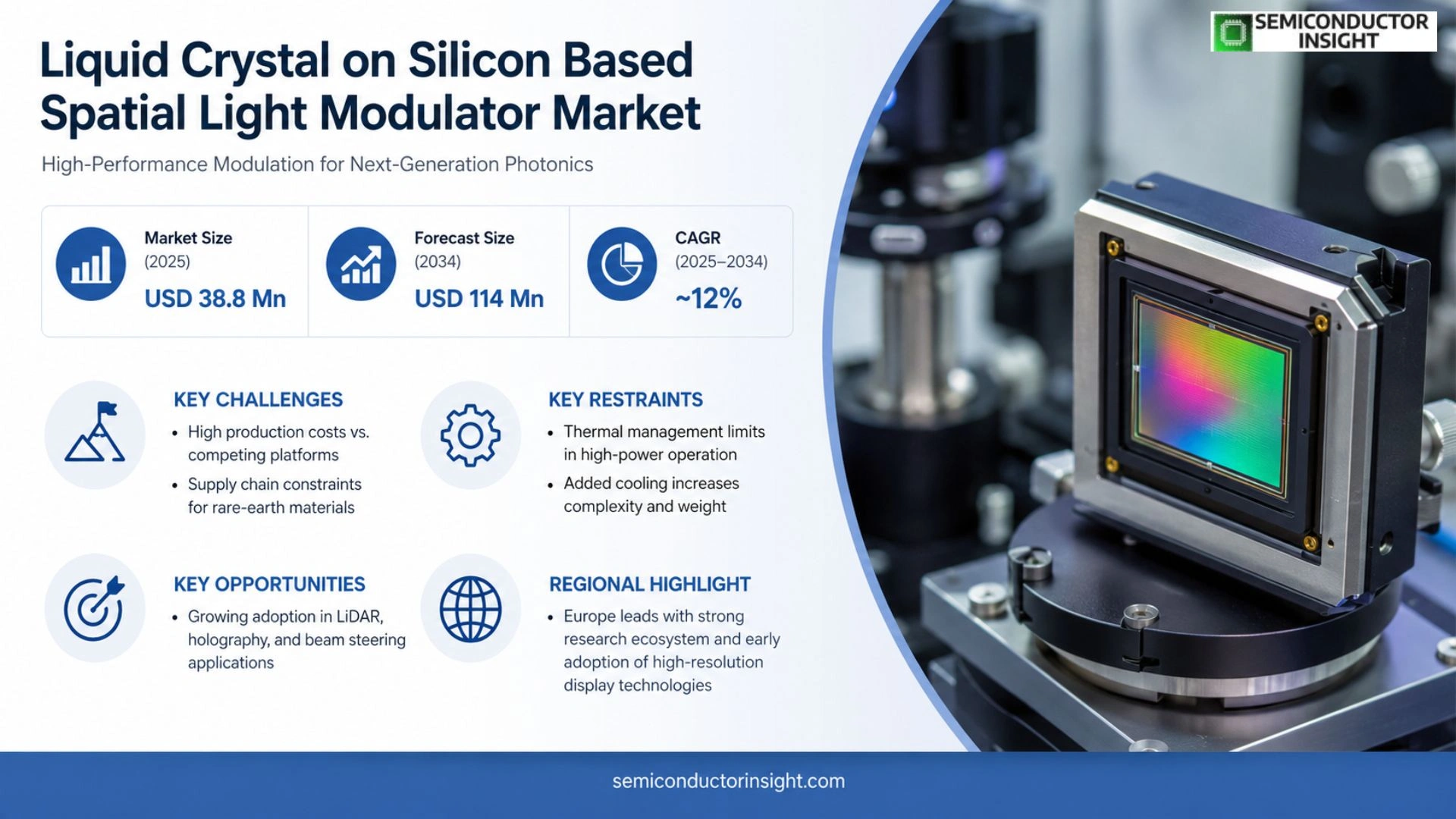
Global Liquid Crystal on Silicon Based Spatial Light Modulator market size was valued at USD 38.8 million in 2025. Forecasts indicate the market will reach USD 114 million by 2034, reflecting a compound annual growth rate of roughly 12 % over the forecast horizon.
Liquid Crystal on Silicon Based Spatial Light Modulator is a two‑dimensional phase‑modulation device that combines silicon micro‑electronics with liquid‑crystal layers to achieve precise optical wavefront control. By steering light across the aperture, it enables holographic imaging, beam deflection and arbitrary beam‑shaping. Applications span ultraviolet‑based 3D printing, visible‑light cell manipulation and infrared laser material processing.
The market gains momentum because advances in high‑resolution displays, optical communications and laser projection drive demand for compact, high‑contrast modulators. Companies such as Hamamatsu Photonics, HOLOEYE Photonics, Meadowlark Optics and Thorlabs are expanding product portfolios and investing in next‑generation silicon‑LC integration. However, challenges remain around manufacturing yield and cost sensitivity in consumer electronics.
MARKET DRIVERS
Increasing Demand in Augmented Reality and Head‑Mounted Displays
The adoption of AR glasses and mixed‑reality headsets has created a measurable uptick in the need for high‑resolution wavefront control. Manufacturers favor liquid crystal on silicon (LCoS) because it delivers pixel‑level phase modulation without the bulk of conventional optics, allowing slimmer device profiles. This engineering advantage translates into greater user comfort and enhanced visual fidelity, which in turn accelerates procurement cycles among OEMs.
Advancements in Semiconductor Fabrication Techniques
Recent refinements in wafer‑level processing,such as improved photolithography alignment and low‑temperature deposition,have lowered defect rates on LCoS panels. The result is a more reliable product line that can sustain higher frame‑rates demanded by projection mapping and digital cinema. As fab facilities scale up, the cost per square inch declines, making the technology competitive against emerging electro‑optic alternatives.
➤ Analysts note that the convergence of tighter pixel pitches and reduced power consumption is reshaping the cost‑benefit equation for LCoS in enterprise imaging solutions.
Combined, these forces bolster Liquid Crystal on Silicon Based Spatial Light Modulator Market by expanding its addressable applications and reinforcing supplier confidence, setting the stage for deeper market penetration over the next cycle.
MARKET CHALLENGES
Escalating Production Costs Relative to Competing Modulator Platforms
While LCoS offers superior image quality, its manufacturing pipeline,requiring high‑precision silicon backplanes and specialized alignment equipment,remains capital intensive. Competing technologies such as digital micromirror devices (DMD) benefit from economies of scale in mature foundries, pressuring LCoS suppliers to rationalize margins without compromising performance.
Other Challenges
Supply Chain Constraints
The reliance on rare‑earth dopants for liquid crystal alignment introduces vulnerability to geopolitical trade flows. Any disruption in the sourcing of these materials can delay production schedules, prompting end‑users to hedge with alternative modulation solutions.
MARKET RESTRAINTS
Thermal Management Limitations in High‑Power Deployments
When LCoS panels operate at elevated illumination levels,common in laser‑based projection,the heat generated can degrade liquid crystal response time, leading to latency spikes. Current cooling architectures add weight and complexity, deterring integration in portable platforms where size‑weight‑power (SWaP) budgets are tight.
MARKET OPPORTUNITIES
Expansion into LiDAR and Holographic Beam Steering
Emerging autonomous‑vehicle and free‑space‑optics sectors are exploring LCoS for dynamic beam shaping, thanks to its ability to modulate phase across a compact silicon substrate. Early pilots indicate that integrating LCoS can reduce system‑level component counts while delivering fine‑grained directionality, positioning the technology as a strategic enabler for next‑generation sensing platforms.
Liquid Crystal on Silicon Based Spatial Light Modulator Market Trends
Integration of SLMs into Immersive Display Systems
The rise of high‑fidelity virtual and augmented realities has created a pressing need for optical components that can modulate phase with pixel‑level precision. Silicon‑based liquid‑crystal modulators satisfy that requirement by delivering millisecond‑scale response times while maintaining the high contrast needed for holographic image synthesis. Manufacturers are now embedding these devices directly into headset optics, eliminating bulky external diffractive elements and reducing system weight. This shift not only improves user comfort but also opens new revenue channels for firms that can balance wafer‑scale production with the stringent optical tolerances demanded by immersive content creators.
Other Trends
Emergence of Reflective SLM Technology
Reflective architectures are gaining traction because they leverage the mature silicon back‑end‑of‑line processes already in place for photonic integrated circuits. By routing the incident beam onto a mirrored liquid‑crystal layer, developers achieve higher diffraction efficiencies and lower power consumption compared with transmissive counterparts. The consequence for end‑users is a more stable beam profile in laser projection and material‑processing equipment, where even minor phase errors can translate into surface defects. Companies that master the reflective stack are positioning themselves to capture a larger share of the laser‑machining and high‑precision metrology segments.
Supply‑Chain Consolidation and Application Diversification
Over the past two years, a handful of OEMs have acquired niche component makers, creating vertically integrated platforms that span design, wafer fabrication, and final‑module testing. This consolidation reduces lead times and harmonizes quality standards across the value chain, an advantage that matters as OEMs rush to meet the expanding demand from optical‑communication carriers seeking adaptive wave‑front correction. Simultaneously, the technology is branching into biomedical optics, where spatial light modulators enable dynamic illumination patterns for cell‑level manipulation. The confluence of tighter supply networks and broader application reach is expected to raise entry barriers for newcomers, while incentivizing incumbents to invest in next‑generation driver electronics and AI‑assisted calibration algorithms.
COMPETITIVE LANDSCAPE
Key Industry Players
Liquid Crystal on Silicon Based Spatial Light Modulator Market: Competitive Overview
Hamamatsu Photonics continues to command the upper tier of the market, leveraging its deep heritage in precision optics and extensive patent portfolio around LCOS devices. The company’s ability to pair high‑resolution silicon backplanes with proprietary liquid‑crystal formulations gives it an edge in demanding AR/VR display projects and high‑fidelity laser projection systems. Hamamatsu’s vertical‑integration model,covering wafer fabrication, device packaging, and after‑sales calibration services,creates a defensible moat that discourages new entrants from targeting the premium segment. Alongside Hamamatsu, a small cohort of diversified optics groups, notably THORLABS and Jenoptik, operate as multibillion‑dollar conglomerates that allocate dedicated R&D funds to LCOS, allowing them to capture sizable share in industrial laser‑processing and adaptive‑optics niches.
Beyond the dominant tier, a vibrant set of specialist firms fuels innovation across the value chain. HOLOEYE Photonics and Meadowlark Optics concentrate on holographic display engines, where their modular LCOS stacks enable rapid prototype cycles for next‑generation virtual‑reality headsets. Santec Corporation supplies telecom‑grade modulators that underpin high‑capacity optical‑communication demonstrators, while Jasper Display Corp. focuses on low‑power, high‑contrast panels for consumer‑grade holographic signage. Emerging players such as UPOLabs and CAS Microstar differentiate through customized form‑factors for biomedical imaging and precision beam shaping. The presence of Kopin (Forth Dimension Displays) and Texas Instruments illustrates crossover from display‑driver expertise to LCOS, providing a bridge between mass‑manufacturing capabilities and niche performance requirements. Collectively, these firms create a competitive mosaic where technology leadership is often tied to application‑specific engineering rather than sheer scale.
List of Key Liquid Crystal on Silicon Based Spatial Light Modulator Companies Profiled
- Hamamatsu Photonics
- HOLOEYE Photonics
- Meadowlark Optics
- Thorlabs
- Jenoptik
- Forth Dimension Displays (Kopin)
- Jasper Display Corp.
- UPOLabs
- CAS Microstar
- Santec Corporation
- Texas Instruments
- Sony Corporation
- Hewlett Packard Enterprise
Segment Analysis:
| Segment Category | Sub-Segments | Key Insights |
| By Type |
|
Reflective SLMs are currently viewed as the most versatile because they enable high‑efficiency phase modulation across a broad spectral range.
|
| By Application |
|
Holography drives innovative user experiences in immersive display technologies.
|
| By End User |
|
AR/VR Display Manufacturers are capitalizing on the high‑resolution, phase‑control capabilities of silicon‑based SLMs.
|
| By Functional Benefit |
|
Fast Switching Speed is increasingly regarded as the decisive factor for dynamic optical systems.
|
| By Integration Mode |
|
Integrated Photonic Chips are shaping the future architecture of optical devices.
|
Regional Analysis: Liquid Crystal on Silicon Based Spatial Light Modulator Market
Europe
Major display manufacturers such as a leading German optics firm have embedded LCoS SLMs into next‑generation projectors, leveraging the region’s precision‑engineered wafer fabs to meet tight tolerances demanded by cinema‑grade imaging.
The European supply chain benefits from vertically aligned silicon foundries and specialty coating providers, enabling rapid prototype turnover and reducing the logistical friction that hampers adoption in other territories.
EU directives on electronic waste and energy efficiency compel vendors to design SLMs with lower power draw, a pressure that inadvertently drives innovation around pixel‑level control and thermal management.
Innovation clusters in Scandinavia and the Benelux region fuse photonic research with start‑up capital, fostering niche applications such as biomedical imaging that expand the market’s use‑case portfolio.
North America
North America’s market activity is anchored by a concentration of defense contractors that view LCoS SLMs as a strategic enabler for high‑resolution infrared sensing. The United States benefits from a flexible venture‑capital environment that nurtures early‑stage firms exploring unconventional modulation schemes. Although the continent lacks the same depth of silicon‑foundry integration found in Europe, strong collaborations between federal labs and private optics firms compensate by accelerating technology transfer. The emerging demand from entertainment studios for immersive cinema experiences adds a commercial dimension that diversifies revenue streams beyond traditional industrial applications.
Asia‑Pacific
In Asia‑Pacific, rapid consumer‑electronics growth fuels a secondary market for compact projectors and heads‑up displays, where cost sensitivity tempers the adoption of premium LCoS solutions. Countries such as Japan and South Korea possess highly capable display manufacturers, yet their focus remains on AMOLED and micro‑LED platforms, limiting immediate upside for LCoS. Nonetheless, expanding investments in smart‑city surveillance and autonomous‑vehicle lidar create pockets of opportunity that could accelerate regional participation if supply‑chain bottlenecks are alleviated.
South America
South America’s exposure to LCoS technology is modest, with most activity concentrated in Brazil’s research institutions that experiment with low‑cost silicon photonics. The region’s limited manufacturing base forces import reliance, which raises total cost of ownership for end‑users. However, growing interest from educational broadcasters in high‑definition projection hints at a niche market that could mature as regional procurement policies begin to emphasize digital transformation.
Middle East & Africa
The Middle East & Africa region exhibits nascent demand driven primarily by defense and oil‑field inspection projects that require rugged, high‑contrast spatial light modulators. While local fabs are scarce, government‑backed technology parks in the United Arab Emirates attract multinational OEMs looking to establish a foothold. African markets remain largely peripheral, yet emerging telecom infrastructure upgrades open a peripheral avenue for LCoS‑based optical networking equipment, suggesting a long‑term, low‑volume growth trajectory.
Report Scope
This market research report provides a comprehensive analysis of the Liquid Crystal on Silicon Based Spatial Light Modulator Market , covering the forecast period 2026–2034. It offers detailed insights into market dynamics, technological advancements, competitive landscape, and key trends shaping the industry.
Key focus areas of the report include:
- Market Overview: The report begins with an overview outlining its current market scenario, key growth indicators, and industry transformation drivers. It discusses macroeconomic factors, demand–supply balance, regulatory landscape, and the strategic role of semiconductors in powering advancements across industries such as automotive, telecommunications, consumer electronics, and industrial automation.
- Market Size & Forecast: Historical data and future projections for revenue, unit shipments, and market value across major regions and segments.
- Segmentation Analysis: Detailed breakdown by product type, technology, application, and end-user industry to identify high-growth segments and investment opportunities.
- Regional Insights: Insights into market performance across North America, Europe, Asia-Pacific, Latin America, and the Middle East & Africa, including country-level analysis where relevant.
- Competitive Landscape: Profiles of leading market participants, including their product offerings, R&D focus, manufacturing capacity, pricing strategies, and recent developments such as mergers, acquisitions, and partnerships.
- Technology Trends & Innovation: Assessment of emerging technologies, integration of AI/IoT, semiconductor design trends, fabrication techniques, and evolving industry standards.
- Market Drivers & Restraints: Evaluation of factors driving market growth along with challenges, supply chain constraints, regulatory issues, and market-entry barriers.
- Stakeholder Insights: Insights for component suppliers, OEMs, system integrators, investors, and policymakers regarding the evolving ecosystem and strategic opportunities.
Primary and secondary research methods are employed, including interviews with industry experts, data from verified sources, and real-time market intelligence to ensure the accuracy and reliability of the insights presented.
FREQUENTLY ASKED QUESTIONS:
What is the current market size of Liquid Crystal on Silicon Based Spatial Light Modulator Market?
-> Liquid Crystal on Silicon Based Spatial Light Modulator market Forecasts indicate the market will reach USD 114 million by 2034
Which key companies operate in Liquid Crystal on Silicon Based Spatial Light Modulator Market?
-> Key players include Hamamatsu Photonics, HOLOEYE Photonics, Meadowlark Optics, Santec Corporation, Thorlabs, Jenoptik, Forth Dimension Displays (Kopin), Jasper Display Corp., UPOLabs, and CAS Microstar.
What are the key growth drivers?
-> Key growth drivers include rapid advancements in information displays, optical communications, and laser projection, which enable high‑resolution holographic displays, precise beam shaping, and adaptive optical systems for improved transmission quality.
Which region dominates the market?
-> Asia‑Pacific holds a leading share of the market, supported by strong electronics, display, and photonics industries, while North America and Europe also exhibit significant activity.
What are the emerging trends?
-> Emerging trends include integration of SLMs into holographic and augmented reality displays, adaptive optics for communication links, and AI‑driven beam‑shaping algorithms that enhance performance and functionality.
Get Sample Report PDF for Exclusive Insights
Report Sample Includes
- Table of Contents
- List of Tables & Figures
- Charts, Research Methodology, and more...
 Download Sample Report PDF