Linear Scale Sensor Market Insights
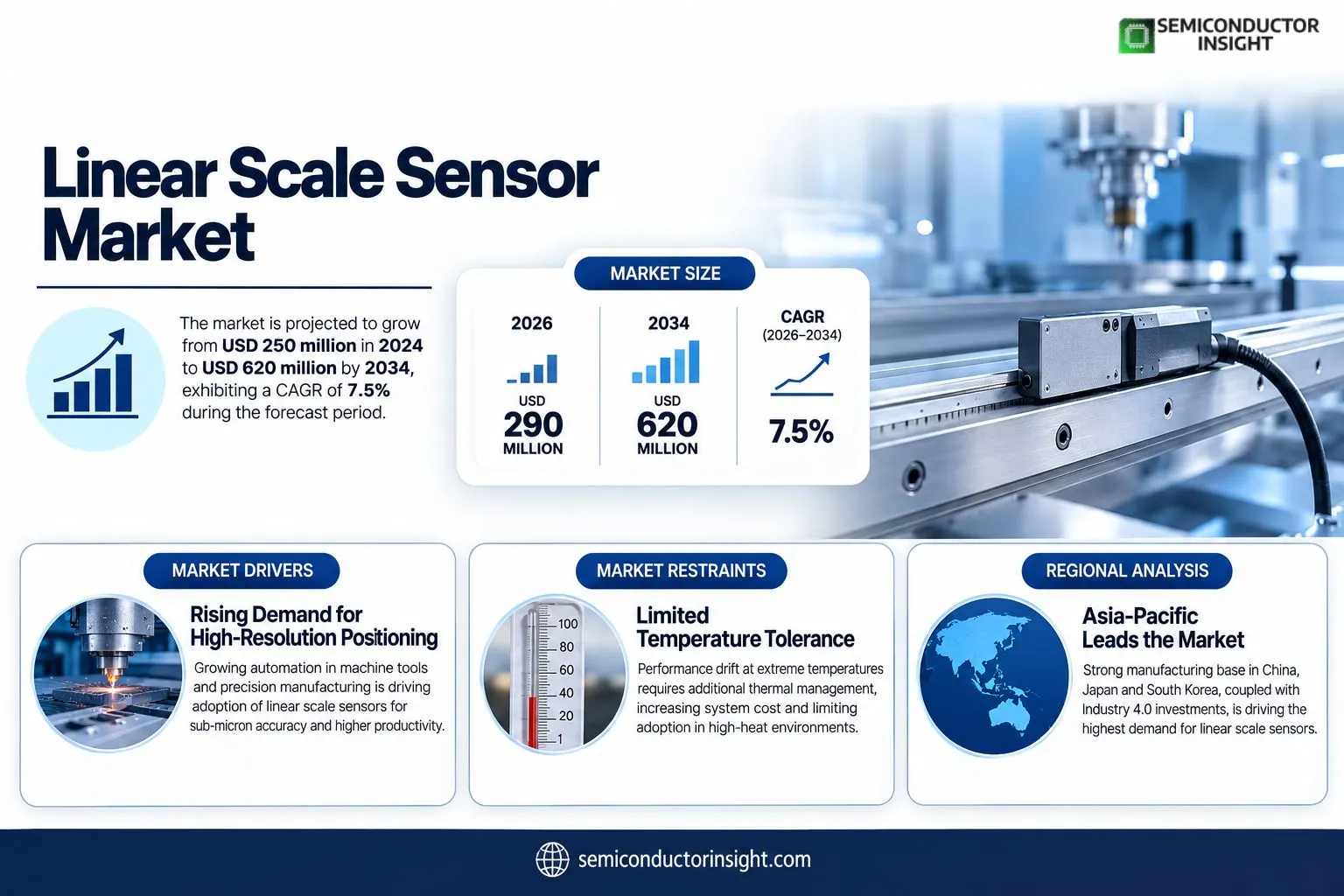
Linear Scale Sensor Market was valued at USD 250 million in 2024 and is expected to reach USD 620 million by 2034, exhibiting a CAGR of 7.5% during the forecast period.
Linear scale sensors are precision transducers that convert linear displacement into electrical signals, typically employing optical or magnetic encoding techniques. They enable high‑resolution position feedback for machine tools, measuring instruments, elevators, and other automation equipment.The market gains momentum as manufacturers adopt Industry 4.0 practices that demand tighter tolerances and real‑time monitoring. While automation upgrades boost demand, supply‑chain constraints on rare‑earth magnets present challenges for some producers. Recent collaborationssuch as NEWALL’s partnership with an automotive OEM in early 2024illustrate how OEMs seek integrated sensor solutions to improve productivity.
MARKET DRIVERS
Rising Demand for High‑Resolution Positioning
Linear Scale Sensor Market is being propelled by manufacturers that require sub‑micron accuracy for CNC machines, semiconductor steppers, and laser cutters. As product tolerances shrink, customers turn to linear encoders that can deliver repeatability below 0.5 µm, creating a clear preference for advanced scale technologies over traditional potentiometers.
Shift Toward Digital Manufacturing
Industry 4.0 initiatives compel factories to replace analog feedback loops with network‑ready digital sensors. The ability of modern linear scale sensors to transmit data via Ethernet or fieldbus protocols aligns with predictive‑maintenance platforms, allowing operators to forecast wear and schedule downtime proactively.
➤ “Clients that integrate closed‑loop linear sensors report up to 15 % higher overall equipment effectiveness within the first year.”
Beyond equipment performance, the adoption of compact, low‑power sensor modules opens opportunities in portable inspection tools, where battery longevity and form‑factor constraints dictate component selection.
MARKET CHALLENGES
Integration Complexity
Design engineers often encounter compatibility hurdles when retrofitting legacy machinery with modern linear scale sensors. Signal conditioning, mounting geometry, and firmware synchronization must be aligned precisely, a process that can extend development cycles and increase project risk.
Other Challenges
Cost Sensitivity
While premium sensors deliver superior accuracy, many mid‑tier manufacturers operate under tight budgetary constraints, pushing them toward cost‑effective alternatives that may sacrifice resolution or environmental robustness.
MARKET RESTRAINTS
Limited Temperature Tolerance
Linear scale sensors that rely on glass or ceramic scale tapes frequently exhibit performance drift beyond ±70 °C. Applications in metal forging or high‑heat extrusion therefore require additional thermal management measures, inflating system cost and deterring some potential adopters.
MARKET OPPORTUNITIES
Emerging Applications in Robotics
Collaborative robots and autonomous guided vehicles depend on precise linear displacement feedback for joint calibration and payload handling. The growing prevalence of such systems in logistics and healthcare is expected to drive demand for compact, high‑bandwidth linear scale sensors that can operate reliably in dynamic environments.
Linear Scale Sensor Market Trends
Rise of Incremental Sensors in Precision Automation
The adoption of incremental linear scale sensors is reshaping equipment design in high‑speed machining and robotics. Manufacturers favor the incremental architecture because it delivers sub‑micron resolution while consuming less power than traditional absolute versions. This efficiency gain translates into lower thermal drift, a factor that directly improves product quality on the shop floor. As factories tighten tolerances to meet tighter regulatory specifications, the incremental approach becomes the preferred engineering solution. Consequently, suppliers are expanding their product portfolios to include compact, digital‑output modules that integrate seamlessly with IoT‑enabled control systems, reinforcing the link between sensor technology and overall production agility.
Other Trends
Regional Shift Toward Asia‑Pacific Production Hubs
Asia‑Pacific economies are witnessing a noticeable reallocation of linear scale sensor demand. Investment in advanced manufacturing corridors, particularly in China, Japan, and South Korea, is prompting local OEMs to source sensors domestically rather than relying on legacy European or North‑American distributors. This shift is driven by government incentives that lower import tariffs and support R&D for precision measurement devices. For Western manufacturers, the implication is a need to diversify supply chains and establish joint ventures that provide localized engineering support. Such strategies help preserve market relevance while mitigating exposure to geopolitical trade fluctuations.
Competitive Consolidation and Value‑Added Services
Industry leaders such as NEWALL, RSF Elektronik, and GURLEY Precision Instruments are extending beyond pure component sales by offering calibration, on‑site integration, and predictive maintenance contracts. This movement toward service‑oriented offerings reflects a broader recognition that equipment uptime is as valuable as sensor accuracy. Companies that bundle hardware with analytics platforms gain a strategic advantage, as they can monitor sensor health in real time and propose firmware updates that extend device life. The competitive pressure is encouraging mid‑tier players to adopt similar models, fostering a market environment where added value and technical support become central differentiators.
COMPETITIVE LANDSCAPE
Key Industry Players
Linear Scale Sensor Market: Competitive Overview
NEWALL retains a dominant position in the linear scale sensor arena, leveraging a portfolio that spans incremental and absolute sensor families. Its extensive R&D pipeline has produced sub‑micron resolution devices that are now standard in high‑precision machine tools across Europe and North America. The company’s vertically integrated supply chain reduces lead times, enabling OEMs to secure consistent production volumes even when demand spikes in the automotive and aerospace sectors. NEWALL’s strategic acquisitions of niche optical‑encoder firms in the past five years have broadened its addressable market, allowing it to cross‑sell to customers seeking integrated measurement solutions. This breadth of offering, combined with a solid service network in the United States and China, forces competitors to differentiate on price or specialized functionality.Beyond the market leader, a cluster of specialized manufacturers shapes the competitive fabric. RSF Elektronik and GURLEY Precision Instruments each command strong footholds in the United States, focusing on rugged sensors for heavy‑duty elevators and conveyor systems. Lika Electronic and Kubler have cultivated reputations for compact incremental sensors that are embedded in robotic arms and CNC machines in Eastern Europe. SIKO and GIVI MISURE dominate the Italian and Spanish markets respectively, where their emphasis on low‑cost, high‑volume production supports the rising demand from small‑to‑medium enterprises. Additional players such as Electronica Mechatronic Systems, Fagor Automation, Leader Precision Instrument, Heidenhain, TESA, and MicronOptics round out the landscape, each carving out niche segmentsranging from ultra‑high‑resolution sensors for semiconductor lithography to budget‑friendly units for educational laboratories. Their collective focus on application‑specific innovation creates a fragmented yet dynamic competitive environment that pressures larger firms to pursue continuous improvement while offering smaller firms ample opportunity for differentiation.
List of Key Linear Scale Sensor Companies Profiled
- NEWALL
- RSF Elektronik
- Lika Electronic
- GURLEY Precision Instruments
- Electronica Mechatronic Systems
- Kubler
- Fagor Automation
- SIKO
- GIVI MISURE
- Leader Precision Instrument
- Heidenhain
- TESA
- MicronOptics
- Precision Motion Systems
- Delta Industrial Sensors
Segment Analysis:
| Segment Category | Sub-Segments | Key Insights |
| By Type |
|
Incremental Linear Scale Sensor
|
| By Application |
|
Machine Tools
|
| By End User |
|
Precision Engineering
|
| By Technology |
|
Optical
|
| By Performance |
|
High Accuracy
|
Regional Analysis: Linear Scale Sensor Market
North America
Vehicle manufacturers are embedding linear scale sensors within steering systems and adaptive suspension mechanisms to achieve finer control loops. The move is driven by consumer expectations for smoother rides and tighter safety margins, prompting sensor vendors to engineer ruggedized packages that survive harsh automotive environments.
In advanced factories, linear scale sensors act as the positional backbone for robotics and CNC machinery. Their role in real‑time error correction enables operators to push cycle times lower without sacrificing accuracy, a critical factor for competitive cost structures.
Aerospace suppliers exploit the high resolution of linear scale sensors for wing‑flap actuation and assembly jig alignment. The sector’s zero‑defect culture demands sensors that maintain calibration over long missions, steering vendors toward premium, low‑drift designs.
Emerging smart‑city projects incorporate linear scale sensors in bridge monitoring and elevator positioning systems. Real‑time displacement data supports predictive maintenance regimes that extend asset lifecycles while reducing unexpected downtime.
Europe
European manufacturers are translating sustainability mandates into tighter process controls, where linear scale sensors become pivotal for material efficiency. Regulatory frameworks around energy usage encourage adoption in precision machining, while the region’s strong standards ecosystem ensures interoperability across borders. Suppliers are therefore aligning product roadmaps with EU directives, emphasizing low‑power consumption and modularity to satisfy a diverse customer base ranging from medical device firms to renewable‑energy equipment makers.
Asia‑Pacific
The Asia‑Pacific arena is witnessing a surge in localized production hubs that prioritize high‑speed assembly lines. Linear scale sensors are instrumental in synchronising multi‑axis operations, allowing manufacturers to compete on both volume and quality. A growing emphasis on digital twins amplifies demand for sensors that feed accurate positional data into simulation platforms, fostering a feedback culture that shortens design cycles for electronics and consumer‑goods producers.
South America
In South America, growth is anchored by expanding petrochemical complexes and an emerging automotive assembly sector. Linear scale sensors enable these industries to refine process tolerances, a prerequisite for meeting international export standards. Local suppliers are forming joint ventures with North American firms to leverage technology transfer, thereby accelerating market maturity while addressing cost‑sensitivity inherent in the region.
Middle East & Africa
The Middle East & Africa segment is gradually shifting from resource extraction to higher‑value manufacturing. Linear scale sensors are finding footholds in water‑management systems and solar‑panel tracking installations, where precise positional feedback drives efficiency. Investment incentives from sovereign wealth funds are encouraging niche players to develop sensor solutions tailored for harsh desert climates, positioning the region for a nascent yet promising market evolution.
Report Scope
This market research report provides a comprehensive analysis of the Linear Scale Sensor Market , covering the forecast period 2026–2034. It offers detailed insights into market dynamics, technological advancements, competitive landscape, and key trends shaping the industry.
Key focus areas of the report include:
- Market Overview: The report begins with an overview outlining its current market scenario, key growth indicators, and industry transformation drivers. It discusses macroeconomic factors, demand–supply balance, regulatory landscape, and the strategic role of semiconductors in powering advancements across industries such as automotive, telecommunications, consumer electronics, and industrial automation.
- Market Size & Forecast: Historical data and future projections for revenue, unit shipments, and market value across major regions and segments.
- Segmentation Analysis: Detailed breakdown by product type, technology, application, and end-user industry to identify high-growth segments and investment opportunities.
- Regional Insights: Insights into market performance across North America, Europe, Asia-Pacific, Latin America, and the Middle East & Africa, including country-level analysis where relevant.
- Competitive Landscape: Profiles of leading market participants, including their product offerings, R&D focus, manufacturing capacity, pricing strategies, and recent developments such as mergers, acquisitions, and partnerships.
- Technology Trends & Innovation: Assessment of emerging technologies, integration of AI/IoT, semiconductor design trends, fabrication techniques, and evolving industry standards.
- Market Drivers & Restraints: Evaluation of factors driving market growth along with challenges, supply chain constraints, regulatory issues, and market-entry barriers.
- Stakeholder Insights: Insights for component suppliers, OEMs, system integrators, investors, and policymakers regarding the evolving ecosystem and strategic opportunities.
Primary and secondary research methods are employed, including interviews with industry experts, data from verified sources, and real-time market intelligence to ensure the accuracy and reliability of the insights presented.
FREQUENTLY ASKED QUESTIONS:
What is the current market size of Linear Scale Sensor Market?
-> Linear Scale Sensor Market was valued at USD million in 2024 and is expected to reach USD million by 2031 at a CAGR of % during the forecast period.
Which key companies operate in Linear Scale Sensor Market?
-> Key players include NEWALL, RSF Elektronik, Lika Electronic, GURLEY Precision Instruments, Electronica Mechatronic Systems, Kubler, Fagor Automation, SIKO, GIVI MISURE, Leader Precision Instrument, among others.
What are the key growth drivers?
-> Key growth drivers include increasing automation in machine tools, rising demand for precision measuring instruments, expansion of elevator infrastructure, and advancements in sensor technology.
Which region dominates the market?
-> Asia holds the largest market share, driven by strong manufacturing bases in China, Japan, and South Korea, while North America shows significant growth potential.
What are the emerging trends?
-> Emerging trends include integration of Linear Scale Sensors with IoT platforms, development of incremental sensor designs for higher resolution, and the use of AI-driven analytics for predictive maintenance.

Get Sample Report PDF for Exclusive Insights
Report Sample Includes
- Table of Contents
- List of Tables & Figures
- Charts, Research Methodology, and more...
 Download Sample Report PDF