LED Epitaxy Susceptor Market Insights
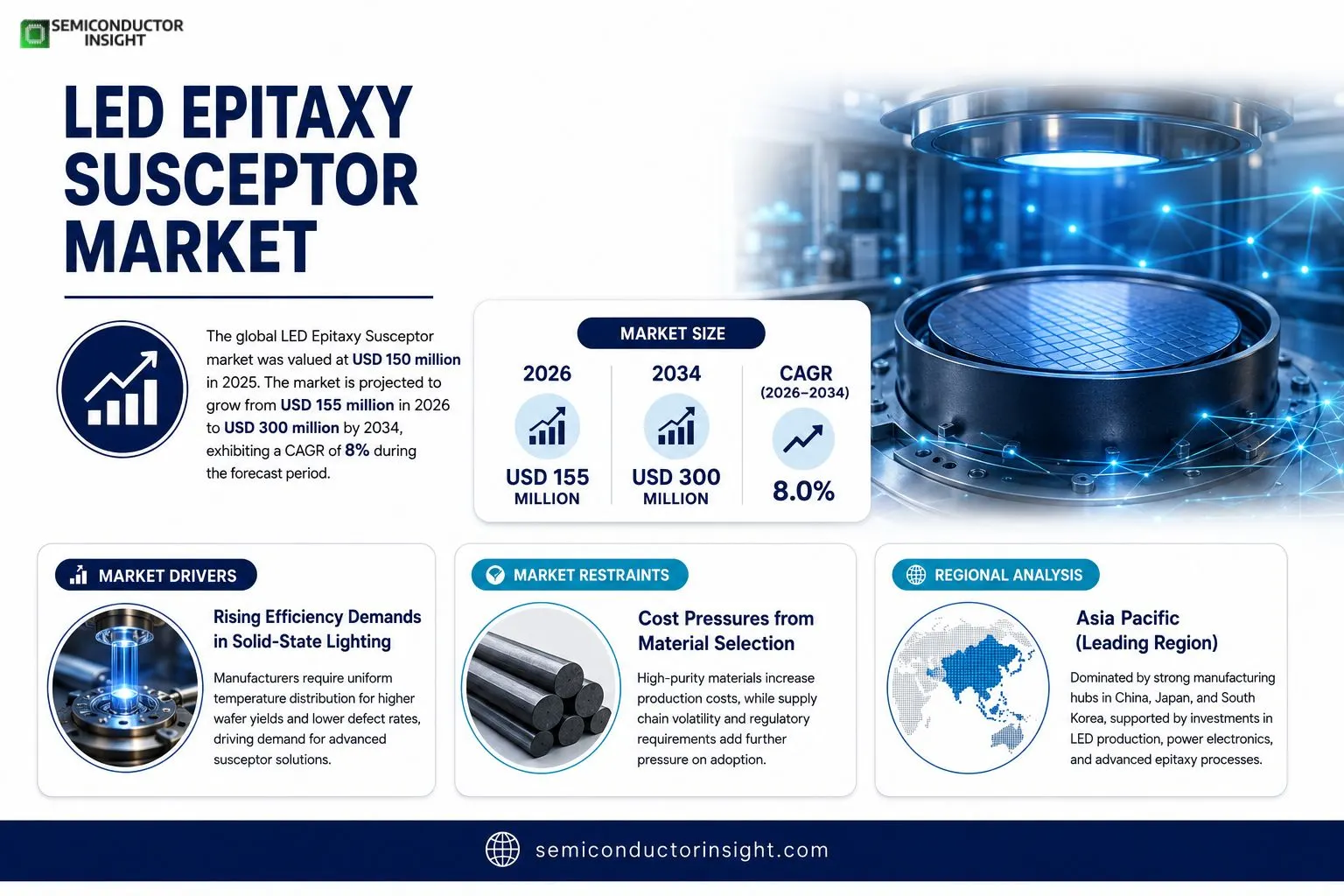
LED Epitaxy Susceptor market size was valued at USD 150 million in 2025. The market is projected to grow from USD 155 million in 2026 to USD 300 million by 2034, exhibiting a CAGR of 8% during the forecast period.
LED Epitaxy Susceptors are wafer holders designed for epitaxial deposition of compound semiconductors such as GaN and InP used in high‑efficiency light‑emitting diodes. Silicon‑carbide‑coated graphite designs deliver superior thermal conductivity and chemical resistance, while plain graphite susceptors provide a cost‑effective solution for large‑volume production.The market expands because manufacturers of power electronics and electric vehicles increasingly adopt SiC‑based devices that require high‑quality epitaxial layers. Advances in reactor design improve uniformity, prompting suppliers like Toyo Tanso and SGL Carbon to broaden their product portfolios. At the same time, price pressure forces producers to optimise material usage without compromising performance.
MARKET DRIVERS
Rising Efficiency Demands in Solid‑State Lighting
Manufacturers of high‑performance LEDs are prioritising process equipment that can sustain uniform temperature distribution. LED Epitaxy Susceptor Market benefits from this focus because susceptor designs that minimize thermal gradients directly translate into higher wafer yields and lower defect rates. Firms that can demonstrate reliable thermal management are gaining preferential treatment in procurement decisions.
Shift Toward Higher‑Power Chip Architectures
As automotive lighting and smart‑city illumination adopt higher‑power LED chips, epitaxial reactors must accommodate larger substrate sizes and longer growth cycles. Susceptors engineered for robust mechanical stability enable these extended runs without compromising surface flatness, thereby supporting the transition to next‑generation chip formats.
➤ “Thermal uniformity is the single most influential factor in achieving wafer‑level consistency for high‑output LEDs,” notes a senior process engineer at a leading fab.
Consequently, investment in advanced susceptor materials—such as high‑purity quartz or silicon carbide composites—has become a strategic lever. Companies that secure access to these materials can differentiate their product lines, command premium pricing, and accelerate time‑to‑market.
MARKET CHALLENGES
Cost Pressures from Material Selection
High‑purity susceptor substrates command price points that strain capital‑intensive semiconductor fabs. While the performance gains are clear, the incremental expense can deter smaller players, limiting broader adoption of cutting‑edge susceptor designs within LED Epitaxy Susceptor Market.
Other Challenges
Supply‑Chain Volatility
Fluctuations in raw‑material availability, especially for specialty ceramics, introduce lead‑time uncertainty. This volatility forces fab managers to hold larger inventories, which erodes the cost advantage of newer susceptor technologies.
MARKET RESTRAINTS
Regulatory Scrutiny on Process Emissions
Environmental regulations in major manufacturing hubs increasingly target the gases emitted during epitaxial growth. Susceptor designs that require higher process temperatures can exacerbate emission levels, prompting facilities to reconsider equipment upgrades until compliance pathways are clarified.
Technical Integration Barriers
Retrofitting existing reactors with next‑generation susceptor assemblies often demands extensive re‑qualification. The engineering effort and downtime associated with such transitions act as a deterrent, particularly for fabs operating close to capacity.
These constraints collectively temper the speed at which new susceptor innovations penetrate LED Epitaxy Susceptor Market, compelling vendors to offer migration services alongside product sales.
MARKET OPPORTUNITIES
Emerging Applications in Micro‑LED Displays
Micro‑LED panels require epitaxial layers with exceptionally low defect densities. Susceptors that can sustain ultra‑stable thermal environments are uniquely positioned to meet this demand, opening a niche segment for suppliers willing to tailor their designs for display manufacturers.The convergence of automotive lighting standards and interior ambient‑lighting trends also creates room for customized susceptor solutions that enable higher lumen outputs while maintaining compact form factors. Providers that align R&D roadmaps with these evolving specifications are poised to capture a growing slice of the market.
LED Epitaxy Susceptor Market Trends
Rising Adoption of Silicon‑Carbide Susceptors in Power Electronics
LED Epitaxy Susceptor Market is feeling the impact of a sustained shift toward high‑efficiency power devices. Silicon‑carbide (SiC) wafers require susceptor platforms that can tolerate extreme temperatures while delivering uniform thermal gradients. Recent advances in SiC coating technologies have reduced defect rates during epitaxial growth, making SiC‑based modules attractive for electric‑vehicle inverters and grid‑level converters. Manufacturers are therefore prioritising susceptor designs that minimize thermal stress, which translates into higher yields and lower per‑unit costs. The ripple effect is a noticeable uptick in capital expenditure by equipment suppliers seeking to capture this niche, and a reallocation of R&D budgets toward materials that support tighter process windows.
Other Trends
Graphite versus SiC‑Coated Graphite Susceptors
Traditional graphite susceptors continue to dominate volume shipments because of their lower price point and established supply chains. However, the performance gap between bare graphite and SiC‑coated variants is narrowing as coating processes become more repeatable. Users targeting GaN or InP epitaxy report that SiC‑coated graphite offers superior thermal emissivity, which improves layer uniformity across 200‑mm wafers. Consequently, tier‑one fabs are incrementally replacing legacy graphite fleets with coated units, while mid‑range facilities balance cost against incremental yield improvements. The market is therefore bifurcating into a cost‑sensitive segment that clings to conventional graphite and a performance‑driven segment that embraces the coated solution.
Geographic Shift Towards Asian Manufacturing Hubs
Production capacity for epitaxy susceptors is increasingly concentrated in East Asia, driven by the region’s mature semiconductor ecosystem and supportive policy frameworks. China’s investment in advanced wafer fabs has spurred local susceptor manufacturers to scale up, leveraging lower labor costs and proximity to downstream memory and power device assemblers. South Korea and Japan, with their deep expertise in SiC and GaN processes, are also expanding tool‑making capabilities, creating a competitive cluster that pressures Western suppliers to innovate or partner locally. For LED Epitaxy Susceptor Market, this geographic rebalancing means tighter price competition, faster technology diffusion, and a strategic imperative for global players to establish joint ventures or supply agreements within the Asian corridor.
COMPETITIVE LANDSCAPE
Key Industry Players
LED Epitaxy Susceptor Market: Competitive Overview 2026‑2034
The competitive arena is anchored by a handful of technologically deep manufacturers that dominate supply for both graphite and SiC‑coated susceptor variants. Toyo Tanso leverages its long‑standing expertise in high‑purity graphite engineering to capture a sizable share of wafer‑holder demand from Asian LED fabs, while SGL Carbon combines scale‑driven cost efficiencies with a robust R&D pipeline that targets uniform thermal profiles essential for GaN and InP epitaxy. Their market presence forces smaller entrants to specialize, either by focusing on niche substrate dimensions or by developing proprietary coating processes that differentiate product performance. The duopoly’s pricing power and close ties to major equipment OEMs shape the overall value chain, compelling downstream manufacturers to align closely with their product roadmaps.Beyond the leaders, a diverse set of midsize and specialist firms enriches the ecosystem. Tokai Carbon and Mersen supply high‑temperature resistant susceptor components to European and North American power‑electronics players, while Bay Carbon and CoorsTek maintain strong footholds in custom‑shaped holders for emerging InP laser applications. Schunk Xycarb Technology, ZhiCheng Semiconductor, and II‑VI Incorporated have each introduced surface‑engineered coatings that improve uniformity in multi‑wafer reactors, attracting customers seeking incremental yield gains. Regional actors such as Sumitomo Electric (Japan), Hitachi High‑Tech (Japan), and Hoya Corp (Japan) reinforce the supply base in East Asia, whereas companies like Advanced Materials Corporation (USA) and Corning Inc. (USA) pursue differentiated offerings for high‑volume LED production lines. This breadth of participants creates a competitive pressure that stimulates continuous innovation while preserving enough market space for niche strategies.
List of Key LED Epitaxy Susceptor Companies Profiled
- Toyo Tanso
- SGL Carbon
- Tokai Carbon
- Mersen
- Bay Carbon
- CoorsTek
- Schunk Xycarb Technology
- ZhiCheng Semiconductor
- II‑VI Incorporated
- Sumitomo Electric
- Hitachi High‑Tech
- Hoya Corp
- Advanced Materials Corporation
- Corning Inc.
Segment Analysis:
| Segment Category | Sub-Segments | Key Insights |
| By Type |
|
Graphite Susceptor
|
| By Application |
|
GaN Application
|
| By End User |
|
LED Manufacturers
|
| By Material |
|
High‑purity Silicon Carbide
|
| By Technology |
|
CVD Susceptor
|
Regional Analysis: LED Epitaxy Susceptor Market
North America
Localized component sourcing and close collaboration with equipment manufacturers reduce lead times, allowing firms to respond swiftly to design revisions and maintain production cadence.
Stringent environmental standards push manufacturers toward susceptor materials that minimize waste, spurring adoption of high‑purity quartz and silicon carbide options.
Concentrations of research institutions in Massachusetts and California generate a pipeline of patents focused on thermal management, influencing supplier roadmaps.
OEMs demand tighter thickness tolerances and lower defect rates, prompting susceptor vendors to integrate in‑situ monitoring capabilities.
Europe
European manufacturers benefit from a harmonized standards framework that facilitates cross‑border equipment deployment. Germany’s focus on precision engineering translates into demand for susceptor designs that support high‑volume wafer processing with minimal thermal drift. In the Nordics, sustainability mandates drive a shift toward recyclable susceptor substrates, encouraging suppliers to explore novel ceramic composites. The region’s relatively fragmented market encourages niche players to specialize in bespoke solutions, creating a competitive landscape where differentiation hinges on material purity and service responsiveness.
Asia‑Pacific
Asia‑Pacific embodies the fastest‑growing demand segment, driven largely by large‑scale LED factories in China, South Korea, and Taiwan. Aggressive cost‑reduction targets force producers to seek susceptor technologies that combine durability with low material expense, prompting a surge in silicon‑based alternatives. Government incentives for energy‑efficient lighting accelerate plant expansions, and the resulting scale economies lower entry barriers for new equipment suppliers. However, supply chain bottlenecks for high‑grade quartz remain a concern, prompting firms to invest in local material production capabilities.
South America
In South America, emerging LED production capacities are centered in Brazil and Mexico, where domestic demand for energy‑saving illumination is rising. Limited local expertise in epitaxial growth means companies often rely on technology transfers from North America and Europe, creating a market niche for turnkey susceptor solutions that include training and after‑sales support. Economic fluctuations temper capital‑intensive investments, yet the region’s abundant raw material reserves position it to develop a modest domestic supply chain over the next decade.
Middle East & Africa
The Middle East & Africa region sees modest but strategic adoption of LED manufacturing, primarily in the United Arab Emirates and South Africa, where government‑led initiatives promote smart‑city lighting projects. Procurement decisions are heavily influenced by long‑term service contracts and the ability of suppliers to guarantee low‑maintenance susceptor performance in high‑temperature environments. Partnerships with international equipment makers are common, allowing local firms to bypass early‑stage R&D costs while still benefitting from cutting‑edge thermal management technologies.
Report Scope
This market research report provides a comprehensive analysis of the LED Epitaxy Susceptor Market , covering the forecast period 2026–2034. It offers detailed insights into market dynamics, technological advancements, competitive landscape, and key trends shaping the industry.
Key focus areas of the report include:
- Market Overview: The report begins with an overview outlining its current market scenario, key growth indicators, and industry transformation drivers. It discusses macroeconomic factors, demand–supply balance, regulatory landscape, and the strategic role of semiconductors in powering advancements across industries such as automotive, telecommunications, consumer electronics, and industrial automation.
- Market Size & Forecast: Historical data and future projections for revenue, unit shipments, and market value across major regions and segments.
- Segmentation Analysis: Detailed breakdown by product type, technology, application, and end-user industry to identify high-growth segments and investment opportunities.
- Regional Insights: Insights into market performance across North America, Europe, Asia-Pacific, Latin America, and the Middle East & Africa, including country-level analysis where relevant.
- Competitive Landscape: Profiles of leading market participants, including their product offerings, R&D focus, manufacturing capacity, pricing strategies, and recent developments such as mergers, acquisitions, and partnerships.
- Technology Trends & Innovation: Assessment of emerging technologies, integration of AI/IoT, semiconductor design trends, fabrication techniques, and evolving industry standards.
- Market Drivers & Restraints: Evaluation of factors driving market growth along with challenges, supply chain constraints, regulatory issues, and market-entry barriers.
- Stakeholder Insights: Insights for component suppliers, OEMs, system integrators, investors, and policymakers regarding the evolving ecosystem and strategic opportunities.
Primary and secondary research methods are employed, including interviews with industry experts, data from verified sources, and real-time market intelligence to ensure the accuracy and reliability of the insights presented.
FREQUENTLY ASKED QUESTIONS:
What is the current market size of LED Epitaxy Susceptor Market?
-> LED Epitaxy Susceptor Market was valued at USD USD 150 million in 2025 USD 155 million in 2026 to USD 300 million by 2034, exhibiting a CAGR of 8%
Which key companies operate in LED Epitaxy Susceptor Market?
-> Key players include Toyo Tanso, SGL Carbon, Tokai Carbon, Mersen, Bay Carbon, CoorsTek, Schunk Xycarb Technology, ZhiCheng Semiconductor, among others.
What are the key growth drivers?
-> Key growth drivers include increasing demand for high‑performance silicon carbide semiconductors, growth of power electronics and electric vehicles, and continuous advancements in SiC epitaxy technology.
Which region dominates the market?
-> Asia holds the largest share, driven by strong manufacturing bases in China, Japan, and South Korea, while North America and Europe also show significant activity.
What are the emerging trends?
-> Emerging trends include development of SiC‑coated graphite susceptors, integration of advanced thermal management solutions, and increasing adoption of LED epitaxy processes for GaN and InP applications.
Get Sample Report PDF for Exclusive Insights
Report Sample Includes
- Table of Contents
- List of Tables & Figures
- Charts, Research Methodology, and more...
 Download Sample Report PDF