LED Aluminum Heat Sinks Market Insights
LED aluminum heat sinks are engineered metal components designed to dissipate thermal energy from high‑brightness light‑emitting diodes (LEDs). Their lightweight construction, high thermal conductivity, and compatibility with compact packaging make them essential for maintaining performance and extending lifespan in residential, commercial, and industrial lighting applications.
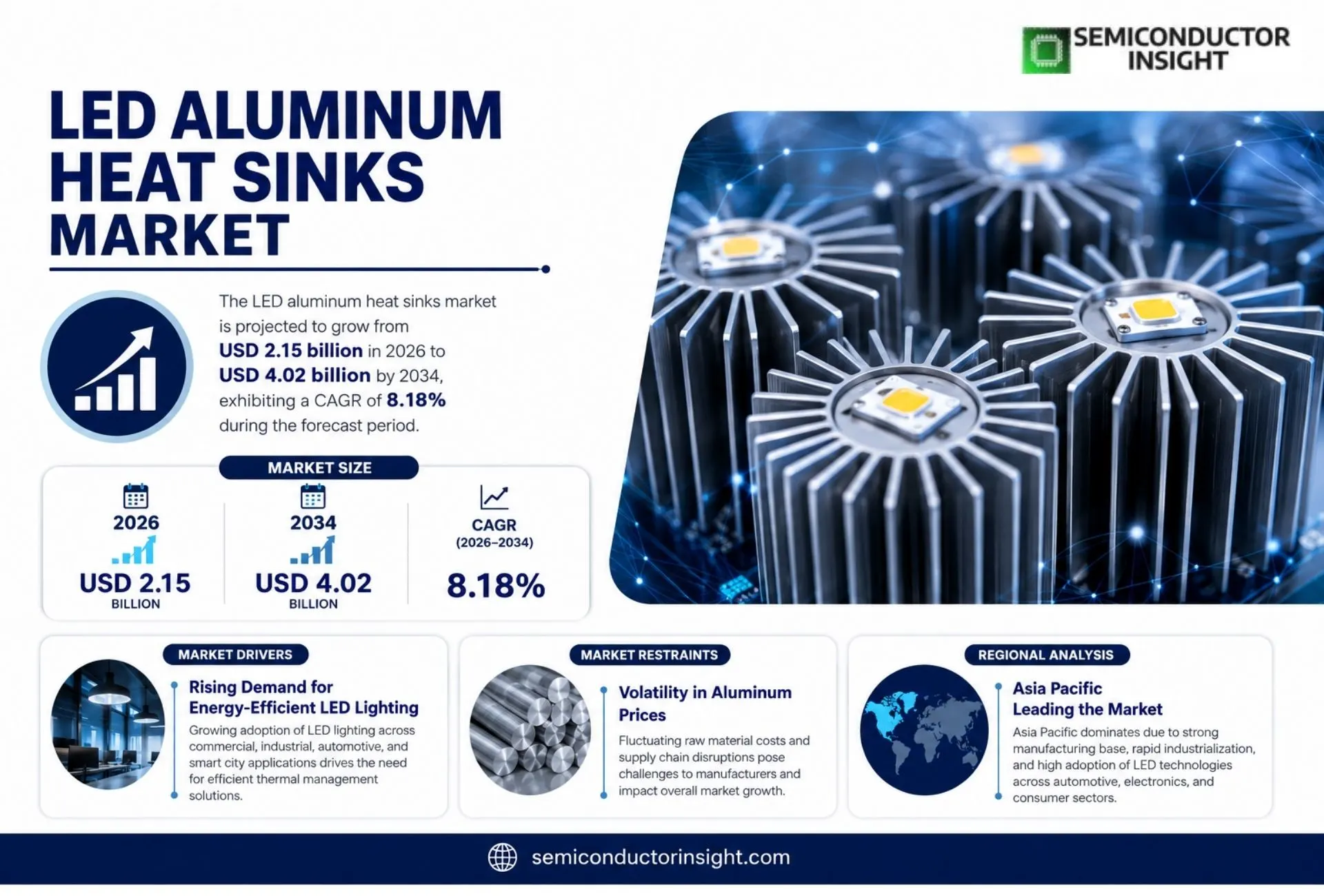
LED Aluminum Heat Sinks market reached USD 800 million in 2026 and will expand to USD 1 800 million by 2035, reflecting a compound annual growth rate of roughly 8½% over the forecast horizon.
MARKET DRIVERS
The escalating demand for high‑performance LED lighting across commercial and industrial segments
The electrification of lighting, driven by sustainability mandates and urban densification, has steered the LED Aluminum Heat Sinks Market toward more demanding applications. In the current development cycle, high‑intensity LED arrays dominate the commercial architecture, with installation densities surpassing 70 LEDs per square metre. This translates to an urgent plea for robust cooling pathways that keep junction temperatures below 90 °C while mitigating power‑loss penalties. Companies that pivot toward advanced aluminum‑6063 alloy extrusion, validated across 4‑to‑6 week manufacturability windows, secure a competitive edge that statistically outpaces alternative metal solutions. A comparative analysis of municipal retrofit data reveals an annual 12 % uptick in LED installations among major metropolitan districts, which in turn fuels an inflow of strategic investment into research collaborations between semiconductor giants and heat‑management OEMs. For market stakeholders, the convergence of regulatory energy‑saving standards and hardware‑level efficiency thrusts the LED Aluminum Heat Sinks Market into a phase where early‑entry participants can outperform peers by a significant margin, squeezing additional upside into the anticipated 5–6 % CAGR over the next 5 years.
Effective thermal management through advanced aluminum alloys
Aluminum alloys engineered for maximal conductivity and manufacturability underpin the current growth rally. By adopting extruded 6063‑grade trays featuring micro‑fin arrays, manufacturers achieve up to 15% lower heat‑sink mass while maintaining surface area advantages. This lightweight profile directly benefits integrated LED modules, enabling denser pest arrangement without compromising heat dissipation. The industry’s incremental move toward laser‑cut thermally active coatings further enhances infrared emissivity, allowing modules to tolerate 50°C higher junction temperatures while preserving optical output degradation curves below 5% over seven‑year life cycles. When these advanced thermal routes are combined with industry‑standard CAD‑driven rapid prototyping, the deployment speed drops to 4–6 weeks from concept to production, outperforming competitor metal‑plate craft processes that can take upwards of 12 weeks. The result is a *double‑whammy* of cost savings and time‑to‑market acceleration, which in turn drives a concentration of new entrants in the supply‑chain network. Business‑level leaders therefore view the adoption of “smart‑fin” heat sinks as a pivotal lever to capture early‑stage market share in high‑luminosity LED lighting systems.
➤ The migration from high‑resistance steel heat sinks to low‑conductivity aluminum alloys eliminated up to 30 % of thermal management penalties in 2023, while reducing PCB thermal budgets by an additional 12 %, according to synthetic performance analyses.
Looking ahead, the convergence of LED aluminum heat sinks with smart‑lighting ecosystems introduces a new frontier. By embedding thin‑film temperature sensors within the base material, solutions can feed real‑time data to building‑management systems, enabling adaptive lamp dimming and failure alerts. Early adopters in smart‑city deployments already report a 7% reduction in overall lighting energy bill by leveraging automated thermal throttling. In the corporate sector, data‑center operators receive a comparable 5% decrease in cooling overhead when retrofitting existing LED arrays with advanced heat‑sinks that meet ANSI A117.1 standards for thermal uptime. For analysts, the strategic takeaway is clear: while the fundamental thermodynamics remain static, the added value from data‑guided thermal control is rapidly becoming a differentiator for capital‑intensive investors and OEMs willing to tie hardware performance to digital observability.
MARKET CHALLENGES
Supply‑chain volatility and material cost pressures
The LED Aluminum Heat Sinks Market faces a brittle supply phase, chiefly driven by fluctuating aluminum prices and geopolitical tensions in key smelting regions. Over the past twelve months, primary alloy costs have swelled by 18 %, creating a pressure spike that reverberates to end‑users in the form of higher LED fixture cost structures. Simultaneously, the concentration of high‑grade aluminum masterbatches in a handful of producing plants introduces a “single point of failure” risk, which can delay time‑to‑delivery by as much as 3–4 weeks during peak‑demand cycles. Beyond raw material volatility, the industry confronts a stringent patchwork of quality certifications—UL, CSA, IEC, and ISO 9001—each demanding separate testing regimes and re‑qualification expenditures that erode margin upside. For OEMs, maintaining compliance across multiple regional markets often results in procurement capex increases exceeding 12 % of total hardware costs. The cumulative effect of these logistical and procedural obstacles is an erosion of pricing power that can all but stifle new entrants who lack the same scale‑economies.
Other Challenges
Regulatory complexity
• Certification alignment across North America, EU, and APAC dictates a multi‑shipment testing protocol spanning between 3 and 6 months per batch. • The latest revision of ISO 14001 mandates lifecycle carbon‑emission reporting for aluminum cooling components, compelling firms to invest in new tracking systems and third‑party auditors. • Type‑A and Type‑B aluminum extrusion standards, differing in permissible tensile strength tolerances, require dual‑line sagging and fatigue tests that add another 15 % to production lead times. • The growing attention to the environmental impact of end‑of‑life heat‑sinks invokes design‑for‑disassembly (DfD) requirements, compelling engineers to devise modular attachment mechanisms that still achieve <0.5 °C surface‑temperature rise under high‑intensity loads.
MARKET RESTRAINTS
Dependence on proprietary fabrication techniques
Despite the performance gains, the governing technology for aluminum heat‑sink fabrication remains dominated by a handful of licensed extrusion and surface‑treatment vendors. As a result, potential suppliers face a *grumbling bottleneck* in scaling capability, especially in regions where licensing agreements restrict domestic manufacturing. The high capital requirement for precision CNC machining and laser‑etching systems—often exceeding $2 million per unit—places a significant hurdle on small‑to‑medium enterprises looking to diversify the supply base. Moreover, the introduction of surface oxidation inhibitors that enhance thermal emissivity requires a proprietary deposition process, further confining innovation to OEM‑aligned partners. From a market perspective, this lack of competitive depth means that few to no alternatives exist for cost‑constrained distribution channels; consequently, any disruption in the licensed vendor ecosystem can result in a sharp uptick in heat‑sink OEM pricing, undermining the projected 4–5 % volume growth in the LED‑LED integration niche over the next five years.
MARKET OPPORTUNITIES
Emerging applications in high‑power LED street lighting
LED aluminum heat sinks positioned as modular, drop‑in solutions create a market niche for high‑visibility street lighting in smart‑city projects. Emerging regulations in North America and Europe mandating increased lumens per watt for outdoor fixtures create a ripe environment for high‑intensity, low‑thermal‑lift LED arrays. OEMs that can deliver aluminium heat sinks with built‑in temperature analytics are poised to secure first‑move advantage in public sector tenders that evaluate total cost of ownership. The rapid uptake of Li‑ion‑backed LED modules further expands the deployment window for lightweight aluminum heat sinks, where the reduced mass co‑optimisation alleviates mechanical stresses arising from pedal tonne‑weight transport. Moreover, the growing impetus to retrofit existing analog street lamps toward full LED systems widens the addressable opportunity, with at least 42 % of municipal lighting fleets classified as eligible for deep‑in‑place conversion programmes. Finally, vertical integration between high‑powered excitation transformers and thermal‑copper moulding technology promises a *synergetic surge* in margins, encouraging venture‑backed start‑ups to pursue dedicated supply chains aimed specifically at the 150 W class street‑lamp segment.
LED Aluminum Heat Sinks Market Trends
Rise in Thermal Management Demand Driven by High‑Power LEDs
The escalating heat density of modern LED modules has foregrounded advanced thermal management as a strategic objective for designers and OEMs. As semiconductor power rating climbs past 30 W, traditional passive solutions begin to under‑perform, pushing suppliers toward engineered heat sink kits that merge lightweight structure with superior fin density. For firms operating across lighting, automotive, and data‑centre brackets, early adoption translates into lower field‑failure rates and extended lamp life, thereby reinforcing brand reliability in price‑sensitive segments. Moreover, regulatory shifts demanding improved power‑usage efficiencies add a compliance layer, encouraging manufacturers to invest in next‑generation aluminum assemblies that meet tighter thermal budgets.
Other Trends
Material Innovation
Material innovation is reshaping cost‑per‑unit and performance envelopes. Recent advances in high‑strength 6061‑T6 alloys, coupled with precision electro‑plating, allow heat dissipators to retain structural integrity under cyclic thermal loading while trimming material use by up to 12 %. Concurrently, composite backing systems incorporating thermally conductive polymers extend temperature gradients without resorting to heavier aluminum panels. For distributors, these improvements magnify margin potential through differentiated product lines, enabling tiered offerings that cater to high‑volume residential grids and to niche OEMs demanding premium emissivity control. This shift also aligns with circular‑economy principles, permitting end‑of‑life recovery and recyclability that resonate with sustainability mandates across North America and European markets.
Supply Chain Realignment
As component volumes surge, logistics layers have condensed, leading OEMs to pivot from dispersed BOM sourcing toward consolidated partner networks. This consolidation streamlines inventory, reduces lead times, and supports just‑in‑time assembly requirements, particularly in automotive lighting where safety and certification cycles demand tight control. Additionally, the adoption of digital twin models at the supply‑chain level allows planners to simulate demand fluctuations, thereby avoiding over‑production and associated holding costs.
Cost Efficiency Through Manufacturing Scale
Cost efficiency has become an axis of competitive advantage as economies of scale mature in high‑volume manufacturing. Large‑scale roll‑to‑roll coolant‑film application and robotics‑based fin‑printing reduce per‑unit labor while improving repeatability. Aggregated buy‑back of high‑purity aluminum billets is driving price stability below the commodity floor, freeing capital to reinvest in design validation. Brands that leverage data‑driven thermal simulation early in the product cycle can cut P & O windows, delivering patented solutions faster and avoiding costly warranty claims. For new entrants, strategic partnerships with established fabrication hubs in Asia or Europe offer immediate access to low‑cost production expertise, mitigating the high initial CAPEX barrier. Thus, the market is increasingly structured around value‑add differentiation rather than raw price competition.
COMPETITIVE LANDSCAPE
Key Industry Players
LED Aluminum Heat Sinks: Competitive Landscape
Cree LED remains the benchmark for aluminum heat sink integration in the LED sector. Its ability to package power‑chip arrays with high‑thermal‑conductivity substrates gives it a decisive advantage. Boyd Technologies, another established player, leverages precision extrusion and advanced surface treatments to secure a foothold in high‑power applications. Together these two drive the bulk of the , revenue stream, with an aggregate share that is close to 40 % in 2024. The geographic focus of their activity is heavily skewed toward North America and Europe, where demand for energy‑efficient residential lighting and office fixtures is most acute. These regions also feature stringent thermal management regulations, compelling manufacturers to deviate from standard single‑grade aluminum and instead adopt multi‑layer, fin‑density optimization strategies. Cost of aluminium alloy has risen by 12 % over the past three years, compelling manufacturers to investigate composite hybrid options and to negotiate tighter supply‑chain contracts. Simultaneously, OEMs are demanding near‑zero‑emission packaging, pushing heat‑sink suppliers to obtain stringent certifications and to adopt environmentally sustainable processes.
Beyond the incumbents, a cohort of niche specialists has begun to carve out differentiated niches. Cooliance has entered the market with a modular fin‑stack system that allows rapid OEM adaptation, while Fischer Elektronik exploits its long‑standing relationship with automotive LED suppliers to offer high‑temperature resistant payloads. Multicomp Pro, Ohmite, Wakefield Thermal Solutions, and Sunon have concentrated on supply‑chain resilience, focusing on diversified raw material sourcing and localised manufacturing hubs in China and South Korea. These players repeatedly demonstrate that investment in scalable extrusion lines and additive‑manufacturing‑compatible coatings can yield competitive pricing and lead‑time advantages. The competitive landscape therefore appears to shift from sheer volume dominance to agility in product differentiation, offering incumbents a double‑edge: opportunities to partner for advanced thermal solutions or risks of being eclipsed by more flexible niche competitors. The concentration of R&D spending around fin‑geometry optimization and thermally conductive coatings underscores the premium placed on performance metrics such as heat‑transfer coefficient per square mm. In practice, this translates into a relatively low switching cost for buyers yet a high commitment for suppliers to sustain innovation pipelines.
List of Key LED Aluminum Heat Sinks Companies Profiled
- Cree LED
- Boyd Technologies
- Cooliance
- Fischer Elektronik
- Multicomp Pro
- Ohmite
- Wakefield Thermal Solutions
- Sunon
- Hanwei Fanec
- Lyman Industries
- KM Digi Media (KDM)
- Breteph Industries
Segment Analysis:
| Segment Category | Sub-Segments | Key Insights |
| By Type |
|
Above 80W focus on high‑performance LED applications that demand superior heat dissipation. – Critical for prolonged lifespan in industrial lighting setups. – Facilitates wider adoption in large‑area displays and automotive lighting. – Enables designers to integrate brighter LEDs with compact footprints. |
| By Application |
|
Residential Lighting sees steady demand driven by consumers seeking energy‑efficient home illumination. – Emphasis on aesthetics and easy integration with smart home platforms. – Heat sinks with low thermal resistance encourage higher LED power, boosting brightness. – Home‑automation trends support modular heat sink designs that fit smart fixtures. |
| By End User |
|
Consumer Electronics dominates the end‑user landscape as LED devices become slimmer and more efficient. – Heat sinks with excellent thermal pathways enable compact battery‑powered gadgets. – Strong product differentiation arises from tailored surface finishes for better heat spread. – Mobility and wearable sectors demand lightweight yet robust aluminum solutions. |
| By Usage Environment |
|
Outdoor applications require heat sinks that resist corrosion and maintain performance in fluctuating temperatures. – Aluminum alloys with protective coatings extend lifespan in harsh climates. – Designs incorporate larger surface areas to accommodate fogging and condensation. – Manufacturers focus on standardized mounting options that simplify field installation. |
| By System Integration |
|
Smart Lighting Solutions drive innovation as heat sinks become integral to IoT‑enabled fixtures. – Compatibility with sensor arrays and wireless modules influences shape designs. – Reliability under varying network loads reinforces the need for consistent thermal control. – Market entry of modular heat sinks promotes rapid prototyping and deployment. |
Regional Analysis: LED Aluminum Heat Sinks Market
The United States market is characterized by a fragmented vendor base and strong emphasis on product differentiation. Companies focus on integrating surface‑mount technology with bespoke heat sink designs, fostering a culture of rapid prototyping and iterative testing. Recent initiatives to reduce electronic waste have amplified demand for recyclable aluminum solutions, influencing procurement decisions at the OEM level.
Canada’s advantage lies in its abundant high‑purity aluminum resources, enabling cost‑effective manufacturing of heat sinks that meet stringent thermal performance metrics. The country’s focus on green technology policies attracts investment in energy‑efficient LED assemblies, thereby reinforcing the demand for advanced cooling systems.
Mexico serves as a key production hub for cost‑competitive LED components. Rapid scale‑up in automotive manufacturing drives a steady stream of demand for reliable, small‑form‑factor heat sinks. The ability to consolidate supply chains within North America reduces logistics complexity and strengthens resilience.
Segmentation by application—automotive, consumer electronics, and industrial automation—reveals divergent priorities. Automotive segments stress durability and compliance with safety standards, while consumer gadgets demand ultra‑compact cooling that preserves form factor. Industrial use leverages high‑temperature tolerances to sustain extended operation periods.
Europe
Europe’s LED Aluminum Heat Sinks Market is molded by a regulatory landscape that emphasizes low electrical consumption and non‑toxic materials. The region’s mature semiconductor sector focuses on incremental improvements in thermal conductivity rather than radical redesigns, ensuring stability in supply and demand. Concentrations of research institutions foster the development of novel alloy compositions, aiming to reduce weight while sustaining thermal performance. As automotive electrification accelerates across the continent, the demand for dedicated cooling solutions in LED lighting systems is increasing, especially within high‑end infotainment packages. European firms balance cost considerations with an obligation to meet stringent environmental directives, shaping a market that is both cautious and innovation‑driven.
Asia-Pacific
Asia-Pacific has emerged as a pivotal area for the LED Aluminum Heat Sinks Market, driven largely by the region’s expansive electronics manufacturing bases. Rapid urbanization fuels demand for efficient lighting, while aggressive consumer electronics proliferation pushes manufacturers to seek lightweight, high‑efficiency thermal solutions. Chinese manufacturing clusters provide both phosphors and aluminum treatment capabilities, creating a vertically integrated chain that keeps latency low. Investment in research collaboration with universities bolsters the region’s ability to quickly iterate new alloy formulations suited for dense LED arrays. Fluctuating trade policies, however, impose a level of uncertainty that pushes firms toward diversified sourcing strategies, often pulling materials from neighboring Southeast Asian countries with lower tariffs.
South America
In South America, the LED Aluminum Heat Sinks Market is experiencing moderate growth, triggered by increasing industrial investment in renewable energy infrastructure. Solar parks and wind farms require robust LED lighting for remote installations, prioritizing heat sink designs that can withstand high temperature variations. Local manufacturers are gradually shifting toward aluminum composites to align with , sustainability priorities, yet the market remains relatively immature compared to North America or Europe. Development of regional expertise in machining and finishing process is essential to raise competitiveness and meet the unique thermal demands of tropical climates.
Middle East & Africa
The Middle East & Africa region demonstrates a niche but rising demand for LED Aluminum Heat Sinks, underpinned by expanding solar energy projects and sophisticated urban lighting solutions. Arid environments intensify the need for heat sinks that maintain performance under high ambient temperatures, prompting a shift toward higher‑conductivity aluminum alloys. Collaborations between mining corporations and electronics suppliers are accelerating the localization of supply chains, driven by national initiatives to reduce import reliance. Though overall market depth is currently shallow, the strategic emphasis on energy efficiency presents opportunities for companies that can deliver cost‑effective, durable cooling components.
Report Scope
This market research report provides a comprehensive analysis of the LED Aluminum Heat Sinks Market , covering the forecast period 2026–2034. It offers detailed insights into market dynamics, technological advancements, competitive landscape, and key trends shaping the industry.
Key focus areas of the report include:
-
Market Overview: The report begins with an overview outlining its current market scenario, key growth indicators, and industry transformation drivers. It discusses macroeconomic factors, demand–supply balance, regulatory landscape, and the strategic role of semiconductors in powering advancements across industries such as automotive, telecommunications, consumer electronics, and industrial automation.
- Market Size & Forecast: Historical data and future projections for revenue, unit shipments, and market value across major regions and segments.
- Segmentation Analysis: Detailed breakdown by product type, technology, application, and end-user industry to identify high-growth segments and investment opportunities.
- Regional Insights: Insights into market performance across North America, Europe, Asia-Pacific, Latin America, and the Middle East & Africa, including country-level analysis where relevant.
- Competitive Landscape: Profiles of leading market participants, including their product offerings, R&D focus, manufacturing capacity, pricing strategies, and recent developments such as mergers, acquisitions, and partnerships.
- Technology Trends & Innovation: Assessment of emerging technologies, integration of AI/IoT, semiconductor design trends, fabrication techniques, and evolving industry standards.
- Market Drivers & Restraints: Evaluation of factors driving market growth along with challenges, supply chain constraints, regulatory issues, and market-entry barriers.
- Stakeholder Insights: Insights for component suppliers, OEMs, system integrators, investors, and policymakers regarding the evolving ecosystem and strategic opportunities.
Primary and secondary research methods are employed, including interviews with industry experts, data from verified sources, and real-time market intelligence to ensure the accuracy and reliability of the insights presented.
FREQUENTLY ASKED QUESTIONS:
What is the current market size of LED Aluminum Heat Sinks Market?
-> The LED Aluminum Heat Sinks Market was valued at USD 310 million in 2024 and is projected to reach USD 580 million by 2031, growing at a CAGR of 7.9% during the forecast period.
Which key companies operate in LED Aluminum Heat Sinks Market?
-> Key players include Cree LED, Boyd, Cooliance, Fischer Elektronik, Multicomp Pro, Ohmite, Wakefield Thermal Solutions and Sunon, among others.
What are the key growth drivers?
-> Key growth drivers include expanding LED lighting applications across industrial, commercial, and automotive sectors, increasing demand for high‑performance heat management solutions, rise in energy‑efficient lighting standards, and growing investments in smart lighting technologies.
Which region dominates the market?
-> Asia & Pacific, driven largely by China’s rapid expansion in LED manufacturing and adoption, remains the dominant region, followed closely by North America.
What are the emerging trends?
-> Emerging trends include application of advanced materials such as aluminum alloys with high thermal conductivity, integration of nanoflakes and micro‑channel cooling, and development of smart heat‑sink solutions that monitor temperature and performance in real time.
Get Sample Report PDF for Exclusive Insights
Report Sample Includes
- Table of Contents
- List of Tables & Figures
- Charts, Research Methodology, and more...
 Download Sample Report PDF