LCD TDDI Market Insights
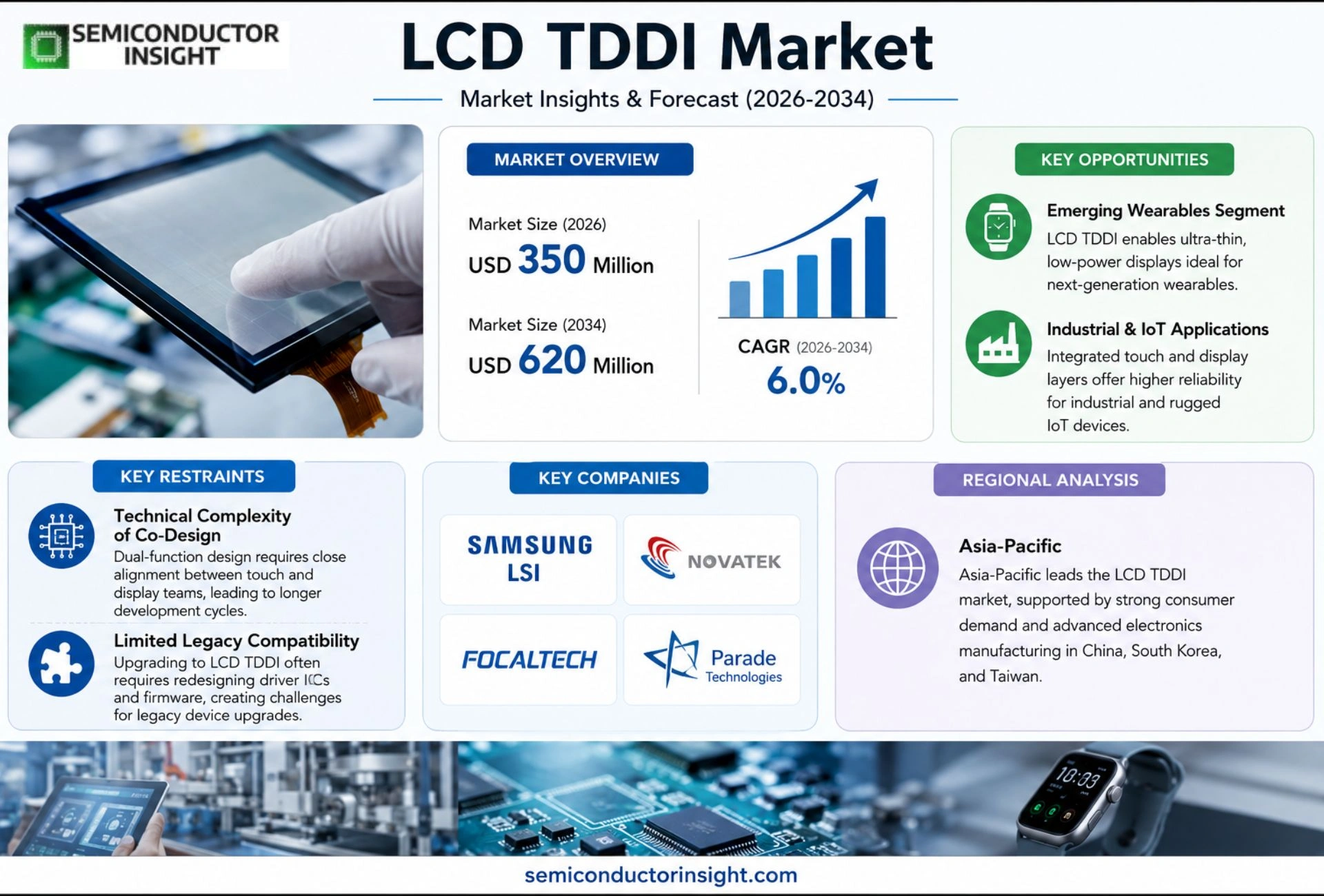
LCD TDDI market size is forecasted to grow from USD 350 million in 2026 to USD 620 million by 2034, exhibiting a CAGR of 6.0% during the forecast period.
LCD TDDI (Touch‑and‑Display‑Driver‑Integration) merges the touch sensor and display driver onto a single silicon die. This consolidation trims panel thickness, cuts power draw and streamlines assembly for smartphones, tablets, automotive infotainment screens and emerging foldable devices.
The expansion is a result of consumer appetite for slimmer high‑resolution panels, rising incorporation of responsive touch interfaces in advanced driver‑assistance systems, and manufacturers’ push toward cost‑efficient high‑volume production. Leading suppliers such as Samsung LSI, Novatek & FocalTech alongside Parade Technologies, LX Semicon, Will Semiconductor, Chipone & GalaxyCore continue investing in next‑generation process nodes and have outlined roadmap updates through 2023‑2025 targeting higher refresh rates and lower latency.
MARKET DRIVERS
Integration of Touch and Display Functions
The convergence of touch sensing and visual output into a single LCD TDDI panel reduces bill of materials and streamlines assembly lines. Manufacturers that adopt this integration can shrink device thickness by up to 30 %, a decisive advantage in premium smartphones and wearable gadgets.
Demand for Compact Smart Devices
Consumers increasingly favor slimmer, lighter devices that retain high‑resolution graphics. By eliminating a discrete touch layer, LCD TDDI technology meets this aesthetic pressure while preserving optical performance, thereby fueling wider adoption across mid‑range and flagship segments.
➤ Industry analysts note that the consolidation of touch‑display architectures shortens time‑to‑market, giving agile OEMs a clear competitive edge in fast‑moving categories.
Beyond consumer electronics, automotive infotainment systems are beginning to exploit LCD TDDI panels for their ruggedness and lower power draw, opening a secondary growth channel that complements traditional mobile applications.
MARKET CHALLENGES
Manufacturing Yield Constraints
Producing an LCD TDDI wafer demands precise alignment of both optical and capacitive layers. Even minor deviations can trigger defect rates that erode profitability, especially when factories transition from conventional LCD production.
Other Challenges
Supply Chain Volatility
The reliance on specialized photo‑mask sets and high‑purity indium‑tin‑oxide inks makes the supply chain susceptible to raw‑material shortages, which can delay new‑product introductions.
Cost pressures intensify as customers seek price parity with legacy LCD modules; thus, cost‑engineering initiatives must balance yield improvement with material substitution strategies.
MARKET RESTRAINTS
Technical Complexity of Co‑Design
The dual‑function nature of LCD TDDI panels requires close collaboration between touch‑sensor engineers and display designers. Misalignment in design specifications often leads to prolonged development cycles, discouraging smaller OEMs from committing resources.
Limited Legacy Compatibility
Existing device architectures built around separate touch and display stacks cannot be retrofitted easily. Upgrading to an LCD TDDI solution may necessitate a complete redesign of driver ICs and firmware, creating a barrier for legacy product refreshes.
MARKET OPPORTUNITIES
Emerging Wearables Segment
The wearables market, valued at roughly $45 billion, is experimenting with ultra‑thin displays that preserve battery life. LCD TDDI panels, with their lower power consumption compared to separate sensor assemblies, present a compelling value proposition for next‑generation smartwatches and health monitors.
Industrial and IoT Applications
Industrial touchscreens demand durability and resistance to harsh environments. By integrating touch and display layers, LCD TDDI modules offer fewer points of failure, positioning them as attractive components for factory‑floor equipment and rugged IoT gateways.
LCD TDDI Market Trend
Integration of Touch and Display Functions Accelerates OEM Adoption
Original equipment manufacturers are consolidating touch‑sensor and display‑panel production to achieve slimmer device profiles and lower bill‑of‑materials. By embedding the touch controller directly onto the LCD substrate, manufacturers eliminate a separate driver IC, reduce inter‑connect complexity, and shrink the overall stack height,attributes that are especially valuable in premium smartphones and emerging automotive infotainment screens. The cost advantage stems from a single‑supply chain, which translates into fewer SKUs for procurement and streamlined testing processes. Moreover, the combined architecture improves visual fidelity because the touch layer no longer interferes with the optical stack, delivering higher contrast and faster response times. These technical and financial incentives are reshaping design roadmaps across LCD TDDI Market, prompting many tier‑1 OEMs to mandate integrated solutions for next‑generation products.
Other Trends
Shift Toward Low‑Temperature Polycrystalline Silicon (LTPS) Panels
While amorphous‑silicon (A‑Si) continues to dominate entry‑level devices, LTPS is gaining traction among mid‑range and high‑end segments due to its superior electron mobility. The higher mobility enables finer pixel pitches and higher refresh rates without escalating power consumption, a combination that appeals to gaming‑focused smartphones and advanced driver‑assistance displays. Suppliers are investing in scaled‑up LTPS fabs to meet growing demand, and several Chinese manufacturers have announced capacity expansions that will increase overall supply elasticity. This trend is not merely technological; it reflects a strategic response to consumer expectations for smoother visual experiences and to automotive OEMs that require robust performance under varying temperature conditions. As LTPS adoption widens, the competitive balance within LCD TDDI Market is expected to tilt toward firms that can deliver both high yield and cost‑effective production.
Regional Competitive Landscape Tightens as Asian Suppliers Expand
The roster of leading players,Samsung LSI, Novatek, FocalTech, Parade Technologies, LX Semicon, Will Semiconductor, Chipone, GalaxyCore, Synaptics, and Solomon Systech,illustrates a geographically diverse supply base. Recent capacity announcements from South Korean and Taiwanese firms signal an intent to capture a larger share of the global demand, particularly in the United States and Europe where OEMs are seeking reliable partners with shorter lead times. This intensifying competition is prompting price adjustments and accelerating innovation cycles, as each vendor strives to differentiate through advanced driver algorithms, lower power consumption, and tighter integration with system‑on‑chip architectures. For downstream manufacturers, the evolving landscape demands vigilant vendor assessment and agile sourcing strategies to secure components that align with both cost targets and performance roadmaps. The cumulative effect is a more dynamic LCD TDDI Market where strategic partnerships and rapid technology adoption become decisive factors for sustained growth.
COMPETITIVE LANDSCAPE
Key Industry Players
LCD TDDI manufacturers – market share, strategic posture and innovation trends (2024‑2031)
LCD TDDI arena continues to be anchored by a handful of vertically integrated giants whose control over semiconductor fabrication and display integration yields decisive pricing power. Samsung LSI, leveraging its advanced 7‑nm process line, dominates high‑volume smartphone shipments and extracts premium margins by bundling driver ICs with proprietary touch algorithms. Novatek follows closely, translating its strong R&D pipeline in low‑temperature polysilicon (LTPS) back‑plane technology into a diversified portfolio that serves both mid‑range mobile devices and emerging automotive head‑up displays. The duopoly’s scale enables rapid iteration cycles, pressuring smaller outfits to specialize in niche form factors or to pursue strategic partnerships that grant access to fab capacity.
Beyond the two largest contenders, a cohort of specialized firms is carving out defensible segments. FocalTech and Parade Technologies have built reputations for ultra‑thin glass integration, attracting flagship tablet makers that value edge‑to‑edge touch sensitivity. LX Semicon and Will Semiconductor focus on cost‑effective A‑Si solutions for budget‑segment smartphones in emerging markets, where price elasticity outweighs performance differentials. Chipone, GalaxyCore and Synaptics differentiate through sensor‑fusion software stacks that enhance stylus latency for premium note‑taking devices. Solomon Systech, Himax and several regional players such as ROHM Semiconductor and TSMC‑sourced design houses add depth to the supply chain by offering custom ASICs tailored to automotive infotainment and wearable applications. Collectively, these firms sustain a competitive environment that forces the leaders to defend market share through incremental feature upgrades rather than outright price wars.
List of Key LCD TDDI Companies Profiled
- Samsung LSI
- Novatek
- FocalTech
- Parade Technologies
- LX Semicon
- Will Semiconductor
- Chipone
- GalaxyCore
- Synaptics
- Solomon Systech
- Himax
- ROHM Semiconductor
- TSMC‑Design House
- Viatech
- Shenzhen SunTech
Segment Analysis:
| Segment Category | Sub-Segments | Key Insights |
| By Type |
|
A‑Si continues to dominate LCD TDDI landscape because:
|
| By Application |
|
Smartphones remain the primary driver for LCD TDDI adoption, reflected by:
|
| By End User |
|
Consumer electronics drive market momentum through:
|
| By Integration Approach |
|
Monolithic integration is gaining traction because:
|
| By Functional Feature |
|
Advanced multi‑touch and gesture recognition is emerging as a differentiator because:
|
Regional Analysis: LCD TDDI Market
Asia‑Pacific
Concentrated fabs and touch‑sensor plants in the region provide a logistical advantage, enabling rapid prototyping and low‑volume pilot runs that are crucial for early‑stage LCD TDDI rollouts. This density curtails inventory holding costs and aligns supply closely with demand spikes.
Harmonized standards across key markets simplify certification pathways, allowing manufacturers to launch unified product families without extensive redesign, thereby preserving engineering resources for innovation.
Asian consumers prioritize sleek aesthetics and fluid touch interaction, pushing brands to embed LCD TDDI modules that deliver thinner profiles while maintaining high touch accuracy, reinforcing the technology’s perceived value.
Joint ventures between display manufacturers and semiconductor firms accelerate co‑development of driver ICs optimized for emerging resolution standards, fostering a pipeline of differentiated products.
North America
North America presents a mature market where LCD TDDI adoption is propelled by premium device manufacturers seeking differentiated user experiences. The region’s emphasis on high‑performance analytics drives demand for integrated driver solutions that can handle complex multitouch gestures without compromising power efficiency. While the overall volume lags behind Asia‑Pacific, the willingness to pay a premium for reliability and advanced features sustains a niche yet profitable segment. Collaboration between U.S. design houses and Asian fabrication partners underscores a cross‑border value chain that balances innovation with cost‑effective manufacturing.
Europe
European OEMs prioritize durability and strict compliance with environmental directives, influencing their selection of LCD TDDI components that meet stringent RoHS and REACH criteria. The market is characterized by a focus on automotive infotainment and high‑end consumer electronics, where integrated display‑touch modules simplify system architecture. Brands often leverage localized testing facilities to validate performance under diverse climatic conditions, ensuring the technology aligns with longevity expectations in both consumer and industrial applications.
South America
In South America, market growth is anchored by rising smartphone penetration and a burgeoning demand for cost‑effective tablets. LCD TDDI solutions appeal to manufacturers looking to consolidate bill‑of‑materials while delivering acceptable touch responsiveness for price‑sensitive segments. Distribution networks still face logistical hurdles, yet strategic partnerships with regional assemblers are mitigating lead‑time challenges, allowing firms to capture emerging demand without extensive capital outlay.
Middle East & Africa
The Middle East & Africa region experiences uneven adoption, with affluent Gulf markets embracing high‑end devices that leverage LCD TDDI for sleek design, while sub‑Saharan markets remain focused on durability and affordability. Infrastructure investment in smart city initiatives is creating niche opportunities for integrated display‑touch solutions in public information kiosks and transportation hubs, encouraging vendors to tailor offerings that balance sophistication with ruggedness.
Report Scope
This market research report provides a comprehensive analysis of the LCD TDDI Market , covering the forecast period 2026–2034. It offers detailed insights into market dynamics, technological advancements, competitive landscape, and key trends shaping the industry.
Key focus areas of the report include:
- Market Overview: The report begins with an overview outlining its current market scenario, key growth indicators, and industry transformation drivers. It discusses macroeconomic factors, demand–supply balance, regulatory landscape, and the strategic role of semiconductors in powering advancements across industries such as automotive, telecommunications, consumer electronics, and industrial automation.
- Market Size & Forecast: Historical data and future projections for revenue, unit shipments, and market value across major regions and segments.
- Segmentation Analysis: Detailed breakdown by product type, technology, application, and end-user industry to identify high-growth segments and investment opportunities.
- Regional Insights: Insights into market performance across North America, Europe, Asia-Pacific, Latin America, and the Middle East & Africa, including country-level analysis where relevant.
- Competitive Landscape: Profiles of leading market participants, including their product offerings, R&D focus, manufacturing capacity, pricing strategies, and recent developments such as mergers, acquisitions, and partnerships.
- Technology Trends & Innovation: Assessment of emerging technologies, integration of AI/IoT, semiconductor design trends, fabrication techniques, and evolving industry standards.
- Market Drivers & Restraints: Evaluation of factors driving market growth along with challenges, supply chain constraints, regulatory issues, and market-entry barriers.
- Stakeholder Insights: Insights for component suppliers, OEMs, system integrators, investors, and policymakers regarding the evolving ecosystem and strategic opportunities.
Primary and secondary research methods are employed, including interviews with industry experts, data from verified sources, and real-time market intelligence to ensure the accuracy and reliability of the insights presented.
FREQUENTLY ASKED QUESTIONS:
What is the current market size of LCD TDDI Market?
-> LCD TDDI market size is forecasted to grow from USD 350 million in 2026 to USD 620 million by 2034, exhibiting a CAGR of 6.0%
Which key companies operate in LCD TDDI Market?
-> Key players include Samsung LSI, Novatek, FocalTech, Parade Technologies, LX Semicon, Will Semiconductor, Chipone, GalaxyCore, Synaptics, Solomon Systech, Himax.
What is the projected CAGR for LCD TDDI market?
-> The market is expected to grow at a compound annual growth rate of % from 2024 to 2031.
Which region shows significant market size in 2025?
-> The United States is a major market, with an estimated size of USD million in 2025, while China is expected to reach USD million in the same year.
What are the forecasts for the A‑Si segment?
-> The A‑Si segment is projected to reach USD million by 2036, with a CAGR of % over the next ten years.

Get Sample Report PDF for Exclusive Insights
Report Sample Includes
- Table of Contents
- List of Tables & Figures
- Charts, Research Methodology, and more...
 Download Sample Report PDF