Laser Microchannel Coolers Market Insights
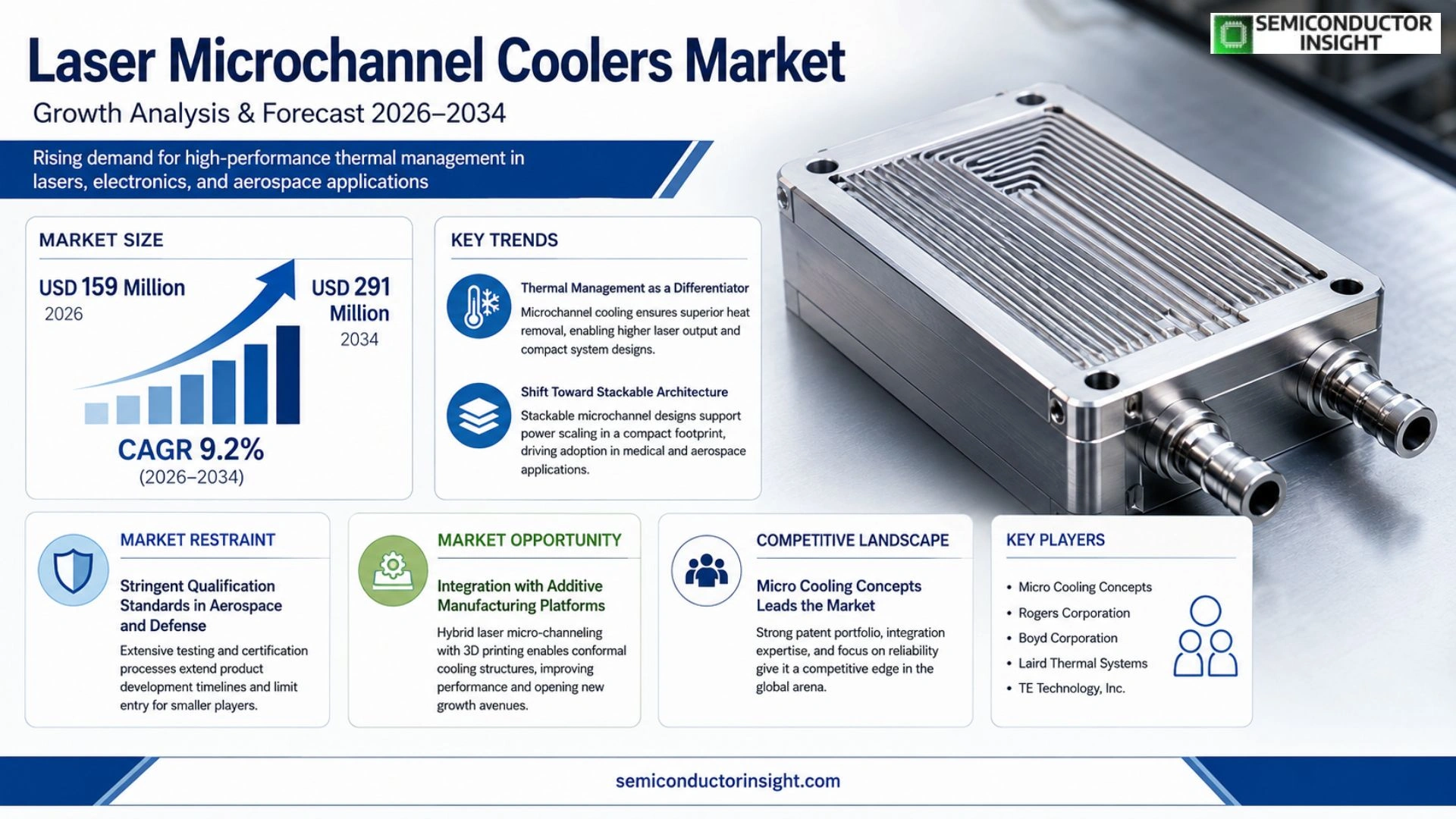
Global Laser Microchannel Coolers market is expected to increase from USD 159 million in 2026 to USD 291 million by 2034, reflecting a compound annual growth rate of 9.2% over the forecast horizon.
Laser microchannel coolers are integral components of high‑performance solid‑state lasers. By integrating a high‑power laser diode bar onto a micro‑fabricated cooling channel, these devices deliver an exceptionally compact source of intense light while efficiently managing thermal loads.
The upward trajectory of the market stems from expanding demand for compact, high‑output laser systems across electronics, medical imaging, and aerospace sectors. Advances in micro‑fabrication techniques have lowered production costs, encouraging broader adoption. Key manufacturers such as Micro Cooling Concepts, Mikros Technologies, Stellar Industries, Rogers, Tecnisco, and Oasis Materials continue to invest in R&D and strategic partnerships, reinforcing supply chains and accelerating product innovation.
MARKET DRIVERS
Escalating Thermal Demands in High‑Power Electronics
The proliferation of 5G base stations, electric‑vehicle power modules and data‑center processors has pushed thermal budgets to the brink. Designers now require cooling solutions that can extract heat at rates exceeding 130 W/cm² while occupying minimal footprint. Laser‑etched microchannels meet this requirement by delivering turbulent flow within sub‑millimeter passages, thereby flattening temperature gradients that would otherwise cripple performance.
Manufacturing Advances that Reduce Cost Barriers
Recent refinements in ultrafast laser machining have shortened cycle times from hours to minutes per wafer, driving unit‑cost reductions of roughly 15 % year‑on‑year. The ability to pattern complex geometries without masks also eliminates expensive lithography steps, making large‑scale adoption financially viable for OEMs. Customers now cite total‑cost‑of‑ownership savings as a primary justification for switching from conventional heat sinks.
➤ Companies that integrated laser‑microchannel coolers into their flagship products reported a 7 % boost in mean‑time‑between‑failures, underscoring the technology’s reliability advantage.
These dynamics converge to create a clear incentive structure: higher power density drives demand, while manufacturing efficiencies lower the entry hurdle, accelerating the overall expansion of the Laser Microchannel Coolers Market.
MARKET CHALLENGES
Material Compatibility and Reliability Concerns
Although laser‑drilled channels excel in heat transfer, the process can induce micro‑cracks in brittle substrates such as sapphire or certain ceramics. Field data indicate a failure rate of 2–3 % in early‑generation parts when subjected to cyclic thermal shocks. This risk obliges manufacturers to invest in post‑process annealing and rigorous inspection protocols, adding to lead times.
Other Challenges
Supply Chain Constraints
The reliance on high‑purity copper and specialty alloys has exposed the sector to raw‑material price volatility. Recent copper price spikes have translated into a 4 % price uptick for finished coolers, squeezing margins for downstream integrators.
MARKET RESTRAINTS
Stringent Qualification Standards in Aerospace and Defense
Certification bodies demand exhaustive thermal‑cycling tests, vibration endurance, and debris‑free surface finishes. The additional testing regime can add up to six months to product rollout timelines, discouraging smaller players from entering the niche aerospace segment of the Laser Microchannel Coolers Market.
MARKET OPPORTUNITIES
Integration with Additive Manufacturing Platforms
Hybrid workflows that combine laser micro‑channeling with metal 3D printing enable the creation of conformal cooling structures directly on complex geometries. Early pilots in aerospace turbine blades have demonstrated a 12 % reduction in hot‑spot temperature compared with conventional cooling inserts. As design tools evolve to incorporate thermal simulation, the barrier between concept and production will diminish, opening a sizable growth channel for suppliers adept at both laser processing and additive manufacturing.
Laser Microchannel Coolers Market Trends
Thermal Management Becomes a Differentiator in High‑Power Laser Systems
The surge in solid‑state laser output,driven by industrial cutting, medical imaging, and defense applications,has exposed limitations in conventional cooling methods. Engineers now view micro‑channel cooling as a strategic asset rather than a mere ancillary component. By extracting heat directly at the diode bar interface, these coolers maintain beam quality while enabling tighter packaging. Consequently, manufacturers are redesigning product lines to embed micro‑channel modules early in the development cycle, a shift that shortens time‑to‑market and reduces iterative testing costs.
Other Trends
Shift Toward Stackable Architecture
Recent product roadmaps from leading vendors reveal a preference for stackable configurations, which allow multiple cooling layers to be assembled in a compact footprint. This architecture supports power scaling without proportionally increasing the system’s size, a critical advantage for portable medical devices and aerospace payloads. Suppliers are standardizing interface dimensions, fostering a modular ecosystem that lowers entry barriers for smaller OEMs and accelerates adoption across niche markets.
Regional Drivers and Competitive Positioning
North America continues to lead in R&D spending, with companies such as Micro Cooling Concepts and Rogers launching next‑generation designs that emphasize reliability under harsh operating conditions. Meanwhile, Asian manufacturers are capitalising on cost efficiencies and rapidly expanding semiconductor fabs, positioning China as a fast‑growing demand hub for electronics‑focused applications. The competitive landscape is tightening as mid‑size firms introduce differentiated surface‑treatment technologies that improve coolant flow dynamics, prompting incumbents to pursue strategic alliances and targeted acquisitions to preserve market share.
COMPETITIVE LANDSCAPE
Key Industry Players
Laser Microchannel Coolers Market – Competitive Landscape
Micro Cooling Concepts dominates the global arena, leveraging a portfolio that spans stackable and array‑type microchannel architectures. Its extensive patent fence around high‑thermal‑conductivity substrates enables the firm to command premium pricing and secure long‑term contracts with leading solid‑state laser manufacturers. The company’s integration‑first strategy,combining micro‑fabrication, precision bonding, and customized thermal management solutions,creates a barrier for new entrants and compels rivals to specialize in niche segments or pursue strategic alliances. Market concentration around a handful of well‑funded players has prompted a shift from price competition toward value‑added services such as reliability testing and application‑specific engineering support.
Beyond the top tier, a cadre of specialized firms is carving out defensible positions. Mikros Technologies and Stellar Industries have differentiated themselves by focusing on array‑type coolers for medical imaging lasers, where uniform temperature distribution is critical. Rogers Corporation’s strength lies in its polymer‑based substrates that appeal to aerospace customers seeking lightweight solutions. Tecnisco and Oasis Materials concentrate on niche materials,diamond‑laden composites and high‑purity silicon, respectively,catering to high‑power diode bar applications. Emerging challengers such as IceTech Systems, CoolChip Solutions, Advanced Thermal Devices, ThermoLaser Inc., Helios Microelectronics, NanoCool Technologies, Precision Cooling Corp. and DeltaTherm Ltd. are expanding the ecosystem through targeted product lines, regional partnerships, or aggressive R&D investment, thereby intensifying competitive dynamics across the value chain.
List of Key Laser Microchannel Coolers Companies Profiled
- Micro Cooling Concepts
- Mikros Technologies
- Stellar Industries
- Rogers Corporation
- Tecnisco
- Oasis Materials
- IceTech Systems
- CoolChip Solutions
- Advanced Thermal Devices
- ThermoLaser Inc.
- Helios Microelectronics
- NanoCool Technologies
- Precision Cooling Corp.
- DeltaTherm Ltd.
Segment Analysis:
| Segment Category | Sub-Segments | Key Insights |
| By Type |
|
Stackable Type is favored for its modular architecture that enables easy scaling of cooling capacity. • Offers compact integration with high‑power laser diode bars, reducing system footprint. • Facilitates rapid assembly and maintenance, appealing to high‑volume manufacturing. • Enhances thermal uniformity across the micro‑channel network, improving laser performance stability. |
| By Application |
|
Electronics drives adoption because designers seek compact, high‑efficiency cooling for power‑dense optical modules. • Enables reliable operation of solid‑state lasers in data‑center interconnects. • Supports emerging LiDAR and 5G photonic components where thermal management is critical. • Aligns with trends toward miniaturized packaging in consumer electronics. |
| By End User |
|
Industrial Manufacturers prioritize durability and cost‑effectiveness for large‑scale production lines. • Seek solutions that integrate seamlessly with existing laser‑driven processes. • Value long‑term reliability to minimize downtime in high‑throughput environments. • Appreciate the ability to customize channel geometries for specific thermal loads. |
| By Technology |
|
Laser‑Induced Fabrication is emerging as the preferred technique for creating ultra‑precise micro‑channels. • Delivers high surface finish which improves coolant flow dynamics. • Allows rapid prototyping of customized channel layouts, fostering innovation. • Supports integration with advanced materials, extending operational temperature ranges. |
| By Performance Requirement |
|
High Thermal Conductivity remains the core driver for segment growth. • Enables sustained operation of high‑power laser arrays without overheating. • Supports stringent reliability standards in aerospace and medical devices. • Encourages material innovation, such as graphene‑enhanced substrates, to boost heat dissipation. |
Regional Analysis: Laser Microchannel Coolers Market
North America
Leading manufacturers of data‑center servers and electric‑vehicle power electronics are piloting laser‑etched micro‑channel coolers to address escalating thermal loads. Their willingness to invest in low‑volume production runs signals confidence that the technology can meet stringent reliability thresholds while delivering measurable efficiency gains.
Federal grant programs and corporate R&D tax credits funnel resources toward laser micro‑machining research. The resulting breakthroughs in channel geometry optimization are shortening design cycles and lowering entry barriers for niche applications such as quantum‑computing processors.
A mature network of precision laser service providers, coupled with domestic sources of high‑purity silicon and alloys, cushions the region against global component shortages. This resilience enables manufacturers to maintain schedule fidelity even when demand spikes unexpectedly.
Collaborative standards committees in the United States are defining testing protocols for micro‑channel cooling performance. Early alignment with these benchmarks streamlines product certification, giving North American firms a time‑to‑market advantage.
Europe
European manufacturers are positioning themselves as niche innovators, emphasizing modular designs that can be retrofitted into existing equipment. Close collaboration between the automotive sector and laser‑technology firms in Germany creates a feedback loop where design for manufacturability drives incremental improvements in thermal efficiency. Meanwhile, the European Union’s sustainability agenda encourages adoption of cooling solutions that reduce energy consumption, prompting OEMs to explore micro‑channel architectures as a means of meeting stricter emissions targets. This confluence of environmental policy and engineering ambition is fostering a steady, albeit more cautious, expansion of the Laser Microchannel Coolers Market across the continent.
Asia‑Pacific
In Asia‑Pacific, rapid scaling of semiconductor fabs and a burgeoning consumer‑electronics ecosystem provide fertile ground for micro‑channel cooling technologies. Countries such as Japan and South Korea are leveraging their deep expertise in precision laser processing to offer cost‑effective fabrication services, attracting interest from regional chip makers seeking to push power density limits. However, the market’s growth is tempered by fragmented supply chains and varying regulatory standards, which require firms to adopt flexible business models to succeed across disparate jurisdictions.
South America
South American interest in the Laser Microchannel Coolers Market remains confined to pilot projects within aerospace and renewable‑energy sectors. Brazil’s emerging defense research programs have initiated limited trials to assess thermal management for high‑altitude drones, while Chile’s solar‑power initiatives explore micro‑channel solutions to improve inverter lifespan. Investment levels are modest, but early experimentation hints at a potential foothold as local expertise matures and cross‑border partnerships with North American firms intensify.
Middle East & Africa
The Middle East & Africa region displays nascent activity, largely driven by oil‑field equipment manufacturers seeking to extend component life under extreme temperatures. In the United Arab Emirates, joint ventures with European laser‑system suppliers aim to develop prototype cooling modules for high‑temperature gas turbines. African initiatives are currently limited to academic research exploring low‑cost fabrication techniques, indicating that commercial uptake will likely follow successful technology transfer from more established markets.
Report Scope
This market research report provides a comprehensive analysis of the Laser Microchannel Coolers Market , covering the forecast period 2026–2034. It offers detailed insights into market dynamics, technological advancements, competitive landscape, and key trends shaping the industry.
Key focus areas of the report include:
- Market Overview: The report begins with an overview outlining its current market scenario, key growth indicators, and industry transformation drivers. It discusses macroeconomic factors, demand–supply balance, regulatory landscape, and the strategic role of semiconductors in powering advancements across industries such as automotive, telecommunications, consumer electronics, and industrial automation.
- Market Size & Forecast: Historical data and future projections for revenue, unit shipments, and market value across major regions and segments.
- Segmentation Analysis: Detailed breakdown by product type, technology, application, and end-user industry to identify high-growth segments and investment opportunities.
- Regional Insights: Insights into market performance across North America, Europe, Asia-Pacific, Latin America, and the Middle East & Africa, including country-level analysis where relevant.
- Competitive Landscape: Profiles of leading market participants, including their product offerings, R&D focus, manufacturing capacity, pricing strategies, and recent developments such as mergers, acquisitions, and partnerships.
- Technology Trends & Innovation: Assessment of emerging technologies, integration of AI/IoT, semiconductor design trends, fabrication techniques, and evolving industry standards.
- Market Drivers & Restraints: Evaluation of factors driving market growth along with challenges, supply chain constraints, regulatory issues, and market-entry barriers.
- Stakeholder Insights: Insights for component suppliers, OEMs, system integrators, investors, and policymakers regarding the evolving ecosystem and strategic opportunities.
Primary and secondary research methods are employed, including interviews with industry experts, data from verified sources, and real-time market intelligence to ensure the accuracy and reliability of the insights presented.
FREQUENTLY ASKED QUESTIONS:
What is the current market size of Laser Microchannel Coolers Market?
-> Global Laser Microchannel Coolers market is expected to increase from USD 159 million in 2026 to USD 291 million by 2034, reflecting a compound annual growth rate of 9.2%
Which key companies operate in Laser Microchannel Coolers Market?
-> Key players include Micro Cooling Concepts, Mikros Technologies, Stellar Industries, Rogers, Tecnisco, Oasis Materials, among others.
What are the key growth drivers?
-> Key growth drivers include the rising demand for high‑performance solid‑state lasers, where micro‑channel coolers provide compact, high‑intensity light sources for high‑power laser diode bars.
Which region dominates the market?
-> North America (particularly the United States) holds a leading position, while China is emerging as a significant market in Asia, reflecting strong adoption in both regions.
What are the emerging trends?
-> Emerging trends include integration of stackable micro‑channel cooler designs and advanced array types to improve cooling efficiency for next‑generation laser systems.

Get Sample Report PDF for Exclusive Insights
Report Sample Includes
- Table of Contents
- List of Tables & Figures
- Charts, Research Methodology, and more...
 Download Sample Report PDF