Laser Beam Collimation Market Insights
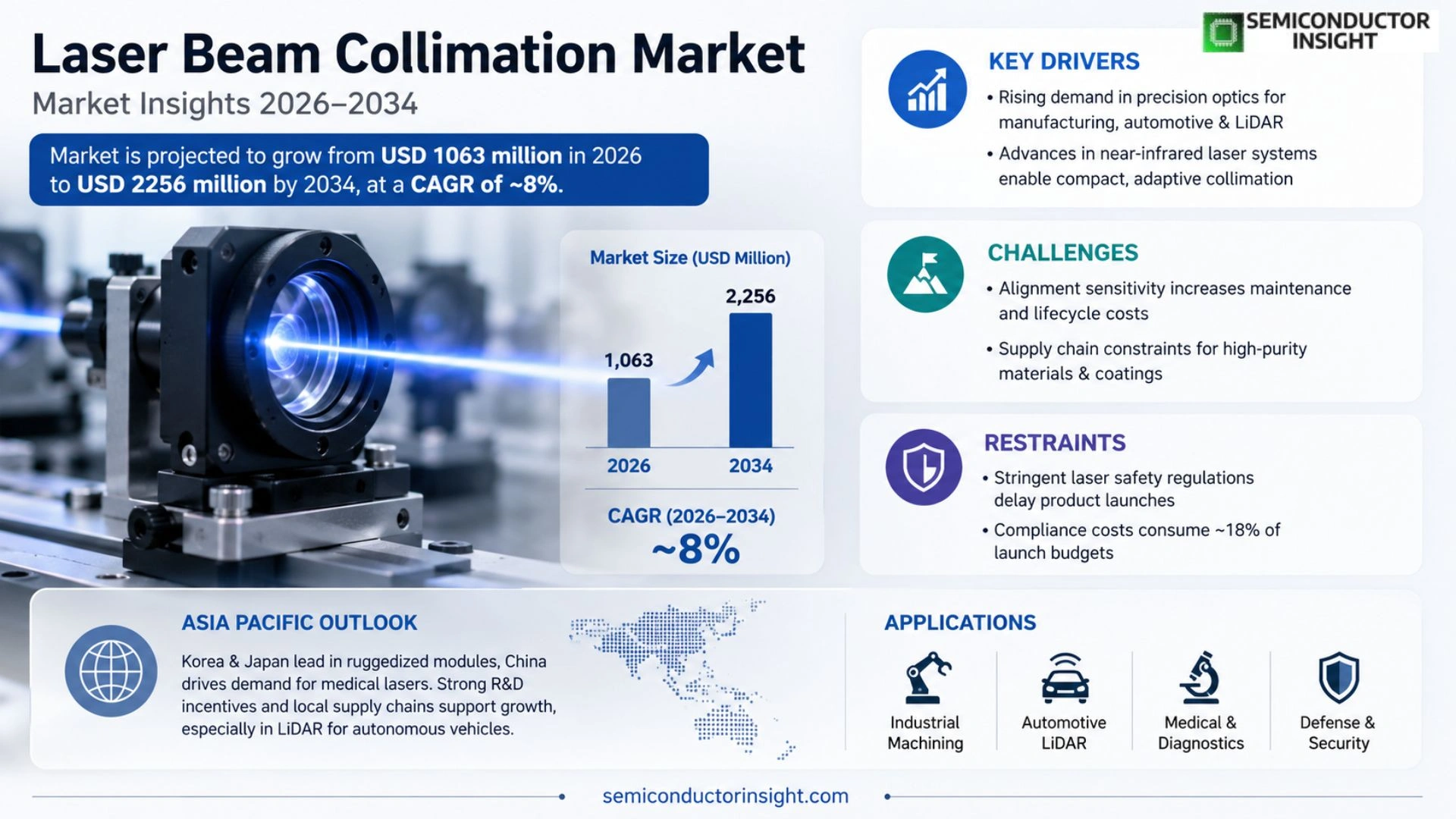
Laser Beam Collimation market is projected to grow from USD 1063 million in 2026 to USD 2256 million by 2034, exhibiting a CAGR of approximately 8% during the forecast period.
A collimator is an optical instrument designed to reduce the divergence of a light beam, thereby producing a narrow, parallel beam suitable for precision measurements and imaging applications such as optical testing, nuclear instrumentation and X‑ray systems.
The sector’s trajectory reflects sustained investment in high‑precision optics, expanding demand across semiconductor manufacturing and medical diagnostics, and ongoing advances in laser source stability,all factors that elevate performance expectations while tightening margins for suppliers.
MARKET DRIVERS
Emerging Demand in Precision Optics
Demand for high‑precision components in the manufacturing and automotive sectors has lifted the need for reliable beam collimation. As gear‑shifting systems and sensor suites evolve, processors require tighter angular tolerance, pushing buyers toward advanced collimation solutions that deliver sub‑microradian alignment.
Technological Advances in Near‑Infrared Laser Systems
Recent breakthroughs in near‑infrared laser diodes have delivered higher output while maintaining narrow linewidths. Coupled with adaptive optics, this allows manufacturers to replace bulkier, analog collimators with compact, electronically tunable units that reduce overall system mass and cost.
➤ This confluence of material science and electronics is redefining the viability of laser collimation across a spectrum of applications, according to market analysts.
Capital investment in research and development continues to rise, and venture capital targeting laser‑related R&D is climbing 12 % annually, reinforcing the adoption curve across diagnostics, industrial machining, and defense systems.
MARKET CHALLENGES
Alignment Sensitivity and Packaging Cost
Achieving optimal beam divergence requires meticulous alignment that is often fragile. Even minor mechanical perturbations can degrade performance, increasing maintenance schedules and overall life‑cycle costs for high‑dependability systems.
Other Challenges
Supply Chain Constraints
Key materials such as ultra‑pure silica and specialized coatings face long lead times, and geopolitical shifts are suddenly tightening access to certain high‑purity component suppliers, forcing companies to rethink logistic strategies.
MARKET RESTRAINTS
Regulatory Compliance and Safety Standards
Strict laser safety regulations, especially in medical and industrial settings, impose stringent certification protocols that delay product roll‑outs. Compliance spending is allocating 18 % of a typical launch budget for devices entering regulated markets, acting as a throttle for rapid expansion.
MARKET OPPORTUNITIES
Adoption Across Emerging Markets
Rapid industrialization in Southeast Asia and expanding research clusters in Eastern Europe present fertile ground for deploying advanced beam collimation, especially in semiconductor fabs and automotive AI sensors. Local procurement policies reward domestic suppliers, encouraging collaborative partnerships that reduce costs while ensuring compliance with regional safety standards.
Laser Beam Collimation Market Trends
Precision Demands Elevate Collimator Adoption
The push for ever tighter beam tolerances is reshaping the landscape of optical testing and laser-based inspection. Engineers now routinely couple collimators with high‑resolution spectrometers to reduce divergence to sub‑millimeter levels, a requirement that has become standard in semiconductor metrology and advanced photonic device fabrication. As a result, suppliers are accelerating development of ultra‑compact, high‑NA reflective and refractive collimators that can be integrated directly onto photonic chips. This evolution is not limited to purely optical laboratories; precision thrust is also being demanded in nuclear safeguards and radiographic imaging, where accurate beam profiles are critical for material characterization and safety compliance.
Other Trends
Diversification Across End‑Use Sectors
Collimators are no longer confined to niche laboratory environments. The automotive sector is leveraging laser beam collimation for lidar systems, while aerospace firms are integrating them into adaptive optics to counteract atmospheric turbulence. In consumer electronics, the rise of augmented reality headsets drives demand for compact, low‑power collimators capable of maintaining beam coherence across variable distances. Industrial automation and smart factories also adopt collimators for in‑process imaging and quality assurance, benefitting from the scalability of modular collimation units that can be configured to different wavelengths.
Supply Chain Adaptation Drives Resilience
Component manufacturers, particularly in the Asia‑Pacific, are diversifying supplier networks to mitigate risks associated with raw‑material shortages and geopolitical constraints. This strategy extends to the adoption of additive‑manufacturing techniques for collimator housings, reducing lead times and allowing rapid prototype iterations. Moreover, the trend toward standardization of optical interfaces,especially in the context of 5G infrastructure and data‑center illumination,has lowered integration barriers for new entrants and encouraged collaborative development platforms.
The convergence of precision optics, digital integration, and supply‑chain agility positions Laser Beam Collimation Market to capture new value streams in a rapidly evolving technology portfolio. Firms that invest in research driven by application‑specific beam control and that structure resilient supply chains will best leverage emerging opportunities while mitigating exposure to component volatility. Such strategic alignment will determine leadership positions in each expanding sector, from defense to consumer electronics, over the next decade.
COMPETITIVE LANDSCAPE
Key Industry Players
Laser Beam Collimation Market
Laser Beam Collimation sector is dominated by a small group of players whose product portfolios span a range of specialty optical systems. Thorlabs, with its extensive catalog of precision collimators and accessories, drives the market through a combination of aggressive R&D investment and a strong global distribution network. The concentration is such that the top five firms collectively capture roughly 55 % of worldwide revenue, underscoring the premium nature of the commodity and the technical expertise required to differentiate within it.
Beyond the incumbents lie niche operators that punctuate the competitive map. Companies such as Plansee, Holmarc Opto‑Mechatronics, and Chrosziel GmbH focus on high‑end, custom solutions for defense, aerospace, and particle‑physics laboratories, while Avantes BV and Light Path Technologies address the rapidly expanding spectroscopy and metrology segments. These players leverage cross‑industry partnerships and proprietary fabrication techniques to secure long‑term contracts, effectively counterbalancing the scale advantage of the market leaders.
List of Key Laser Beam Collimation Companies Profiled
- Thorlabs
- Thorlabs
- Optics Technology
- Optics Technology
- Trioptics
- Trioptics
- Holmarc Opto‑Mechatronics
- Holmarc Opto‑Mechatronics
- Light Path Technologies
- Plansee
- Nuclear Fields
- AMS Technologies
- Chrosziel GmbH
- HAAG‑STREIT GROUP
- INGENERIC GmbH
- Avantes BV
- Auer Lighting GmbH
Segment Analysis:
| Segment Category | Sub-Segments | Key Insights |
| By Type |
|
Reflective Collimators
Refractive Collimators
|
| By Application |
|
Optical Fibers
Laser Diodes
Integrated Optics
Others
|
| By End User |
|
Industrial Controls
Scientific Research
Medical Imaging
Military Sensors
|
| By Industry Sector |
|
Automotive
Aerospace
Energy & Power
Telecommunications
|
| By Technology Focus |
|
Adaptive Optics
MEMS‑Based Collimators
High‑Power Collimators
|
Regional Analysis: Laser Beam Collimation Market
Within North America, an increasing shift toward adaptive optics and integrated photonic chips is redefining beam attitude precision. Engineers now embed miniature collimation modules directly into system assemblies, shortening cable lengths and reducing electromagnetic interference. This trend aligns with the broader move toward miniaturization, enabling larger sensor deployments without compromising optical quality.
Venture activity in the region focuses on automated alignment platforms that reduce manual servicing downtime. Start‑ups harness AI algorithms to predict collimation drift over long‑term missions, attracting large strategic partners from the defense sector.
Medical imaging and defense research sectors are the standout drivers. In radiation therapy, finely collimated laser beams enable precise dose delivery, boosting patient outcomes. In the sector, precision alignment is central to guided‑missile systems, ensuring accuracy over intercontinental ranges.
Regional OEMs such as Thorlabs, Edmund Optics, and Signify compete closely, yet differentiation emerges through integration of digital correction algorithms and multi‑wavelength compatibility. Market share pivots as emerging suppliers introduce low‑cost, high‑performance collimators tailored for industrial automation.
Europe
Laser Beam Collimation Market in Europe upholds a mature mesh, driven largely by industrial automation and high‑end scientific instrumentation. Precision manufacturing hubs in Germany, France, and the UK supply bespoke collimator assemblies that meet stringent safety and quality standards. The region’s regulatory rigor forces manufacturers to adhere to IEC and ISO norms, driving continuous improvement. Collaborations between academia and industry spur early‑stage prototyping, and the proximity of optical component suppliers lowers lead times. However, geopolitical uncertainties and varying export controls have introduced some supply chain volatility, prompting local firms to diversify sourcing chains. Nevertheless, European players sustain healthy growth through targeted investments in fibre‑optic collimation and adaptive optics for stability‑critical applications such as autonomous vehicle sensors and space‑borne imaging systems. Experts track Laser Beam Collimation Market trend as it shapes future precision manufacturing strategies.
Asia‑Pacific
Laser Beam Collimation Market in Asia‑Pacific emerges as the fastest expanding segment, marked by a surge of laser system deployments in electronics manufacturing, semiconductor packaging, and emerging 5G infrastructure. Korean and Japanese OEMs lead in ruggedized collimation modules designed for operational extremes, while Chinese firms capitalize on steep domestic demand for medical laser devices. Government incentives support R&D, especially in autonomous vehicle technology, where beam alignment is crucial for LiDAR safety. The region also benefits from a robust domestic supplier base, reducing trans‑pacific shipping constraints. Nonetheless, the market grapples with regional intellectual‑property concerns and varying certification requirements. Despite these hurdles, collaborative R&D centers have secured progressive breakthroughs, positioning Asia‑Pacific as a winning future hub. Laser Beam Collimation Market benefits from supportive policy frameworks that accelerate adoption.
South America
Laser Beam Collimation Market in South America remains modest yet steady, underpinned by growing investments in industrial automation and renewable energy sector upgrades. Chile’s astronomical observatories and Brazil’s petrochemical plants rely on sophisticated laser collimation to enhance measurement accuracy and process control. Partnerships between local distributors and multinational vendors facilitate technology transfer, while localized compliance with national safety standards mitigates regulatory friction. The region’s limited domestic manufacturing capacity shifts focus toward assembly‑after‑import, encouraging cost‑effective solutions derived from global supply chains. Nevertheless, emerging market players are exploring low‑cost collimation kits for agricultural and environmental monitoring applications, hinting at niche opportunities.
Middle East & Africa
Laser Beam Collimation Market in the Middle East & Africa presents a fragmented yet growing need across defense, oil‑and‑gas, and emerging telecoms initiatives. The Gulf region benefits from substantial defense budgets, prompting procurement of high‑precision collimation systems that enhance strategic asset performance. Downstream, North African markets focus on educational institutes and research laboratories. Import reliance remains high, but local assembly contracts are increasing, driven by regional governments’ push for industrial autonomy. Volatility in oil prices and fluctuating LNG infrastructure development shape investment cycles. Irrespective of macro‑economic swings, the continuous improvement of optical measurement techniques in downstream industries signals steady base‑level demand. Laser Beam Collimation Market reflects strategic investment in optical defense capabilities.
Report Scope
This market research report provides a comprehensive analysis of the Laser Beam Collimation Market , covering the forecast period 2026–2034. It offers detailed insights into market dynamics, technological advancements, competitive landscape, and key trends shaping the industry.
Key focus areas of the report include:
- Market Overview: The report begins with an overview outlining its current market scenario, key growth indicators, and industry transformation drivers. It discusses macroeconomic factors, demand–supply balance, regulatory landscape, and the strategic role of semiconductors in powering advancements across industries such as automotive, telecommunications, consumer electronics, and industrial automation.
- Market Size & Forecast: Historical data and future projections for revenue, unit shipments, and market value across major regions and segments.
- Segmentation Analysis: Detailed breakdown by product type, technology, application, and end-user industry to identify high-growth segments and investment opportunities.
- Regional Insights: Insights into market performance across North America, Europe, Asia-Pacific, Latin America, and the Middle East & Africa, including country-level analysis where relevant.
- Competitive Landscape: Profiles of leading market participants, including their product offerings, R&D focus, manufacturing capacity, pricing strategies, and recent developments such as mergers, acquisitions, and partnerships.
- Technology Trends & Innovation: Assessment of emerging technologies, integration of AI/IoT, semiconductor design trends, fabrication techniques, and evolving industry standards.
- Market Drivers & Restraints: Evaluation of factors driving market growth along with challenges, supply chain constraints, regulatory issues, and market-entry barriers.
- Stakeholder Insights: Insights for component suppliers, OEMs, system integrators, investors, and policymakers regarding the evolving ecosystem and strategic opportunities.
Primary and secondary research methods are employed, including interviews with industry experts, data from verified sources, and real-time market intelligence to ensure the accuracy and reliability of the insights presented.
FREQUENTLY ASKED QUESTIONS:
What is the current market size of Laser Beam Collimation Market?
-> Laser Beam Collimation market is projected to grow from USD 1063 million in 2026 to USD 2256 million by 2034, exhibiting a CAGR of approximately 8%
Which key companies operate in Laser Beam Collimation Market?
-> Key players include Thorlabs, Optics Technology, Trioptics, Holmarc Opto‑Mechatronics, Light Path Technologies, Ocean Optics, McPherson, Plansee, Nuclear Fields, AMS Technologies, Chrosziel GmbH, HAAG‑STREIT GROUP, INGENERIC GmbH, Avantes BV, and Auer Lighting GmbH.
What are the key growth drivers?
-> Growth is driven by increasing demand in optical testing, nuclear power stations, and X‑ray imaging, the expansion of electronic components in automotive and consumer electronics, and the adoption of advanced laser systems in industrial automation.
Which region dominates the market?
-> The Asia-Pacific region dominates due to unparalleled growth in electronic component manufacturing and expanding optical research facilities, followed by the strong presence of high‑end collimation equipment in Europe.
What are the emerging trends?
-> Emerging trends include the integration of AI and IoT for automated beam alignment, the development of high‑precision reflective and refractive collimators, and a focus on sustainable manufacturing practices within the sector.

Get Sample Report PDF for Exclusive Insights
Report Sample Includes
- Table of Contents
- List of Tables & Figures
- Charts, Research Methodology, and more...
 Download Sample Report PDF