Isolated I2C Chip Market Insights
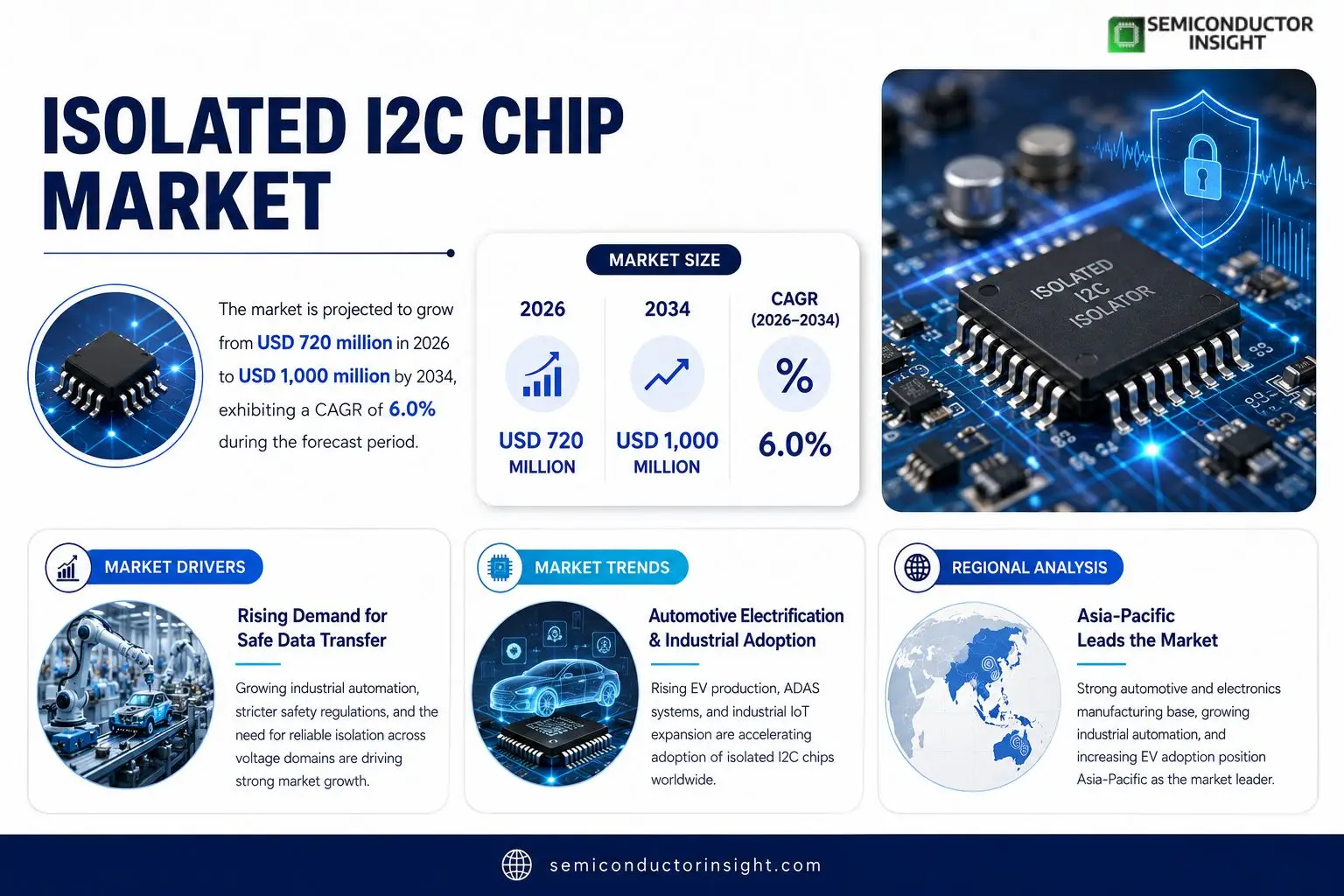
Isolated I2C Chip market was valued at USD 119 million in 2024 and is estimated to reach USD 348 million by 2034, delivering an implied CAGR of roughly 17.0% throughout the forecast horizon.
Isolated I²C Chip functions as a bidirectional, low‑power isolator that conforms to the I²C protocol; electrical isolation between the input and output sides safeguards signal integrity when crossing disparate voltage domains. The technology finds increasing adoption in automotive control units, new‑energy vehicle power‑train modules, and assorted industrial equipment where safety‑critical data exchange is required.The upward trajectory aligns with the overall analog segment’s double‑digit expansion reported in recent semiconductor surveys, where analog devices grew over 20 percent year‑over‑year while sensor categories posted mid‑teens gains. North American OEMs have been allocating larger budgets toward isolated interfaces to meet stricter EMC regulations, whereas Asian manufacturers are scaling production capacity to satisfy growing EV volumes.
MARKET DRIVERS
Rising Demand for Safe Data Transfer
Isolated I2C Chip Market is buoyed by an escalating need to protect low‑voltage communication links in industrial automation. As factories adopt more distributed sensors, the risk of ground loops and voltage spikes intensifies, prompting system architects to embed isolation directly on the I2C bus. This shift translates into higher bill‑of‑materials for each node but delivers a measurable reduction in unplanned downtime.
Regulatory Push for Electrical Isolation
Recent updates to safety standards for medical devices and automotive electronics require explicit isolation between patient‑facing or vehicle‑critical circuits and peripheral modules. Compliance mandates have compelled OEMs to source chips that meet stringent isolation voltage thresholds, thereby inflating the addressable market for dedicated isolated I2C solutions.
➤ “Designers are now evaluating isolation as a mandatory design element rather than an optional add‑on.”
Beyond compliance, the cost of integrating an isolated I2C chip has narrowed as silicon scaling drives down die size. This price trajectory encourages even mid‑tier equipment manufacturers to adopt the technology, reinforcing the upward momentum of Isolated I2C Chip Market.
MARKET CHALLENGES
Complexity of Integration
Embedding isolation on an I2C bus introduces additional design stepsbiasing, layout clearance, and verification of leakage currents. Small‑to‑medium enterprises often lack the engineering bandwidth to manage these nuances, leading to longer time‑to‑market cycles.
Other Challenges
Thermal Management
Isolated chips typically incorporate high‑voltage transistors that generate localized heat. Without adequate thermal paths, performance drift can occur, especially in densely packed modules where airflow is limited.Supply‑chain volatility also hampers the ability to secure consistent volumes of specialized isolation components, forcing some manufacturers to resort to legacy parts that lack the latest performance metrics.
MARKET RESTRAINTS
Higher Unit Cost Compared to Non‑Isolated Alternatives
Although economies of scale are beginning to materialize, isolated I2C chips still command a premium relative to standard I2C transceivers. Budget‑constrained projects often prioritize upfront cost savings over long‑term reliability, curbing adoption rates in low‑margin sectors.
Limited Awareness Among System Designers
Many design engineers remain unfamiliar with the nuanced failure modes that isolation mitigates. This knowledge gap results in missed opportunities to embed isolation early in product development, thereby restricting market penetration.
Stringent Certification Timelines
Achieving certification for safety‑critical applications can add months to a product’s launch schedule. The additional testing required for isolated components discourages some manufacturers from pursuing the technology, especially when rapid market entry is a strategic priority.
MARKET OPPORTUNITIES
Expansion into Edge‑AI Devices
Edge‑AI platforms increasingly rely on sensor arrays that operate in harsh electrical environments. Incorporating isolated I2C chips can safeguard data integrity, making these devices more attractive to sectors such as predictive maintenance and smart grid monitoring.
Customization for Niche Verticals
Specialty marketsmedical imaging, aerospace instrumentation, and high‑voltage power conversionrequire tailored isolation specifications. Companies that develop configurable isolation families stand to capture a premium segment of Isolated I2C Chip Market.
Growth of Modular Platform Ecosystems
Modular hardware ecosystems that advertise plug‑and‑play compatibility are emerging as a design paradigm. Embedding isolated I2C interfaces as a standard module lowers integration risk for end users and creates a recurring revenue stream for component suppliers.
Isolated I2C Chip Market Trends
Automotive Electrification Fuels Component Uptick
The shift toward electric drivetrains and advanced driver‑assistance systems has elevated the need for reliable, low‑power communication bridges. Isolated I2C Chip designs, with their bidirectional isolators, satisfy the strict safety envelopes required in power‑train modules while keeping energy consumption modest. OEMs are integrating these chips into battery‑management units and sensor clusters, translating into a noticeable lift in component orders across Europe and the United States. The practical benefitpreventing ground‑loop failures without sacrificing data speedhas turned the chip into a preferred choice for engineers targeting both performance and regulatory compliance.
Other Trends
Industrial Automation Embraces Isolation
Factory floor controllers are increasingly populated with mixed‑voltage networks, where legacy equipment coexists with high‑speed digital assets. In such environments, the electrical isolation offered by the I2C chip mitigates risk of transient spikes propagating between zones. Manufacturers of motion‑control boards report that the chip’s low‑power profile supports longer device lifespans, aligning with sustainability goals that many Southeast Asian plants have adopted. Consequently, procurement cycles have shortened, and suppliers see a steady uptick in repeat business from this sector.
Safety‑Driven Standards Accelerate Adoption
New safety regulations for medical devices and aerospace avionics now mandate isolation on critical data lines, a requirement that dovetails with the inherent characteristics of the Isolated I2C Chip. Engineers cite the chip’s ability to maintain data integrity while meeting stringent isolation voltage thresholds as a decisive factor in design selection. This regulatory pressure encourages component vendors to expand their portfolios, offering variants optimized for temperature extremes and ultra‑low latency. The net effect is a broadened addressable market that stretches beyond traditional consumer electronics into high‑trust domains.
COMPETITIVE LANDSCAPE
Key Industry Players
Isolated I2C Chip Market: Competitive Overview
The market is anchored by a handful of semiconductor powerhouses that command both breadth of portfolio and depth of engineering expertise. Analog Devices (ADI) leverages its legacy in precision analog to dominate the higher‑performance segment, offering dual‑direction isolators that satisfy automotive safety standards. Texas Instruments complements this dominance with a focus on cost‑effective single‑direction devices, exploiting its extensive distribution network to capture volume‑driven applications such as industrial sensor hubs. The structure of the market reflects a tiered competitive set: legacy analog leaders occupy the premium space, while a growing cohort of logic‑centric firms supplies commoditized parts to emerging sectors like new‑energy vehicles. This segmentation forces vendors to differentiate on isolation voltage, propagation delay, and power envelope, prompting incremental product road‑maps that aim to reduce board‑level bill‑of‑materials while preserving robustness.Beyond the top three, several niche innovators are reshaping the value chain. STMicroelectronics and NXP Semiconductors have introduced mixed‑signal solutions that integrate isolation with on‑chip level‑shifting, targeting automotive gateway modules. Renesas Electronics and Microchip Technology focus on automotive‑grade certifications, emphasizing long‑term reliability for safety‑critical links. Infineon Technologies and ON Semiconductor provide automotive‑qualified parts with hardened packaging for harsh environments. Smaller specialists such as Maxim Integrated, Cypress Semiconductor, ROHM Semiconductor, Skyworks Solutions, Silicon Labs, AMS AG, and Qorvo concentrate on specific applicationsranging from consumer wearables to high‑frequency communicationwhere low‑power isolation and compact form‑factor are decisive. Their emergence broadens the competitive set, pressures incumbents to accelerate feature cycles, and creates partnership opportunities for system integrators seeking tightly coupled sensor‑to‑controller interfaces.
List of Key Isolated I2C Chip Companies Profiled
- Analog Devices (ADI)
- Texas Instruments
- STMicroelectronics
- NXP Semiconductors
- Renesas Electronics
- Microchip Technology
- Infineon Technologies
- ON Semiconductor
- Maxim Integrated
- Cypress Semiconductor
- ROHM Semiconductor
- Skyworks Solutions
- Silicon Labs
- AMS AG
- Qorvo
Segment Analysis:
| Segment Category | Sub-Segments | Key Insights |
| By Type |
|
SCK Mode Dual Direction
|
| By Application |
|
Automotive
|
| By End User |
|
Industrial Equipment
|
| By Integration Level |
|
Integrated Module
|
| By Market Focus |
|
Safety‑Critical Systems
|
Regional Analysis: Isolated I2C Chip Market
Europe
European directives on electromagnetic interference and medical device safety embed isolation as a compliance checkpoint, prompting OEMs to embed Isolated I2C Chips early in the design phase rather than as an after‑thought. Certification bodies audit isolation performance, making conformance a decisive factor for market entry.
Automotive control modules, industrial motion controllers, and diagnostic imaging equipment dominate European consumption, each leveraging isolation to protect sensitive analog front ends from digital noise, thereby extending product lifecycles.
Localized silicon fabs in the Benelux corridor reduce lead times, while a network of specialist distributors offers value‑added testing services, ensuring that design teams receive both components and validation support in a single channel.
High‑precision robotics and renewable‑energy inverters are beginning to integrate Isolated I2C solutions to safeguard control loops, illustrating a gradual shift toward more sophisticated, safety‑aware deployments.
North America
North America’s market rhythm contrasts with Europe’s by emphasizing scale and cost efficiency, yet isolation remains indispensable in sectors like aerospace and defense. U.S. defense contractors often embed isolated interfaces to meet survivability standards that protect avionics against electromagnetic bursts. Canadian industrial automation firms, meanwhile, adopt I2C isolation to reduce downtime in harsh manufacturing environments. Though price pressure is higher, the willingness to invest in validated, high‑quality chips persists because system failure carries steep penalties. Suppliers that blend competitive pricing with rigorous reliability data tend to capture sizable contracts across the continent.
Asia‑Pacific
The Asia‑Pacific region is characterized by rapid product turnover and an expanding portfolio of consumer‑grade electronics that increasingly incorporate safety features. In Japan, precision instrumentation manufacturers embed isolated I2C links to guarantee measurement fidelity, while Chinese factory automation players view isolation as a safeguard against power‑line transients common in dense production lines. The prevailing business mindset values quick time‑to‑market; therefore, partners that provide ready‑to‑use reference designs and localized technical support enjoy a distinct advantage in securing design wins.
South America
South American adopters are generally slower to replace legacy architectures, yet emerging infrastructure projects are driving modest demand for isolation. Brazil’s renewable‑energy sector, for example, integrates isolated I2C chips within turbine control units to protect against voltage spikes caused by fluctuating grid conditions. Argentine automotive assemblers also cite isolation as a risk‑mitigation measure for newly introduced electric‑vehicle platforms. The market’s modest size underscores the importance of targeted outreach and flexible pricing structures to stimulate broader uptake.
Middle East & Africa
In the Middle East & Africa, burgeoning oil‑and‑gas installations and expanding data‑center footprints are the primary catalysts for Isolated I2C Chip deployment. Operators prioritize isolation to shield critical monitoring systems from harsh electromagnetic environments endemic to extraction sites. African renewable‑energy projects similarly embed isolated interfaces to enhance the reliability of solar‑farm inverters. Given the region’s fragmented distribution network, vendors that partner with regional system integrators and offer on‑site testing services are better positioned to navigate procurement complexities.
Report Scope
This market research report provides a comprehensive analysis of the Isolated I2C Chip Market , covering the forecast period 2026–2034. It offers detailed insights into market dynamics, technological advancements, competitive landscape, and key trends shaping the industry.
Key focus areas of the report include:
- Market Overview: The report begins with an overview outlining its current market scenario, key growth indicators, and industry transformation drivers. It discusses macroeconomic factors, demand–supply balance, regulatory landscape, and the strategic role of semiconductors in powering advancements across industries such as automotive, telecommunications, consumer electronics, and industrial automation.
- Market Size & Forecast: Historical data and future projections for revenue, unit shipments, and market value across major regions and segments.
- Segmentation Analysis: Detailed breakdown by product type, technology, application, and end-user industry to identify high-growth segments and investment opportunities.
- Regional Insights: Insights into market performance across North America, Europe, Asia-Pacific, Latin America, and the Middle East & Africa, including country-level analysis where relevant.
- Competitive Landscape: Profiles of leading market participants, including their product offerings, R&D focus, manufacturing capacity, pricing strategies, and recent developments such as mergers, acquisitions, and partnerships.
- Technology Trends & Innovation: Assessment of emerging technologies, integration of AI/IoT, semiconductor design trends, fabrication techniques, and evolving industry standards.
- Market Drivers & Restraints: Evaluation of factors driving market growth along with challenges, supply chain constraints, regulatory issues, and market-entry barriers.
- Stakeholder Insights: Insights for component suppliers, OEMs, system integrators, investors, and policymakers regarding the evolving ecosystem and strategic opportunities.
Primary and secondary research methods are employed, including interviews with industry experts, data from verified sources, and real-time market intelligence to ensure the accuracy and reliability of the insights presented.
FREQUENTLY ASKED QUESTIONS:
What is the current market size of Isolated I2C Chip Market?
-> Isolated I2C Chip Market was valued at USD 119 million in 2024 and is expected to reach USD 348 million by 2034, growing at a CAGR of 17.0% during the forecast period.
Which key companies operate in Isolated I2C Chip Market?
-> Key players include ADI, Texas Instruments, Shanghai Chipanalog Microelectronics, NOVOSENSE, and 2Pai Semiconductor, among others.
What are the key growth drivers?
-> Key growth drivers include the rising demand for low‑power isolated communication in automotive and new‑energy vehicles, increasing safety requirements in industrial control systems, and the expansion of IoT‑enabled devices that rely on reliable I2C isolation.
Which region dominates the market?
-> Asia‑Pacific remains the largest market in terms of revenue, driven by strong automotive and consumer electronics production, while North America shows the fastest growth rate.
What are the emerging trends?
-> Emerging trends include integration of isolated I2C chips with AI‑edge computing modules, migration to silicon‑photonic isolation techniques, and the development of multifunctional isolators that support both I2C and SPI interfaces.
Get Sample Report PDF for Exclusive Insights
Report Sample Includes
- Table of Contents
- List of Tables & Figures
- Charts, Research Methodology, and more...
 Download Sample Report PDF