Isolated CAN Transceiver Chip Market Insights
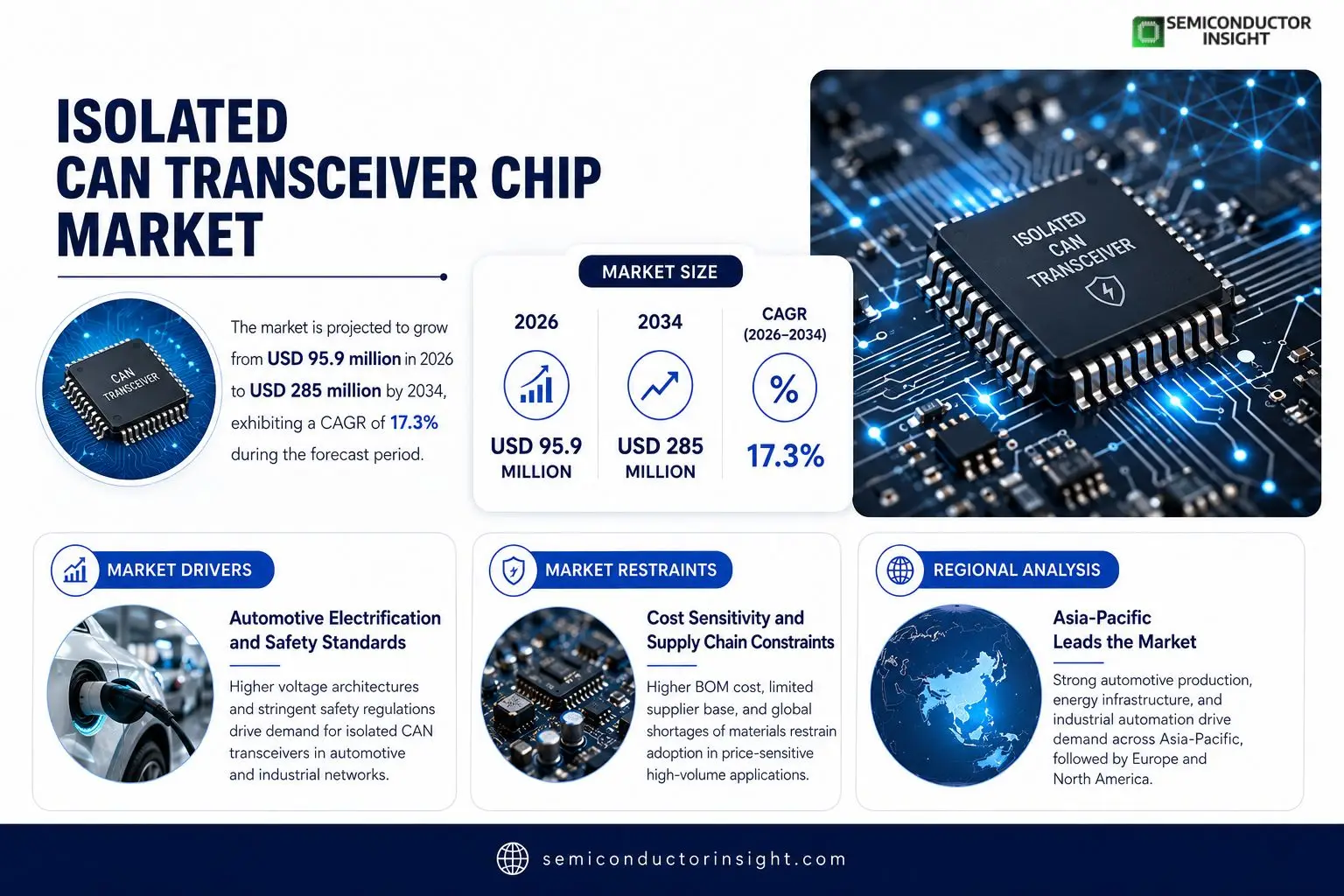
Isolated CAN Transceiver Chip market size was valued at USD 95.9 million in 2026 and will reach USD 285 million by 2034, reflecting a CAGR of 17.3% over the forecast horizon.
The Isolated CAN Transceiver Chip combines a digital isolator with a high‑reliability CAN transceiver, delivering robust data integrity for automotive and industrial networks. Demand accelerates as vehicle electrification expands and safety‑critical communication standards tighten. Manufacturers such as ADI, Texas Instruments and Infineon are broadening portfolios, while supply chains adapt to stricter isolation requirements across new‑energy vehicles and smart‑grid deployments.
MARKET DRIVERS
Automotive Electrification and Safety Standards
Manufacturers of electric and hybrid vehicles are integrating higher voltage architectures, which forces designers to adopt isolation solutions that protect low‑voltage control domains. Isolated CAN Transceiver Chip Market benefits because engineers can meet stringent functional‑safety targets without redesigning legacy networks.
Industrial Automation and EMI Mitigation
Factories upgrading to Industry 4.0 platforms are exposing communication lines to noisy power converters. Isolated transceivers provide a deterministic barrier against electromagnetic interference, allowing predictive‑maintenance sensors to relay data reliably.
➤ “Isolation reduces fault propagation, enabling higher system uptime and lower warranty costs.”
When OEMs factor the total cost of ownership, the modest price premium of isolated chips is offset by reduced board‑level redesigns and longer product lifecycles, reinforcing demand across automotive and factory sectors.
MARKET CHALLENGES
Cost Sensitivity and Design Complexity
Design teams often confront a trade‑off between isolation performance and bill‑of‑materials. The added magnetic components raise unit cost, which can be decisive in high‑volume commodity applications where margins are thin.
Other Challenges
Regulatory Certification Burden
Achieving compliance with automotive functional‑safety standards (e.g., ISO 26262) requires extensive testing. Small and midsize suppliers may lack the resources to certify isolated solutions, limiting market penetration.
MARKET RESTRAINTS
Supply‑Chain Constraints
Global shortages of silicon wafers and magnetic materials have elongated lead times for isolated transceiver modules, prompting OEMs to maintain higher safety stocks and discouraging adoption in fast‑track projects.
Limited Supplier Base
Only a handful of qualified manufacturers currently offer fully isolated CAN solutions, which reduces competitive pricing pressure and can lock customers into single‑source agreements.Legacy system integrators often hesitate to replace proven non‑isolated parts, fearing integration risk and the need for redesign validation, thereby dampening short‑term growth.
MARKET OPPORTUNITIES
Electric‑Vehicle Powertrain Expansion
The surge in electric‑vehicle production creates a demand for high‑voltage power modules that must communicate with vehicle‑wide CAN networks safely. Isolated transceivers are uniquely positioned to bridge these voltage domains while preserving data integrity.
Industrial‑IoT and Edge Computing
Edge gateways that aggregate sensor streams in harsh electromagnetic environments rely on isolation to prevent cross‑talk. As more factories adopt decentralized analytics, the addressable market for isolated CAN chips expands noticeably.Emerging standards for secure automotive communication are prompting manufacturers to embed isolation as a baseline requirement, opening a pathway for new entrants that can deliver cost‑effective, fully qualified devices.
Isolated CAN Transceiver Chip Market Trends
Automotive Safety Systems Driving Wider Adoption
The convergence of digital isolation and CAN transceiver functions has turned a single‑chip solution into a compelling choice for modern vehicle architectures. Stricter functional‑safety regulations in Europe and North America compel OEMs to embed fault‑tolerant communication links across power‑train and chassis networks. At the same time, the cost of silicon‑on‑silicon isolators has fallen enough to make the integrated device financially viable for volume production. As a result, manufacturers are replacing discrete isolation stages with the isolated CAN transceiver chip, gaining board‑level simplicity and reduced BOM complexity. This shift is noticeable in mid‑range passenger cars where engineering teams prioritize reliability without inflating chassis weight. The trend reshapes supplier negotiations, as automotive tier‑1s now request higher volume commitments and faster lead times, pushing the market toward a more predictable demand curve.
Other Trends
Emerging Applications in New Energy Vehicles and Smart‑Grid Equipment
Electrified power‑train designs place the communication bus in close proximity to high‑voltage converters, making galvanic isolation a non‑negotiable requirement. New energy vehicles therefore represent a fast‑growing niche for the isolated CAN transceiver chip, especially in battery‑management and motor‑control modules. Parallelly, communication base stations for 5G deployments and photovoltaic inverters are integrating CAN interfaces to monitor power electronics, creating cross‑industry demand. These sectors benefit from the chip’s ability to sustain data integrity under harsh electrical stress while maintaining a compact footprint. Vendors are tailoring package options—such as SOIC8‑WB and SOIC16‑WB—to satisfy space‑constrained designs, a move that widens the addressable customer base beyond traditional automotive customers.
Supply‑Chain Consolidation Among Leading Suppliers
Key players including ADI, Texas Instruments, Infineon and NXP are converging their product roadmaps around the integrated isolator‑transceiver architecture. Recent joint‑development agreements have produced silicon that merges higher data rates with enhanced isolation ratings, prompting smaller competitors to either specialize in niche form‑factors or seek acquisition. This consolidation exerts pressure on pricing tiers, yet also drives a wave of advanced features—such as built‑in diagnostic functions—that can justify premium positioning. For customers, the evolving supplier landscape translates into more stable long‑term availability but also necessitates vigilance around intellectual‑property licensing and compliance with emerging automotive standards. Companies that can align product development with these market dynamics are likely to secure stronger footholds as the ecosystem matures.
COMPETITIVE LANDSCAPE
Key Industry Players
Competitive Overview of Leading Isolated CAN Transceiver Chip Suppliers
The market is anchored by a handful of multinational semiconductor firms whose portfolio breadth and deep engineering resources shape the overall competitive contour. Analog Devices (ADI) leverages its legacy in precision analog and mixed‑signal design to offer integrated isolated CAN transceivers that combine high‑speed digital isolation with automotive‑grade robustness. Texas Instruments follows a similar strategy, differentiating through extensive design‑in support and a global sales network that penetrates automotive OEMs, electric‑vehicle makers, and industrial equipment vendors. Together, these two powerhouses command a substantive share of total revenue, driven by their ability to bundle isolation, protection, and transceiver functions into single‑chip solutions that simplify board layout and reduce Bill‑of‑Materials costs. Their pricing power and sustained R&D investment compel smaller entrants to specialize, either by focusing on niche form‑factors such as SOIC‑8 WB packages or by targeting emerging applications like photovoltaic smart‑grid interfaces.Beyond the dominant tier, a diverse set of regional and application‑focused players enriches the ecosystem. Infineon Technologies and NXP Semiconductors concentrate on automotive safety standards, delivering parts that meet stringent ISO 26262 requirements. Shanghai Chipanalog Microelectronics and Guangzhou Zhiyuan Electronics provide cost‑competitive options for Chinese OEMs, often customizing package footprints for local manufacturing constraints. NOVOSENSE and NVE specialize in high‑voltage isolation technologies, catering to electric‑vehicle power‑train developers. Emerging firms such as 2Pai Semiconductor, Silicon Internet of Things Technology, and 2Pai’s Korean counterpart bring innovative CMOS‑on‑SiC processes that promise lower power consumption for communication‑base‑station deployments. European specialists like STMicroelectronics and Renesas balance automotive pedigree with strong presence in the new‑energy‑vehicle segment, while Microchip Technology and ON Semiconductor round out the competitive set by targeting industrial automation and sensor‑gateway markets. This multi‑layered structure forces incumbents to continuously refine product roadmaps and compels newcomers to exploit niche specifications or regional partnerships to gain traction.
List of Key Isolated CAN Transceiver Chip Companies Profiled
- Analog Devices (ADI)
- Texas Instruments
- Infineon Technologies AG
- NXP Semiconductors
- Shanghai Chipanalog Microelectronics
- NOVOSENSE
- NVE
- 2Pai Semiconductor
- Silicon Internet of Things Technology
- Guangzhou Zhiyuan Electronics
- STMicroelectronics
- Renesas Electronics
- Microchip Technology
- ON Semiconductor
Segment Analysis:
| Segment Category | Sub-Segments | Key Insights |
| By Type |
|
SOIC8‑WB Package is favored for its compact footprint and ease of integration in space‑constrained designs.
|
| By Application |
|
Automotive drives the market due to stringent safety and reliability requirements.
|
| By End User |
|
Vehicle Electronics benefit from enhanced fault tolerance and reduced EMI coupling.
|
| By Package |
|
Miniature Packages are gaining traction as OEMs pursue tighter packaging budgets.
|
| By Technology Trend |
|
Digital Isolation Integration is reshaping chipset architecture.
|
Regional Analysis: Isolated CAN Transceiver Chip Market
Europe
Tightened functional‑safety directives across the EU compel vehicle makers to embed isolation early, prompting a shift from generic components to purpose‑built transceiver chips that satisfy documented safety integrity levels.
The transition to electric drivetrains raises voltage differentials on bus lines, making isolation indispensable for protecting low‑voltage control units from high‑power inverter spikes.
Modernization of legacy PLC networks in factories drives demand for chips that can isolate sensor inputs from motor‑drive noise, enhancing overall system reliability.
European customers value vendors that supply extensive validation kits, reference designs, and on‑site troubleshooting, reinforcing premium pricing tiers.
North America
North America presents a divergent landscape where cost efficiency and rapid time‑to‑market dominate procurement strategies. While OEMs adhere to safety standards, the emphasis lies in leveraging scalable silicon platforms that can be quickly adapted across multiple vehicle platforms. Consequently, chip manufacturers compete on design‑in flexibility and short lead times rather than on ultra‑high‑spec isolation performance. The burgeoning presence of autonomous‑vehicle pilots adds a layer of complexity, yet many pilots still favour modular solutions that can be swapped as system requirements evolve. Industrial sectors, particularly in the United States, focus on ruggedization for mining and energy infrastructure, prompting modest growth in isolation demand, albeit with a stronger price‑sensitivity than seen in Europe.
Asia‑Pacific
The Asia‑Pacific region showcases rapid expansion of vehicle production capacity, especially in China, India, and Southeast Asia. Domestic manufacturers are integrating isolation to meet emerging safety expectations, but the market remains highly fragmented, with numerous low‑cost suppliers vying for share. The cost‑driven nature of the region means that many OEMs prioritize functional adequacy over the higher reliability margins demanded by European clients. Nevertheless, the rise of premium electric‑vehicle brands in Japan and South Korea introduces pockets of high‑spec demand, encouraging localized R&D investments aimed at bridging the gap between cost and performance.
South America
South America’s automotive sector is modest but growing, with Brazil leading regional production. Market dynamics are shaped by import‑tariff structures and a focus on durability in harsh climatic conditions. Manufacturers favor chips that can withstand high temperature variations without intensive cooling, prompting a niche for robust isolation solutions. However, limited local design expertise drives reliance on foreign distributors, which adds a layer of complexity to supply‑chain visibility and often results in longer qualification cycles.
Middle East & Africa
In the Middle East and Africa, demand for Isolated CAN Transceiver Chips is largely driven by oil‑field automation and emerging automotive assembly operations. Harsh desert environments impose strict thermal and dust‑ingress requirements, steering buyers toward ruggedized components. The region’s fragmented market infrastructure leads many end‑users to source through regional value‑add distributors who bundle technical support with product offerings. While overall volume remains modest, strategic projects—such as smart‑grid deployments in the Gulf—offer opportunities for premium‑grade isolation technologies to gain footholds.
Report Scope
This market research report provides a comprehensive analysis of the Isolated CAN Transceiver Chip Market , covering the forecast period 2026–2034. It offers detailed insights into market dynamics, technological advancements, competitive landscape, and key trends shaping the industry.
Key focus areas of the report include:
- Market Overview: The report begins with an overview outlining its current market scenario, key growth indicators, and industry transformation drivers. It discusses macroeconomic factors, demand–supply balance, regulatory landscape, and the strategic role of semiconductors in powering advancements across industries such as automotive, telecommunications, consumer electronics, and industrial automation.
- Market Size & Forecast: Historical data and future projections for revenue, unit shipments, and market value across major regions and segments.
- Segmentation Analysis: Detailed breakdown by product type, technology, application, and end-user industry to identify high-growth segments and investment opportunities.
- Regional Insights: Insights into market performance across North America, Europe, Asia-Pacific, Latin America, and the Middle East & Africa, including country-level analysis where relevant.
- Competitive Landscape: Profiles of leading market participants, including their product offerings, R&D focus, manufacturing capacity, pricing strategies, and recent developments such as mergers, acquisitions, and partnerships.
- Technology Trends & Innovation: Assessment of emerging technologies, integration of AI/IoT, semiconductor design trends, fabrication techniques, and evolving industry standards.
- Market Drivers & Restraints: Evaluation of factors driving market growth along with challenges, supply chain constraints, regulatory issues, and market-entry barriers.
- Stakeholder Insights: Insights for component suppliers, OEMs, system integrators, investors, and policymakers regarding the evolving ecosystem and strategic opportunities.
Primary and secondary research methods are employed, including interviews with industry experts, data from verified sources, and real-time market intelligence to ensure the accuracy and reliability of the insights presented.
FREQUENTLY ASKED QUESTIONS:
What is the current market size of Isolated CAN Transceiver Chip Market?
-> Isolated CAN Transceiver Chip Market was valued at USD 95.9 million in 2026 and is expected to reach USD 285 million by 2034, growing at a CAGR of 17.3% during the forecast period.
Which key companies operate in Isolated CAN Transceiver Chip Market?
-> Key players include ADI, Texas Instruments, Infineon Technologies AG, NXP Semiconductors, Shanghai Chipanalog Microelectronics, NOVOSENSE, NVE, 2Pai Semiconductor, Silicon Internet of Things Technology, Guangzhou Zhiyuan Electronics.
What are the key growth drivers?
-> Key growth drivers include the integration of digital isolators with high‑reliability CAN transceivers, expanding automotive electrification, increasing adoption in new energy vehicles, and rising demand for reliable communication in automotive and industrial applications.
Which region dominates the market?
-> Asia‑Pacific remains the largest market by revenue, although it experienced a slight decline of 2.0% in 2022, while the Americas and Europe showed double‑digit growth.
What are the emerging trends?
-> Emerging trends include growing applications in automotive, new energy vehicles, communication base stations, photovoltaic and smart grid systems, and the development of more compact package types such as SOIC8‑WB and SOIC16‑WB.
Get Sample Report PDF for Exclusive Insights
Report Sample Includes
- Table of Contents
- List of Tables & Figures
- Charts, Research Methodology, and more...
 Download Sample Report PDF