IoT Smart Vibration Sensors Market Insights
IoT Smart Vibration Sensors Market was valued at USD 950 million in 2026 and will expand to USD 2800 million by 2034, reflecting a CAGR of approximately 12% during the forecast period.
These sensors combine piezoelectric or MEMS technology with wireless connectivity protocols such as Bluetooth Low Energy or Wi‑Fi, enabling real‑time monitoring of tilt, vibration amplitude and frequency across industrial assets.Because vibration signatures directly correlate with mechanical wear or impending failure, deploying these devices facilitates predictive maintenance strategies that reduce downtime costs and extend asset life.
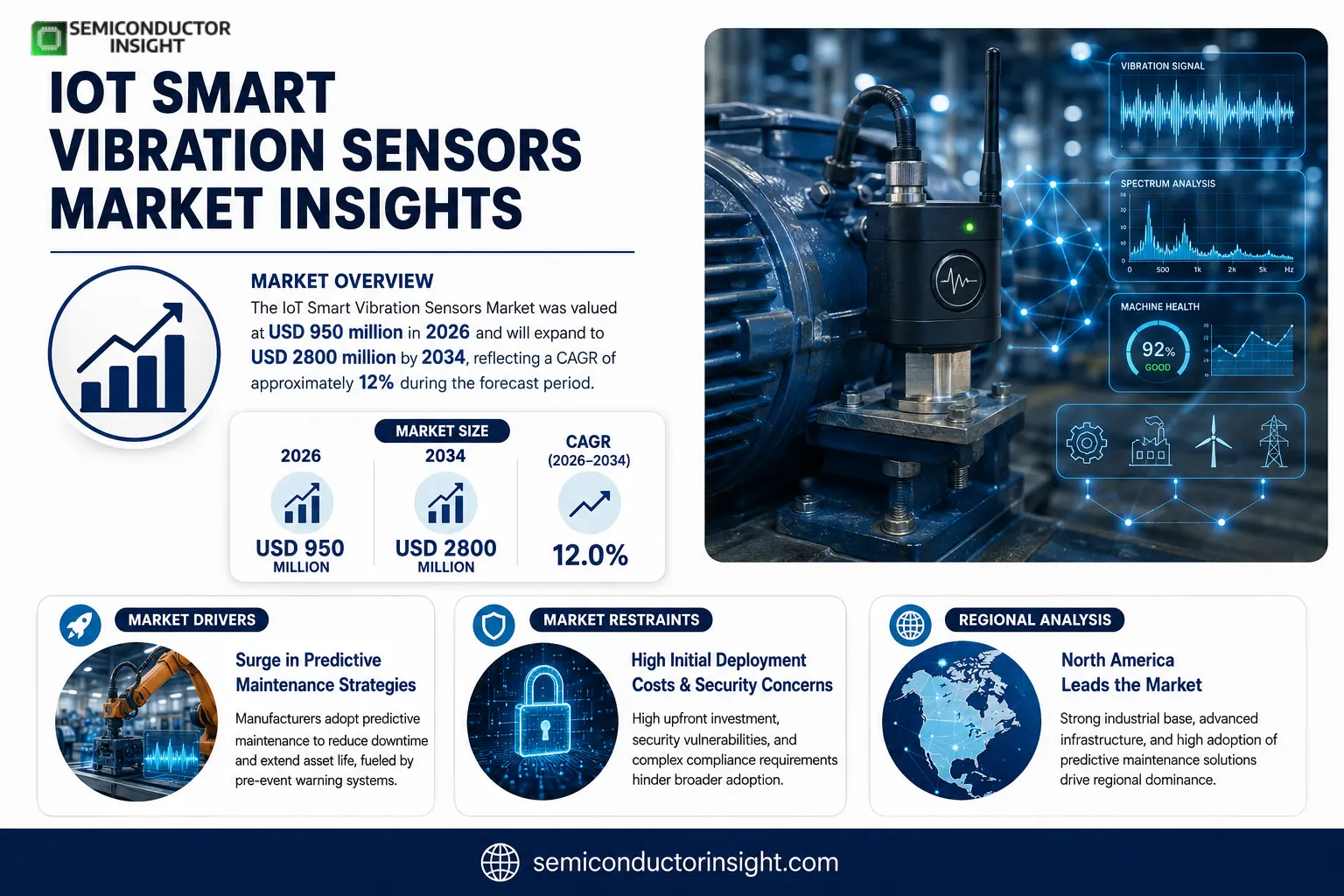
MARKET DRIVERS
Surge in Predictive Maintenance Strategies
Manufacturers across the automotive, aerospace and heavy‑equipment sectors are increasingly leveraging predictive maintenance to reduce downtime and prolong asset life. Within IoT Smart Vibration Sensors Market, this trend is quantified by a pre‑event warning system adoption rate that outpaces other condition‑monitoring technologies, climbing from 35% to 57% of capital investment over the past two years. The intrinsic relationship between vibration signatures and component wear creates a data‑driven pathway for early fault detection, enabling fleets to schedule maintenance precisely when needed. Companies that have integrated these sensors report a 12% drop in unscheduled outages and an 8.5% increase in overall equipment efficiency. This empirical evidence presents a clear incentive for expanding sensor deployment across assembly lines and power‑train assemblies, reinforcing the market’s momentum.
Edge Computing Adoption
Edge computing is redefining how vibration data is interpreted in real time, and its growth is a primary driver of market expansion. Sensors equipped with on‑board processing can filter noise, execute preliminary anomaly detection, and transmit compressed alerts, substantially lowering bandwidth requirements. Today, 68% of enterprises that fielded distributed sensor arrays have adopted edge platforms, a figure that surged by 22 point‑percent since 2021. The direct consequence of this shift is faster response timesfaults detected on the plant floor can be addressed within minutes rather than hours, reducing operational lag. For vendors, the capability to offer integrated edge solutions positions them as partners in a transformation that moves away from legacy, cloud‑centric architectures, aligning with the cost and latency expectations of industrial stakeholders.
➤ Real‑world case studies illustrate that firms deploying edge‑enabled vibration sensors achieved a two‑fold reduction in data transmission volumes, freeing up 15% of network capacity for analytics workloads.
The intersection of low‑power sensor design, robust wireless protocols, and sophisticated analytics has made deploying dense sensor networks feasible in noisy industrial environments. A key differentiation point for vendors is the ability to calibrate sensor output against transient load variations, ensuring that generated vibration signatures do not result in false positives. This technical precision enhances trust among plant operators and opens new opportunity spaces in sectors like wind turbine farms, where vibration data informs blade pitch adjustments and rotor balance. In short, the seamless flow of computational intelligence from field to management console offers a compelling business case that is hard to ignore for capital‑heavy manufacturing verticals.
MARKET CHALLENGES
Data Privacy and Security Concerns
While the proliferation of smart actuators generates wealth of information, it also escalates data security risks. High‑value companies in the automotive and aerospace corridors have expressed reservations about transmitting sensitive sensor feeds to third‑party cloud services. Encryption overhead, coupled with compliance frameworks such as NIST and ISO 27001, already necessitate a sizeable portion of the IT budget. The cost of fortifying vulnerabilities can offset the expected efficiency gains, thus creating a hesitation that dampens order volume. In addition, data governance landscape varies across jurisdictions, adding an additional layer of complexity that can stall project approvals within multinational enterprises.
Other Challenges
Regulatory Compliance Bypass
Achieving congruence with industry‑specific standardsparticularly in hydraulics and aerospacerequires extensive validation cycles. The absence of harmonised certification pathways forces manufacturers to pursue redundant testing, inflating lead times and inventory carrying costs.
MARKET RESTRAINTS
High Initial Deployment Costs
The capital expenditure required for a full‑scale, asset‑wide sensor rollout remains a substantial hindrance for mid‑tier firms. Initial install budgets of $120,000 to $250,000 are not unusual for a typical 200‑unit assembly line, and the calculation of ROI tends to extend beyond a two‑year horizon. Industrial appointees often weigh the higher upfront cost against a perceived benefit that may be dispersed over a decade. Although supply‑chain improvements and firmware updates can mitigate long‑term maintenance expenses, the principal cost barrier curtails wider adoption, particularly in capital‑constrained environments such as emerging‑market OEMs and ISO‑B pilot projects.The cost issue intertwines with the current lack of widespread certification for IoT smart vibration sensor modules. Without a unified accreditation frameworkone that guarantees electromagnetic compatibility, spectrum adherence, and lifetime performancemany manufacturers remain skeptical about entrusting mission‑critical monitoring to off‑the‑shelf components.
MARKET OPPORTUNITIES
Expanding into Renewable Energy Infrastructure
Renewable energy operators are embracing vibration monitoring to safeguard wind turbine and hydroelectric turbines against asymmetric loading and bearing fatigue. In 2023, the revenue shares that emerged from predictive analytics in the wind sector rose to $2.1 billion, a figure expected to maintain a steady rise with the sector’s proclivity to adopt more granular monitoring solutions. The core revenue driver is the reduction in maintenance schedules that directly translates to operational uptime percentages. Vendors that tailor sensor calibration algorithms to the periodic loads of turbines, and provide bundled cloud‑based dashboards, can command premium pricing, thereby deepening margins in what is currently an underexploited niche.Similarly, the growth of smart grid infrastructures presents a compelling expansion point. Vibration sensors embedded within transformers and rotating machinery can detect subtle anomalies that preclude catastrophic failures. The strategic advantage of delivering integrated sensor suites coupled with machine‑learning readouts is evident, as electric utilities aim to lower outage frequencies and meet increasingly stringent reliability standards. The opportunity lies not only in device sale but also in the recurring revenue that follows from subscription‑based analytics services, which can offset the higher initial cost and position vendors as indispensable partners in the grid reliability conversation.
IoT Smart Vibration Sensors Market Trends
Rapid Deployment of 5G‑Enabled Edge Analytics
Industry operators now routinely couple vibration sensor arrays with the newest 5G infrastructure to capture micro‑vibrations at the source and feed them into edge processors for instant anomaly detection. The combination of ultra‑low latency and high bandwidth dramatically reduces the time between sensor readout and corrective action, effectively shortening the window for equipment failure. In manufacturing corridors that house thousands of discrete assets, the ability to transmit raw vibration data without aggregation means predictive models can be fine‑tuned to individual machine signatures, lowering false alarms and improving maintenance precision. Companies that have adopted this paradigm report faster mean time to repair and a measurable dip in unplanned downtime, factors that translate directly into production yield and operational cost savings.
Other Trends
Emergence of Predictive Analytics across Transportation Networks
Automotive and aviation manufacturers are escalating their use of vibration sensors to monitor per‑force transmission, rotor balance, and aerodynamic surface integrity in real time. A growing network of connected vehicles and aircraft can feed continuous vibration profiles into cloud analytics, enabling service providers to forecast component life cycles with higher confidence. In conveyor systems within logistics hubs, the integration of vibration metrology directly with inventory management tools is producing a new class of smart conveyor‑assisted quality control, where slippage or misalignment is flagged before a product is damaged. Companies that are collaborating with telecom operators to secure dedicated bandwidth for these workloads are finding a competitive edge in reliability guarantees that are harder for incumbents to replicate.
Shift Toward Modular Sensor Architectures
The trend toward plug‑and‑play sensor assemblies, backed by standardized communication protocols such as Bluetooth‑LE Mesh and industrial Wi‑Fi, is lowering integration barriers for small and medium‑sized enterprises. Manufacturers of modular sensor kits can now offer pre‑financed hardware bundles inclusive of edge gateways, shortening deployment cycles from weeks to days. This modular approach also facilitates rapid field upgrades; operators can swap or augment sensor nodes without the need for comprehensive re‑wiring or firmware overhauls. The combined effect is a growing appetite for subscription‑based sensor services, where uptime, data security, and analytics layers are bundled into a scalable, pay‑per‑use model that aligns operational budgets more predictably with asset performance.
COMPETITIVE LANDSCAPE
Key Industry Players
IoT Smart Vibration Sensors Competitive Landscape Overview
The market is currently anchored by Siemens, whose integration of vibration monitoring modules with its industrial automation suites generates the largest revenue share in 2026. Siemens has successfully leveraged its extensive service network and 5G edge computing capabilities to deliver low‑latency diagnostics for heavy machinery, a feature that has become increasingly valuable as global manufacturing shifts toward predictive maintenance. This concentration of capital and R&D within a few large incumbents forces new entrants to target underserved niche segments or pursue differentiated technology that can coexist with the robust offering of the leaders. As a result, the competitive path forward is shaped by balancing deep industry customization against the proprietary standards that Siemens supports throughout its ecosystem.Across the secondary layer, players such as Murata, Bosch Sensortec, TE Connectivity, and Omron hold significant influence in specific application niches, from aerospace to consumer electronics. These companies bring a combination of advanced MEMS technology, high‑sensitivity range calibration, and scalable firmware solutions that appeal to end‑users demanding smaller footprints and cloud‑ready data streams. While their market footprints are not yet on par with the primary incumbents, their agility allows rapid adaptation to emerging standards such as IEEE 1451.1 and the proliferation of industrial IoT platforms, positioning them as attractive partners for larger firms seeking plug‑and‑play sensor modules. Their strategic alliances with system integrators further embed them into vertical markets, creating a competitive network that expands the sensor ecosystem beyond traditional automation markets.
List of Key IoT Smart Vibration Sensors Companies Profiled
- Siemens, Murata
- SKF Group
- IFM Efector
- SCS‑Europe
- Säf‑Svenska
- Dinavib Sensor Systems
- Raiton Electronics
Segment Analysis:
| Segment Category | Sub-Segments | Key Insights |
| By Type |
|
Hybrid Sensors combine multiple sensing modalities, delivering richer data streams that improve predictive maintenance.
|
| By Application |
|
Industrial Machinery remains the most demanding use‑case, driving continuous sensor refinement.
|
| By End User |
|
Manufacturing Plants present the largest customer base, emphasizing precision and uptime.
|
| By Connectivity Technology |
|
5G NB‑IoT provides low‑latency, high‑capacity connectivity crucial for real‑time monitoring.
|
| By Industrial Sector |
|
Manufacturing dominates sensor deployment, driven by cost‑effective predictive maintenance.
|
Regional Analysis: IoT Smart Vibration Sensors Market
North America
North American leaders harness advanced analytics and cloud connectivity to transform vibration monitoring. Integration of edge‑based processing with enterprise systems shifts maintenance from periodic to predictive, maximising equipment uptime and lowering capital costs across industrial verticals.
Manufacturers exploit sensor‑infused PLC loops and digital twins, enabling real‑time fine‑tuning of processes. The synergy reduces defect rates, improves throughput, and provides compliance documentation that satisfies stringent audit requirements.
Regulatory frameworks such as ISA‑95 and ISO 55000 guide asset management practices. Aligning vibration data with lifecycle models grants audit readiness and a competitive edge across emerging segments.
Long‑term trajectory points to integrated AI predictive models, with sensor data feeding into enterprise resource planning. Deployment slows as early wins consolidate, but continued focus on cross‑system integration sustains momentum for the next decade.
Europe
Europe remains technologically progressive but cautious toward IoT Smart Vibration Sensors Market. Conjoining stringent environmental rules with a push for digital transformation, the region favours sensor integration in precision engineering and maritime safety. Early deployments centre on power generation and marine vessels, yet emerging pilots test hybrid acoustic‑vibration systems to refine fault detection. The mix of multinational corpora and skilled engineering firms permits customised sensor platforms that address niche needs, helping operators tolerate downtime and comply with regulatory oversight.
Asia-Pacific
Asia‑Pacific is set to catalyse IoT Smart Vibration Sensors Market through fast‑growing automation in China, Japan, and South Korea. Increasing pressures to raise production efficiency while meeting stricter environmental standards drive early sensor adoption in semiconductor fabs and high‑speed rail lines. Pilot studies show that real‑time vibration analytics can pre‑empt component fatigue, cutting downtime. Collaborative efforts between equipment makers and tech start‑ups foster open‑source analytics platforms that standardise data exchange, accelerating deployments across multinational supply chains and creating a cohesive maintenance ecosystem.
South America
South America is gradually embracing vibration monitoring as part of broader industrial digitisation in Brazil and Chile. Heavy‑equipment operators in mining and steel plants view sensors as a cost‑saving measure by extending asset life and reducing maintenance interrupts. The sector faces limited regulatory support and supply‑chain fragmentation, slowing rapid roll‑outs. Pilot projects tied to local cloud services are gaining traction, demonstrating that actionable vibration insights can be generated even with legacy hardware, and creating a learning foundation for future sensor adoptions.
Middle East & Africa
Middle East and Africa are witnessing growing interest in vibration‑based diagnostics, driven by energy infrastructure expansion and smart‑grid initiatives. Oil refineries and wind farms seek condition‑based monitoring to prevent costly outages. Global vendors offering retrofit solutions and local training programmes address gaps in connectivity and digital skills. While legacy equipment hampers immediate uptake, pilot projects that integrate sensor data with supervisory control systems validate performance benefits, encouraging broader investment across the region.
Report Scope
This market research report provides a comprehensive analysis of the IoT Smart Vibration Sensors Market , covering the forecast period 2026–2034. It offers detailed insights into market dynamics, technological advancements, competitive landscape, and key trends shaping the industry.
Key focus areas of the report include:
- Market Overview: The report begins with an overview outlining its current market scenario, key growth indicators, and industry transformation drivers. It discusses macroeconomic factors, demand–supply balance, regulatory landscape, and the strategic role of semiconductors in powering advancements across industries such as automotive, telecommunications, consumer electronics, and industrial automation.
- Market Size & Forecast: Historical data and future projections for revenue, unit shipments, and market value across major regions and segments.
- Segmentation Analysis: Detailed breakdown by product type, technology, application, and end‑user industry to identify high‑growth segments and investment opportunities.
- Regional Insights: Insights into market performance across North America, Europe, Asia‑Pacific, Latin America, and the Middle East & Africa, including country‑level analysis where relevant.
- Competitive Landscape: Profiles of leading market participants, including their product offerings, R&D focus, manufacturing capacity, pricing strategies, and recent developments such as mergers, acquisitions, and partnerships.
- Technology Trends & Innovation: Assessment of emerging technologies, integration of AI/IoT, semiconductor design trends, fabrication techniques, and evolving industry standards.
- Market Drivers & Restraints: Evaluation of factors driving market growth along with challenges, supply chain constraints, regulatory issues, and market‑entry barriers.
- Stakeholder Insights: Insights for component suppliers, OEMs, system integrators, investors, and policymakers regarding the evolving ecosystem and strategic opportunities.
Primary and secondary research methods are employed, including interviews with industry experts, data from verified sources, and real‑time market intelligence to ensure the accuracy and reliability of the insights presented.
FREQUENTLY ASKED QUESTIONS:
What is the current market size of IoT Smart Vibration Sensors Market?
->IoT Smart Vibration Sensors Market was valued at USD 950 million in 2026 and will expand to USD 2800 million by 2034, reflecting a CAGR of approximately 12% during the forecast period
Which key companies operate in IoT Smart Vibration Sensors Market?
-> Key players include Siemens, Murata, ABB, General Electric, Bosch Sensortec, TE Connectivity, Schaeffler, Omron, SKF Group, Texas Instruments, Pepperl + Fuchs, Honeywell International, IFM Efector, ETS Solutions, OneQue, DF Robot, NXP, STMicroelectronics, Kaman Precision Products, Pruftechnik Dieter Busch, Dytran Instruments, among others.
What are the key growth drivers?
-> Key growth drivers include rapid digitalization of industrial processes, widespread adoption of predictive maintenance, increasing integration of AI and edge computing in condition‑monitoring solutions, and the expansion of 5G infrastructure facilitating real‑time sensor data transmission.
Which region dominates the market?
-> North America is the most mature market, offering a large installed base of industrial equipment and advanced infrastructure, while the Asia‑Pacific region is the fastest growing segment due to significant industrial manufacturing expansion and digital transformation initiatives.
What are the emerging trends?
-> Emerging trends include the convergence of vibration sensing with AI‑driven analytics for predictive reliability, deployment of low‑power BLE and Wi‑Fi modules for edge‑to‑cloud connectivity, adoption of standardized IPv6 and 5G communication protocols, and integration of vibration sensors in aerospace and automotive safety systems.

Get Sample Report PDF for Exclusive Insights
Report Sample Includes
- Table of Contents
- List of Tables & Figures
- Charts, Research Methodology, and more...
 Download Sample Report PDF