IoT Smart Temperature Sensors Market Insights
IoT Smart Temperature Sensors market was valued at USD 2 401 million in 2026 and is projected to reach USD 3 769 million by 2035, registering a CAGR of 6.8%.
Smart temperature sensors are electrical transducers that convert thermal readings into proportional electrical outputs, providing real‑time proxies for ambient or process temperatures.
Their application spectrum spans industrial control loops, commercial HVAC systems, consumer electronics and home automation platforms.
A recent survey shows roughly 14 billion connected IoT devices worldwide—a rise of about 18%% since 2021—highlighting the expanding deployment base for these sensing solutions.
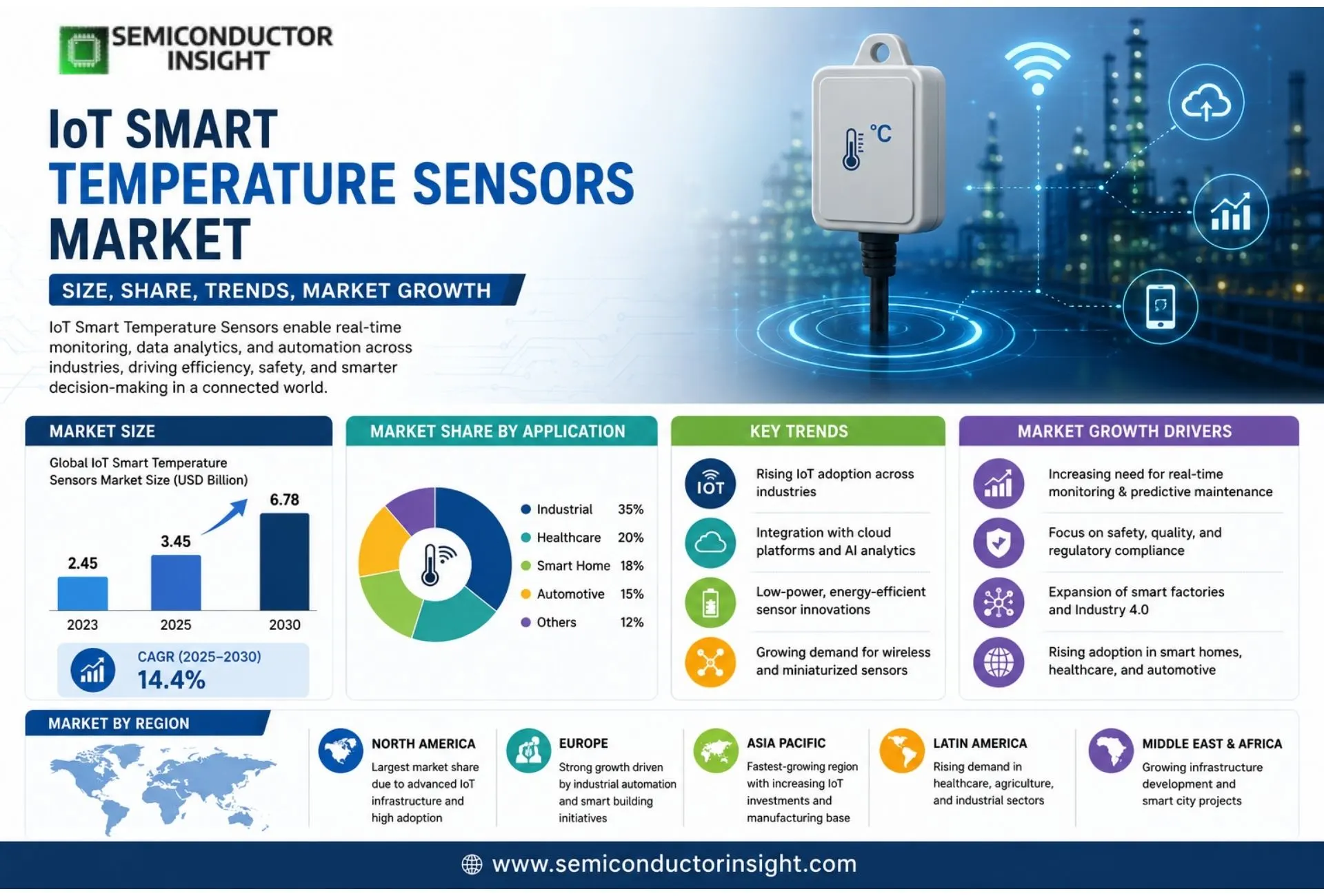
MARKET DRIVERS
Industrial Automation and Predictive Maintenance
In the current industrial landscape, the push toward end‑to‑end automation is generating a relentless demand for real‑time, high‑resolution temperature data. Implementations of digital twin models require accurate temperature feedback to calibrate simulated asset behavior, reduce downtime, and forecast component life cycles. As a result, the IoT Smart Temperature Sensors Market is expanding beyond traditional factory floors to include remote processing facilities and critical infrastructure. The integration of sensors with enterprise asset management platforms enables continuous visibility, allowing maintenance teams to react to deviations before they evolve into costly failures. Additionally, tightening safety regulations in sectors such as pharmaceuticals and aerospace have driven the adoption of monitoring solutions that meet stringent traceability and documentation standards. The convergence of cloud analytics and edge computing further reinforces the value proposition, as temperature trends can now be processed locally, minimizing latency and preserving bandwidth. Technological progress in MEMS and semiconductor fabrication has brought sensor accuracy under 0.5°C with minimal drift, making it feasible for operators to shift from reactive to proactive maintenance strategies. In sum, the shift toward data‑centric maintenance models directly fuels the growth of the IoT Smart Temperature Sensors Market by creating new value streams across multiple verticals.
Enhanced Sensor Accuracy and Low‑Cost Deployment
Parallel to automation, the relentless focus on cost efficiency is reshaping sensor design trajectories. Advances in thin‑film deposition techniques and wafer‑level packaging have yielded temperature sensors that are not only smaller but also cheaper to produce, without compromising linearity or hysteresis. The elimination of bulky external components has allowed OEMs to embed sensors directly into motor housings, cooling units, and even packaging lines, reducing assembly complexity and overall system cost. From a deployment perspective, the advent of battery‑less, energy‑harvesting IoT modules eliminates the logistical burden of field power supply, making it viable to monitor remote or hostile environments. Moreover, more flexible communication stacks—such as Thread, BLE Mesh, and Sub‑GHz LoRa—enable scalable, low‑power networks that support thousands of devices per gateway. The market response has been swift: startups focused on fractional‑cost sensing platforms now dominate the value‑added segment of the IoT Smart Temperature Sensors Market, offering plug‑and‑play modules that integrate seamlessly with existing SCADA and MES systems. Consequently, price‑sensitive segments that previously rejected high‑precision instrumentation are now embracing smart temperature monitoring on a mass‑production scale.
➤ Accuracy alone is not a differentiator; integration capability and deployment flexibility define the competitive edge in the evolving IoT infrastructure.
Looking ahead, the convergence of sensor affordability, edge analytics, and adaptive network topologies suggests a trajectory where temperature monitoring becomes a baseline requirement across all critical processes. Operators who adopt the most advanced solutions will gain upstream visibility into thermal stress, mitigate risk, and unlock efficiencies that extend beyond mere compliance. As the IoT Smart Temperature Sensors Market continues to mature, the strategic focus will shift from cost reduction to demonstrating measurable return on investment through predictive insights, thereby enabling market players to command premium pricing in high‑value use cases.
MARKET CHALLENGES
Security Concerns and Data Privacy
With greater connectivity comes heightened exposure to cyber threats. Vulnerabilities in firmware, weak authentication mechanisms, and unsecured protocols can expose sensitive temperature data or render entire systems inoperable. As sensors proliferate across supply chains and operational networks, the risk surface expands, prompting regulatory frameworks to mandate robust encryption and secure lifecycle management. Compliance with standards such as IEC 62443 and ISO/IEC 27001 is becoming a prerequisite for deployment in many regulated industries, driving up the barrier to entry for small‑to‑mid‑size manufacturers. Consequently, vendors that fail to integrate industry‑grade security from design time will find themselves sidelined in a market that increasingly values resilience alongside performance.
Other Challenges
Signal Interference in Harsh EnvironmentsIndustrial sites frequently expose temperature sensors to electromagnetic pulses, fluctuating line frequencies, and high vibration levels. Such conditions can induce noise on analog front‑ends, cause sensor drift, and provoke false alarms. Mitigation strategies—shielded packaging, frequency‑hopping radios, and adaptive filtering—add complexity and cost. Operators must therefore implement rigorous testing to ensure reliability over the sensor’s lifecycle, a requirement that slows deployment timelines and inflates maintenance expenditures.
Limited Standardization Across Prototypes
The sensor ecosystem remains fragmented, with disparate communication protocols, data formats, and calibration procedures. While consolidation on common data models such as OPC UA is underway, the pace remains uneven. Fragmentation hampers interoperability, requiring custom integrations and increasing the skill set needed for system administrators. Unless standardization advances, the market will continue to see a proliferation of proprietary solutions, forcing clients to juggle multiple platforms and retaining higher support costs.
Integration Complexities with Legacy Systems
Many industrial environments still rely on legacy PLCs, SCADA, and MES solutions that were not designed for embedded IoT connectivity. Retro‑fitting these systems with modern temperature sensors often necessitates adapter layers, middleware, or even partial system overhauls. The resulting integration overhead—both in terms of budget and downtime—can outweigh the operational benefits, especially for small‑batch manufacturers or facilities with stringent uptime commitments. As such, the perceived return on investment can be dampened, delaying strategy shifts and reducing market penetration rates.
MARKET RESTRAINTS
High Initial Capabilities for Advanced Sensors
Advanced smart temperature sensors with sub‑micron accuracy, wide temperature ranges, and built‑in calibration routines often command premium pricing that exceeds the average cost curves of conventional meters. For organizations with tight capital budgets, the upfront outlay can be prohibitive, especially when scaling to thousands of nodes across geographically dispersed sites. This barrier remains particularly acute in emerging markets, where cost considerations frequently outweigh the anticipated long‑term savings from predictive maintenance and energy optimization. Consequently, early adoption rates may lag behind projected market forecasts, constraining the expansion of the IoT Smart Temperature Sensors Market in price‑sensitive segments.
Power consumption represents a second restraint that particularly hampers remote or battery‑less deployments. While energy harvesting technologies promise self‑sufficient operation, they typically deliver only a few microwatts of power—a range that limits the choice of sensor architecture, processing capability, and communication bandwidth. Therefore, solutions that aim for high data rates or multipurpose processing within the same module often need external power supplies, re‑introducing logistical challenges and elevating maintenance complexity. For industries such as oil & gas or mining, where power‑harvesting scenarios are attractive, the limited availability of low‑power, high‑accuracy temperature modules inhibits broader rollout across those verticals.
Regulatory hurdles associated with field deployment form yet another constraint. In sectors like food & beverage and pharmaceuticals, temperature monitoring devices must satisfy rigorous documentation, traceability, and audit standards. Achieving such certifications entails extensive validation, periodic recalibration, and cross‑disciplinary compliance checks—processes that are both time-consuming and costly. The resulting administrative burden often deters smaller operators from adopting modern sensors, slowing the pace at which the IoT Smart Temperature Sensors Market can fully permeate these highly regulated environments.
Supply‑chain bottlenecks have amplified these constraints. Global shortages in semiconductor inventories and specialty packaging materials have introduced lead‑time volatility and price spikes. Even mature sensor platforms face production delays when critical raw‑materials fail to arrive on schedule. Consequently, demand from high‑growth regions must compete with constrained supply streams, resulting in inventory shortages and delayed project timelines. For market participants, this unpredictability translates into higher risk exposure and market entry hesitation.
MARKET OPPORTUNITIES
Expansion into Smart Cities and Healthcare
Urban smart‑city initiatives are deploying dense networks of temperature sensors to regulate HVAC systems, monitor park refrigeration units, and optimize street‑lighting thermostats, all of which contribute to shared‑energy models. The opportunity lies in the integration of these sensors with municipal GIS platforms, enabling data‑driven zoning decisions and predictive maintenance for public assets. Parallel to this, healthcare facilities increasingly rely on high‑precision temperature monitoring to uphold patient safety, regulate sterilization protocols, and manage vaccine cold-chain logistics. Sensors that offer rapid response times, low drift, and seamless connectivity to electronic health records create a compelling value proposition for hospitals and long‑term care providers, expanding the use base of the IoT Smart Temperature Sensors Market beyond traditional manufacturing domains.
In the agricultural sector, precision farming is leveraging temperature sensors to monitor microclimates within greenhouses and storage facilities, thereby reducing spoilage and aligning with sustainability mandates. Agriculture‑technology firms are now offering integrated sensor suites that pair thermal data with soil moisture and humidity metrics, enabling a holistic, data‑centric approach to crop management. Likewise, the logistics industry can benefit from temperature‑aware routing algorithms that adjust delivery paths based on real‑time thermal feedback, improving cold‑chain integrity for time‑sensitive freight.
Emerging economies, particularly across Southeast Asia and parts of Eastern Europe, are experiencing rapid digitalization efforts under public‑private partnerships. These regions have abundance of semi‑industrial capacity and lower workforce cost, making them fertile ground for the deployment of affordable, low‑maintenance smart sensors. The inclusion of temperature monitoring in the digital transformation roadmaps of these markets signals an expanding customer base for the IoT Smart Temperature Sensors Market, especially as these regions seek to modernize legacy infrastructure while keeping capital expenditure in check.
Finally, the convergence of AI and edge analytics offers a driver for new monetization models. Sensor platforms that embed lightweight inference engines enable on‑board anomaly detection, freeing network resources and reducing reliance on cloud connectivity. As AI‑assisted maintenance programs become mainstream, vendors that can demonstrate actionable insights directly from temperature data will differentiate themselves, creating a pathway for premium pricing and subscription‑based service offerings.
IoT Smart Temperature Sensors Market Trends
Digital Transformation of Industrial Processes
Industrial operators are embedding smart temperature sensors into assembly lines, clean rooms and fermentation tanks to achieve real‑time visibility and accelerated decision cycles. The momentum behind this shift is fueled by the explosive growth in connected IoT devices, which reached roughly fourteen billion by the end of last year, an increase of 18 percent over 2021. In the same period, China alone expanded its 5G infrastructure to 2.3 million base stations, opening bandwidth for gigabit growth while IPv6 penetration tops fifty percent of mobile traffic. These network upgrades supply the bandwidth and low latency required for sensors to funnel data reliably to centralized and edge analytics. As a result, manufacturers can replace reactive checks with predictive maintenance, reducing downtime and shrinking refrigerant footprints. The market for temperature sensors has reflected this trend, with a spend of approximately US$ 2.4 billion in 2024 and a projected rise to nearly US$ 3.8 billion by 2031.
Other Trends
Rise of Edge Analytics
Edge analytics is becoming the linchpin of sensor deployments, moving calculation from the cloud to the device or nearby gateway. This shift is narrowing network bottlenecks and slashing response time, which is critical when temperature excursions trigger immediate safety protocols. Because algorithmic real‑time correction can now be executed locally, operators can fine‑tune refrigeration cycles and cryogenic environments with unprecedented precision. For temperature providers, delivering integrated firmware bundled with industry‑standard communication modules is now a differentiator. Developing microcontrollers that support both Zigbee‑Pro and Thread alongside LTE‑cat M1 enhances the versatility of sensor suites, enabling cross‑platform compatibility in multi‑vendor ecosystems. The cumulative effect is a clearer alignment between sensor cost curves and application‑specific performance targets, which in turn bolsters adoption rates across the defense, pharmaceutical and food‑service sectors.
Energy Efficiency and Sustainability Imperative
Accelerated regulatory pressure on emissions, coupled with corporate sustainability agendas, is compelling supply chains to pursue ultra‑low‑power temperature monitoring solutions. Sensors that consume milliwatt‑level power while maintaining sub‑degree accuracy can shave cooling costs across data centers, hospitals and cold‑chain logistics. These efficiency gains are facilitated by advanced silicon design and battery‑free radio‑frequency techniques, such as BLE‑LE advertising fused with energy harvesting from vibration or solar sources. Market actors that can deliver a single‑chip, open‑source platform with a total cost of ownership below two dollars per device are expected to outpace rivals, as buyers weigh long‑term operating expenses against upfront capital outlay. Consequently, the adoption curve in emerging markets is expected to flatten earlier, allowing firms that can deliver quick‑start, plug‑and‑play modules to capture a significant share of the industrial and commercial slice of the market.
COMPETITIVE LANDSCAPE
Key Industry Players
IoT Smart Temperature Sensors Market Competitive Landscape
Leading the field is Texas Instruments (TTI), whose 2024 revenue from the smart temperature sensor segment exceeded $400 million—a proportion of the $2,401 million global market. TTI’s strategic integration of Wi‑Fi and Bluetooth Low Energy (BLE) onto compact, low‑power silicon allows instant, secure connections to the cloud, satisfying the burgeoning demand for real‑time telemetry in industrial and automotive environments. The company’s deep-rooted partnerships with OEMs and automation platforms give it first‑mover access to long‑term maintenance networks that monetize predictive analytics and asset health, directly aligning with the 6.8% CAGR projected for the market through 2031. The expansion of 5G edge computing infrastructure, with China’s 2.3 million 5G base stations and global IPv6 adoption, further accelerates the need for precise, low‑latency temperature data, a niche TTI capitalises on with its robust antenna‑enabled sensor modules.
Complementing TTI’s dominance are niche entities that carve dominance in specific application layers. Siemens Process Instrumentation delivers high‑accuracy, industrial‑grade sensors for chemical and power plant systems, leveraging field‑bus compatibility and stringent safety certifications. Honeywell’s portfolio prioritises secure connectivity, meeting telecom‑grade encryption mandates that appeal to defense contractors and high‑assurance manufacturing lines. STMicroelectronics pursues volume markets such as HVAC and consumer electronics, offering cost‑effective MEMS‑based sensors that integrate with home‑automation ecosystems. Analog Devices plays a pivotal role in aerospace and defense, where certified accuracy and radiation tolerance are prerequisites. These focused players sustain a competitive dynamic that compels incumbents to refine product differentiation, expand protocol support, and enhance post‑sales network services to maintain market traction.
List of Key IoT Smart Temperature Sensors Companies Profiled
- Texas Instruments
- Siemens Process Instrumentation
- STMicroelectronics
- Honeywell
- ABB
- Thermik
- CeramTec
- General Electric
- Analog Devices
- Locon Sensor Systems
- Temperature Specialists
- Sensata Technologies
Segment Analysis:
| Segment Category | Sub-Segments | Key Insights |
| By Type |
|
Contact Sensing
|
| By Application |
|
Industrial Application
|
| By End User |
|
Food & Beverage
|
| By Connectivity Protocol |
|
Wi‑Fi
|
| By Deployment Environment |
|
Harsh Environments
|
Regional Analysis: IoT Smart Temperature Sensors Market
Asia‑Pacific
The Asia‑Pacific market is characterized by an early adoption curve, with manufacturers deploying IoT smart temperature sensors across automotive assembly lines, cold‑chain logistics, and critical‑care facilities. Integration with edge‑computing platforms enables real‑time anomaly detection, which reduces stock loss and improves operational uptime. Emerging players also leverage BLE mesh networks to meet the growing demand for fallback connectivity in remote regions.
National safety boards and data‑privacy regimes have begun mandating continuous temperature logging for pharmaceuticals and hazardous materials. In Japan, the “Safe‑Cool Act” now requires digital thermometers in storage units, while China’s Ministry of Industry has accelerated firmware certification pathways. Compliance incentives have spurred adoption, encouraging vendors to embed tamper‑proof hardware in their sensor designs.
Supply‑chain visibility remains a priority, leading OEMs to source sensors from integrated chip‑make‑trade‑draw platforms that reduce bill‑of‑materials complexity. Regional logistics firms are forming joint ventures with sensor developers to create end‑to‑end monitoring suites, while shared cloud back‑ends provide real‑time dashboards for asset managers across supply networks.
New market segments are blossoming, notably environmental monitoring in micro‑climate farms, and industrial‑automation startups deploying IoT temperature sensors in additive manufacturing. Vendor differentiation now hinges on secure firmware, low‑tier power consumption, and standardized data formats that enable interoperability across platforms such as AWS IoT or Azure Sphere.
North America
In North America, the IoT smart temperature sensors market lags behind Asia‑Pacific in sheer volume, but its maturity stems from a highly developed healthcare and logistics infrastructure. Hospitals rely on continuous environmental monitoring to meet stringent CDC guidelines, while transportation carriers deploy sensors to audit perishable loads across the Belt. The U.S. government’s advanced packaging initiatives have injected funding into sensor‑enabled cold‑chain pilots, accelerating adoption. In contrast, detailed integration hurdles, such as data‑sharing regulations around patient privacy, remain a barrier. The region’s growth dynamics focus on vendor specialization, offering subscription‑based analytics and long‑term maintenance contracts to address the cycle cost concerns of enterprises.
Europe
Europe’s market is distinctive for its stringent regulatory environment, prioritizing product safety, data security, and lifecycle sustainability. The EU’s General Data Protection Regulation protects sensor data, while the European Alliance for Data‑First manufacturing encourages open‑standard analytics. German and French OEMs incorporate IoT temperature sensors into automotive and aerospace production lines to achieve real‑time compliance with ISO 26262 and DO‑254. The UK’s post‑Brexit industrial strategy has boosted grants for smart‑factory pilots, positioning it as a testbed for cross‑border data integration. While the region’s adoption pace remains moderate, the focus on high‑precision, tamper‑proof sensor designs underscores a commitment to critical‑infrastructure resilience.
South America
South America’s IoT temperature sensor landscape is expanding from a low base, driven largely by the agrifood sector’s need for precision climate control in export facilities. Brazil’s agro‑industry importation of sensor‑enabled greenhouses aims to reduce post‑harvest losses, while in Chile salmon farms deploy temperature loggers to meet fish‑meal regulations. Growth curves are constrained by limited remote connectivity and modest capital investment in IoT ecosystems. However, partnerships between national telecoms and sensor vendors accelerate the rollout of low‑cost, cellular‑based firmware, offering a path to larger supply chains.
Middle East & Africa
The Middle East and Africa region presents a mixed picture, with Gulf states leading in advanced logistics and cooling infrastructure while Sub‑Saharan nations grapple with intermittent connectivity. Saudi Arabia’s retail sector pilots IoT temperature sensors in smart‑grocery stores to curb spoilage, exploiting the region’s robust 4G and emerging 5G coverage. In Kenya and South Africa, demand is spurred by healthcare initiatives to monitor vaccine cold‑chains in remote clinics. Market incentives are sparse, yet multilateral development banks fund connectivity hubs that pave the way for sensor integration and data analytics.
Report Scope
This market research report provides a comprehensive analysis of the IoT Smart Temperature Sensors Market , covering the forecast period 2026–2035. It offers detailed insights into market dynamics, technological advancements, competitive landscape, and key trends shaping the industry.
Key focus areas of the report include:
-
Market Overview: The report begins with an overview outlining its current market scenario, key growth indicators, and industry transformation drivers. It discusses macroeconomic factors, demand–supply balance, regulatory landscape, and the strategic role of semiconductors in powering advancements across industries such as automotive, telecommunications, consumer electronics, and industrial automation.
- Market Size & Forecast: Historical data and future projections for revenue, unit shipments, and market value across major regions and segments.
- Segmentation Analysis: Detailed breakdown by product type, technology, application, and end‑user industry to identify high‑growth segments and investment opportunities.
- Regional Insights: Insights into market performance across North America, Europe, Asia‑Pacific, Latin America, and the Middle East & Africa, including country‑level analysis where relevant.
- Competitive Landscape: Profiles of leading market participants, including their product offerings, R&D focus, manufacturing capacity, pricing strategies, and recent developments such as mergers, acquisitions, and partnerships.
- Technology Trends & Innovation: Assessment of emerging technologies, integration of AI/IoT, semiconductor design trends, fabrication techniques, and evolving industry standards.
- Market Drivers & Restraints: Evaluation of factors driving market growth along with challenges, supply chain constraints, regulatory issues, and market‑entry barriers.
- Stakeholder Insights: Insights for component suppliers, OEMs, system integrators, investors, and policymakers regarding the evolving ecosystem and strategic opportunities.
Primary and secondary research methods are employed, including interviews with industry experts, data from verified sources, and real‑time market intelligence to ensure the accuracy and reliability of the insights presented.
FREQUENTLY ASKED QUESTIONS:
What is the current market size of IoT Smart Temperature Sensors Market?
-> The Global IoT Smart Temperature Sensors Market was valued at USD 2401 million in 2024 and is projected to reach USD 3769 million by 2031, growing at a CAGR of 6.8% during the forecast period.
Which key companies operate in IoT Smart Temperature Sensors Market?
-> Key players include Texas Instruments, Siemens Process Instrumentation, ABB, Thermik, Rockwell Automation, CeramTec, STMicroelectronics, General Electric, Analog Devices, Honeywell, Locon Sensor Systems, Temperature Specialists, Sensata Technologies, Eaton, Endress+Hauser, Innovative Sensor Technology, Pyromation, Mod‑Tronic Instruments, B & B Instruments, TE Connectivity, MTI Industrial Sensors, Emerson Electric, Johnson Controls, and Konica Minolta Sensing.
What are the key growth drivers?
-> Key growth drivers include the expanding industrial automation market, increasing adoption of connected smart buildings, rapid deployment of 5G networks boosting device connectivity, large‑scale data center expansion, and the proliferation of IoT devices reaching 14 billion worldwide.
Which region dominates the market?
-> Asia‑Pacific dominates the market, driven by rapid industrial growth, strong manufacturing base in China and other East Asian economies, and extensive deployment of 5G and smart infrastructure.
What are the emerging trends?
-> Emerging trends include AI‑enabled predictive analytics, integration of edge computing for real‑time temperature monitoring, adoption of low‑power wireless protocols, and the development of environmentally friendly sensor materials.

Get Sample Report PDF for Exclusive Insights
Report Sample Includes
- Table of Contents
- List of Tables & Figures
- Charts, Research Methodology, and more...
 Download Sample Report PDF