IoT Smart Photoelectric Proximity Sensors Market Insights
IoT Smart Photoelectric Proximity Sensors market was valued at USD 1.05 billion in 2026 and is estimated to reach USD 1.95 billion by 2035, representing an implied CAGR of 6.8% over the forecast period.
IoT smart photoelectric proximity sensors detect the presence or absence of objects by emitting light—visible or infrared—and sensing its interruption or reflection through dedicated receivers.
These devices are engineered for operation amid dense atmospheric contaminants such as dust or steam, making them ideal for conveyor belts, automated cleaning stations and similar industrial environments.
Because Industry 4·0 initiatives intensify automation across manufacturing lines, reliable object detection becomes essential for maintaining throughput while preventing downtime caused by sensor failures in dusty or humid settings.
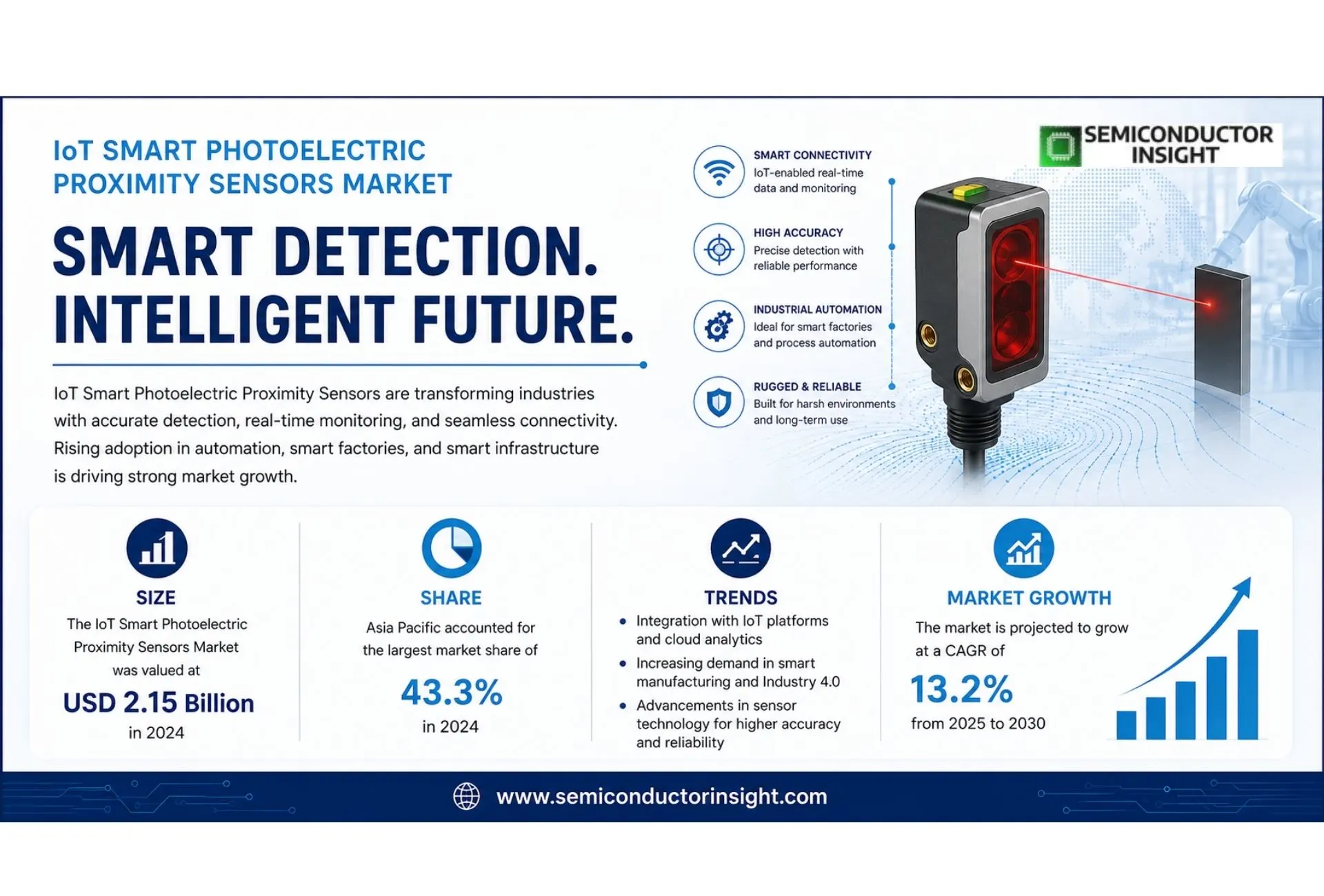
MARKET DRIVERS
Industry Adoption of Intelligent Automation
The continued push toward intelligent automation across automotive, electronics and logistics sectors is compelling demand for IoT Smart Photoelectric Proximity Sensors Market solutions. Companies are now deploying sensor farms to provide non-contact detection of assemblies, reducing downtime caused by mechanical backlash and wear. The ability of these proximity detectors to transmit performance metrics to cloud dashboards eliminates manual calibration cycles, cuts maintenance labor, and accelerates cycle time by 15–20 %. Businesses that implement IP74‑rated sensors in dusty assembly lines have reported a 12 % increase in throughput while maintaining compliance with ISO 13849 safety standards. As plants expand their digital twins, the data harvested from these proximity sensors becomes integral to predictive analytics, allowing engineers to forecast component arrival and adjust scheduling in real time. This synergy between sensor technology and automation platforms underscores a solid growth engine that is unlikely to reverse without an exogenous shock.
Energy Efficiency as a Competitive Differentiator
Energy consumption is increasingly a focal point for both cost management and ESG reporting. IoT Smart Photoelectric Proximity Sensors Market devices are designed to operate on micro‑current levels, often <0.5 mA, which translates into a 25 % reduction in overall field power usage when compared to legacy inductive or capacitive alternatives. Manufacturers that integrate these low‑power sensors with smart M2M networks can significantly lower the kinetic footprint of their production lines. Moreover, the integration of advanced firmware that performs adaptive thresholding reduces false‑trigger rates and extends component lifespan, bringing additional savings in replacement and spare parts inventory. Financial models indicate that factories employing these energy‑efficient sensors can offset their initial capital expenditure within three to four years through conserved power budgets and elevated production capacity.
➤ “The convergence of energy management and real‑time visibility positions IoT smart proximity systems as indispensable in next‑generation factories.”
Combine these technological and economic incentives, and the trajectory of the market shows clear upward momentum. Companies shifting from analog to digital sensor ecosystems are not only modernizing their production flows but also realigning their operational risk profiles, thereby creating a virtuous cycle that fuels further investment in the IoT Smart Photoelectric Proximity Sensors Market.
MARKET CHALLENGES
Integration Complexity Across Legacy Infrastructure
Despite the compelling benefits, many large‑scale OEMs face hurdles when retrofitting existing equipment with advanced proximity detection. Legacy machinery often lacks the standardized communication stacks (e.g., MQTT, OPC UA) required for seamless IoT integration, mandating costly field‑bus converters or custom firmware development. The fragmentation of legacy protocols creates a barrier to entry for suppliers of IoT smart proximity solutions, especially in regions with tightly regulated industrial directives. Consequently, the adoption curve is uneven, with high‑value deployments concentrated in high‑tech hubs, while mid‑tier plant operators lag behind due to integration overhead.
Other Challenges
Implementation Cost Concerns
Upfront hardware purchases, firmware licensing fees, and the need for skilled personnel to deploy and monitor IoT pipelines raise the project cost envelope. Many firms calculate that the return on investment for an IoT proximity sensor array is 12 to 18 % higher than for conventional analog systems, but this incremental yield may not justify the full capital batch for budget-constrained units.
MARKET RESTRAINTS
Supply Chain Vulnerabilities of Miniaturized Components
The miniaturization that characterizes the latest generation of photodiodes and p‑i‑n junctions has rendered them highly dependent on specialized semiconductor fabrication facilities. Any disruption in the global micro‑electronics supply chain—whether from geopolitical tension, natural disasters, or rink‑code shortages—can lead to prolonged lead times that ripen the risk profile for manufacturers. Quarterly shipment data indicates that lead times for high‑resolution IP84 sensors have increased by 22 % compared with pre‑pandemic levels, thereby eroding the strategic advantage of rapid deployment. Companies building up inventory buffers mitigate this risk but pay a premium that can offset short‑term cash flows.
Regulatory Compliance Deterrents
Higher safety standards imposed by occupational safety authorities require rigorous testing and certification for sensors used in hazardous environments, especially when employed in hazardous material handling or robotic workcells. The certification pathway, often spanning 12 to 18 months, adds to the cycle time and complicates market entry for new product variants that purport enhanced detection ranges or lower power consumption. The regulatory lag can stall product roll‑outs, leaving competitors with a temporary advantage.
MARKET OPPORTUNITIES
Emerging Applications in Autonomous Mobile Robotics
Autonomous mobile robots (AMRs) are redefining material transport and warehouse operations. The core requirement for collision avoidance and navigational accuracy lies in reliable, low‑latency proximity sensing. IoT Smart Photoelectric Proximity Sensors Market offerings, equipped with adaptive light‑beam alignment and real‑time drift correction, provide AMRs with up to 95 % accuracy over a 1.5‑meter detection window, even under variable lighting. The rapid uptake of AMR fleets across e‑commerce fulfillment networks and cross‑border freight hubs presents a rising demand curve that remains under 40 % penetrated, suggesting ample capacity for growth.
By positioning their products as integral safety layers within robot perception stacks, sensor manufacturers can secure long‑term collaboration agreements with leading industrial robot makers. Incorporating built‑in firmware that streams diagnostic data over secure industrial protocols ensures that sensor downtime correlates with overall vehicle health metrics, producing a closed‑loop maintenance model that resonates with asset‑intensive operators.
Investments in research areas such as machine‑learning‑enhanced signal filtering will further differentiate product portfolios, allowing companies to claim “edge‑computing” capabilities that reduce reliance on edge gateways. The convergence of these technologic avenues with growing capital commitments to automation in the automotive and aerospace segments signifies a fertile territory for market expansion, as enterprises seek to embed predictive safety and operational visibility into every step of their production ethos.
IoT Smart Photoelectric Proximity Sensors Market Trends
Primary Trend: Demand Surge Driven by Distributed Industrial Connectivity
Steady expansion in globally connected IoT devices, reaching roughly 14 billion units, creates a pronounced need for sensors that maintain integrity amid atmospheric contaminants and complex automation environments. Photoelectric proximity sensors, especially through‑beam and retro‑reflective variants, have proven resilient on conveyor belts and in automatic sanitisation lines. Their capability to switch between dark‑on and light‑on modes enables tight integration with safety‑critical systems, reducing false‑positives that can halt production lines. As industrial portfolios continue to embrace predictive maintenance and real‑time process visibility, the demand for sensors delivering millimetre‑level accuracy is escalating, pushing suppliers to innovate trigger circuits and adherence standards.
Other Trends
Integration with Autonomous Vehicle Platforms
In the automotive arena, sensor clusters are migrating from traditional radar and lidar back to optical modules that offer lower power consumption and immunity to electromagnetic interference. Manufacturers are deploying photoelectric modules in rear‑view monitoring arrays and blind‑spot detection systems, leveraging the higher contrast ratios attainable in urban light conditions. The shift is prompted by tightening safety regulations that mandate redundancy; a dual‑modal sensor that can cross‑verify signals mitigates single‑point errors. Consequently, North American OEMs are allocating larger budgets to optical sensor farms, creating upstream opportunities for component suppliers fluidly sourcing precision collimators.
Advanced Modulation and Signal Processing
Beyond basic illumination, the industry is experimenting with pulsed narrow‑band lasers and frequency‑shift modulation to distinguish target types in high‑noise factories. These approaches allow a single unit to discriminate metallic from non‑metallic surfaces while sustaining detection distances beyond 20 cm. Implementation of error‑correction protocols embedded in the bridge circuitry further tightens signal fidelity. Accompanying firmware updates are enabling OTA calibration routines, reducing maintenance downtime. Firms that master these techniques position themselves as preferred partners for high‑volume production plants seeking reliability under explosive gas or dust envelopes.
Regional Expansion in Southeast Asia: Accelerated 5G Adoption Fuels Market Growth
Southeast Asian markets are harnessing accelerated 5G rollouts, with over 2 million base stations deploying globally, creating bandwidth for real‑time sensor telemetry. Chinese, Vietnamese, and Thai manufacturers are investing in local fabrication lines to cater to expanding automotive and consumer electronics hubs. The region’s rising demand for clean‑room and food‑processing automation will accelerate adoption of photoelectric proximity sensors. While data‑center densities remain below North American levels, targeted subsidies for IoT ecosystems are driving domestic vendors to adopt sensor modules early, nurturing a competitive ecosystem that may recalibrate global supply chains.
COMPETITIVE LANDSCAPE
Key Industry Players
IoT Smart Photoelectric Proximity Sensors Market Analysis
At the core of the IoT smart photoelectric proximity sensor market lies a concentration of a handful of legacy manufacturers who have leveraged their extensive automation portfolios to capture the growing demand in safety‑critical and process‑automation applications. Rockwell Automation, with its Rockwell Digital™ brand, has built a compelling sensor offering that integrates seamlessly into its FactoryTalk® ecosystem, thereby gaining visibility in industrial plants that prioritize open‑loop and closed‑loop control. Siemens, through its SINUMERIK and SIMATIC sensor lines, delivers high‑confidence detection that aligns with the company’s emphasis on digital twins and predictive maintenance, attracting OEMs in automotive and fatigue‑sensitive manufacturing. SICK, a long‑standing authority on safety sensing, has recently expanded its product range to incorporate low‑light and high‑temperature variants, positioning itself at the forefront of environments with harsh atmospheric contaminants. These incumbents set a high bar for performance and interoperability, leading market participants across the value chain to look beyond traditional sensor characteristics toward data‑driven edge intelligence.
Meanwhile, a cohort of specialized suppliers is carving niches through focused technical capabilities and regionally concentrated operations. Wenglor Sensoric offers compact, low‑power retro‑reflective units that appeal to portable assembly lines, while Marsh Bellofram’s dual‑modality sensors (infrared and acoustic) address aerospace components where fine grain detection is mandatory. HTM Sensors delivers a broad spectrum of through‑beam solutions that cater to conveyor systems in high‑density warehouses, and Autonics publishes low‑cost, high‑throughput variants that serve consumer electronics manufacturing. Fargo Controls and Pepperl+Fuchs, both headquartered in Europe, supply sensors with built‑in diagnostic features that resonate with compliance‑driven factories. STMicroelectronics and Murata Electronics augment the market with silicon‑based proximity solutions that integrate directly with microcontrollers, enabling seamless edge deployment in smart factory use cases. Together, these players infuse depth into the competitive landscape, encouraging incumbents to reinvest in R&D to maintain differentiation.
List of Key Industry Companies Profiled
- Rockwell Automation
- SICK
- Siemens
- IFM Efector
- ABB
- Keyence
- Honeywell
- Wenglor Sensoric
- Marsh Bellofram
- HTM Sensors
- Autonics
- Fargo Controls
- STMicroelectronics
- Pepperl + Fuchs
- Murata Electronics
Segment Analysis:
| Segment Category | Sub-Segments | Key Insights |
| By Type |
|
Through-Beam sensors dominate contexts requiring high accuracy and swift response, offering consistent performance amid fluctuating ambient light. • Provide precise detection over moderate distances. • Maintain reliability in harsh industrial environments. • Enable seamless integration with industrial control systems. |
| By Application |
|
Automotive applications leverage photoelectric sensors for safety interlocks, gear position detection, and automated parking. • Deliver rapid response times that support active safety features. • Operate reliably under extreme temperature variations. • Conform to stringent automotive safety standards. |
| By End User |
|
Manufacturing users prioritize reliability, compactness, and low maintenance for assembly line automation. • Require sensors that withstand continuous operation and vibration. • Benefit from long‑life components that reduce downtime. • Demand certification to meet industrial safety protocols. |
| By Installation Environment |
|
Industrial Floor settings drive demand for robust, vibration‑tolerant sensors that maintain accuracy in dynamic factory environments. • Offer high durability and low drift. • Provide quick response for automated conveyor controls. • Often designed with brush‑less electronics to reduce maintenance. |
| By Protection Level |
|
IP67 qualifies for applications that experience water splash and dust exposure, such as outdoor kiosks and ports. • Ensure waterproofing without sacrificing sensor performance. • Facilitate rugged design for harsh weather or marine environments. • Support fail‑safe operations in safety‑critical installations. |
Regional Analysis: IoT Smart Photoelectric Proximity Sensors Market
Demand from automotive‑sector automation and flex‑pick systems fuels revenue growth; increasing focus on real‑time safety monitoring expands sensor footprints across production cells.
Integration of AI‑enabled optical classification and wireless edge protocols reduces latency, boosting accuracy for high‑speed conveyor environments.
Consolidated supply of key photodiodes lowers component risk; tier‑2 suppliers diversify with low‑cost CMOS variants.
Emerging safety mandates on sensor‑enabled security systems accelerate adoption across critical infrastructure projects.
Europe
Europe’s sensor market is tightening its focus on high‑precision industrial deployments, leveraging robust compliance frameworks that demand fail‑safe optical detection. Many European OEMs are partnering with cloud‑based analytics platforms to enhance sensor visibility, creating a synergistic environment tailored to sustainability initiatives. The region also sees a rising emphasis on localized manufacturing to reduce lead times, benefiting from a strong supplier network for optical components.
Asia-Pacific
Asia‑Pacific remains the fastest expanding footprint for IoT Smart Photoelectric Proximity Sensors Market, driven by vast automotive production hubs and a booming consumer electronics sector. Rapid digitalization in the region catalyzes widespread deployment of smart factory solutions, and players are capitalizing on cost‑effective production facilities while integrating edge‑computing utilities to optimize sensor performance across sprawling premises. Regulatory drives for energy efficiency induce a shift toward lower‑power, longer‑lifetime optical sensors, reinforcing demand trajectories.
South America
South America’s sensor adoption is intimately linked to resilient supply chains within industrial textile and beverage sectors; modernization of production lines accommodates smart proximity devices for safety and quality control. Emerging market players are exploring joint ventures with European technology firms to transfer optical expertise, generating value for both sides. A surge in automation contracts for export‑oriented manufacturers is forecast to modestly lift sensor penetration, chaptering a gradual yet consistent growth profile.
Middle East & Africa
The Middle East & Africa region captures niche demand from petrochemical and refinement industries, where optical sensors are essential for leak detection and safety protocols. Subsidised capital expenditure initiatives tailored to industrial modernization sustain incremental sensor uptake, while local governments push for higher automation levels to counter labour scarcity. Investor interest in renewable energy hubs also drives sensor application across solar and wind farms, establishing a diversified customer base that fosters incremental market expansion.
Report Scope
This market research report provides a comprehensive analysis of the IoT Smart Photoelectric Proximity Sensors Market , covering the forecast period 2026–2035. It offers detailed insights into market dynamics, technological advancements, competitive landscape, and key trends shaping the industry.
Key focus areas of the report include:
-
Market Overview: The report begins with an overview outlining its current market scenario, key growth indicators, and industry transformation drivers. It discusses macroeconomic factors, demand–supply balance, regulatory landscape, and the strategic role of semiconductors in powering advancements across industries such as automotive, telecommunications, consumer electronics, and industrial automation.
- Market Size & Forecast: Historical data and future projections for revenue, unit shipments, and market value across major regions and segments.
- Segmentation Analysis: Detailed breakdown by product type, technology, application, and end-user industry to identify high-growth segments and investment opportunities.
- Regional Insights: Insights into market performance across North America, Europe, Asia-Pacific, Latin America, and the Middle East & Africa, including country-level analysis where relevant.
- Competitive Landscape: Profiles of leading market participants, including their product offerings, R&D focus, manufacturing capacity, pricing strategies, and recent developments such as mergers, acquisitions, and partnerships.
- Technology Trends & Innovation: Assessment of emerging technologies, integration of AI/IoT, semiconductor design trends, fabrication techniques, and evolving industry standards.
- Market Drivers & Restraints: Evaluation of factors driving market growth along with challenges, supply chain constraints, regulatory issues, and market-entry barriers.
- Stakeholder Insights: Insights for component suppliers, OEMs, system integrators, investors, and policymakers regarding the evolving ecosystem and strategic opportunities.
Primary and secondary research methods are employed, including interviews with industry experts, data from verified sources, and real-time market intelligence to ensure the accuracy and reliability of the insights presented.
FREQUENTLY ASKED QUESTIONS:
What is the current market size of IoT Smart Photoelectric Proximity Sensors Market?
-> The IoT Smart Photoelectric Proximity Sensors Market was valued at USD not disclosed in 2026 and is projected to reach USD not disclosed by 2035, at a CAGR of not disclosed% during the forecast period.
Which key companies operate in IoT Smart Photoelectric Proximity Sensors Market?
-> Key players include Rockwell Automation, IFM Efector, Pepperl + Fuchs, SICK, Schneider Electric, Keyence, Siemens, Wenglor Sensoric, Honeywell, Altech, ABB, Omron, STMicroelectronics, Murata Electronics, Marsh Bellofram, HTM Sensors, Monarch Instrument, Autonics, Fargo Controls.
What are the key growth drivers?
-> Key growth drivers include increasing demand for automation in manufacturing, the expanding use of proximity sensors in harsh industrial environments, and the rapid adoption of smart manufacturing technologies.
Which region dominates the market?
-> Information not disclosed.
What are the emerging trends?
-> Emerging trends not disclosed.

Get Sample Report PDF for Exclusive Insights
Report Sample Includes
- Table of Contents
- List of Tables & Figures
- Charts, Research Methodology, and more...
 Download Sample Report PDF