IoT Smart Magnetic Proximity Sensors Market Insights
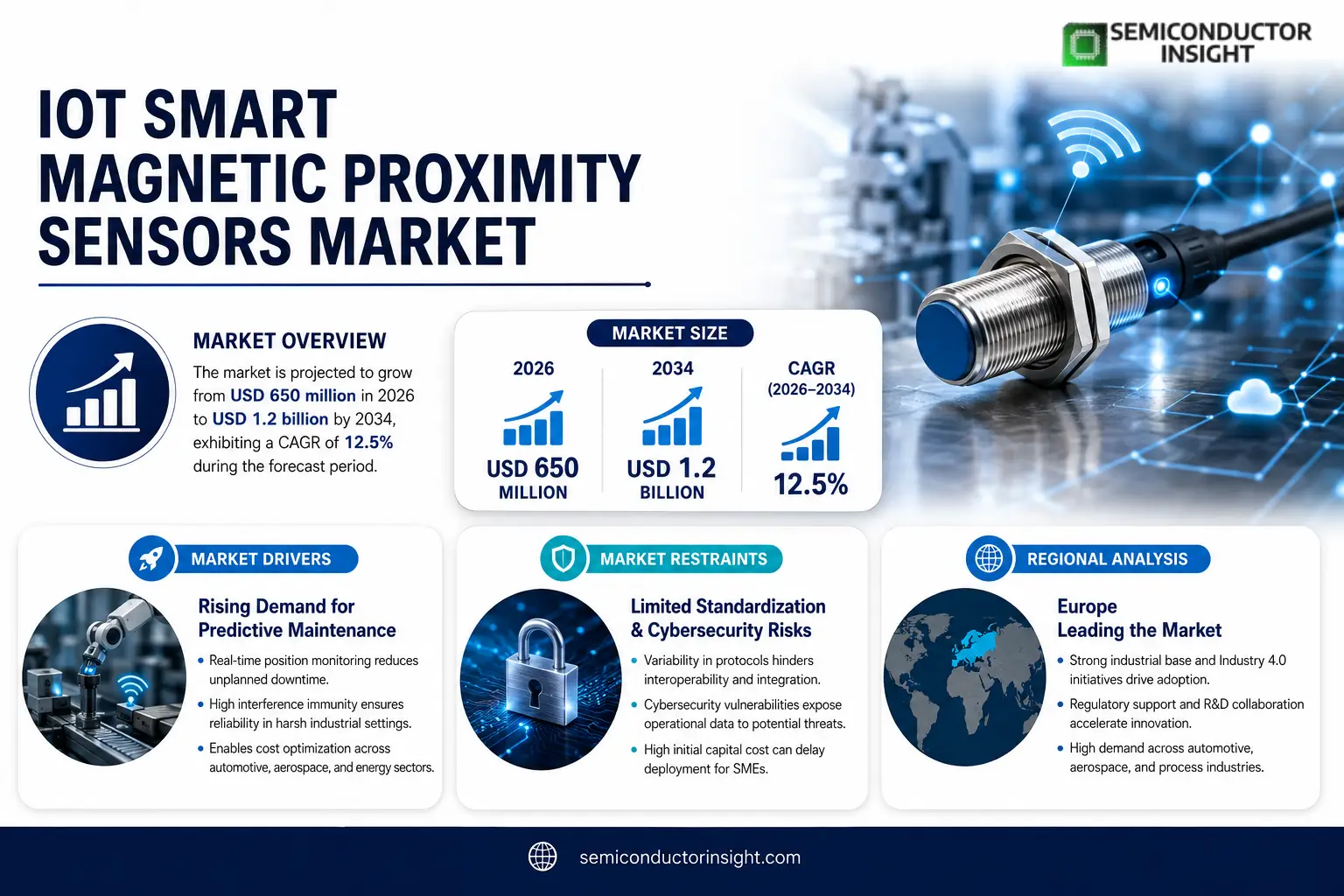
IoT Smart Magnetic Proximity Sensors market was valued at USD 650 million in 2026 and is projected to reach USD 1.2 billion by 2034, exhibiting a CAGR of 12.5% during the forecast period.
IoT smart magnetic proximity sensors operate over longer ranges than inductive counterparts and can detect magnets through non‑ferrous metals, plastic and wood, making them suitable for clean‑in-place systems and tracking cleaning equipment within pipelines. Each sensor houses a hermetically sealed reed switch; when a magnet approaches, the reed contacts flex together, creating an electrical bridge that signals the presence of the magnet.The number of ly connected IoT devices reached approximately 14 billion in early 2026an increase of roughly 18% versus 2021while China’s deployment of over 2.3 million 5G base stations by end‑2022 supports this expansion; IPv6 adoption now accounts for nearly half of mobile network traffic.
MARKET DRIVERS
Rising Demand for Predictive Maintenance
The push toward predictive maintenance is reshaping industrial operations, creating an environment where real‑time positional awareness is critical. For the IoT Smart Magnetic Proximity Sensors Market, this translates into a heightened need for reliable, low‑maintenance sensors that can monitor critical components such as bearings, gear trains, and motor shafts without manual intervention. The sensors’ inherent immunity to electromagnetic interference makes them particularly suitable for harsh factory settings, allowing businesses to capture precise data streams that feed advanced analytics platforms. As manufacturers look to reduce unplanned downtime, investing in magnetic proximity solutions becomes a strategic lever for cost optimization, directly influencing procurement budgets and sustaining a rapid adoption curve across automotive, aerospace, and energy sectors.
Integration of Edge Computing and AI/ML Capabilities
Edge‑enabled IoT sensors, equipped with onboard processing, are reducing data latency and expediting decision making. The IoT Smart Magnetic Proximity Sensors Market benefits from this trend as devices can now perform local anomaly detection, flagging deviations before they cascade into system failures. The confluence of edge computing and AI/ML also enhances energy efficiency: by dynamically adjusting sampling rates based on real‑time load, sensors consume less power, extending lifetime in remote locations. Consequently, operators can deploy larger sensor swarms without escalating network traffic, making widespread deployment both economically and technically viable.
➤ Strategic procurement of magnetic proximity sensors is no longer a niche decisionit is integral to modern industrial digitization, setting the groundwork for resilience in production lines and supply chains.
When businesses align their digital transformation roadmap with scalable sensor ecosystems, they unlock measurable performance gains. For the IoT Smart Magnetic Proximity Sensors Market, the ability to minimize reactive maintenance, reduce operational expenditures, and support compliance with safety standards positions magnetic proximity solutions as a catalyst for long‑term competitive advantage.
MARKET CHALLENGES
High Initial Capital Expenditure
Despite operational savings, the upfront installation cost associated with deploying a comprehensive network of magnetic proximity sensors remains a deterrent for small and medium enterprises. Retrofitting legacy machinery requires careful integration work, and the capital budget allocation competes with other digital initiatives. Moreover, while many sensors promise minimal maintenance, the initial hardware and firmware costs can push total invested capital beyond the thresholds of cost‑benefit analyses in the near term. These financial barriers extend the lead time for the IoT Smart Magnetic Proximity Sensors Market to reach saturation.
Other Challenges
Cyber‑Security Vulnerabilities
As sensors become part of an interconnected fabric, protecting sensitive positional data from cyberattacks emerges as a critical concern. Inadequate encryption or unsecured communication channels can expose operational intelligence to malicious actors, compromising production integrity and eroding trust in IoT deployments.
MARKET RESTRAINTS
Limited Standardization Across Sensor Modules
Variability in sensor interfaces, data formats, and communication protocols hinders interoperability among devices from disparate vendors. In the IoT Smart Magnetic Proximity Sensors Market, this lack of standardization slows integration efforts and inflates technology acquisition costs. Operators must invest in custom middleware or develop proprietary solutions to bridge gaps, which can delay time‑to‑value and dilute economies of scale.
MARKET OPPORTUNITIES
Expansion Into Emerging Markets
The IoT Smart Magnetic Proximity Sensors Market is poised to benefit from infrastructure development in emerging economies. Rapid industrialization in Southeast Asia and Latin America is fostering a demand for cost‑effective, low‑maintenance sensing solutions. Export‑oriented manufacturers can capitalize on these growth corridors by tailoring sensor packages that accommodate regional power characteristics and localized communication standards, thereby capturing a first‑mover advantage in untapped territories.Market players must navigate the dual imperatives of technological innovation and practical deployment. By aligning sensor capabilities with specific industry pain pointssuch as energy conservation, predictive analytics, and robust edge computingcompanies can create differentiated value propositions that resonate with their target clientele, ensuring sustainable market growth.
IoT Smart Magnetic Proximity Sensors Market Trends
Elevated Adoption in Industries Demanding High-Precision Tracking
Executives in process control and critical automation now view IoT Smart Magnetic Proximity Sensors as less of an ancillary component and more as a core enabler of yield optimization. In sectors such as clean-in-place systems, the ability to detect magnets across non-ferrous metals, plastics and wood removes a persistent blind spot that inductive models cannot cover. Consequently, the cost advantage of magnetic offers is outweighing incumbent technologies, especially where the inventory cycle can be compressed from hours to minutes through real‑time asset monitoring.
Other Trends
Grid Connectivity and Network Maturity as Enablers
China’s recent launch of over half a million gigabit cameras across 110 megacities is an early sign that high bandwidth and low latency are standard rather than exceptional. In parallel, the nearly 50 % penetration of IPv6 traffic underscores a shift toward network architectures capable of supporting the massive device footprints required for full‑scale sensor fleets. These network evolutions directly lower the command‑and‑control latency, enabling real‑time close‑loop adjustments that were previously constrained by layer‑2 hops.
Distributed Manufacturing and the Rise of Custom Sensor Modules
Manufacturers are re‑engineering sensor stacks to support faster, more granular data collection. The “plug‑and‑play” approach, made viable by standardized fibre‑optic interfaces, offers a flexible deployment scheme that aligns with the trend of distributed control loops. As a result, OEMs in the aerospace and automotive supply chains are invoicing sensor modules at a higher gross margin, reflecting the added value delivered through predictive maintenance and real‑time defect filtering.
COMPETITIVE LANDSCAPE
Key Industry Players
IoT Smart Magnetic Proximity Sensors Competitive Landscape
At the forefront of the IoT smart magnetic proximity sensor arena remains IFM Efector, whose integrated reed‑switch architecture has cemented a dominant position in both industrial automation and safety‑critical applications. The firm’s expansive portfoliospanning inductive, capacitive and magnetic proximity modulessupports a broad spectrum of verticals, from automotive assembly lines to high‑speed conveyor systems. IFM’s 2026 revenue, which exceeded US$ 900 million, and its sustained investment in design‑capture tools underscore a commitment to differentiated performance and seamless integration with Industrial Internet of Things (IIoT) platforms. Coupled with a robust distribution network that covers over 70 countries, the company has successfully tokenised scale as a source of recurring revenue, while simultaneously locking in sizeable proportion of the near‑term demand driven by heightened safety standards and automation digitisation. The upward trajectory of its earnings trajectory, coupled with steady order intake from tier‑one OEMs, bolsters the company’s leverage to pursue strategic acquisitions within adjacent sub‑segments, notably in high‑precision positioning.Niche but technically agile operators, such as Red Lion Controls, SICK, and Hans Turck, carve out a complementary niche by offering specialised solutions tuned for clean‑room automation, hazardous‑environment monitoring and retrofit applications. These firms bring an elevated focus on modular scalability, low‑power consumption, and open‑API compatibility, thereby resonating with SMEs seeking rapid time‑to‑market deployments without large upfront capital. While their revenue figuresgenerally in the range of US$ 100–250 millionfall short of the industry leader, their high‑margin positioning compensates by targeting high‑value, low‑volume verticals such as aerospace maintenance and medical device manufacturing. Importantly, the vendor mix demonstrates increasing fragmentation in end‑use categories, a trend that points to future opportunities for mid‑tier players to augment their capability with tailored firmware networking stacks or predictive‑maintenance services. Consequently, incumbents face the imperative to extend product ecosystems beyond standalone sensing to capture the tranche of enterprise. This strategic shift will be pivotal in retaining market share against a backdrop of escalating automation budgets and tightening regulatory environments.
List of Key IoT Smart Magnetic Proximity Sensors Companies Profiled
- IFM Efector
- Pepperl + Fuchs
- Honeywell
- Red Lion Controls
- SICK
- Rockwell Automation
- Keyence
- Fargo Controls
- Hans Turck
- Emerson Automation Solutions
- IDEC
- Celduc
Segment Analysis:
| Segment Category | Sub-Segments | Key Insights |
| By Type |
|
Leading Segment description with qualitative insights only [Pointers preferred in bullets atleast 2-3].
|
| By Application |
|
Leading Segment description with qualitative insights only [Pointers preferred in bullets atleast 2-3].
|
| By End User |
|
Leading Segment description with qualitative insights only [Pointers preferred in bullets atleast 2-3].
|
| By Power Supply Type |
|
Leading Segment description with qualitative insights only [Pointers preferred in bullets atleast 2-3].
|
| By Sensor Size |
|
Leading Segment description with qualitative insights only [Pointers preferred in bullets atleast 2-3].
|
Regional Analysis: IoT Smart Magnetic Proximity Sensors Market
Europe
European manufacturers are integrating magnetic proximity sensors into broader digital twins, thereby elevating fault‑prediction models. Supply‑chain visibility is improved as sensor data feeds into cloud‑based analytics, driving leaner operation cycles and reducing downtime costs.
The adoption of EU safety and data‑privacy directives has steered the development of sensors with built‑in encryption and tamper‑proof features, boosting confidence in field deployments.
Collaborative projects between consortia and universities foster rapid prototyping of ultra‑compact magnetic modules that fit 3D‑printed or additive‑manufactured components, expanding the utility of sensors in niche production lines.
From automotive torque monitoring to healthcare imaging, European firms are tailoring magnetic proximity analytics to diverse verticals, thus broadening the market portfolio across key industrial sectors.
North America
In North America, the IoT Smart Magnetic Proximity Sensors Market remains driven by the automotive and aerospace segments, where precise motor fault detection is critical. U.S. firms are pivoting toward edge‑computing modules that pair sensor output with rapid data processing, allowing instant anomaly alerts within complex robotic systems. The region’s venture‑capital environment fuels start‑ups that are pushing the envelope on low‑energy consumption, adaptive‑frequency sensing that integrates seamlessly with existing PLC systems. However, regulatory complianceparticularly concerning cybersecurity in industrial control systemsposes a challenge that is reshaping vendor offerings toward built‑in secure communication protocols.
Asia-Pacific
Across the Asia‑Pacific, the market is expanding at a pace fueled by manufacturing conglomerates that are upgrading legacy plants with IoT skeletons. Chinese equipment makers, in particular, are incorporating magnetic proximity sensors into large‑scale conveyor and packaging lines to slash maintenance windows, while South Korean firms integrate these sensors with AI‑driven quality‑control workflows. Regional smart‑city initiatives are also fostering sensor deployments that monitor infrastructure health, notably in rail and elevated‑track systems. Pricing sensitivity remains high, pushing manufacturers toward modular sensor kits that can be rapidly redeployed across multiple product lines without system overhauls.
South America
In South America, enterprise adoption is gaining traction in the mining and petrochemical industries, where near‑field magnetic proximity sensors are used to monitor rotating equipment in harsh environments. Brazilian steel mills have introduced multipoint sensor arrays to track bearing wear, demonstrating reductions in unscheduled plant downtime. Nevertheless, the region contends with a fragmented regulatory landscape that makes cross‑border data integration difficult, limiting the scalability of geographically dispersed sensor networks. To mitigate this, local integrators are developing region‑specific firmware that translates sensor outputs into standardized readability, ensuring smoother interoperability across multinational processing chains.
Middle East & Africa
In the Middle East and Africa, infrastructure projects driven by sovereign wealth funds present an opportunity for deploying IoT Smart Magnetic Proximity Sensors in power generation, water treatment, and logistics. Oil‑field equipment increasingly uses magnetic proximity analytics to predict vibration anomalies in turbine gearboxes, while Qatar’s ports are installing sensor clusters on cranes to improve operational safety. The region faces challenges in power consistency for cloud connectivity, prompting vendors to offer hybrid edge‑cloud solutions that can operate offline and sync when throughput is available. Strategies focused on low‑maintenance, ruggedized sensor housings tailored for high‑temperature, corrosive environments are also emerging, providing a competitive edge in emerging markets.
Report Scope
This market research report provides a comprehensive analysis of the IoT Smart Magnetic Proximity Sensors Market , covering the forecast period 2026–2034. It offers detailed insights into market dynamics, technological advancements, competitive landscape, and key trends shaping the industry.
Key focus areas of the report include:
- Market Overview: The report begins with an overview outlining its current market scenario, key growth indicators, and industry transformation drivers. It discusses macroeconomic factors, demand–supply balance, regulatory landscape, and the strategic role of semiconductors in powering advancements across industries such as automotive, telecommunications, consumer electronics, and industrial automation.
- Market Size & Forecast: Historical data and future projections for revenue, unit shipments, and market value across major regions and segments.
- Segmentation Analysis: Detailed breakdown by product type, technology, application, and end-user industry to identify high-growth segments and investment opportunities.
- Regional Insights: Insights into market performance across North America, Europe, Asia-Pacific, Latin America, and the Middle East & Africa, including country-level analysis where relevant.
- Competitive Landscape: Profiles of leading market participants, including their product offerings, R&D focus, manufacturing capacity, pricing strategies, and recent developments such as mergers, acquisitions, and partnerships.
- Technology Trends & Innovation: Assessment of emerging technologies, integration of AI/IoT, semiconductor design trends, fabrication techniques, and evolving industry standards.
- Market Drivers & Restraints: Evaluation of factors driving market growth along with challenges, supply chain constraints, regulatory issues, and market-entry barriers.
- Stakeholder Insights: Insights for component suppliers, OEMs, system integrators, investors, and policymakers regarding the evolving ecosystem and strategic opportunities.
Primary and secondary research methods are employed, including interviews with industry experts, data from verified sources, and real-time market intelligence to ensure the accuracy and reliability of the insights presented.
FREQUENTLY ASKED QUESTIONS:
What is the current market size of IoT Smart Magnetic Proximity Sensors Market?
-> IoT Smart Magnetic Proximity Sensors market was valued at USD 650 million in 2026 and is projected to reach USD 1.2 billion by 2034, exhibiting a CAGR of 12.5% during the forecast period.
Which key companies operate in IoT Smart Magnetic Proximity Sensors Market?
-> Key players include IFM Efector, Pepperl + Fuchs, IDEC, Honeywell, Fargo Controls, Red Lion Controls, SICK, Rockwell Automation, Celduc, Hans Turck, Emerson Automation Solutions, Keyence, Micro-Epsilon, Omron, General Electric, Eaton, Phidgets, NXP Semiconductors, Panasonic, STMicroelectronics, Sensata Technologies, and Smith Systems.
What are the key growth drivers?
-> Key growth drivers include long‑range detection capabilities, integration with clean-in-place systems, tracking of cleaning devices inside pipelines, the rapid expansion of 5G base stations, Internet of Things (IoT) connectivity, and the growing demand for smart industrial automation solutions.
Which region dominates the market?
-> Asia-Pacific is the fastest‑growing region, while Europe remains a dominant market.
What are the emerging trends?
-> Emerging trends include long‑range magnetic proximity sensors, integration with AI and edge computing, adoption of 5G connectivity, expansion of data center infrastructure, and the rise of smart manufacturing platforms.

Get Sample Report PDF for Exclusive Insights
Report Sample Includes
- Table of Contents
- List of Tables & Figures
- Charts, Research Methodology, and more...
 Download Sample Report PDF