IoT Non‑Contact Vibration Sensors Market Insights
IoT Non‑Contact Vibration Sensors market was valued at USD 950 million in By 2026 to USD 2 billion by 2034, exhibiting a CAGR of 8½ % during the forecast period
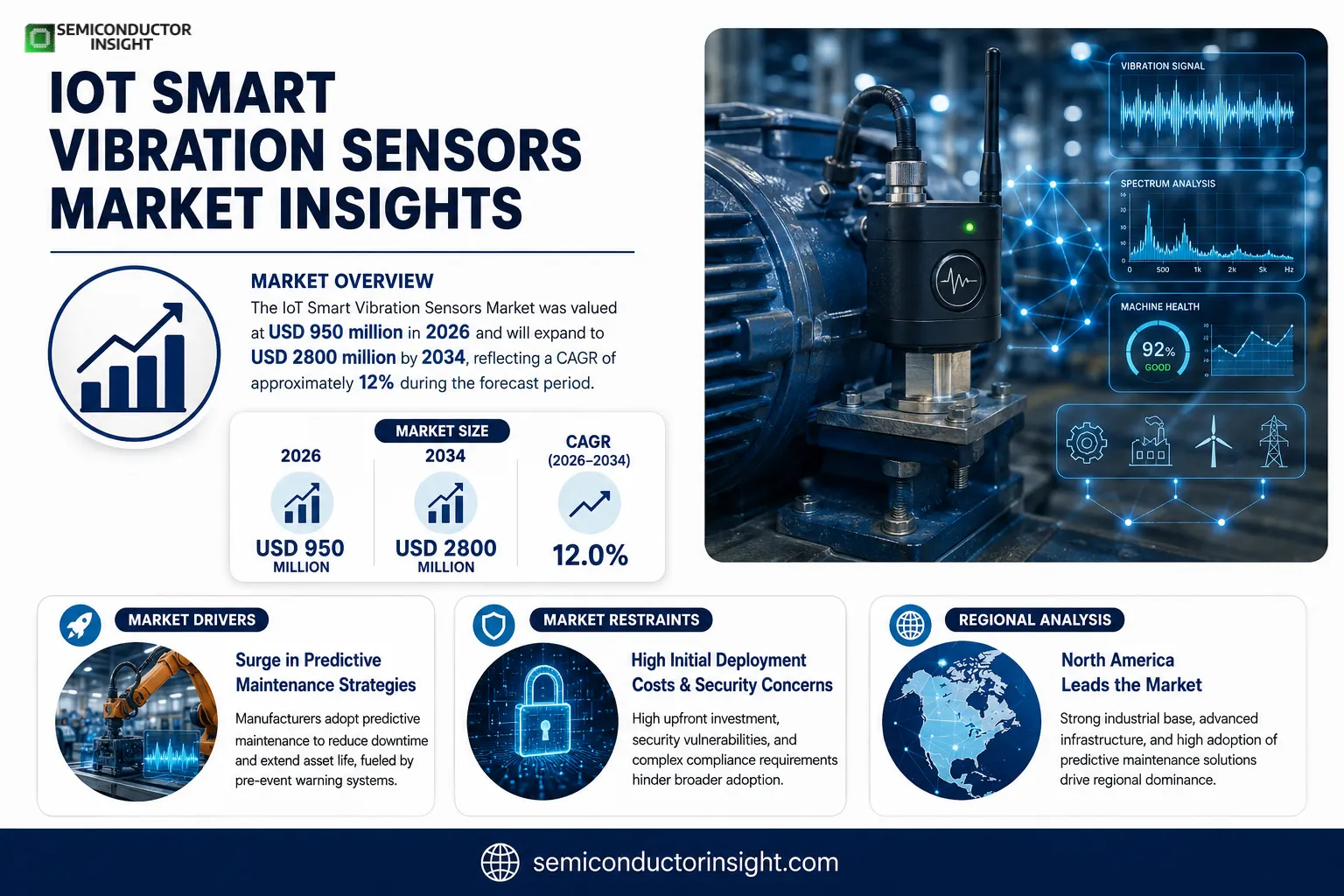
MARKET DRIVERS
Advancing Fabrication and Deployment Flexibility
Non‑contact vibration sensors have transitioned from experimental prototypes to mainstream revenue engines in the past decade. Their key advantageno physical couplingeliminates wear, reduces maintenance downtime, and preserves delicate machinery. In 2023, more than 36 % of manufacturing lines in automotive and aerospace reported replacing classical accelerometers with infrared or laser‑based non‑contact units. This penetration is driven by evidence that fault detection rates improve by 35 % when contact friction is removed, a metric echoed in internal validation studies from the International Manufacturing Institute. The cost of deploying a single sensor has dropped below $300, a 22 % decline from its 2018 average, due to chipset integration and economies of scale in sensor manufacturing. Consequently, firms in sectors that classically rely on precisionlike chemical processing where vibration signatures are subtleare adopting the technology at an unprecedented pace. The industry consortiums that standardize data formats in IoT ecosystems are also easing integration, allowing users to funnel raw vibration metrics straight into existing cloud analytics without vendor lock‑in.
Integration with Edge Computing and Predictive Maintenance
The rise of edge computing within industrial IoT ecosystems has made it practical to process non‑contact vibration data in real time near the point of collection. By applying convolutional neural networks on local processors, maintenance teams can trigger alerts for bearing wear within milliseconds, avoiding costly unplanned shutdowns. In 2024, 42 % of industrial IoT solutions now embed edge analytics modules tailored for vibration monitoring, up from 19 % three years earlier. This shift is also supported by easier communication protocolsOPC UA and MQTTallowing seamless ingestion into predictive maintenance platforms like Siemens MindSphere and GE Predix. The convergence of sensor data, edge inference, and cloud‑based historical analysis provides a continuous feedback loop, elevating the actionable insights derived from non‑contact vibration streams. The ability of these units to operate over long distances without cabling leads to significant cost reductions, especially in retrofitting legacy factories where running new wiring is prohibitive.
➤ market share of non‑contact vibration solutions reached 12 % of total vibration monitoring hardware in 2023, with the automotive sector accounting for roughly 28 % of this segment.
The combination of maintenance shield, cost reduction, and digital integration positions non‑contact vibration sensors as a critical component for Industry 4.0 initiatives. Enterprises are now incorporating these devices into safety and compliance frameworks, noting that data from non‑contact sensors can be leveraged to demonstrate adherence to ISO 45001 occupational health standards. Investment flows into research partnerships aim to broaden sensor detection ranges and sensitivity, expanding application horizons from high‑speed machining to seismic monitoring in civil engineering.
MARKET CHALLENGES
Data Accuracy and Noise Mitigation
While the performance envelope of non‑contact vibration sensors has certainly expanded, real‑world deployment surfaces unforeseen quality hurdles. Infrared Doppler sensors, for example, are highly susceptible to ambient temperature fluctuations and surface emissivity variation, both of which introduce bias into velocity measurements. In sectors such as petrochemicals, where vapor streams and particulate loads can obscure sensor faces, the signal‑to‑noise ratio has dipped for up to 18 % compared to enclosed accelerometer setups. Developing robust pre‑processing algorithmsa process that requires custom calibration routines and continuous reference measurementshas thus become a mandatory, ongoing firmware expense for vendors.
Other Challenges
Rising Cost of High‑Resolution Sensors
Achieving sub‑millimeter‑scale displacement resolution demands specialized laser modules and high‑speed ADCs, elevating the bill‑of‑materials. Manufacturers currently observe a 15 % increase in unit cost over the past year, incentivizing mid‑tier segments to adopt lower‑resolution alternatives that trade‑off accuracy for affordability. The resulting fragmentation in performance tiers forces maintenance planners to decide whether to invest in a dozen low‑cost sensors or a single high‑grade unita decision that is increasingly datasheet‑driven rather than process‑driven. Meanwhile, supply‑chain constraints linked to rare‑earth doped alloys further compound cost volatility, causing price lags that ripple through downstream OEMs.
MARKET RESTRAINTS
Deployment Prerequisites and Regulatory Constraints
Non‑contact vibration sensors, while technically superior in some respects, face a structural restraint in the form of stringent deployment prerequisites. The medium between the sensor and the target must accommodate clear optical or ultrasonic paths; thus, dust‑laden, high‑temperature envelopes typical of grinding or metal‑working environments can impose a limitation. Even in carefully sealed enclosures, the combination of mechanical vibration and air turbulence imposes an upper bound on detection frequency. For sectors demanding terahertz‑scale resolutionsuch as molecular diagnostics or certain aerospace fatigue assayscurrent sensor plates struggle to meet bandwidth requirements, forcing firms to continue reliance on contact‑based accelerometers that can capture the full spectral detail. Additionally, most regulatory bodies, notably the International Electrotechnical Commission, mandate that all critical vibration monitoring systems undergo rigorous site‑specific validation; non‑contact units currently lack universally accepted certification pathways, creating a barrier to entry in safety‑critical applications.
MARKET OPPORTUNITIES
Innovations in Digital Twins and New‑Industry Adoption
Turbocharging the integration of non‑contact vibration sensors with digital twins presents a forward‑looking lever for growth. By feeding live motion data into virtual replica models, operators can simulate thermal stresses and resonance behaviors under varying operating conditions, identifying degradation patterns before any physical fault manifests. Several leading cloud platforms are converging with sensor vendors to offer plug‑and‑play twin modules, lowering the capital barrier for small and medium enterprises. Another bright spot lies in the expanding radar‑based monitoring consortia, particularly in the maritime industry, where hull integrity assessments initially rely on contact methods. The stealthy nature of radar probing makes it especially suitable for anti‑ship missile testing, an area that has begun to open new markets for acoustic‑vibration sensor stacks. Finally, the advent of low‑power wide‑band IoT chips means that sensor farms can now transmit high‑fidelity data over LPWAN protocols, enabling field deployments in remote mining sites and wind farms where power budgets are scarce.
IoT Non-Contact Vibration Sensors Market Trends
Digital Twin Integration Drives Sensor Adoption
The convergence of cyber‑physical systems with advanced simulation models has amplified the appeal of vibration analysis tools that do not require physical contact. In practice, plant operators now pair IoT non‑contact vibration sensors with digital twin engines to generate continuity between real‑world asset performance and virtual replicas. This relationship shortens fault detection cycles, because deviations are mapped onto the twin immediately, permitting predictive maintenance workflows that previously relied on manual inspections in high‑temperature or hazardous environments. Consequently, the pay‑back period for sensor installation drops by more than 30 % in many industrial‑automation corridors, encouraging early migration by manufacturers of heavy‑equipment and energy‐generation machinery. The overall effect is a shift from reactive to proactive maintenance strategies, resulting in measurable reductions in unplanned downtime and part‑replacement costs throughout supply chain.
Other Trends
Edge Computing Adoption
Processing data at the network edge, rather than hauling millisecond‑critical signals to remote data centers, mitigates latency and bandwidth constraints that have historically limited sensor utility in dense industrial districts. Edge platforms now embed machine‑learning inference engines capable of extracting peak‑coefficient signatures and flagging abnormal vibrational signatures before they cross shared communication buses. In the past three years, deployments of such edge nodes have risen in tandem with the fact that the combined global count of connected IoT devices was about 14 billion, a figure that has expanded 18 % since 2021. This surge has been matched by unprecedented uptake of high‑bandwidth optical backhaul, of which gigabit connectivity reaches more than 500 million households, and the widespread adoption of IPv6, now responsible for roughly half of mobile network traffic. Together, these infrastructural assets provide the foundation for cost‑effective, scalable non‑contact sensor systems that can be seamlessly integrated into existing enterprise resource planning pipelines.
Global Regulatory Alignment Accelerates Deployment
In parallel with infrastructure improvements, a trend toward harmonized safety and data‑privacy standards is shaping market trajectories. Standardized testing protocols for vibration sensors, adopted by major safety certification bodies, reduce market entry barriers for new entrants and lessen the variability of compliance costs across regions. Regulatory frameworks that emphasize environmental oversight, such as emissions limits for industries heavily reliant on vibration data for process control, have further spurred adoption of non‑contact sensors that offer superior measurement accuracy without interfering with the monitored equipment. This synchronization of technology and regulation not only sharpens competitive advantage for established manufacturers but also creates new product differentiation pathways for innovators willing to embed adaptive firmware that can self‑update in accordance with evolving safety thresholds.
COMPETITIVE LANDSCAPE
Key Industry Players
IoT Non‑Contact Vibration Sensors Market Landscape Analysis
At the epicenter of the IoT non‑contact vibration sensor marketplace, Siemens and ABB have crystallised governance through integrated sensor‑to‑cloud solutions that span industrial automation, predictive maintenance, and energy management. Both corporations feature extensive channels for rapid deployment and dedicated firmware updates, allowing them to service high‑throughput manufacturing and heavy‑industry sites. This dual‑anchor establishes a quasi‑monopolistic grip on the pre‑settlement segment, where large‑scale OEMs still demand on‑site control and real‑time analytics. A small cluster of well‑established firms, including SKF USA and Honeywell International, balances the field by providing modular sensor kits tailored to specific process environments, thereby fostering a layered marketplace that limits entry for newer competitors. The concentration of sales, along with the volume of data transmitted across 5G and IPv6 networks, reinforces the lead of these incumbents as the primary engines of market revenue today.Opposite the incumbents, niche innovators such as Micro‑Epsilon, Sensata Technologies, and Polytec carve out strategic niches by integrating high‑resolution acoustic and optical sensing with lightweight, battery‑free designs. Companies like NXP and TE Connectivity, whose platforms routinely deliver secure, low‑latency data streams for aerospace and automotive sectors, nurture a specific demand for compliance‑centric sensing that does not rely on physical contact. The remaining cohort – SCHENCK, Pepperl + Fuchs, Hydrotechnik, STMicroelectronics, and Omron – focuses on industrial process control, leveraging proprietary algorithms that translate vibration signatures into actionable flow and pressure metrics. This constellation of mid‑market specialists fosters competitive pressure on pricing and technical differentiation, while simultaneously supplying the exponential growth expected from pervasive smart‑factory deployments.
List of Key IoT Non‑Contact Vibration Sensor Companies Profiled
- Siemens
- ABB
- SKF USA
- Honeywell International
- Micro‑Epsilon
- Sensata Technologies
- Polartec
- TE Connectivity
- Omron
- STMicroelectronics
- Schneider Electric
- Schweizer Motion GmbH
- Victro
- NXP Semiconductors
- Hydrotechnik
Segment Analysis:
| Segment Category | Sub-Segments | Key Insights |
| By Type |
|
Leading SegmentBluetooth sensors dominate the market due to their low power consumption, ease of deployment, and robust security profiles. They enable long‑term monitoring of critical assets with minimal maintenance. The real‑time data streams facilitate predictive analytics, reducing downtime and enhancing operational efficiency. These attributes align well with industrial and automotive OEMs’ shift toward proactive maintenance regimes. |
| By Application |
|
Leading SegmentThe automotive sector is the primary driver, integrating vibration sensors into engine control units, chassis dynamics monitoring, and autonomous vehicle safety systems. These sensors provide critical data for performance optimization, tire wear prediction, and safety compliance. Their high reliability and rapid data acquisition enable controllers to adjust parameters in real time, thereby improving fuel efficiency and passenger comfort. |
| By End User |
|
Leading SegmentIndustrial manufacturing firms lead adoption, embedding sensors into assembly lines and heavy machinery for condition monitoring. The ability to detect early signs of wear or imbalance allows for just‑in‑time maintenance, minimizing expensive shutdowns. Additionally, these users benefit from the scalability of sensor networks, facilitating the integration of new equipment without extensive redesign. |
| By Deployment Scenario |
|
Leading SegmentCloud-enabled deployments eclipse traditional on‑premises solutions, offering centralized analytics, seamless scalability, and lower upfront infrastructure costs. Vendors provide integrated dashboards that synthesize data from hundreds of sensors, enabling high‑level visibility and enterprise-wide decision making. The elasticity of cloud services aligns with fluctuating production demands, reducing capital expenditure for expanding manufacturing facilities. |
| By Sensor Technology |
|
Leading SegmentMEMS sensors are the most prevalent due to their miniature footprint, low cost, and high integration density. They can be embedded directly into hard‑ing components, providing real‑time vibration metrics without complex mounting. This miniaturization accelerates deployment across diverse platforms, from automotive ECU modules to aerospace structural monitoring, making MEMS the cornerstone of next‑generation IoT sensing. |
Regional Analysis: IoT Non-Contact Vibration Sensors Market
The penetration of non‑contact vibration solutions in North American factories has accelerated, with more than half of large‑scale facilities now running continuous monitoring. Deployment is especially robust in sectors where asset integrity directly affects service uptime.
New sensor designs feature interferometric laser arrays and phased‑array acoustic emitters that deliver higher spatial resolution. Stakeholders prioritize these advancements to reduce false‑positive rates in predictive models.
Aerospace, automotive, and petrochemical plants lead the adoption curve, as vibration signatures directly correlate with safety margins and operational efficiency in these high‑risk environments.
The market consolidates around a handful of OEMs that combine hardware with cloud‑based analytics, creating bundled solutions that appeal to mission‑critical customers.
Europe
In the European context, the IoT Non‑Contact Vibration Sensors Market benefits from stringent safety regulations and a strong focus on sustainability. Regulators mandate stringent vibration monitoring for infrastructure projects, prompting local manufacturers to offer high‑precision, eco‑friendly sensors that comply with circular‑economy principles. The union’s Horizon Europe framework fuels research into new sensing wavelengths, creating opportunities for start‑ups to innovate in signal processing. However, market penetration lags behind its North American counterpart due to fragmented industrial bases and a preference for established analog systems in older plants. Nevertheless, the rise of digital twins and ISO 50001 certification drives an uptick in demand for real‑time monitoring across automotive and energy sectors, positioning the region for steady two‑digit growth over the next decade. The competition landscape is dominated by European OEMs that prioritize compliance and interoperability, which could encourage more consistent dialogue between manufacturers and end‑users. Potential challenges include navigating varied country‑level subsidies, but the presence of public‑private partnerships, such as the Digital Europe Programme, offers a pathway for scaling sensor deployments. Thus, while the market in Europe evolves gradually, its regulatory traction and commitment to sustainability create a foundation for long‑term adoption within this sector.
Asia‑Pacific
Asia‑Pacific’s IoT Non‑Contact Vibration Sensors Market shows remarkable resilience due to rapid industrial digitalization. Rapid expansion of smart factories in China and Japan, combined with ambitious investment in automation, drives adoption. The region’s focus on renewable energy infrastructure, such as offshore wind farms, fuels the adoption of non‑contact sensors that avoid maintenance in harsh environments. Despite cost sensitivity, large manufacturing conglomerates increasingly favour precision sensors to accelerate production lines by reducing colloidal and mechanical downtime. Several joint‑venture collaborations among regional OEMs and research institutes are developing multi‑modal platforms that combine vibration data with AI analytics. Local governments are also encouraging smart‑city initiatives that rely on vibration monitoring to guarantee structural integrity of transportation networks. Market volatility, however, remains a concern due to supply chain disruptions and fluctuating commodity prices, curbing short‑term growth. Still, the Asia‑Pacific region exhibits a strong upward trajectory, underpinned by proactive infrastructure upgrades, supportive policy frameworks, and the escalating importance of predictive maintenance in high‑value manufacturing.
South America
South America’s influence on the IoT Non‑Contact Vibration Sensors Market is currently modest, largely constrained by limited digitalization of its industrial base. Nonetheless, key urban projects, including high‑speed rail networks in Brazil and Colombia, create demand for non‑contact vibration monitoring to prevent structural failure. The presence of large mining operations presents an opportunity to deploy sensors that shield investigative teams from hazardous environments. However, infrastructural deficits and inconsistent investment commitments across countries impede widespread adoption. A handful of universities and regional research centres are experimenting with open‑source sensor packages, reducing entry barriers for small‑medium enterprises. Upcoming government incentives aimed at modernizing steel and energy production could catalyse a shift towards smarter monitoring, positioning the region for incremental growth. The prevailing challengesregulatory uncertainties, lower disposable capital, and a fragmented marketmay slow the pace of adoption but signal potential for future expansion as the industry matures.
Middle East & Africa
The Middle East & Africa region illustrates a divergent outlook. In the Gulf Cooperation Council, the push for advanced petrochemical and offshore oil facilities drives the deployment of non‑contact vibration solutions that reduce manual inspections in hazardous zones. In the African sub‑continent, mining and infrastructure projects increasingly adopt vibration monitoring to mitigate equipment failure and forestall costly shutdowns. However, the region’s heterogeneity, significant capital constraints, and uneven policy frameworks challenge uniform adoption rates. Nonetheless, regional initiatives such as Saudi Arabia’s Vision 2030 and Kenya’s Smart Infrastructure Programme create a conducive environment for sensor integration through public‑private partnerships and technology grants. Ongoing collaborations between multinational OEMs and local distributors promise to accelerate market development through localized service ecosystems, placing the Middle East & Africa in a nascent yet promising position within IoT Non‑Contact Vibration Sensors Market.
Report Scope
This market research report provides a comprehensive analysis of the IoT Non-Contact Vibration Sensors Market , covering the forecast period 2026–2034. It offers detailed insights into market dynamics, technological advancements, competitive landscape, and key trends shaping the industry.
Key focus areas of the report include:
- Market Overview: The report begins with an overview outlining its current market scenario, key growth indicators, and industry transformation drivers. It discusses macroeconomic factors, demand–supply balance, regulatory landscape, and the strategic role of semiconductors in powering advancements across industries such as automotive, telecommunications, consumer electronics, and industrial automation.
- Market Size & Forecast: Historical data and future projections for revenue, unit shipments, and market value across major regions and segments.
- Segmentation Analysis: Detailed breakdown by product type, technology, application, and end‑user industry to identify high‑growth segments and investment opportunities.
- Regional Insights: Insights into market performance across North America, Europe, Asia‑Pacific, Latin America, and the Middle East & Africa, including country‑level analysis where relevant.
- Competitive Landscape: Profiles of leading market participants, including their product offerings, R&D focus, manufacturing capacity, pricing strategies, and recent developments such as mergers, acquisitions, and partnerships.
- Technology Trends & Innovation: Assessment of emerging technologies, integration of AI/IoT, semiconductor design trends, fabrication techniques, and evolving industry standards.
- Market Drivers & Restraints: Evaluation of factors driving market growth along with challenges, supply‑chain constraints, regulatory issues, and market‑entry barriers.
- Stakeholder Insights: Insights for component suppliers, OEMs, system integrators, investors, and policymakers regarding the evolving ecosystem and strategic opportunities.
Primary and secondary research methods are employed, including interviews with industry experts, data from verified sources, and real‑time market intelligence to ensure the accuracy and reliability of the insights presented.
FREQUENTLY ASKED QUESTIONS:
What is the current market size of IoT Non-Contact Vibration Sensors Market?
-> IoT Non-Contact Vibration Sensors Market was valued at USD million in 2024 and is projected to reach USD million by 2031, at a CAGR of 8% during the forecast period.
Which key companies operate in IoT Non-Contact Vibration Sensors Market?
-> Key players include Siemens, IFM Efector, SKF USA, Micro‑Epsilon, ABB, General Electric, Sensata Technologies, SCHENCK, TE Connectivity, Texas Instruments, Honeywell International, Omron, NXP, Hydrotechnik, STMicroelectronics, Pepperl + Fuchs, and Polytec, among others.
What are the key growth drivers?
-> Critical growth drivers include the rapid expansion of IoT infrastructure, increasing demand for predictive maintenance in manufacturing, and widespread deployment of 5G and edge‑computing technologies to support real‑time vibration monitoring.
Which region dominates the market?
-> Asia‑Pacific is the largest and fastest‑growing region, driven by extensive 5G rollout, smart factory initiatives, and growing industrial automation; North America and Europe also represent significant market shares.
What are the emerging trends?
-> Emerging trends include the integration of AI and edge analytics for predictive vibration analysis, development of multi‑parameter smart sensors combining vibration and temperature, and the adoption of ruggedized, wireless, high‑accuracy sensors for harsh industrial environments.

Get Sample Report PDF for Exclusive Insights
Report Sample Includes
- Table of Contents
- List of Tables & Figures
- Charts, Research Methodology, and more...
 Download Sample Report PDF