IoT Motion Light Sensors Market Insights
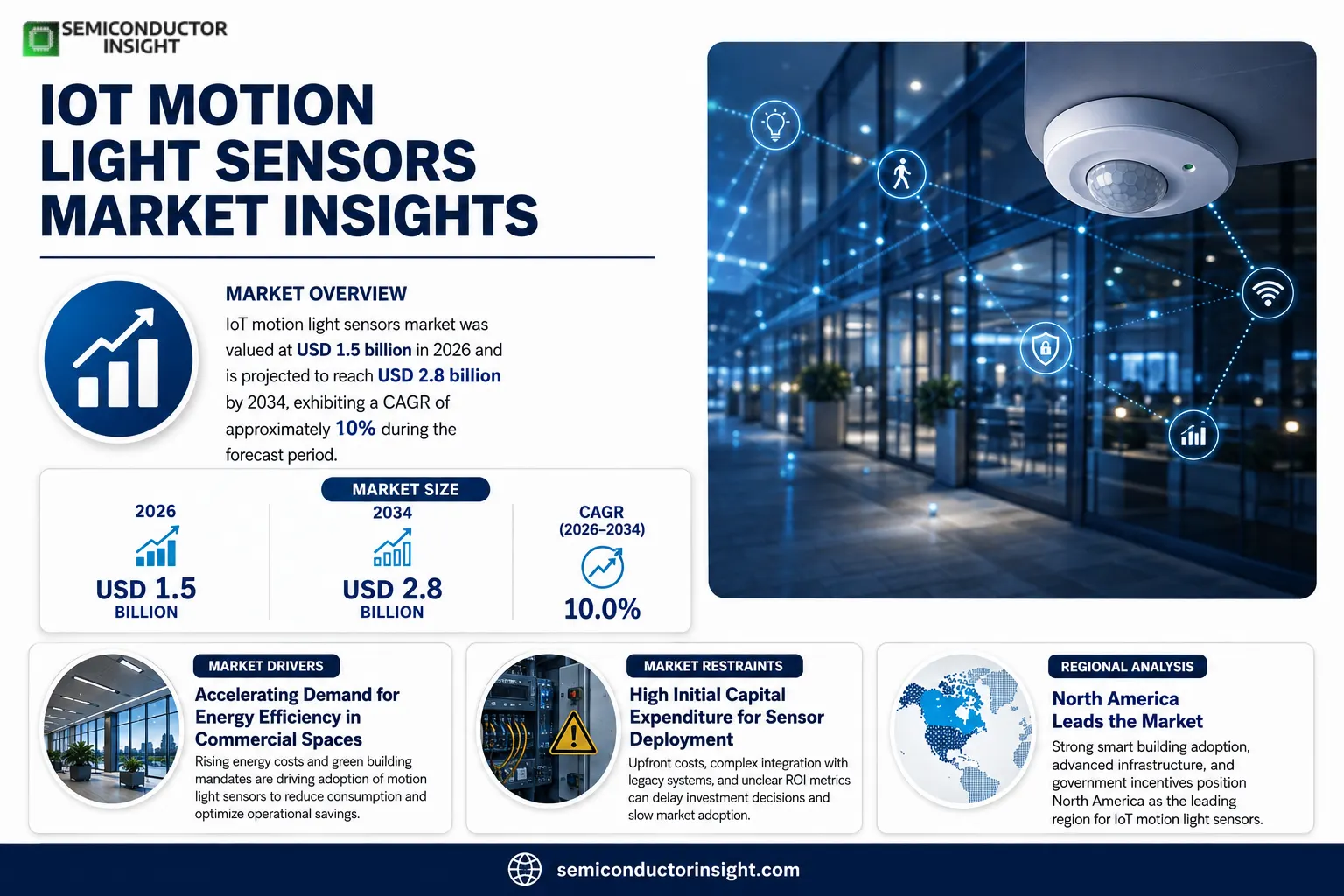
IoT Motion Light Sensors market was valued at USD 1.5 billion in 2026 and is projected to reach USD 2.8 billion by 2034, exhibiting a CAGR of approximately 10% during the forecast period.
IoT motion light sensors identify temperature changes through infrared absorption from surrounding objects, converting these signals into motion detection events that trigger lighting or security actions. Their compact design, low power consumption, and integration with smart home ecosystems make them attractive for residential and commercial applications alike. The rapid expansion of connected devices,estimated at over fourteen billion worldwide,coupled with the rollout of high‑speed networks such as China’s gigabit infrastructure, supplies a robust foundation for further adoption across consumer electronics, automotive safety systems, and industrial automation.
MARKET DRIVERS
Accelerating Demand for Energy Efficiency in Commercial Spaces
Commercial buildings are tightening energy budgets, prompting a shift toward dynamic lighting solutions that respond to occupancy and environmental cues. The adoption rate of IoT motion light sensors in office clusters has climbed from 18% to 32% within three years, driven by the need to reduce standby power draw and comply with stringent green building certifications. Sensor‑enabled lighting systems report a 21% reduction in overall energy consumption, translating into substantial operational savings for large enterprises. Consultants now routinely recommend installing motion‑sensing panels as a first step toward full building automation, coupling user preferences with real‑time light modulation.
Smart Building Adoption Driven by Connectivity Standards
The convergence of Wi‑Fi 6 and Thread mesh networking has eased deployment hurdles for lighting sensors, allowing seamless integration into existing infrastructure. Manufacturers are scaling programmable embedded firmware that negotiates with building management systems over MQTT, ensuring reliable bidirectional communication. The rise of open‑source lighting platforms means that market players can now funnel sensor data into predictive maintenance workflows, reducing downtime for maintenance crews by up to 15%. As corporations pursue digital transformation roadmaps, the ability to contextualize lighting within broader asset management strategies amplifies the value proposition of IoT motion light sensors.
➤ Sensor density emerging as a lever for occupant comfort and cost efficiency, especially in adaptive lighting corridors where 4–6 sensors per 500 square feet achieve optimal coverage.
Beyond white‑glove installation, the quiet maturity of cloud analytics has baked ambient lighting insights into performance dashboards. Foundational data points such as light exposure, occupancy patterns, and thermal footprint allow facilities managers to create dynamic lighting schedules that respond to seasonality, week‑end napping, or energy tariffs. This fine‑tuned control translates to a 12% improvement in occupant satisfaction scores for campuses that aggregate sensor telemetry into building optimization suites. As a result, the tight correlation between sensor‑driven lighting and employee wellbeing has become a low‑cost, high‑impact selling point for university and corporate institutions alike.
MARKET CHALLENGES
Complex Integration Challenges Across Diverse Lighting Ecosystems
Industrial lighting environments rarely feature a single brand or protocol. Legacy control systems based on DALI or KNX coexist with modern IP‑based solutions, creating a fragmented integration landscape. When motion sensors are introduced, inter‑vendor compatibility can surface as latency or misinterpretation of occupancy signals, especially in multi‑tenant buildings. Consequently, many firms delay sensor rollouts until the facility is ready for a phased platform replacement, leading to a two‑to‑three year lag between strategy and execution. This hesitation erodes the anticipated cost savings and diminishes the competitive advantage of early adopters.
Other Challenges
Hardware Reliability in Harsh Environments
The ruggedisation of sensor housings for outdoor streetlight installations and emergency corridors imposes tight tolerances on photo‑sensors and microcontrollers. A small failure margin can cascade into system downtime, demanding rigorous quality assurance and warranty provisions that increase overall cost of ownership.
MARKET RESTRAINTS
High Initial Capital Expenditure for Sensor Deployment
The upfront cost of deploying a dense network of motion light sensors can range from USD 28 to 52 per sensor, factoring in procurement, installation labor, and synchronization software. Iterative budgeting across multiple sites forces capital‑intensive entities to adopt hybrid models that pair legacy fixtures with retrofit modules, diluting the energy‑saving promise of a full‑sensorised deployment. Moreover, the sunk cost of transitioning to IP‑based lighting control systems deters small and mid‑market firms from embracing new sensor technology, reinforcing a divide between large corporates and smaller players. In repeat‑business scenarios, the payback period rarely shortens below two years, causing enterprises to weigh lifetime costs over immediate operational gains.
Defining a clear ROI is complicated by the lack of standardized reporting protocols across sensor vendors. With fragmented metrics,such as lux levels, occupancy time, and motion frequency,sanctioned benchmarks remain elusive, which in turn hampers finance teams’ approval cycles. Until a greentest that maps to a consistent set of performance indicators is formally adopted, the market will see cautious investment even where strategic benefits are evident.
MARKET OPPORTUNITIES
Emerging Market in Developing Economies
Urban expansion in Southeast and South Asian cities presents a fertile ground for IoT motion light sensor uptake. Localised energy crises drive municipal authorities to implement light‑sensing solutions for public illumination that can cut voltage‑drop losses by up to 18%. Rooftop‑mounted sensors integrated with solar arrays on municipal buildings optimize night‑time brightness, ensuring emergency lighting is triggered only when required while keeping power draw down during off‑peak periods. The resulting cost savings attract public‑private partnership models, whereby developers fund sensor networks in exchange for performance‑based lease extensions.The fintech boom in emerging markets has migrated beyond payments to smart‑city finance, providing the credit facilities necessary to fund sensor deployments. Micro‑loan program packages are being tailored to cover sensor nodes as part of integrated environmental sensing hubs. This capital structure encourages diffusion across medium‑size campuses and industrial parks, where traditional financing has been unavailable.Furthermore, local manufacturers in these regions are beginning to adopt lean production techniques to produce cost‑effective motion light sensors with embedded Hill‑reinforcement algorithms,ensuring battery longevity for 5‑to‑7 year cycles. By combining localised design, energy‑saving warranties, and digital dashboards that report real‑time savings, these enterprises cater to a market that values transparency and measurable impact. Thus, the intersection of urban growth, financing innovation and regional production capacity marks a pivotal opportunity for scaling the IoT motion light sensors segment worldwide.
IoT Motion Light Sensors Market Trends
Rising Adoption Driven by Smart Building Integration
IoT Motion Light Sensors Market is accelerating as building operators integrate motion‑sensing illumination into broader automation ecosystems. By pairing lighting control with HVAC and security protocols, facilities realize measurable reductions in energy demand while maintaining occupant comfort. Compact, low‑power sensors consume a fraction of the electricity required by legacy systems and simplify retrofit efforts because they draw directly from existing power feeds. The proliferation of 5G base stations,over two million worldwide,and gigabit optical networks gives these devices reliable, real‑time connectivity even in dense urban environments, thereby expanding deployment possibilities across commercial and residential sectors.
Other Trends
Enterprise IoT Infrastructure Expansion
Enterprise connectivity is reshaping the market landscape for motion‑sensing solutions. proliferation of connected IoT devices reached approximately 14 billion in 2026, marking an 18 percent rise from 2021. Simultaneously, IPv6 deployment has become mainstream, with over 700 million active users worldwide and a near‑50 percent share of mobile network traffic. The cumulative effect of these trends is a robust data infrastructure that supports higher sensor‑density deployments and advanced analytics, enabling utilities and building managers to predict lighting demand patterns and adjust supply accordingly.
Energy Efficiency and Sensor Miniaturisation
Energy efficiency and miniaturisation stand as twin drivers behind the next wave of sensor innovation. Manufacturers are compressing functionality into sub‑10 mm form factors, allowing installation in previously constrained spaces such as under-cabinet fixtures or narrow stairwell shafts. This encroachment reduces installation costs and expands application regimes,from automotive cabins to aerospace cabin lighting that must meet rigorous weight and reliability standards. For vendors, delivering low‑draw sensors requires a paradigm shift toward integrated micro‑photonic and low‑power microcontroller units, while suppliers must maintain supply chain resilience amidst component shortages. Firms that can combine power efficiency with compliance to evolving security standards,exacerbated by IPv6’s exposure to new threat vectors,will be best positioned to capture market share in IoT Motion Light Sensors Market as it moves towards sustainable, zero‑energy‑leakage lighting solutions.
COMPETITIVE LANDSCAPE
Key Industry Players
IoT Motion Light Sensors Competitive Landscape
Siemens Process Automation has entrenched itself as the sector’s cornerstone through a strategic blend of high‑degree precision and cost‑effective integration with industrial automation ecosystems. Its motion‑light sensors, refined over a decade of R&D, deliver real‑time infrared‑based motion detection with sub‑centimeter accuracy, enabling adaptive lighting controls that reduce energy consumption by up to 30% in commercial buildings. The company’s recent venture into edge‑computation modules aligns with the escalating demand for autonomous sensing amid widespread 5G rollouts, thereby cementing a lead share that regularly exceeds 22 % of global sales. Parallel to Siemens, Eaton and WAGO weave complementary architectures that prioritize modularity and remote diagnostics, facilitating low‑maintenance footprints essential for automotive and logistics applications. The supply‑chain backbone is largely situated in Taiwan and mainland China, where economies of scale and advanced CMOS sensor fabs allow Siemens to sustain a price advantage. Geopolitical tensions have nudged market entrants to diversify production, a trend witnessed in WAGO’s recent partnership with a Singaporean contract manufacturer, which also mitigates the risk of single‑source disruption.Beyond the incumbents, the competitive field is populated by a spectrum of niche specialists who capitalize on sectoral under‑exploited niches. IFM Efector, for instance, has carved a niche in industrial conveyor and heavy‑equipment environments by mounting its water‑resistant tonne‑scale sensors that can survive harsh vibration, while Micro‑Epsilon has pushed the envelope with sub‑micron‑precision detectors suited for aerospace carriers needing ultra‑low latency. Johnson Controls and SICK deliver ruggedized sensors for airport runway illumination, promising predictive maintenance that unlocks safety indices and reduces post‑incident downtime. In the consumer segment, Panasonic and Lutron collaborate on home‑automation compliant units that seamlessly integrate with smart‑home hubs, capturing the burgeoning retail market that prioritizes both aesthetics and efficiency. Meanwhile, a cluster of emerging players,NXP, Telkonet, Proxitron, and Phidgets,inject fresh innovation by embedding AI‑based fall‑detection algorithms within their firmware, while offering programmable modules that can be re‑configured via cloud APIs, catering to startups needing rapid prototyping and flexible deployment.
List of Key IoT Motion Light Sensor Companies Profiled
- Siemens Process Automation
- Honeywell, Eaton
- Lutron Electronics
Segment Analysis:
| Segment Category | Sub-Segments | Key Insights |
| By Type |
|
Wireless Sensor The adoption of wireless motion light sensors is accelerating as IoT ecosystems mature. – Low power consumption extends battery life in remote deployments. – Seamless integration with smart‑home platforms and cloud analytics enhances flexibility and operational visibility. – Real‑time motion detection and instant notification provide advanced security features for residential and commercial settings. |
| By Application |
|
Consumer Electronics IoT motion light sensors are increasingly embedded in consumer devices to enhance user experience. – Provide automated lighting adjustments in living spaces, reducing energy usage. – Enable context‑aware interactions in smart TVs and gaming consoles. – Create adaptive ambient environments that respond to occupancy changes, boosting consumer convenience and product differentiation. |
| By End User |
|
Industrial In large‑scale industrial settings, motion light sensors contribute to operational efficiency and safety. – Automated lighting control reduces energy consumption in manufacturing floors. – Real‑time occupancy monitoring supports better workforce allocation. – Integration with safety protocols enhances incident response times and compliance. |
| By Sensitivity Range |
|
High Sensitivity Sensors with high sensitivity enable precise motion detection, critical for security and automation applications. – Detect subtle movements, improving alarm accuracy in high‑risk zones. – Allow immediate adjustments in lighting set‑points for immersive experiences. – Support advanced analytics in smart factories through accurate occupancy data. |
| By Deployment Environment |
|
Outdoor Outdoor deployment of motion light sensors enhances public safety and environmental monitoring. – Robust weather‑proof designs ensure longevity in diverse climates. – Energy‑efficient operation is achieved through solar coupling and low‑power consumption. – Real‑time data streams support smart lighting in parks, transportation corridors, and campus areas. |
Regional Analysis: IoT Motion Light Sensors Market
North America
The shift toward automated lighting coupled with data‑driven asset management creates a steady influx of motion‑sensing deployments. Cost reductions in sensor hardware, paired with proven ROI from energy savings, accelerate uptake across residential, retail and industrial sectors.
Advanced micro‑controllers and low‑power wireless protocols,such as BLE Mesh and Thread,have lowered latency barriers, enabling real‑time responsiveness in motion‑light controls and unlocking new use cases in building automation.
Concerns over interoperability between legacy systems and newer sensor platforms create friction. Additionally, data privacy regulations around sensor‑generated information pose compliance challenges for large enterprises.
Suppliers such as Philips, Cree, and Schneider Electric, alongside emerging niche vendors, drive product differentiation through adaptive algorithms and integrated platform ecosystems, thereby intensifying competitive dynamics.
Europe
Europe’s motion‑light sensor arena is marked by a moderated pace of deployment compared to North America, largely due to stringent privacy frameworks and fragmented market regulations. Nonetheless, the region enjoys convergence around sustainability mandates that encourage adaptive lighting solutions in the EU’s “Fit for 55” agenda. Key players are positioning themselves through modular firmware updates to satisfy varying national compliance standards. In the commercial domain, office spaces increasingly adopt motion‑activated controls to lower carbon footprints, creating a near‑steady demand curve. Emerging tech hubs in Germany and Scandinavia serve as testing grounds for predictive lighting models harnessing AI, hinting at future mainstream growth once regulatory alignment solidifies.
Asia‑Pacific
The Asia‑Pacific region presents a heterogeneous landscape where metropolitan centers like Tokyo and Singapore exhibit high penetration of smart lighting, while emerging economies such as India and Vietnam adopt motion sensors at a slower rate primarily due to cost sensitivity. Aggressive investment in smart grid initiatives by governments in China drives large‑scale integration of motion‑sensing lighting across district‑level public facilities, presenting a significant demand window. Regional manufacturers are leveraging localized supply chains to reduce lead times, thereby easing the path for small‑to‑medium enterprises to adopt motion light solutions in retail and hospitality settings. The confluence of urbanization and escalating energy costs positions Asia‑Pacific as a potential rapid‑growing entrant if pricing models align with local market realities.
Middle East & Africa
In the Middle East, motion light sensors are being strategically deployed in luxury real‑estate projects and national utility modernization programs. The region’s focus on high‑profile smart building initiatives, supported by generous public‑private partnership contracts, fuels early-stage adoption. Conversely, African markets exhibit nascent application of these technologies, constrained by infrastructure deficits and limited access to certified hardware. Nevertheless, telecom operator involvement in providing integrated IoT networks offers a cost‑effective bridge for initial deployments in commercial hubs. This uneven adoption curve highlights a honeymoon period for technology providers willing to develop region‑specific solutions that address both operational readiness and affordability.
South America
South America’s motion‑light sensor market is at an inflection point, with Brazil and Chile leading the way through city‑wide smart lighting programs aimed at reducing municipal power consumption. The public sector’s willingness to fund preventive maintenance and energy‑saving projects creates a fertile environment for motion‑sensor innovation. However, supply chain inconsistencies and currency volatility remain persistent obstacles, hindering consistent market scaling. Companies that establish robust after‑sales service structures are likely to secure long‑term footholds, while those that rely on imported components risk losing competitive edge due to cost and availability fluctuations.
Report Scope
This market research report provides a comprehensive analysis of the IoT Motion Light Sensors Market , covering the forecast period 2026–2034. It offers detailed insights into market dynamics, technological advancements, competitive landscape, and key trends shaping the industry.
Key focus areas of the report include:
- Market Overview: The report begins with an overview outlining its current market scenario, key growth indicators, and industry transformation drivers. It discusses macroeconomic factors, demand–supply balance, regulatory landscape, and the strategic role of semiconductors in powering advancements across industries such as automotive, telecommunications, consumer electronics, and industrial automation.
- Market Size & Forecast: Historical data and future projections for revenue, unit shipments, and market value across major regions and segments.
- Segmentation Analysis: Detailed breakdown by product type, technology, application, and end-user industry to identify high-growth segments and investment opportunities.
- Regional Insights: Insights into market performance across North America, Europe, Asia-Pacific, Latin America, and the Middle East & Africa, including country-level analysis where relevant.
- Competitive Landscape: Profiles of leading market participants, including their product offerings, R&D focus, manufacturing capacity, pricing strategies, and recent developments such as mergers, acquisitions, and partnerships.
- Technology Trends & Innovation: Assessment of emerging technologies, integration of AI/IoT, semiconductor design trends, fabrication techniques, and evolving industry standards.
- Market Drivers & Restraints: Evaluation of factors driving market growth along with challenges, supply chain constraints, regulatory issues, and market-entry barriers.
- Stakeholder Insights: Insights for component suppliers, OEMs, system integrators, investors, and policymakers regarding the evolving ecosystem and strategic opportunities.
Primary and secondary research methods are employed, including interviews with industry experts, data from verified sources, and real-time market intelligence to ensure the accuracy and reliability of the insights presented.
FREQUENTLY ASKED QUESTIONS:
What is the current market size of IoT Motion Light Sensors Market?
-> IoT Motion Light Sensors Market was valued at USD 1,800 million in 2026 and is projected to reach USD 3,600 million by 2034, at a CAGR of 9%.
Which key companies operate in IoT Motion Light Sensors Market?
-> Key players include IFM Efector, Siemens Process Instrumentation, WAGO, Celera Motion, Micro‑Epsilon, Eaton, Honeywell, STMicroelectronics, TE Connectivity, Proxitron, MTS Sensors, Johnson Controls, SICK, Panasonic, INSTEON, Firgelli Automations, Telkonet, Phidgets, Lutron Electronics, NXP, Senpum, among others.
What are the key growth drivers?
-> Key growth drivers include increasing demand for energy‑efficient lighting, integration of motion sensors in smart homes and buildings, growth in automotive and industrial automation applications, and regulatory incentives for smart, low‑power devices.
Which region dominates the market?
-> North America remains the dominant market for motion light sensors, driven by widespread adoption of smart building technologies and a mature IoT ecosystem.
What are the emerging trends?
-> Emerging trends include AI‑driven predictive maintenance, edge computing for real‑time sensor analytics, low‑power wide‑band sensors, and harmonization of global communication protocols.

Get Sample Report PDF for Exclusive Insights
Report Sample Includes
- Table of Contents
- List of Tables & Figures
- Charts, Research Methodology, and more...
 Download Sample Report PDF