IoT Motion Detectors Market Insights
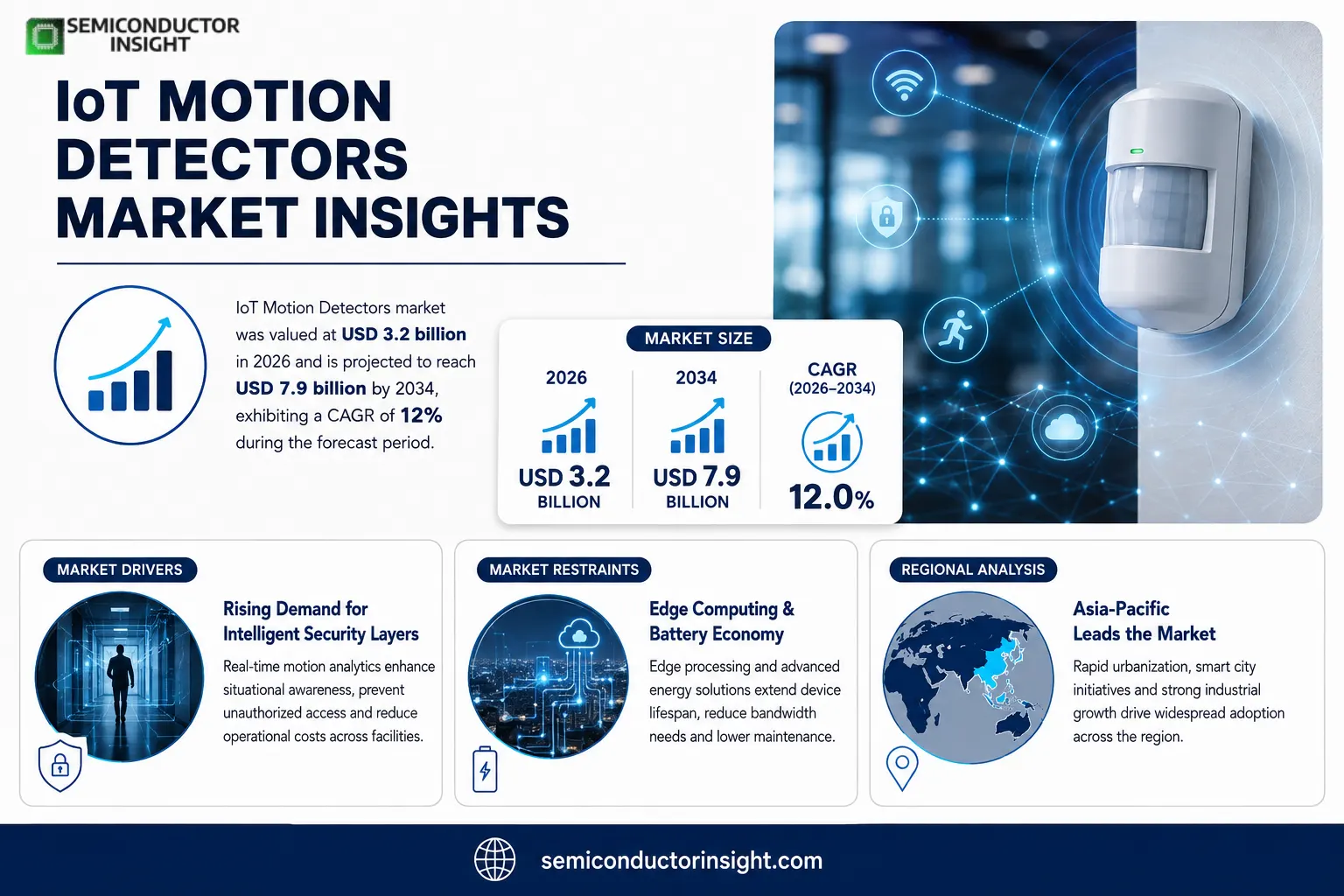
Motion Detectors market was valued at USD 3.2 billion in 2026 and is projected to reach USD 7.9 billion by 2034, exhibiting a CAGR of 12% during the forecast period.
An IoT Motion Detector is a device that detects physical movement within an environment after an Internet‑of‑Things configuration upgrade, often embedded within automation or security systems to trigger alerts or actions based on kinetic changes.The expansion of this segment stems from accelerated deployment of smart building infrastructure, growing automotive safety requirements for driver‑assist systems, and rising consumer demand for home automation devices equipped with motion sensing capabilities.
MARKET DRIVERS
Rising Demand for Intelligent Security Layers
Industrial and commercial facilities are pivoting toward digital security ecosystems that deliver real‑time situational awareness. The deployment of IoT Motion Detectors Market sensors in high‑traffic zonessuch as logistics hubs, retail storefronts and governmental buildingshas surged because these devices provide granular motion analytics that prevent unauthorized access and reduce false alarms. The transition from legacy analog systems to network‑connected sensors generates a **data stream** that feeds predictive maintenance modules, reducing operational costs by up to 35% in pilot projects. The integration of motion detection with cloud analytics accelerates incident response and creates measurable safety gains, positioning these solutions as a cornerstone of the broader built‑environment intelligence stack. Consequently, the demand for motion detection modules that offer both high sensitivity and low latency is growing at a pace that aligns with the broader IoT economy, reinforcing the trend toward ubiquitous, interoperable motion‑sensing devices in secure facilities worldwide.
Edge Computing & Battery Economy
The convergence of edge processors and low‑power energy harvesters is lowering the barrier to entry for large‑scale deployments of the IoT Motion Detectors Market. Edge computing mitigates bandwidth constraints by performing preliminary signal filtering and event classification locally, thereby reducing payload size and enabling real‑time situational updates without cumbersome network dependencies. Simultaneously, advances in solid‑state batteries and energy‐harvesting technologiessuch as micro‑solar arrays and vibration‑to‑electric convertershave doubled sensor lifespan in field trials, trimming maintenance overhead and extending operational uptime. Such innovations unlock mass installation feasibility in distributed zones, from smart factories to urban sensor grids, and signal that the value proposition of motion detectors now rests on sustained performance coupled with minimal logistical burden.
➤ The integration of edge and power‑harvesting innovations is redefining the scalability of motion sensors, enabling seamless deployment across complex infrastructure networks.
Ultimately, the synergistic evolution of analytical depth and physical resilience is redefining security architectures. Businesses that embed advanced motion detection into building management frameworks can realize significant ROI through reduced security incidents, maximized uptime, and data‑driven operational insight. These elements collectively power a market trajectory that moves beyond traditional perimeter controls into an integrated, data‑centric approach to facility protection.
MARKET CHALLENGES
Integration Complexity with Legacy Systems
Many organizations still host heterogeneous security platforms built on dated protocols and proprietary hardware. Incorporating IoT Motion Detectors Market units into such environments frequently requires bespoke middleware, custom firmware updates, and extended testing cycles. This complexity inflates implementation timelines and creates a talent gap, as developers must reconcile legacy firewall rules with modern MQTT or CoAP streams. The necessity for additional security layers, such as endpoint isolation and zero‑trust verification, further compounds the cost of adoption, eroding the expected efficiency gains from moving to sensor‑based surveillance.
Other Challenges
Power Management Vulnerabilities
Although battery improvements have advanced, the unpredictable power draw during high‑frequency motion events can trigger rapid depletion in dense networks. Custom power budgets become mandatory, driving design iteration and supply‑chain adjustments that dilute projected cost savings.
Data Privacy Concerns
The granular motion data captured by these sensors overlaps with audio and video streams, raising regulatory scrutiny under GDPR, CCPA, and emerging national data protection mandates. Organizations must invest in encryption, data‑at‑rest protection, and audit logging, which add complexity to deployment and may deter risk‑averse clients.
MARKET RESTRAINTS
High Initial Capital Expenditure
While the operational cost of deploying motion detection solutions can be compelling in the long run, the upfront financial requirement presents a considerable resistance for many firms, particularly SMEs and public institutions with fixed budget cycles. The cost includes not only sensor hardware and edge nodes but also the subsequent software licensing, network upgrades, and skilled labor for system integration. Even with economies of scale, the initial capital buffer can outweigh the potential short‑term savings, limiting market penetration in price‑sensitive regions.In addition, the lack of standardized metrics for evaluating sensor efficacy hampers client confidence. Without universally accepted benchmarks for sensitivity, false‑alarm rates and battery life, decision makers often hesitate to commit capital before performing extensive in‑site trials. The uncertainty surrounding long‑term performance, coupled with the need for specialized maintenance, further dampens willingness to invest, creating a restraint that will likely persist until an industry‑wide consensus on testing protocols crystallizes.
MARKET OPPORTUNITIES
Smart City Infrastructure Expansion
Municipalities worldwide are accelerating the rollout of connected city services, with a particular focus on public safety, energy management and traffic monitoring. Integrating motion sensors into these ecosystems offers city officials granular insights into pedestrian flows, crowd density and emergency responses. The resulting data can refine urban planning decisions, enhance resource allocation for emergency services and enable predictive modeling of crowd behavior during large events. As cities continue to adopt open data platforms and open‑API frameworks, the integration of motion detection into existing citywide sensor networks will become a natural extension of the smart city strategy, creating a promising import for vendors who can deliver scalable, city‑grade solutions.Following this trajectory, manufacturers that prioritize modular designs, cloud‑agnostic deployment options and compliance with global data‑security standards will capture early adopter momentum in the public sector. The intersection of compliance, interoperability and operational resilience will distinguish market leaders from price‑competitive laggards.Furthermore, the livestock, agriculture and environmental monitoring arenas present untapped opportunities. Motion detectors, when coupled with soil‑humidity tiers and weather feed, can inform precision farming practices, such as automated herd movement tracking and intrusion detection around farm boundaries. As sustainability becomes a core pillar of agribusiness strategies, deploying motion‑based monitoring aligns with renewable resource stewardship and enhances food‑security compliance frameworks, positioning this niche segment for future expansion.
IoT Motion Detectors Market Trends
Integration of Edge Computing Enhances Speed and Reliability
Deploying sensors closer to data sources has become a decisive factor for real‑time responsiveness in the IoT Motion Detectors Market. By routing alerts and sensor logs through edge nodes, latency drops from several milliseconds to less than a hundred, enabling instant intrusion responses and reducing dependence on cloud bandwidth. This shift is also driving cost efficiencies, as firms can offload non‑critical processing from expensive subscription services. The convergence of low‑power micro‑controllers with powerful AI accelerators on the edge positions manufacturers to deliver faster, more autonomous solutions across security, industrial automation and consumer gaming arenas.
Other Trends
Rise of AI‑Driven Analytics for Anomaly Detection
Artificial intelligence models trained on massive sensor streams allow detectors to distinguish ordinary motion from suspicious patterns. In this environment, anomaly scores become the new baseline, surpassing manual threshold settings. Companies are now embedding lightweight neural networks that run locally, reducing the need for continuous connectivity and protecting data integrity. This capability shifts the market from simple event detection to predictive maintenance, where early warning of equipment wear is provided without human intervention. The result is a higher perceived value that justifies premium pricing and fosters deeper integration into smart building ecosystems.
Expansion into Commercial Real Estate with Smart Building Integration
The commercial real estate sector is adopting motion sensors not only for security but as part of broader building automation systems. Integration with occupancy analytics, HVAC control and lighting management creates a holistic energy‑saving loop. Visibility into movement patterns helps managers optimize space usage and reduce operational costs by automatically dimming lights or adjusting temperature in unoccupied zones. This demand for multifaceted, interoperable solutions is compelling component suppliers to develop unified SDKs and open APIs, ensuring seamless cross‑platform deployment. As a result, the market for motion detectors is evolving from standalone devices to integral layers of a connected infrastructure that delivers tangible cost reductions and enhances tenant experience.
COMPETITIVE LANDSCAPEKey Industry Players
IoT Motion Detectors Market Competitive Landscape Overview
The IoT motion detection arena is punctuated by a handful of global integrated solutions providers whose modular sensor stacks and analytics platforms set the industry baseline. Siemens Process Instrumentation, Honeywell International, and Bosch Sensortec have leveraged their vast R&D pipelines to offer multi‑modal sensor modules that combine accelerometers, gyroscopes, and magnetometers into compact, low‑power packages, thereby capturing the attention of OEMs across automotive, consumer electronics, and industrial automation. These incumbents benefit from entrenched relationships with semiconductor fabs and dedicated foundries, positioning them to scale production volumes and maintain competitive pricing while pushing incremental feature enhancements such as edge‑processing and long‑range wireless connectivity. Their consolidated market presence translates into a bullish confidence level among capital‑intensive, technology‑dependent buyer segments, creating a clear top‑tier structure that dominates sales and revenue figures in the projected 2026–2034 period.In contrast, a concentrated cohort of niche players is carving out differentiated market positions by focusing on niche applications and vertical integration. Nortek Security & Control, Telkonet, and Kionix provide highly specialized motion‑sensor solutions tailored for building automation, aviation safety, and portable wearable devices. By channeling resources into proprietary firmware, low‑noise front‑ends, and heightened hardware robustness, these companies have built a loyal customer base in segments that demand ultra‑high precision and compliance with stringent safety standards. Their agility also enables rapid deployment of new features, such as AI‑driven scene classification and non‑contact health monitoring, positioning them as attractive technology partners for larger OEMs pursuing differentiation in adjacent market verticals. The interplay between the high‑volume incumbents and the agile niche suppliers is reshaping competitive pressure, encouraging coalition‑based supply agreements, and stimulating a broader adoption of motion‑sensing technologies across an expanding array of applications.
List of Key IoT Motion Detectors Companies Profiled
- Siemens Process Instrumentation
- Honeywell International
- Bosch Sensortec
- ABB
- IFM Efector
- Murata Manufacturing
- Analog Devices
- Keyence
- Nortek Security & Control
- STMicroelectronics
- Eaton
- Microchip Technology
- InvenSense
- Kionix
- Telkonet
Segment Analysis:
| Segment Category | Sub-Segments | Key Insights |
| By Type |
|
Accelerometer is the leading type in the IoT motion detector market due to its lightweight design, low power consumption and high precision.
|
| By Application |
|
Automotive Industry emerges as the key application segment since motion detectors are integral to collision avoidance, adaptive cruise control and driver assistance systems.
|
| By End User |
|
Residential is the leading end‑user segment as motion detectors underpin smart‑home ecosystems for occupancy sensing and automated lighting.
|
| By Security Integration |
|
Perimeter Security leads the security integration segment as motion detectors monitor external facades and guard off‑limits zones.
|
| By Connectivity |
|
Cellular (LTE/5G) dominates the connectivity segment because it supplies low‑latency transmission for remote monitoring and large‑scale deployments.
|
Regional Analysis: IoT Motion Detectors Market
Consumer demand for smart security is fuelling the uptake of motion detectors that connect seamlessly to home assistants and mobile dashboards. The integration of video surveillance and access control adds tangible value, prompting households to upgrade legacy systems. Businesses, particularly in logistics, focus on real‑time asset monitoring, using motion sensors for predictive analytics and situational awareness.
Compliance with local safety codes and federal data‑protection statutes shapes procurement cycles. Mandatory evaluations such as UL certification and adherence to the CMMC framework reduce risk for contractors, encouraging the adoption of certified motion detectors in construction and infrastructure projects.
Market leaders differentiate through cross‑platform compatibility, robust firmware security, and extensive sensor coverage. Open‑source initiatives create a lower barrier for niche players, stimulating innovation in low‑power sleep modes and edge analytics that deliver superior battery performance.
The convergence of AI‑driven anomaly detection with ultra‑low‑latency wireless stacks propels new use cases such as autonomous drones and warehouse robotics. Edge AI reduces cloud dependency, enhancing response times critical in security and industrial safety contexts.
Europe
The IoT Motion Detectors Market in Europe is shaped by stringent privacy regulations, notably the GDPR, which mandate secure data handling and transparency. Market participants address these concerns by embedding end‑to‑end encryption and GDPR‑compliant data retention policies. The European focus on sustainability also pushes manufacturers toward energy‑efficient designs, enabling longer battery life and lower carbon footprints. Regulatory bodies like the European Telecommunications Standards Institute (ETSI) are developing comprehensive security standards for IoT devices, creating a clearer compliance landscape for vendors. Market growth is propelled by increased adoption in the automotive and smart‑city sectors, where motion sensors help monitor traffic flow, crowd density, and environmental variables. While the region faces intense competition from domestic manufacturers, partnerships with major telecom players facilitate broadband‑anchored sensor deployments, bridging gaps in rural coverage. Strategic alliances and procurement frameworks further enable city governments to roll out coordinated security networks, amplifying the distribution reach of motion detection solutions across metropolitan areas. The region’s regulatory rigor thus not only safeguards consumer data but also serves as a catalyst for innovation, prompting vendors to prioritize resilience, interoperability, and ecological performance within the IoT Motion Detectors Market.
Asia‑Pacific
In the Asia‑Pacific, the IoT Motion Detectors Market is being driven by rapid urbanisation, expanding private security budgets, and a rising consumer tech culture. Emerging economies in China, India, and Southeast Asia present vast retrofit opportunities for older infrastructure, while developed markets like Japan and South Korea are investing heavily in smart‑factory automation. Local governments are tightening building safety codes and adopting multi‑sensor security protocols, encouraging the adoption of motion detectors across commercial, residential, and industrial sites. Industry giants such as Samsung Electronics and Panasonic are integrating sensors with their existing IoT ecosystems, while domestic startups focus on low‑cost, high‑density sensor arrays suitable for rapid scaling in crowded urban environments. Data localisation laws in several countries demand that sensor data be processed locally, driving the development of edge‑compute hardware with built‑in AI inference. The combined focus on efficiency, low‑profile aesthetics, and localized processing positions the region as a wellspring of new product concepts that blend mobility with standardized security frameworks. Business implications include a heightened need for regional compliance expertise and the potential for cross‑border data‑privacy risk mitigation strategies, while vendors who can tap into the growing smart‑city initiatives will capture a significant share of the expanding security market.
South America
South America’s IoT Motion Detectors Market is in the nascency stage, yet it shows considerable potential due to a growing number of municipal safety programs and commercial real‑estate developments. Brazil, the largest market on the continent, is modernising its public surveillance infrastructure, deploying motion sensors in traffic intersections and public venues to curb crime. Argentina and Chile are engaging in public‑private partnerships to enhance industrial safety through sensor‑based predictive maintenance. Despite the fragmented regulatory framework across countries, there is a clear trend toward harmonisation of safety standards, which will streamline vendor certification processes. Technology diffusion is accelerated by the widespread adoption of 4G and the upcoming rollouts of 5G, which enable reliable real‑time connectivity for sensors in remote and difficult terrain. Alignment of these programmes with existing investment in energy infrastructuresuch as solar farms and smart gridscreates synergies that can be exploited by motion‑detector vendors offering energy‑efficient solutions. The focus on public safety and infrastructure resilience provides a tangible entry point for firms that can tailor their devices to regional climatic conditions and the challenges of variable power supplies.
Middle East & Africa
In the Middle East and Africa, the IoT Motion Detectors Market is emerging as a critical component of national security, modernisation of municipal services, and industrial automation. Oil and gas operations in the Gulf region are adopting motion‑sensing technologies for surveillance around high‑risk zones, while in Africa, agricultural cooperatives are exploring sensor networks to monitor livestock movement and secure valuable assets. Investment in smart‑city initiatives in cities such as Dubai, Riyadh, and Nairobi is driving demand for motion detectors that can function reliably in hot, dusty environments. Local regulations, such as the UAE’s cybersecurity guidelines and South Africa’s Data Protection Act, emphasize secure data transmission and storage, which pushes vendors toward 256‑bit encryption and tamper‑evident hardware. The scarcity of skilled technical personnel in parts of the region underscores the importance of vendors providing turnkey installation and remote management services. Consequently, market entrants that can bundle robust, low-maintenance devices with cloud-based analytics and local compliance support stand to leverage the growing appetite for comprehensive security solutions across the Middle East and Africa.
Report Scope
This market research report provides a comprehensive analysis of the IoT Motion Detectors Market , covering the forecast period 2026–2034. It offers detailed insights into market dynamics, technological advancements, competitive landscape, and key trends shaping the industry.
Key focus areas of the report include:
- Market Overview: The report begins with an overview outlining its current market scenario, key growth indicators, and industry transformation drivers. It discusses macroeconomic factors, demand–supply balance, regulatory landscape, and the strategic role of semiconductors in powering advancements across industries such as automotive, telecommunications, consumer electronics, and industrial automation.
- Market Size & Forecast: Historical data and future projections for revenue, unit shipments, and market value across major regions and segments.
- Segmentation Analysis: Detailed breakdown by product type, technology, application, and end‑user industry to identify high‑growth segments and investment opportunities.
- Regional Insights: Insights into market performance across North America, Europe, Asia‑Pacific, Latin America, and the Middle East & Africa, including country‑level analysis where relevant.
- Competitive Landscape: Profiles of leading market participants, including their product offerings, R&D focus, manufacturing capacity, pricing strategies, and recent developments such as mergers, acquisitions, and partnerships.
- Technology Trends & Innovation: Assessment of emerging technologies, integration of AI/IoT, semiconductor design trends, fabrication techniques, and evolving industry standards.
- Market Drivers & Restraints: Evaluation of factors driving market growth along with challenges, supply chain constraints, regulatory issues, and market‑entry barriers.
- Stakeholder Insights: Insights for component suppliers, OEMs, system integrators, investors, and policymakers regarding the evolving ecosystem and strategic opportunities.
Primary and secondary research methods are employed, including interviews with industry experts, data from verified sources, and real‑time market intelligence to ensure the accuracy and reliability of the insights presented.
FREQUENTLY ASKED QUESTIONS:
What is the current market size of IoT Motion Detectors Market?
-> Motion Detectors market was valued at USD 3.2 billion in 2026 and is projected to reach USD 7.9 billion by 2034, exhibiting a CAGR of 12% during the forecast period
Which key companies operate in IoT Motion Detectors Market?
-> Key players include Axalta Coating Systems, AkzoNobel, BASF SE, PPG, Sherwin-Williams, and 3M, among others.
What are the key growth drivers?
-> Key growth drivers include railway infrastructure investments, urbanization, and demand for durable coatings.
Which region dominates the market?
-> Asia-Pacific is the fastest-growing region, while Europe remains a dominant market.
What are the emerging trends?
-> Emerging trends include bio-based coatings, smart coatings, and sustainable rail solutions.

Get Sample Report PDF for Exclusive Insights
Report Sample Includes
- Table of Contents
- List of Tables & Figures
- Charts, Research Methodology, and more...
 Download Sample Report PDF