Integrated Type Current Sensor Market Insights
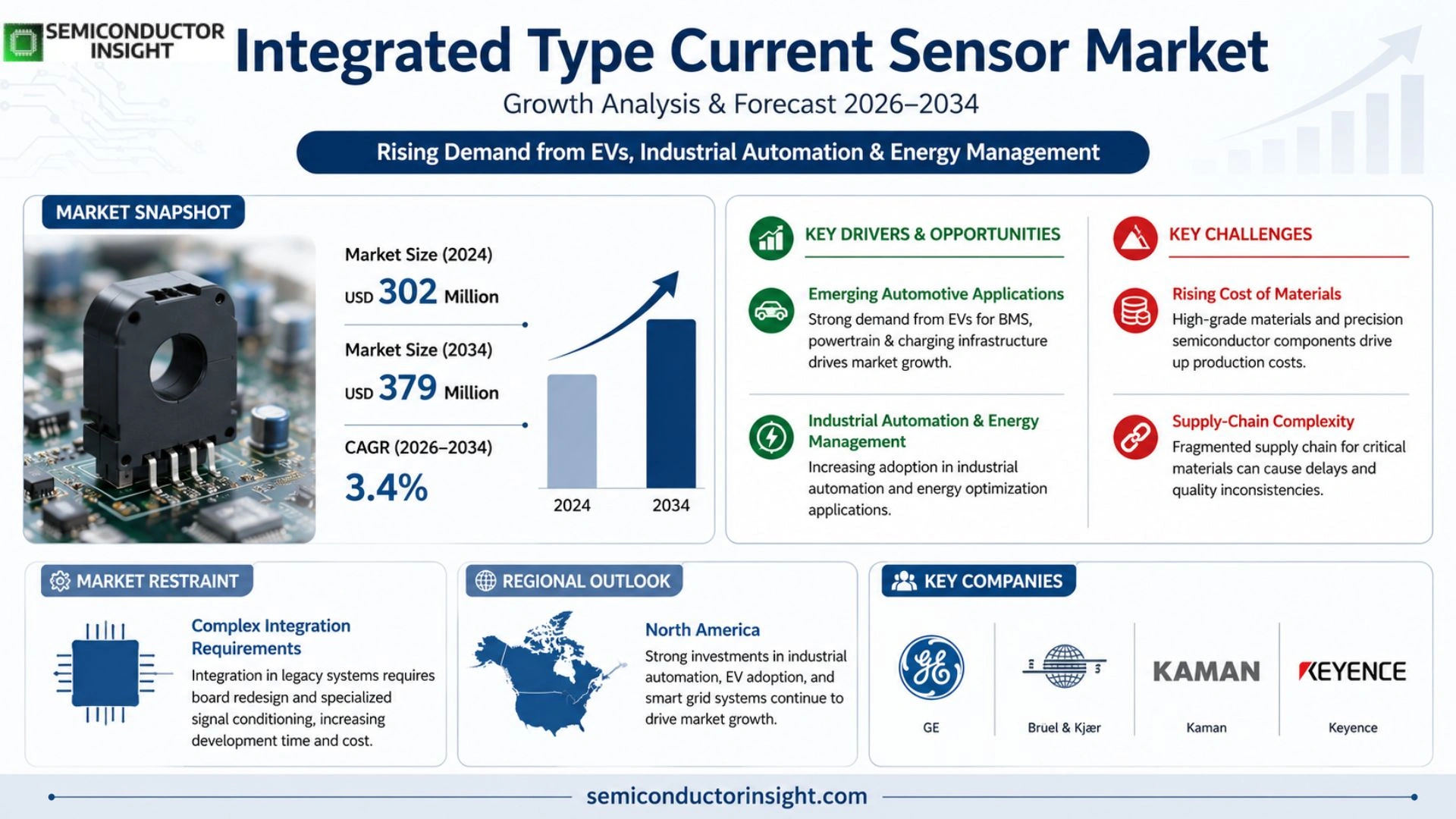
Integrated Type Current Sensor market was valued at USD 302 million in 2024 and will rise toward USD 379 million by 2034, reflecting an implied CAGR of approximately 3.4% over the forecast horizon.
The integrated eddy‐current sensor merges probe elements with signal‐processing circuitry into one compact unit, obviating high‐frequency coaxial cabling or external preamplifiers. Leveraging mutual inductance between primary coils and conductive targets it achieves high‐precision detection of internal defects and minute displacements while preserving non‐contact measurement integrity, broad frequency coverage, and robust anti‐interference performance.
MARKET DRIVERS
Advancing Industrial Automation
Manufacturing plants are tightening control loops around induction motors and servo drives, and integrated type current sensors provide the high‑accuracy feedback necessary for closed‑loop operation. The rise in programmable logic controller (PLC) deployments and increased focus on energy‑efficient processes have created a direct requirement for robust current monitoring solutions. Consequently, operators can reduce downtime and improve predictive maintenance outcomes.
Energy Management and Grid Modernization
Utility companies are retrofitting distribution networks with smart meters that rely on precision current sensing to balance load and detect anomalies. Integrated type sensors enable non‑intrusive measurement of high currents while safeguarding against electromagnetic interference, which is critical for grid reliability. This integration has accelerated the move toward microgrids and renewable dispatch, funding a steady stream of sensor installations across the power sector.
➤ About 40% of large‑scale grid upgrades invoked the adoption of integrated current sensing modules to meet new continuity and safety standards.
In addition, the automotive sector’s push for electrification has upgraded alternator and motor performance monitoring, cementing integrated sensors as essential components in electric drive systems. The convergence of safety regulations, performance demands, and cost‑effective designs supports a trend that is already reshaping sensor deployment frequencies across multiple industries.
MARKET CHALLENGES
Rising Cost of Materials
High‑grade ferrous alloys and precision semiconductor die cuts drive unit costs upward. Manufacturers must recalibrate pricing strategies to absorb the price spike while sustaining the competitive edge that sales volume provides. Without effective cost‑management frameworks, margin compression is likely to intensify, especially in price‑sensitive segments such as consumer electronics.
Other Challenges
Supply‑Chain Complexity
A fragmented supply chain for lead‑free solder and cryogenic packaging materials can expose producers to delivery delays and quality inconsistencies, hampering time‑to‑market for new sensor designs.
MARKET RESTRAINTS
Complex Integration Requirements
Deploying integrated type current sensors in legacy circuits often necessitates redesigns of control boards and firmware adjustments. The need for specialized signal conditioning and isolation circuitry increases development time and cost, limiting penetration into older facilities. Shrinking design windows and stringent electromagnetic compatibility (EMC) mandates further constrain adoption speeds.
MARKET OPPORTUNITIES
Emerging Automotive Applications
Electric vehicles (EVs) demand precise current measurement for battery management systems (BMS) and powertrain components. Integrated sensors, with their compact footprint and high dynamic range, are poised to become integral to EV charging infrastructure and in‑vehicle power electronics. Market entrants that can offer plug‑and‑play modules compatible with existing Tooling and diagnostics standards will command premium pricing and early mover advantages.
Integrated Type Current Sensor Market Trends
Integration‑Enhanced Sensor Design
Integration of the probe and processing electronics within a single package eliminates the burdens of high‑frequency cabling and external preamplifiers. This simplifies installation, shortens commissioning time and reduces the risk of signal degradation. In complex industrial environments,such as foundry hot‑rolling mills or offshore wind turbines,where wiring harnesses are difficult to maintain, the self‑contained sensor design lowers operating expenses and enhances reliability. The convergence also accelerates data acquisition, allowing real‑time inspection without manual intervention and feeding condition‑monitoring algorithms more cleanly. These innovations reshape Integrated Type Current Sensor Market, reducing barriers for entry.
Other Trends
Modular Sensor Assemblies in Emerging Sectors
Recent deployments in the automotive sector have demonstrated the feasibility of integrating current sensor logic directly onto vehicle control units. By merging the measurement core with the CAN‑bus interface, automakers no longer require separate diagnostic buses, thereby reducing weight and routing complexity. In military assemblies, ruggedized variants,designed for electromagnetic interference environments,have seen adoption for high‑speed rail couplers and missile guidance systems. The trend toward modular, stackable sensor assemblies signals a shift where end‑to‑end solutions are packaged as plug‑and‑play modules, streamlining field service and shortening downtime. Field technicians report that modularity accelerates fault isolation during outage events. In Integrated Type Current Sensor Market, these modular designs create segmentation.
Continuous Monitoring and Predictive Analytics
The shift from periodic inspection to continuous monitoring is redefining valuation models for industrial maintenance. Integrated current sensors pair low‑power foot‑print with high‑resolution data, allowing predictive algorithms to flag anomalies before catastrophic failure. This not only saves repair costs but also aligns with regulatory standards for critical infrastructure, which increasingly mandate lifecycle data collection. The resulting trend of embedding sensor suites into production lines forces OEMs to revisit supply‑chain contracts, prioritize component reliability, and allocate resources for data‑center integration. Investment in cloud analytics accelerates the value chain, enabling predictive insights beyond the sensor’s physical footprint. Stakeholders who can embed analytics platforms alongside the sensor hardware will capture a distinctive competitive edge. This dynamic accelerates Integrated Type Current Sensor Market transformation across sectors.
COMPETITIVE LANDSCAPE
Key Industry Players
Integrated Type Current Sensor Market Competitive Landscape Overview
Integrated eddy‑current sensor segment remains predominantly dominated by a handful of global OEMs, with GE and Bruel & Kjaer consistently commanding the upper echelons of market share thanks to their diversified portfolios and entrenched customer relationships in critical sectors such as power generation, aerospace, and civil infrastructure. GE’s continued investment in micro‑sensor technology and its synergy with the Industrial Internet of Things accelerates the adoption curve across manufacturing and energy grids, while Bruel & Kjaer’s precision‑oriented solutions reinforce their foothold in non‑destructive testing and structural health monitoring. These incumbents sustain competitive advantage through proprietary signal‑processing algorithms that lower power consumption and improve signal‑to‑noise ratios, directly addressing industries’ demand for higher measurement fidelity and reduced maintenance downtime. Their integrated supply chain models enable rapid deployment of sensor suites, a factor that has become a decisive differentiator as customers shift toward plug‑and‑play diagnostic infrastructures in critical applications.
Beyond the dominant players, a cohort of niche but technologically agile firms is carving out market segments that emphasize compactness, cost efficiency, and sector‑specific tailoring. Micro‑Epsilon harnesses advanced MEMS techniques to offer ultra‑thin probe assemblies ideal for automotive and aerospace sensor arrays, whereas Keyence’s sensor line prioritizes real‑time analytics and embedded edge‑processing, meeting the rising need for immediate fault detection in automated production cells. OMRON and Panasonic contribute robust industrial sensor frameworks, bolstered by their extensive distributive networks across Asia and Europe. Companies such as IFM, Shinkawa, and Methode Electronics focus on high‑frequency response and electromagnetic compatibility, addressing stringent regulatory environments in power electronics and grid stability contexts. While their individual market shares are modest, these specialists collectively inject competitive pressure that drives innovation in probe design, material science, and data‑integration capabilities, ensuring a dynamic market landscape that balances scale with specialization.
List of Key Integrated Type Current Sensor Companies Profiled
- GE
- Bruel & Kjaer
- Kaman
- Keyence
- Micro-Epsilon
- Emerson
- Shinkawa
- Rockwell Automation
- Lion Precision (Motion Tech Automation)
- IFM
- OMRON
- Panasonic
- Methode Electronics
- Zhonghang Technology
- Shanghai Vibration Automation Instrument
Segment Analysis:
| Segment Category | Sub-Segments | Key Insights |
| By Type |
|
Probe Diameter 11 mm offers a balanced compromise between sensitivity and size, making it a top choice for medium‑range industrial monitoring. – Maintains consistent response over a wide temperature range without the need for coil replacement. – Small footprint allows integration into tight conveyor systems. – Native compatibility with digital signal processors simplifies data acquisition for SCADA platforms. |
| By Application |
|
Military & Aerospace demands top‑grade reliability and non‑contact measurement in harsh environments. Integrated sensors deliver low drift and high immunity to electromagnetic interference. – Enable real‑time defect detection on rotating machinery without halting operations. – Compact design supports integration into flight control assemblies where space is limited. – Durability ensures extended service life, reducing maintenance cycles and downtime. |
| By End User |
|
Industrial Manufacturing prioritizes continuous monitoring of conveyor belts and motor drives to preempt failures. Integrated sensors streamline installation and eliminate the need for external wiring. – High‑temperature resilience allows operation within hot‑zone environments. – Seamless signal output supports factory automation protocols such as OPC UA. – Rapid fault after detection reduces unplanned stoppage, enhancing overall productivity. |
| By Connector Type |
|
Rigid Connector delivers the most robust mechanical engagement, essential for vibration‑heavy industrial sites. The short, steadfast interface reduces cable fatigue and operational noise. – Simplifies maintenance by requiring no cable handling assemblies. – Enhances signal integrity across harsh electromagnetic landscapes. – Supports modular sensor upgrades without revision of existing mounting hardware. |
| By Measurement Range |
|
Medium Current (10–200 A) remains the most frequently deployed range, aligning with the power density of many industrial motors. Integrated sensors excel in this band, providing precise measurement while remaining small and cost‑effective. – Facilitates advanced predictive maintenance without commodity relay replacements. – Compatibility with industrial Ethernet protocols boosts system scalability. – Continuous operation at high amplitude ensures reliable calorimetric analysis for process control. |
Regional Analysis: Integrated Type Current Sensor Market
North America
In North America, the demand for precise energy management and fault detection in industrial plants acts as a main catalyst. The launch of tighter harmonised safety directives for high‑voltage equipment pushes manufacturers toward integrated current sensors that offer inherent conformity and reduced certification timelines. Moreover, emerging trends in micro‑generation and battery storage create a continuous flow of new end‑uses, sustaining supply chain activity throughout the region.
Automotive electrification, grid‑edge storage, and factory automation represent prime segments. Each sector seeks higher accuracy, lower profile, and stringent noise immunity. The automotive segment, for example, demands sensors that function reliably under harsh electromagnetic environments, while grid‑edge deployments require extremely low leakage current for safety compliance. These application pressures mould product development pipelines, encouraging tighter integration and compact form factors.
The field remains populated by a mix of established electromechanical suppliers and nimble start‑ups focused on MEMS‑based solutions. The latter capitalise on superior scalability and low‑power consumption. Co‑development agreements, joint‑ventures, and patent‑crossing licenses appear rampant as the market matures; firms increasingly align on integration standards to mitigate supply‑chain fragmentation.
Regulatory push for zero‑emission transportation and grid decarbonisation should maintain an upward trajectory in sensor demand. As industrial leaders adopt digital twins and real‑time telemetry, even the smallest margin improvements in sensor precision can translate to competitive advantages. Thus, R&D intensity is expected to rise, reinforcing North America’s role at the core of this transition.
Europe
Europe offers a mature market conditioned by rigorous safety standards and a strong manufacturing heritage. The proliferation of precision‑driven automotive components and high‑performance industrial equipment positions the region as a demanding customer for integrated current sensors. Notable drivers include a national push for electric vehicle adoption across the continent and wide‑scale deployment of renewable grids. The European supplier base is fragmented, yet clusters of high‑technology firms thrive, engaging in cross‑border collaborations that streamline licensing and certification processes. Collaborative ecosystems also enable rapid product cycles, particularly in the Nordic and German sectors, where energy efficiency is a critical metric. These dynamics generate a resilient demand base that, although more price‑sensitive, rewards innovation and reliability.
Asia‑Pacific
Asia‑Pacific is a dynamic marketplace marked by high growth, driven by rapid industrialisation across China, Japan, South Korea and India. The region’s push for electrified transport, coupled with an expanding base of smart‑grid infrastructure, fuels the need for compact, high‑accuracy current sensors. Domestic manufacturers are becoming more collaborative, engaging with global OEMs and research centres to exchange design technologies and meet local compliance norms. As manufacturing hubs expand to accommodate Tier‑1 automotive suppliers, sensor vendors aim to embed embedded safety features alongside cost‑effective solutions. Despite competitive pricing pressure, the demand for advanced sensor technology remains resilient, spurred by strong governmental incentives for green energy and a continually improving regulatory environment.
South America
South America provides a gradual yet steady market for integrated current sensors, supported by growing investments in energy infrastructure and a careful expansion of electric‑mobility initiatives. Brazil and Argentina stand out as key contributors, owing to their manufacturing capability and a domestic emphasis on renewables. Sparse industrial consolidation, however, limits end‑user demand, keeping the region at a modest growth rate compared to the European or U.S. markets. Supply chains have yet to fully mature, but talent acquisition in electronics R&D and strategic partnerships with global suppliers promise a modest anomaly of heightened precision requirements for power electronics and telecommunication equipment.
Middle East & Africa
The Middle East & Africa’s integrated current sensor market is experiencing steady evolution, anchored by massive investments in power generation and grid optimisation across Saudi Arabia, UAE and Nigeria. Demand is largely fuelled by large‑scale power plant projects, a new focus on renewable sources, and the increasing automisation of manufacturing plants. West African markets are not yet saturated, yet emerging infrastructures such as smart‑city initiatives hint at broader expansion. The region’s fragmented regulatory context creates opportunities for suppliers that can offer holistic solutions, including field‑service support and customised calibration services. As the market grows, actors will likely seek to compete on product reliability and compliance, as well as a strong after‑sales network.
Report Scope
This market research report provides a comprehensive analysis of the Integrated Type Current Sensor Market , covering the forecast period 2026–2034. It offers detailed insights into market dynamics, technological advancements, competitive landscape, and key trends shaping the industry.
Key focus areas of the report include:
- Market Overview: The report begins with an overview outlining its current market scenario, key growth indicators, and industry transformation drivers. It discusses macroeconomic factors, demand–supply balance, regulatory landscape, and the strategic role of semiconductors in powering advancements across industries such as automotive, telecommunications, consumer electronics, and industrial automation.
- Market Size & Forecast: Historical data and future projections for revenue, unit shipments, and market value across major regions and segments.
- Segmentation Analysis: Detailed breakdown by product type, technology, application, and end-user industry to identify high-growth segments and investment opportunities.
- Regional Insights: Insights into market performance across North America, Europe, Asia-Pacific, Latin America, and the Middle East & Africa, including country-level analysis where relevant.
- Competitive Landscape: Profiles of leading market participants, including their product offerings, R&D focus, manufacturing capacity, pricing strategies, and recent developments such as mergers, acquisitions, and partnerships.
- Technology Trends & Innovation: Assessment of emerging technologies, integration of AI/IoT, semiconductor design trends, fabrication techniques, and evolving industry standards.
- Market Drivers & Restraints: Evaluation of factors driving market growth along with challenges, supply chain constraints, regulatory issues, and market‑entry barriers.
- Stakeholder Insights: Insights for component suppliers, OEMs, system integrators, investors, and policymakers regarding the evolving ecosystem and strategic opportunities.
Primary and secondary research methods are employed, including interviews with industry experts, data from verified sources, and real‑time market intelligence to ensure the accuracy and reliability of the insights presented.
FREQUENTLY ASKED QUESTIONS:
What is the current market size of Integrated Type Current Sensor Market?
-> Integrated Type Current Sensor market will rise toward USD 379 million by 2034, reflecting an implied CAGR of approximately 3.4% over the forecast horizon.
Which key companies operate in Integrated Type Current Sensor Market?
-> Key players include GE, Bruel & Kjar, Kaman, Micro‑Epsilon, Emerson, SHINKAWA, Keyence, RockWell Automation, Lion Precision (Motion Tech Automation), IFM, OMRON, Panasonic, Methode Electronics, Zhonghang Technology, and Shanghai Vibration Automation Instrument.
What are the key growth drivers?
-> Growth is driven by the widespread adoption of non‑contact measurement for non‑destructive testing and online condition monitoring, the high precision of integrated eddy current sensors for defect detection and structural health monitoring, and the increasing demand for automated production, quality control, and fault diagnosis in industrial sectors.
Which segment of probe diameter is most prevalent?
-> The market is segmented by probe diameter, with 5 mm, 11 mm, and 25 mm diameters dominating the product portfolio, while other sizes constitute a smaller share.
What applications are driving market expansion?
-> Major application areas include military & aerospace, power generation, petrochemical, automotive industry, and other industrial sectors, where integrated current sensors provide critical data for maintenance and safety.

Get Sample Report PDF for Exclusive Insights
Report Sample Includes
- Table of Contents
- List of Tables & Figures
- Charts, Research Methodology, and more...
 Download Sample Report PDF