MARKET INSIGHTS
InP lasers market refers to the ecosystem built around lasers manufactured using indium phosphide-based semiconductor materials, along with the wafers, epitaxy, chip fabrication, packaging, and end-use devices connected to them. From a chemical industry viewpoint, this market sits at the intersection of advanced materials science, precision deposition, and high-purity compound semiconductor processing. In simple terms, it is the part of photonics that turns highly engineered indium phosphide material into fast, compact, low-power laser components used in modern digital infrastructure.
- In 2024, it brought in USD 6 million
- By 2032, revenue is expected to reach USD 171 million
- Observing an 7% CAGR between 2026 and 2034
Indium phosphide is valued because it has a direct bandgap and supports efficient optical emission, which is why it is preferred for telecom-grade lasers and related photonic devices. The material also plays well in the 1,300 nm to 1,625 nm range, which aligns with the low-loss window of silica fiber and makes it highly relevant for high-speed transmission. From a materials perspective, the market depends on high-purity indium, phosphorus, epitaxial layers, and tightly controlled deposition environments, all of which make it a highly specialized chemical-material chain.
Key Takeaways:
- Asia Pacific dominates the conversation, because it combines manufacturing scale, telecom expansion, and strong semiconductor supply chains.
- The 1300nm-1600nm band leads the market, as it is the natural fit for fiber-optic communication and long-distance signal transmission.
- Information and communication stays at the center, powering transceivers, optical networks, and data-heavy digital infrastructure.
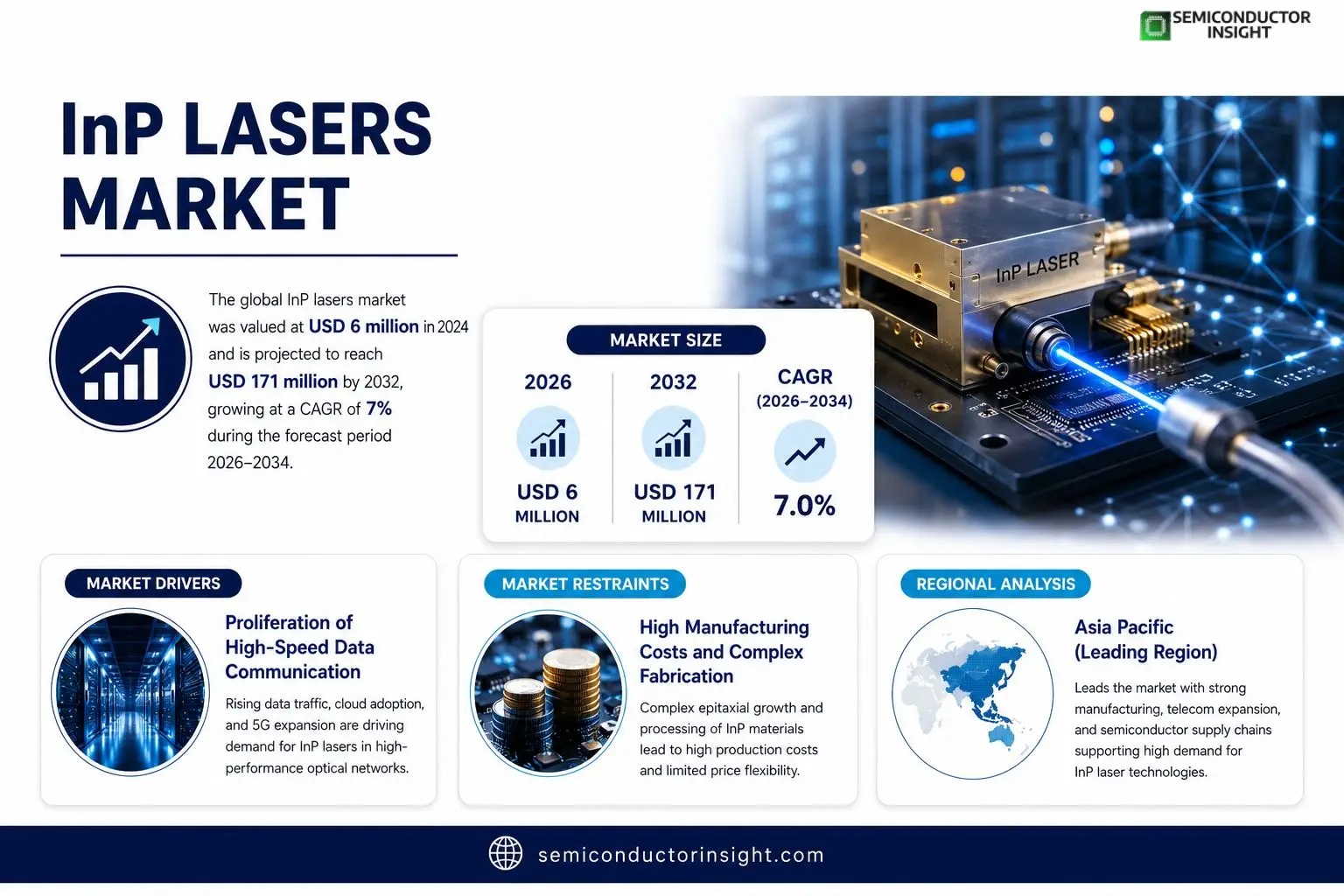
MARKET DRIVERS
Proliferation of High-Speed Data Communication
The exponential growth in data traffic, driven by cloud computing, video streaming, and the expansion of 5G networks, is a primary driver for the InP lasers market. Indium Phosphide (InP) lasers are essential components in optical transceivers for long-haul and metropolitan fiber-optic networks due to their superior performance in high-speed data transmission. The demand for bandwidth-intensive applications continues to push the adoption of advanced telecom and datacom infrastructure, directly fueling the need for reliable InP laser sources.
Expansion of Silicon Photonics and Co-Packaged Optics
The integration of InP lasers with silicon photonics platforms is a significant trend, enabling higher levels of integration and cost-effective manufacturing for data centers. The move towards co-packaged optics (CPO) for next-generation switches aims to reduce power consumption and increase bandwidth density, creating a sustained demand for high-performance InP laser diodes.
➤ Emerging applications in sensing and LiDAR are opening new revenue streams beyond traditional telecommunications.
The deployment of Fiber-to-the-Home (FTTH) networks ly, especially in emerging economies, along with ongoing upgrades to existing telecom infrastructure, provides a steady, long-term driver for the market. Government initiatives supporting broadband expansion further bolster this growth trajectory.
MARKET CHALLENGES
High Manufacturing Costs and Complex Fabrication
The epitaxial growth and processing of InP-based materials are inherently complex and expensive compared to other semiconductor lasers like those based on Gallium Arsenide (GaAs). This high cost of manufacturing presents a significant challenge for achieving price competitiveness, particularly in cost-sensitive market segments.
Other Challenges
Intense Competition from Alternative Technologies
The market faces competition from emerging technologies, including quantum dot lasers and advances in germanium-based sources on silicon, which aim to offer similar performance at potentially lower costs.
Thermal Management and Reliability Concerns
Maintaining performance and longevity at high operating powers and in dense integration scenarios requires sophisticated thermal management solutions, adding to the design complexity and cost of the final systems.
MARKET RESTRAINTS
Cyclical Nature of the Telecommunications Industry
The InP laser market is heavily dependent on capital expenditure cycles within the telecommunications sector. Periods of reduced spending by major network operators can lead to significant volatility and demand fluctuations, restraining steady market growth.
Supply Chain Vulnerabilities for Raw Materials
The supply of key raw materials, such as indium, can be subject to geopolitical and economic uncertainties. Price volatility and potential shortages of these critical elements pose a risk to stable production and can act as a restraint on the market.
MARKET OPPORTUNITIES
Growth in LiDAR for Autonomous Vehicles and Sensing
The advancement of autonomous driving technology is creating substantial opportunities for InP-based lasers, particularly for Long-Range LiDAR systems. Their coherence and ability to operate at eye-safe wavelengths around 1550 nm make them highly suitable for this demanding application.
Adoption in Quantum Technology and Medical Applications
InP lasers are finding new applications in quantum key distribution (QKD) for secure communications and in advanced medical diagnostics and therapeutics. The unique properties of these lasers are critical for the development of next-generation quantum and biomedical systems.
Development of Advanced Modulation Formats
The ongoing transition towards higher-order modulation formats like 16-QAM and 64-QAM for increasing spectral efficiency in optical networks requires lasers with exceptional linewidth and stability, areas where InP-based devices excel. This technological evolution presents a key opportunity for market differentiation and growth.
InP Lasers Market Trends
Strong Growth Driven by Telecommunications Demand
The InP Lasers market is on a trajectory of significant expansion, driven by their critical role in telecommunications. The market, valued at $80.6 million in 2024, is projected to reach $171 million by 2032, growing at a robust Compound Annual Growth Rate (CAGR) of 11.7%. This strong growth is primarily fueled by the increasing demand for high-speed data transmission and the deployment of fiber optic networks worldwide. Indium Phosphide (InP) is the material of choice for producing efficient lasers and photodetectors in the 1550 nm wavelength window, which is the standard for long-haul and metropolitan optical communication systems. When design and fabrication are optimized, InP lasers provide high spectral purity and consistent optical power over a wide temperature range, making them indispensable for reliable telecommunications infrastructure.
Other Trends
Dominance of the 1300nm-1600nm Wavelength Segment
In terms of product type, the 1300nm-1600nm segment is the clear market leader, holding a dominant share of 77%. This dominance aligns directly with the primary application of these lasers in information and communication technologies. The wavelength range is optimal for minimizing signal loss in silica-based optical fibers, cementing its position as the industry standard. The segment’s growth is intrinsically linked to the ongoing expansion of 5G networks, data centers, and broadband internet services, which require the high-performance characteristics that InP lasers in this range deliver.
Regional Market Concentration and Competitive Landscape
The market exhibits a distinct regional concentration, with the Americas being the largest market, accounting for approximately 39% of the share. This is followed by Asia-Pacific with 31% and Europe with 28%. The competitive landscape is consolidated, with the top three playersMACOM, Lumentum, and Coherentcollectively holding over 68% of the market share. This high level of consolidation underscores the significant barriers to entry, including advanced material science expertise and complex manufacturing processes required for high-yield production of InP-based components.
Application Diversification Beyond Communications
While the Information and Communication application segment is the largest, commanding about 73% of the market, other sectors present emerging opportunities. The medical field utilizes InP lasers for advanced diagnostic equipment and minimally invasive surgical procedures. In aerospace and defense, these lasers are critical for sensing, lidar systems, and secure communications. Although these segments are smaller, they represent potential growth avenues as the unique properties of InP lasers, such as their efficiency and wavelength versatility, are leveraged in new and innovative applications beyond their traditional telecommunications stronghold.
COMPETITIVE LANDSCAPE
Key Industry Players
A Market Dominated by a Few Leaders and Specialized Niche Players
The InP lasers market is characterized by a high level of concentration, with the top three playersMACOM, Lumentum, and Coherentcollectively commanding over 68% of the market share. This dominance is largely attributed to their extensive product portfolios, significant research and development capabilities, and established distribution networks that cater primarily to the telecommunications sector, which accounts for approximately 73% of the market’s application. These leading companies possess advanced fabrication facilities and hold critical intellectual property related to optimizing InP lasers for high spectral purity and power output across the crucial 1300nm to 1600nm wavelength range, which constitutes 77% of the product market.Beyond the market leaders, a number of specialized and emerging players compete effectively in specific niches. Companies like InPhenix and Sheaumann Laser focus on high-performance custom and specialty lasers for research and medical applications. Firms such as Eblana Photonics are known for their innovative discrete mode laser technology. Several players, including SemiNex and Shengshi Optical Technology, have strong regional footholds, particularly in the Asia-Pacific market, which is the second-largest geographic segment. These companies often compete on factors such as customization, specific wavelength expertise, and cost-effectiveness for applications in aerospace, defense, and emerging medical technologies.
List of Key InP Lasers Companies Profiled
- MACOM
- Lumentum
- Coherent
- InPhenix
- Sheaumann Laser
- SemiNex
- Eblana Photonics
- Shengshi Optical Technology
- Chilas
- II-VI Incorporated (now Coherent)
- NeoPhotonics
- Thorlabs
- Finisar (now part of II-VI/Coherent)
- Emcore
- AC Photonics
Segment Analysis:
| Segment Category | Sub-Segments | Key Insights |
| By Type |
|
1300nm-1600nm dominates the market as these wavelengths align perfectly with the low-loss transmission window of optical fibers used in telecommunications, making them the standard for long-haul and metro networks. Lasers in this range are prized for their high spectral purity and power output efficiency, which are critical for maintaining signal integrity over vast distances. The other segments cater to specialized applications requiring different optical characteristics. |
| By Application |
|
Information and Communication is the primary application area, driven by the relentless demand for high-speed data transmission, internet bandwidth, and the expansion of 5G infrastructure. These lasers are foundational components in transceivers and optical amplifiers that form the backbone of modern communication networks. The Medical and Aerospace & Defense segments represent specialized, high-value niches with stringent requirements for reliability and precision that InP lasers are well-suited to meet, ensuring strong demand from these advanced technology sectors. |
| By End User |
|
Telecom Service Providers constitute the most significant end-user segment, as they are the primary customers for the optical networking equipment that incorporates InP lasers. Their continuous investment in network upgrades to support cloud computing, streaming services, and next-generation wireless technologies fuels consistent demand. Medical Device Manufacturers and Defense Contractors are other critical end-users; they require lasers that deliver exceptional performance, reliability, and stability for applications ranging from surgical tools to sophisticated sensing and targeting systems. |
| By Wavelength Specificity |
|
Telecom Standard Band represents the leading segment due to the massive, standardized infrastructure built around specific wavelength bands for optical communication. This generates high-volume, cost-sensitive demand. Specialized Sensing Bands are crucial for applications like gas detection and Light Detection and Ranging (LiDAR), where precise wavelengths are needed to interact with specific materials. The Medical & Scientific Band is characterized by highly customized solutions for procedures such as spectroscopy and diagnostics, demanding extreme precision and stability for critical measurements. |
| By Technology Integration Level |
|
Photonic Integrated Circuits (PICs) are emerging as the key growth driver, as they allow multiple optical functions to be combined on a single InP chip, leading to significant improvements in performance, power efficiency, size, and cost for high-volume applications like datacom transceivers. Discrete Component Lasers remain vital for applications demanding the highest possible power or specialized performance characteristics. Hybrid Integrated Modules offer a flexible middle ground, combining the benefits of integration with the performance of discrete components for complex systems in defense and advanced sensing. |
Regional Analysis: InP Lasers Market
Asia-Pacific
The region’s leadership is heavily reliant on its aggressive deployment of fiber-optic networks. InP lasers are critical components in transceivers for data transmission over long distances with minimal signal loss. This relentless infrastructure expansion, particularly for 5G backhaul and broadband access, creates a continuous and high-volume demand that regional suppliers are perfectly positioned to fulfill, cementing their market dominance.
Asia-Pacific hosts a mature and highly integrated supply chain for photonic components. The presence of major foundries and assembly facilities enables cost-effective, high-volume manufacturing of InP lasers and related devices. This established ecosystem reduces production lead times and costs, providing a significant competitive advantage over other regions and attracting telecommunications companies to source their components from this region.
Substantial investments in R&D from both public institutions and private corporations are a hallmark of the region. Research focuses on advancing laser efficiency, developing new wavelengths for specialized applications, and integrating InP lasers into sophisticated photonic integrated circuits. This strong emphasis on innovation ensures the region stays ahead of the technological curve, developing the next generation of laser products.
The explosive growth of cloud computing, streaming services, and big data analytics in Asia-Pacific is driving immense demand for high-capacity data centers. These facilities require high-speed optical interconnects that utilize InP lasers for efficient data transfer between servers and switches. The proximity to this rapidly expanding end-market provides a stable and growing base for InP laser manufacturers in the region.
North America
North America remains a critical and technologically advanced market for InP lasers, characterized by a strong focus on high-value, specialized applications. The region, particularly the United States, is a hub for innovation in defense and aerospace, where InP lasers are essential for sensing, lidar, and secure communications systems. Furthermore, major technology and cloud service providers are driving demand for advanced optical networking components within their massive data center infrastructures. The presence of leading research universities and companies engaged in developing quantum computing technologies, which often rely on precise laser sources, also contributes to a sophisticated demand base. While the volume may be lower than Asia-Pacific, the demand is for highly specialized, high-performance lasers, keeping North America a key and influential market.
Europe
Europe holds a significant position in the InP lasers market, supported by a strong academic research foundation and a well-established telecommunications sector. The region sees substantial application of these lasers in scientific research, medical instrumentation, and environmental sensing. European initiatives aimed at building a sovereign digital infrastructure are also expected to stimulate demand for advanced optical components. Collaborative projects between universities, research institutes, and industry players foster innovation in photonics, particularly in areas like silicon photonics integration. While facing strong competition from Asia in mass production, Europe maintains a stronghold in niche, high-performance segments and is a center for foundational research and development in photonic technologies.
South America
The InP lasers market in South America is in a developing stage, with growth primarily driven by the gradual modernization and expansion of telecommunications networks in key economies like Brazil. The demand is fueled by the need to improve internet connectivity and data services across the continent. However, the market size remains relatively small compared to other regions, constrained by economic volatility and lower levels of investment in cutting-edge technological infrastructure. Adoption is currently focused on essential communication infrastructure rather than advanced R&D or specialized industrial applications, indicating a market with significant potential for future growth as digitalization efforts intensify.
Middle East & Africa
The Middle East & Africa region represents an emerging market for InP lasers, with growth prospects tied to major infrastructure projects. In the Middle East, wealthy Gulf nations are investing in building smart cities and advanced telecommunications networks, creating opportunities for high-speed optical components. In Africa, the market is nascent, with demand slowly emerging from projects aimed at improving continental connectivity, such as new submarine cable landings and terrestrial fiber links. The overall market dynamics are characterized by high growth potential over the long term, but current adoption is limited and largely dependent on large-scale government-led infrastructure initiatives rather than widespread industrial or consumer application.
Report Scope
This market research report provides a comprehensive analysis of the InP Lasers Market, covering the forecast period 2025–2032. It offers detailed insights into market dynamics, technological advancements, competitive landscape, and key trends shaping the industry.
Key focus areas of the report include:
- Market Overview: The report begins with an overview outlining its current market scenario, key growth indicators, and industry transformation drivers. It discusses macroeconomic factors, demand–supply balance, regulatory landscape, and the strategic role of semiconductors in powering advancements across industries such as automotive, telecommunications, consumer electronics, and industrial automation.
- Market Size & Forecast: Historical data and future projections for revenue, unit shipments, and market value across major regions and segments.
- Segmentation Analysis: Detailed breakdown by product type, technology, application, and end-user industry to identify high-growth segments and investment opportunities.
- Regional Insights: Insights into market performance across North America, Europe, Asia-Pacific, Latin America, and the Middle East & Africa, including country-level analysis where relevant.
- Competitive Landscape: Profiles of leading market participants, including their product offerings, R&D focus, manufacturing capacity, pricing strategies, and recent developments such as mergers, acquisitions, and partnerships.
- Technology Trends & Innovation: Assessment of emerging technologies, integration of AI/IoT, semiconductor design trends, fabrication techniques, and evolving industry standards.
- Market Drivers & Restraints: Evaluation of factors driving market growth along with challenges, supply chain constraints, regulatory issues, and market-entry barriers.
- Stakeholder Insights: Insights for component suppliers, OEMs, system integrators, investors, and policymakers regarding the evolving ecosystem and strategic opportunities.
Primary and secondary research methods are employed, including interviews with industry experts, data from verified sources, and real-time market intelligence to ensure the accuracy and reliability of the insights presented.
FREQUENTLY ASKED QUESTIONS:
What is the current market size of InP Lasers Market?
-> InP Lasers Market was valued at USD 80.6 million in 2024 and is projected to reach USD 171 million by 2032, exhibiting a CAGR of 11.7% during the forecast period.
Which key companies operate in InP Lasers Market?
-> Key players include MACOM, Lumentum, Coherent, InPhenix, Sheaumann Laser, SemiNex, Eblana Photonics, Shengshi Optical Technology, and Chilas, among others. The top three players hold a share over 68%.
What are the key growth drivers?
-> Key growth is driven by the demand for efficient lasers and photodetectors in telecommunications, particularly for 1550 nm wavelengths, and the advantages of Indium Phosphide as a direct bandgap semiconductor offering high spectral purity and optical power.
Which region dominates the market?
-> Americas is the largest market, holding a share of about 39%, followed by Asia-Pacific with a share of 31% and Europe with a share of 28%.
What are the emerging trends?
-> Emerging trends include the optimization of InP laser design and fabrication for enhanced performance over a wide temperature range and the dominant application in the Information and Communication sector, which holds about a 73% share.

Get Sample Report PDF for Exclusive Insights
Report Sample Includes
- Table of Contents
- List of Tables & Figures
- Charts, Research Methodology, and more...
 Download Sample Report PDF