
Wafer-Scale AI Engine Market Insights
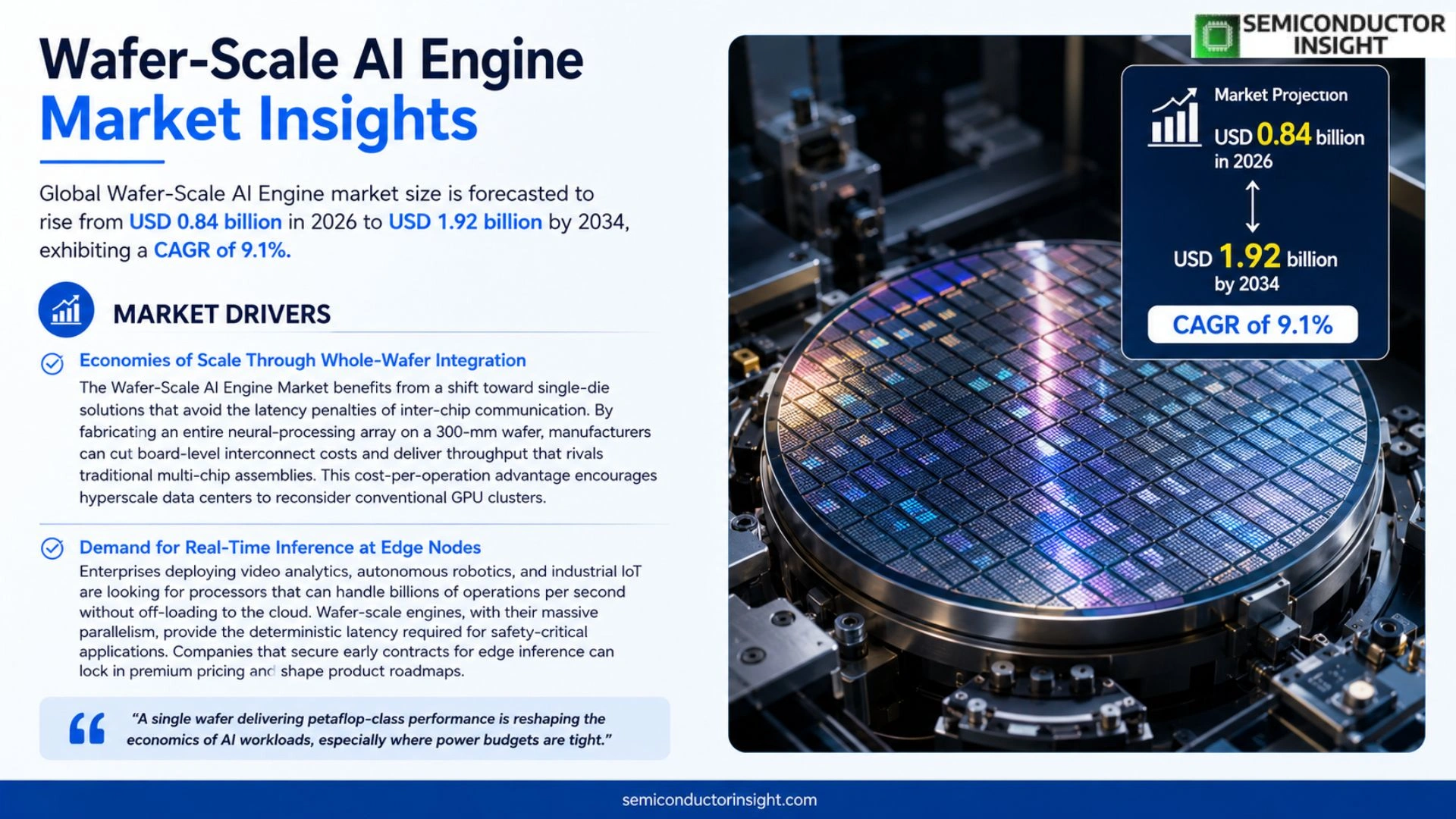
Global Wafer‑Scale AI Engine market size was valued at USD 0.78 billion in 2025. The market is forecasted to rise from USD 0.84 billion in 2026 to USD 1.92 billion by 2034, exhibiting a CAGR of 9.1% during the forecast period.
Wafer‑Scale AI Engines are monolithic processors that keep an entire silicon wafer intact as a single computational substrate. By embedding thousands of AI cores, ultra‑high bandwidth memory and on‑die interconnects on one piece of silicon, these engines eliminate traditional packaging constraints and deliver unprecedented throughput for deep‑learning inference and training workloads.
The market is gaining momentum because modern generative models require compute densities that exceed what conventional multi‑chip solutions can provide. Cloud operators are allocating capital toward next‑generation inference platforms, while breakthroughs in photonic routing lower latency across the wafer surface. Recent collaborations, such as Cerebras Systems’ partnership with Microsoft Azure announced in early 2024, demonstrate how ecosystem support accelerates adoption. Other notable participants include Graphcore, SambaNova Systems and Intel’s Habana Labs, each expanding their portfolios with wafer‑scale designs.
MARKET DRIVERS
Economies of Scale Through Whole‑Wafer Integration
Wafer-Scale AI Engine Market benefits from a shift toward single‑die solutions that avoid the latency penalties of inter‑chip communication. By fabricating an entire neural‑processing array on a 300‑mm wafer, manufacturers can cut board‑level interconnect costs and deliver throughput that rivals traditional multi‑chip assemblies. This cost‑per‑operation advantage encourages hyperscale data centers to reconsider conventional GPU clusters.
Demand for Real‑Time Inference at Edge Nodes
Enterprises deploying video analytics, autonomous robotics, and industrial IoT are looking for processors that can handle billions of operations per second without off‑loading to the cloud. Wafer‑scale engines, with their massive parallelism, provide the deterministic latency required for safety‑critical applications. Companies that secure early contracts for edge inference can lock in premium pricing and shape product roadmaps.
➤ “A single wafer delivering petaflop‑class performance is reshaping the economics of AI workloads, especially where power budgets are tight.”
Beyond performance, the integration of advanced packaging techniques, such as embedded high‑density interposers, has lowered the thermal envelope of large dies. This enables operators to pack more compute per square foot, directly translating into higher rack utilization and lower total cost of ownership.
MARKET CHALLENGES
Thermal Dissipation and Power Delivery Limits
While wafer‑scale designs eliminate inter‑chip latency, they also concentrate heat generation on a single substrate. Managing temperature gradients across a 300‑mm die demands sophisticated cooling solutions that can drive up OPEX. Failure to address these constraints may force customers to throttle workloads, eroding the promised efficiency gains.
Other Challenges
Design Ecosystem Maturity
The software stack for programming monolithic AI engines is still evolving. Developers must adapt existing frameworks to handle non‑standard memory hierarchies, which can slow adoption and increase engineering overhead for early adopters.
MARKET RESTRAINTS
Supply‑Chain Vulnerabilities
Fabrication of full‑wafer AI engines relies on a narrow set of foundries capable of handling extreme lithography and yield requirements. Any disruption, whether geopolitical or pandemic‑related, can compress lead times and inflate component prices, discouraging mid‑size firms from committing to large‑scale purchases.
MARKET OPPORTUNITIES
Customizable Architectures for Cloud Service Providers
Major cloud operators are experimenting with bespoke wafer‑scale processors that align with their specific model workloads. By offering configurable TPU‑like blocks, vendors can capture a share of the multi‑year contracts that traditionally flow to off‑the‑shelf GPU suppliers. This creates a revenue stream that scales with the volume of AI‑driven services sold by the provider.
Wafer-Scale AI Engine Market Trends
Compute Density as a Differentiator
Wafer‑Scale AI Engine Market is being reshaped by the relentless demand for higher compute density in generative‑model workloads. By preserving an entire wafer as a single die, manufacturers embed thousands of AI cores alongside ultra‑high bandwidth memory, effectively bypassing the die‑to‑die bottlenecks that constrain traditional multi‑chip assemblies. This architecture translates into a step‑change in inference throughput, allowing cloud providers to run larger models with fewer physical servers. The financial impact is evident: the market’s valuation moved from USD 0.78 billion in 2025 to an estimated USD 0.84 billion in 2026, with projections reaching USD 1.92 billion by 2034. The upward trajectory reflects capital allocation toward platforms that can sustain the compute intensity required by the latest AI breakthroughs.
Other Trends
Photonic Interconnect Advances Reduce Latency
Recent progress in photonic routing technology is curbing the latency penalties that historically plagued wafer‑scale designs. By routing optical signals across the wafer surface, data movement between cores occurs at near‑light speed, narrowing the gap between memory access and processing cycles. This improvement not only boosts training efficiency but also widens the appeal of wafer‑scale engines to edge‑centric cloud services that prioritize response time. The combination of optical interconnects with on‑die networking fabrics is prompting vendors such as Graphcore and Intel’s Habana Labs to announce next‑generation products that claim up to 30 % lower latency compared with earlier silicon‑only implementations.
Strategic Cloud Investments Accelerate Deployment
Cloud operators are translating the technical advantages of wafer‑scale processors into concrete procurement programs. Early‑2024 saw a high‑profile partnership between Cerebras Systems and Microsoft Azure, where the latter committed to integrating a new wafer‑scale inference cluster into its regional data centers. This move signals confidence that the architecture can meet enterprise‑grade reliability while delivering cost efficiencies through reduced hardware footprints. Parallel initiatives from Amazon Web Services and Google Cloud, though less public, are reportedly allocating budget toward similar engines, motivated by the prospect of offering differentiated AI services. For ecosystem participants, the trend creates a clear incentive to align product roadmaps with cloud‑scale requirements, reinforcing a feedback loop that speeds up adoption across Wafer‑Scale AI Engine Market.
COMPETITIVE LANDSCAPE
Key Industry Players
Wafer‑Scale AI Engine Competitive Overview
The market is currently dominated by a handful of developers that have succeeded in keeping an entire silicon wafer intact as a single compute substrate. Cerebras Systems, with its Wafer‑Scale Engine (WSE‑2) and the recent partnership with Microsoft Azure, illustrates how scale can be translated into cloud‑grade inference capacity while preserving power efficiency. Graphcore’s second‑generation IPU architecture, although not a full wafer, leverages a dense interconnect that mirrors many of the same latency‑reduction goals. SambaNova’s DataScale platform, launched in 2023, demonstrates a strategic shift toward integrating massive on‑die memory alongside thousands of AI cores, directly addressing the bandwidth bottlenecks that limit conventional multi‑chip solutions. Intel’s Habana Labs contributes a distinct design philosophy, pairing wafer‑scale concepts with its Gaudi family to provide a hybrid approach that balances programmability and throughput. Collectively, these leaders shape a market structure where deep‑learning workloads are increasingly migrated from fragmented GPU farms to monolithic engines that promise lower total cost of ownership for hyperscale operators.
Beyond the headline players, a cohort of specialist firms is expanding the competitive perimeter. Tenstorrent has announced a roadmap that includes a wafer‑scale variant aimed at next‑generation training clusters, positioning itself as a bridge between ASIC performance and software flexibility. Groq, known for its single‑core high‑throughput processors, is investing in photonic interposers that could eventually extend to wafer‑scale implementations. Mythic’s analog‑compute approach, while not a pure wafer product, introduces a parallel path where mixed‑signal circuitry may be tiled across larger substrates. IBM Research continues to explore wafer‑level integration for quantum‑inspired AI accelerators, offering a long‑term disruptive potential. Alibaba’s DAMO Academy and Qualcomm’s AI research groups have filed patents related to wafer‑scale memory hierarchies, suggesting that the ecosystem is widening to include cloud service providers and mobile silicon giants seeking to capture emerging workloads.
List of Key Wafer-Scale AI Engine Companies Profiled
- Cerebras Systems
- Graphcore
- SambaNova Systems
- Intel (Habana Labs)
- Microsoft Azure (partner)
- Tenstorrent
- Groq
- Mythic
- IBM Research
- Alibaba DAMO Academy
- Qualcomm AI Research
Segment Analysis:
| Segment Category | Sub-Segments | Key Insights |
| By Type |
|
Digital AI Wafer‑Scale Engines
|
| By Application |
|
Large Language Model Training
|
| By End User |
|
Cloud Service Providers
|
| By Integration Approach |
|
Hybrid Multi‑Chip Integration
|
| By Technology Enabler |
|
Photonic Interconnects
|
Regional Analysis: Wafer-Scale AI Engine Market
Institutional investors channel funds into both established fabs and early‑stage design houses, creating a pipeline that spans prototype silicon to volume production. These allocations are often contingent on demonstrable power‑efficiency gains, prompting firms to prioritize architectures that can run large transformer models on a single wafer.
The concentration of PhD‑level engineers in AI hardware, concentrated around Silicon Valley and emerging hubs in Texas, fuels rapid iteration cycles. Employers compete for talent by offering equity stakes tied to milestone‑driven chip design, aligning staff incentives with market success.
Federal policies that streamline export licensing for advanced semiconductor equipment reduce time‑to‑market for new wafer‑scale engines. At the same time, privacy frameworks encourage the deployment of on‑premise AI accelerators, mitigating reliance on public cloud bandwidth.
Domestic sources of high‑purity silicon wafers and mature lithography services dampen the impact of geopolitical disruptions, ensuring that product launches remain on schedule despite global material constraints.
Europe
European nations leverage a strong tradition of collaborative research consortia to nurture Wafer-Scale AI Engine Market. Programs that unite automotive OEMs, university labs, and chip manufacturers generate use cases focused on safety‑critical AI, prompting designers to embed redundancy and deterministic execution into their silicon. Policy instruments such as the EU Digital Europe Programme provide subsidies that de‑risk large‑scale prototype runs, while data‑sovereignty concerns drive enterprises toward on‑premise inference solutions. The cumulative effect is a market segment that prizes robustness and compliance as much as raw performance.
Asia‑Pacific
In the Asia‑Pacific corridor, burgeoning demand from cloud hyperscalers and telecom operators fuels a pragmatic approach to wafer‑scale engines. Nations with aggressive semiconductor roadmaps, notably Taiwan and South Korea, invest heavily in advanced packaging techniques that enable higher interconnect density without sacrificing yield. Meanwhile, emerging economies such as India are cultivating design talent through specialized curricula, positioning themselves as future contributors to the ecosystem. The region’s competitive pricing pressure encourages vendors to innovate around cost‑effective manufacturing, shaping a market that values scalability at modest expense.
South America
South American markets, while smaller in absolute volume, are exploring niche applications for wafer‑scale acceleration in sectors like agritech and mining analytics. Partnerships between local universities and multinational equipment providers aim to adapt AI inference to low‑latency edge environments, where data cannot be shipped to distant clouds. Government incentives for technology transfer and the establishment of regional testbeds provide a foothold for early adopters, signaling a gradual but deliberate entry into the broader Wafer-Scale AI Engine Market.
Middle East & Africa
The Middle East & Africa region is beginning to align its digital transformation agendas with the capabilities of wafer‑scale AI engines. Sovereign wealth funds allocate capital toward joint ventures that marry regional data centers with next‑generation accelerator hardware, anticipating use cases in oil‑field optimization and smart city initiatives. African tech hubs, driven by a youthful developer community, experiment with open‑source AI models that can be mapped onto larger silicon footprints, fostering a grassroots ecosystem that could later attract larger commercial players.
Report Scope
This market research report provides a comprehensive analysis of the Wafer-Scale AI Engine Market , covering the forecast period 2026–2034. It offers detailed insights into market dynamics, technological advancements, competitive landscape, and key trends shaping the industry.
Key focus areas of the report include:
- Market Overview: The report begins with an overview outlining its current market scenario, key growth indicators, and industry transformation drivers. It discusses macroeconomic factors, demand–supply balance, regulatory landscape, and the strategic role of semiconductors in powering advancements across industries such as automotive, telecommunications, consumer electronics, and industrial automation.
- Market Size & Forecast: Historical data and future projections for revenue, unit shipments, and market value across major regions and segments.
- Segmentation Analysis: Detailed breakdown by product type, technology, application, and end-user industry to identify high-growth segments and investment opportunities.
- Regional Insights: Insights into market performance across North America, Europe, Asia-Pacific, Latin America, and the Middle East & Africa, including country-level analysis where relevant.
- Competitive Landscape: Profiles of leading market participants, including their product offerings, R&D focus, manufacturing capacity, pricing strategies, and recent developments such as mergers, acquisitions, and partnerships.
- Technology Trends & Innovation: Assessment of emerging technologies, integration of AI/IoT, semiconductor design trends, fabrication techniques, and evolving industry standards.
- Market Drivers & Restraints: Evaluation of factors driving market growth along with challenges, supply chain constraints, regulatory issues, and market-entry barriers.
- Stakeholder Insights: Insights for component suppliers, OEMs, system integrators, investors, and policymakers regarding the evolving ecosystem and strategic opportunities.
Primary and secondary research methods are employed, including interviews with industry experts, data from verified sources, and real-time market intelligence to ensure the accuracy and reliability of the insights presented.
FREQUENTLY ASKED QUESTIONS:
What is the current market size of Wafer-Scale AI Engine Market?
-> Wafer-Scale AI Engine Market was valued at USD 0.78 billion in 2025 and is expected to reach USD 1.92 billion by 2034.
Which key companies operate in Wafer-Scale AI Engine Market?
-> Key players include Cerebras Systems, Graphcore, SambaNova Systems, Intel’s Habana Labs, and Microsoft Azure (through partnership), among others.
What are the key growth drivers?
-> Key growth drivers include rising demand for compute‑dense generative AI models, cloud operators investing in next‑generation inference platforms, and breakthroughs in photonic routing that lower wafer‑level latency.
Which region dominates the market?
-> The market exhibits strong adoption across multiple regions, with notable activity in North America and Asia‑Pacific, reflecting a globally distributed growth pattern.
What are the emerging trends?
-> Emerging trends include strategic collaborations between wafer‑scale vendors and cloud providers, advances in photonic interconnects, and expanding product portfolios that integrate wafer‑scale designs into broader AI infrastructure.

Get Sample Report PDF for Exclusive Insights
Report Sample Includes
- Table of Contents
- List of Tables & Figures
- Charts, Research Methodology, and more...
 Download Sample Report PDF


